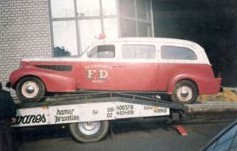
1937 Cadillac LaSalle
Does anyone remember this vehicle or know when it was used in Deseronto?
This is how the ambulance looks today:

July 21, 2010
1937 Cadillac LaSalle
Does anyone remember this vehicle or know when it was used in Deseronto?
This is how the ambulance looks today:
July 16, 2010

Mechanics Institute and Library Board Minute Book, 1885-1907
The Library started life as part of the Deseronto Mechanics Institute in 1885. The Deseronto Public Library Board took over the management of the Library on May 1, 1896 (the minutes for the Library Board are in the same volume as the earlier minutes of the Mechanics Institute). On that day, the first regular meeting of the Public Library Board took place, at which the following rules and regulations were agreed:
1. The Librarian shall, under the direction of the Board of Management, have the charge and superintendence of the Library, News Room and Premises, and shall be responsible for the care and safety of all books and other public property contained in them; shall enforce all regulations, collect all fines, and pay over the same to the Treasurer; must cut the leaves of new books, magazines etc before placing them on the shelves; shall issue no book unless the Library Card is presented at the time of drawing and the book registered thereon.
2. Any resident (Of Deseronto) over the age of twelve years shall be entitled to the privileges of the Library and News Room, upon signing the application and otaining the signature of one ratepayer (who must be approved of by the Board of Management) to the required guarantee or on making the Cash deposit. The signature of any ratepayer of the Town will be sufficient guarantee for himself.
3. When the ratepayer who has signed the required guarantee, desires to withdraw from it, he must give notice thereof, in writing, to the Secreatary of the Board, who will give a release as soon as it shall have been ascertained that no liability exists.
4. The privileges accorded in consequence of the required guarantee may be revoked at pleasure by the Board of Management.
5. Borrowers are especially cautioned against losing the Library Cards, as they will be held responsible for any book that may be taken out with such ticket. When a ticket is lost or rendered unfit for use, the borrower will be charged five cents for a new one.
6. Only one book can be drawn at a time and on one day. No book can be kept longer than fourteen days, but a book may be redrawn for seven days and repeated until asked for.
7. Books of Reference are not to be taken from the Library Rooms.
8. No one shall be permitted to take books from the shelves except the Librarian and assistant and members of the Board of Management.
9. Noise, audible conversation, or disorderly conduct in the Library and Reading Room is strictly prohibited.
10. The Library and News Room shall be open each lawful day, except the ordinary holidays, and such other days as the Board of Management may direct, from 7 P. M. to 10 P. M.
11. No Book shall be issued unless the Library Card is presented at the time of drawing.
12. Readers desirous of proposing books, periodicals or newspapers for addition to the Library, may do so by writing the same on a suggestion card and leaving same in charge of the Librarian.
13. The Librarian, or any member of the Board may suspend from the use of the Library and News Rooms, for a period not to exceed thirty days, any person repeatedly violating any of the Rules and Regulations, and shall report the same to the proper Committee.
14. Strangers and visitors in the Town shall be entitled to the privileges of the Library and News Room on furnishing the required guarantee.
15. Parties living outside of the Town may be allowed the privileges of the Library on payment of an annual fee of $1.00 each and on furnishing the required guarantee.
16. A fine of one cent for each day up to the value of the volume will be imposed for retaining a book longer than the time allowed by these rules. Fines will be imposed for marking in, or in any way injuring or defacing a book or magazine.
17. In cases where there has been any contagious disease in a house during the time a book belonging to the Library has been there the fact must be reported to the Librarian when the book is returned.
18. These regulations, or any of them, may be repealed or amended, and new Regulations may be made at any Regular Meeting of the Board of Management, a notice of at least one week being given of the proposed change by the proposer to each member of the Board and the majority of the Board concurring.
Things have moved on a little in the Library today. The staff will let you take books off the shelf yourself and borrow more than one at a time. They even let children under twelve join the library!
July 14, 2010

Bay View Ranche (now Fingland's Farm): scanned image donated by Brad Fingland
And, more to the point, are you willing to share it with the rest of the world?
Deseronto Archives has received some money from Ontario’s Ministry of Culture to create a website that will allow people to upload their own memories, videos and images of Deseronto and the surrounding areas. We’re delighted to report that the ‘About Deseronto’ website is now up and running!
We would love to hear from you if you would like to share any old photos or memories of the town. You can bring any materials into the Library on a Wednesday (or on other days by arrangement with the archivist, Amanda Hill) and we will be happy to scan them and add them to the About Deseronto site. If you have old objects relating to the town, we can take photos of them. If you have your own scans or digital photos, you can send them to us directly at deseronto.archives@gmail.com.
Later in the year, the site will be updated so that you will be able to upload items yourself directly to About Deseornto.
We’re very excited about this new project, but we’re going to need your help to make it a success.
You can contact the archivist on a Wednesday between 10am and 4pm at 613-396-2744 to arrange a time to bring your treasures in. Or just visit the Library on Main Street on any Wednesday between those hours.
We look forward to seeing what you’ve got!
June 16, 2010

"One of the first steam autos"
This image is from a scrapbook that was compiled in 1904 (Accession 2010.08). The scrapbook contains many clippings from Montreal and Toronto papers relating to sporting events and teams. This cutting shows a reproduction of a painting of “one of the first steam autos”. The text reads:
The vehicle was built by Mr. Rickett, of the Castle Foundry, Buckingham, and was shown to Queen Victoria and Prince Albert in the early part of 1860. It had a 10-h.p. two-cylinder engine. The weight was 30 cwt., and with a full load-water 12 cwt., coal 3 cwt., and passengers 5 cwt. – the gross weight was 2 tons. On good roads sixteen miles per hour was attained. The tank held ninety gallons of water, enough for a ten miles’ run. The consumption of coal was 8 to 10 lbs. per mile. Of the two hind wheels one was engaged by a clutch, so that, when disengaged, they permitted the vehicle to turn in its own length without stopping. It is curious to contrast this vehicle with the touring cars of to-day.
The “cars of today”, when this article was written in 1904, being vehicles like this Ford Model A with a top speed of 28 mph (45 kph).

Ford Model A
Image from LaertesCTB on Flickr.
June 13, 2010

Detail of Sambro Island Lighthouse lens from the Maritime Museum of the Atlantic
The annual conference of the Association of Canadian Archivists has just come to an end. It has been an excellent event, with many stimulating papers. One of Thursday’s sessions was particularly relevant to Deseronto, as the speaker, Ian Richards, did his Masters thesis on the topic of the contribution that archives can make to the development of their local communities. His particular focus is on the City of Brandon in Manitoba, but the general points he made are relevant to many other municipalities, including Deseronto. His thesis is available from the University of Manitoba’s electronic thesis collection.
Other sessions covered issues such as Access to Information and Privacy laws, measuring the impact of an archival program and the role of outreach in a networked world.
I gave a talk on the Saturday about the work we’ve been doing in Deseronto, including this blog and our Flickr and Twitter accounts. This dovetailed quite well with Ian’s talk and with the talks on outreach and impact, as I was trying to show what the effects of our engagement with these Web 2.0 technologies have been.* My main arguments were that people need direct access to online cultural materials from search engines, that they have to be able to share those materials with other people and that if they are experts on a particular item, they need to be able to contribute to improving its description.
I summarised the main impacts of sharing Deseronto’s photographs online as:
Many of these consequences have been featured in posts on this blog. The difficult thing to measure is the impact that the Archives’ activities have had upon the community of Deseronto as a whole. One of the sessions this week suggested that we need to measure the ‘hard to measure’, over an extended period of time. I look forward to hearing about the best way of achieving that.
*The slides are available on SlideShare.
June 2, 2010
A recent accession into the archives was this fragile photograph album, dating from the late nineteenth century. It was found in the home of the late Beatrice Boulender of Niagara Falls and was donated to the archives by her great-neice, Aaron Baptiste.

Photo album 2010.06
The picture below shows the See family and was taken in Bathgate, North Dakota. John See was born in Ontario in 1854 to Samuel and Mary See, who had both been born in England in around 1809. Samuel was a farmer. Census records show that John was the youngest of seven children, all of whom were born in Canada except the eldest, William. This means that the family must have come to Canada between 1833, when William was born, and 1837, the year of Elizabeth’s birth. Between 1851 and 1881 the family were living in Richmond township, Lennox County (in or close to Napanee).

John and Mary See and family, c.1893
In 1881 John was married and living with his wife, Mary, and their two eldest children, William (4) and Annie (1), still in Richmond township. In 1886 they left Canada and moved to the United States. The 1890 US census was destroyed by fire in 1921, but in 1900 the family were living in North Carlisle, Pembina, North Dakota, by which time they had seven children: William (23), Annie (20), James (17), Thomas (13), Richard (11), Grace (8) and Allice May (2). In this photograph, the baby is probably Grace and the picture would date from around 1893.
The album clearly has a connection to the Quinte area: it seems to record images of friends, or perhaps family, who had moved away from the immediate locale and who kept in touch by sending back their photographs. As yet, we don’t know the exact connection of the people in the album to Beatrice Boulender’s family.
All the photographs from the album are now available through our Flickr account. We’d be interested to hear from you if you have any connection with any of the families who are pictured there.
April 14, 2010

Bank of Montreal, Deseronto, c.1910 (now the Town Hall)
This project is going to be an interactive community website where people can share their memories and images of people, events, artefacts and pretty much anything relating to the history of the town of Deseronto and its surroundings.
The site will be open to current residents of the town and to anyone with a Deseronto connection: there are many people whose families have lived in the town in the past and who are interested in helping to tell the story of those people and their activities.
We look forward to working with people who are interested in sharing information with the site over the next six months. We also hope that we can arrange some cross-generational activities, with old and young people working together to collect and contribute information.
Watch this site for further information as the project gets under way!
April 8, 2010
A genealogist visited the archives last week, interested in finding out more about her ancestor, a man listed in the 1881 census as of African origin, who had been born in the United States. A closer look at the whole census for Mill Point, as Deseronto was then known, using the search interface at Library and Archives Canada, shows that there were five adults in the town at that date who are identified as being of African origin: two women and three men. The three men were all born in the United States and two of the three (John Jackson and James Butler) are described as barbers. They were, in fact, the only barbers in Mill Point at that time.1
Former archivist Kenneth M. Brown found the following advertisement for John Jackson’s business in the September 2, 1881 edition of the Napanee Express:

In light of this discovery, I thought it might be interesting to have an overall look at the racial origins of Mill Point (Deseronto) citizens in 1881. There were 1,670 people in the town at that time (slightly fewer than today). Here is a table breaking down the population by their reported racial origins:
| Racial origin | Number |
| Irish | 542 |
| German | 343 |
| Scottish | 253 |
| French | 177 |
| Indian | 121 |
| English | 112 |
| Dutch | 41 |
| African | 10 |
In this next table, the places of birth of the townspeople are listed:
| Place of birth | Number |
| Ontario | 1,300 |
| Quebec | 106 |
| Ireland | 99 |
| England | 71 |
| USA | 52 |
| Scotland | 25 |
| Germany | 7 |
| Nova Scotia | 4 |
| West Indies | 4 |
| Alberta | 1 |
We can see that by 1881, nearly 100 years after this area was first settled in any great numbers, 85% of the town’s population had been born in Canada. This was a period of industrial expansion for the Rathbun Company, whose mills and factories were attracting working men to the town. A closer look at the ethnically Irish third of the population shows how youthful the people of the town were in 1881:
| Age | Number |
| 1 to 10 | 170 |
| 11 to 20 | 110 |
| 21 to 30 | 118 |
| 31 to 40 | 48 |
| 41 to 50 | 44 |
| 51 to 60 | 23 |
| 60+ | 22 |
If we compare this age profile with information taken from the 2001 census for the town, the difference is obvious:

Profile of age groups in Deseronto, 1881 and 2001
The gender profile was also quite different from today’s. Now there is an even split between men and women in Deseronto. A sampling of the 1881 data suggests that two thirds of the population were male and only a third female back then. Those American barbers would not have been short of customers!
1 Douglas Bristol’s article, “From Outposts to Enclaves: A Social History of Black Barbers from 1750 to 1915,” Enterprise & Society 5 (2004), gives a good overview of the entrepreneurial success of black barbers.
March 24, 2010
…then the Archives’ Flickr account is now worth a cool one million!
Today we uploaded our one thousandth photograph to Flickr. This milestone means that nearly every photograph held in our small collection is now available to view by anyone with access to the Internet. This is a huge step forward for us, as physical access to our resources is limited to our public opening times of six hours a week. Now they are available every day of the week!
One of the most exciting parts about our Flickr experiment has been the willingness of other people to share their historic photographs and objects through this medium. A fair proportion of the items in our Flickr pages are held outside of the archives. We are very grateful to the owners of those materials for their permission to share them with a wider audience.
Sharing our photographs on Flickr has been beneficial in other ways. Often, Flickr users have been able to add valuable information which has improved our knowledge of the items within our collection. Just yesterday, we received a helpful comment on this image:

HMR1-09-36: ‘Tin Can Cathedral’ Ukrainian Orthodox Church, Winnipeg
The only information we had about the church originally was a caption written by Harold McMurrich Rathbun, the photographer, which read “Old Greek Church, Winnipeg”. A Flickr user recognised the church as the ‘Tin Can Cathedral‘, a Ukrainian Orthodox church which was situated at the junction of King Street and Stella Avenue in Winnipeg. This was North America’s first independent Ukrainian church.
Another image of this church can be found in the Glenbow Museum Archives collection at the University of Calgary.
This is just one example of the power of sharing our images on the Internet. With the help of other people our descriptions become more accurate and more people become aware of the interesting things we hold. Things that would once have required a determined effort (and a trip to Deseronto) to find out about. A million thanks!
March 9, 2010
In the days when logs were floated down rivers to be processed, it was important for the lumber companies to reliably identify whose logs were whose. The Timber Marking Act was passed in 1870 and required logging firms in Ontario, Quebec and New Brunswick to register a unique identifying mark and then to stamp the cut trees with that symbol. Between 1870 and 1990, some 2,200 timber marks were registered.1 Failure to register and use a timber mark incurred a fine of $50, while wrongly applying a mark to someone else’s logs was also an offence, with a fine of up to $100.
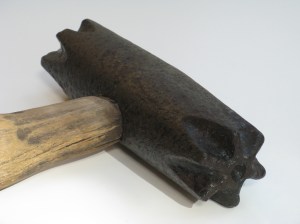
Rathbun Company timber mark stamping hammer
This week, the archives heard from Peter Haughton of Bristol, Quebec, who has come into possession of a timber mark stamping hammer with a Deseronto connection. The hammer’s mark (a six-pointed star) was registered by Deseronto’s H. B. Rathbun & Son on July 18, 1870. Mr Haughton has been kind enough to share photographs of the hammer and also of the relevant page of The Lumberman’s Timber Mark Guide, which lists all the marks that the lumber companies had registered.
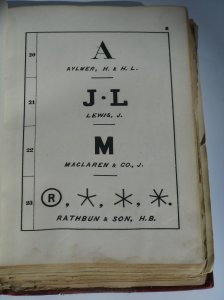
Timber marks registered in July 1870
The page shows that the Rathbun Company had registered four different marks in 1870: perhaps a reflection of the scale of the timber limits that were being exploited by this firm. By 1890 The New York Times described the Rathbun Company as “the most valuable lumber manufacturing concern in Canada”.2 It also (slightly less accurately) located Deseronto “a few miles east of Toronto”.
1The Timber Marking Act is likely to be repealed, as logs are no longer transported down rivers in this way. A consultation on the proposal to repeal the Act is available from the Canadian Intellectual Property Office.
2The New York Times, November 4, 1890 ‘A big syndicate deal‘


 Deseronto Archives