World War I


Ernest Sharpe signature

On this day in 1918, Ernest Sharpe died of wounds he sustained in the Battle of the Scarpe with the 21st Battalion in France. His unit’s war diary describing the three-day advance can be read online (page 1, page 2, page 3).

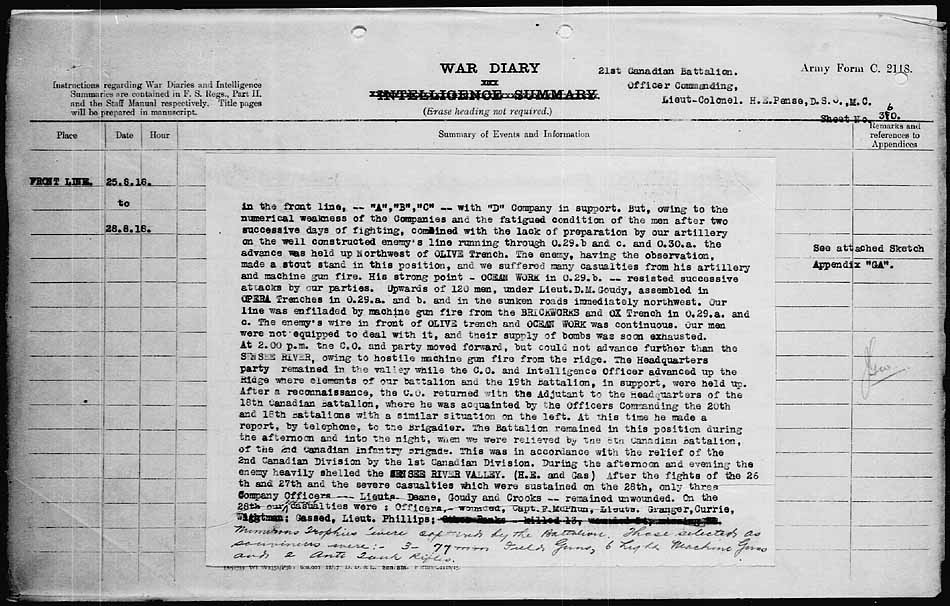
This extract from the diary entry for August 27th shows the increasing importance of the use of aircraft as weapons of war:

Extract from 21st Battalion war diary 27th August 1918

…During the night our men had little or no rest.

While during the operations of the 26th our aircraft proved their superiority to that of the enemy, German machines were very active on the 27th. They temporarily held up the advance of our men by machine gun fire and the use of light bombs.

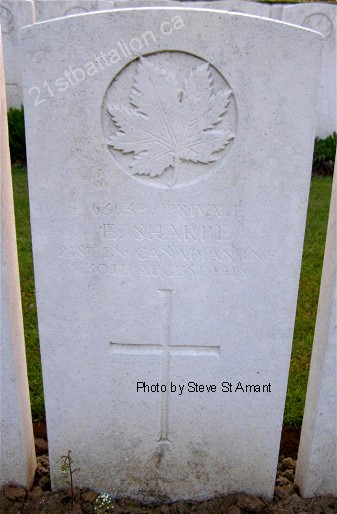
Ernest Sharpe was buried in the Aubigny Communal Cemetery Extension, to the northwest of Arras in France.

Headstone for Ernest Sharpe

Courtesy of The 21st Battalion CEF site

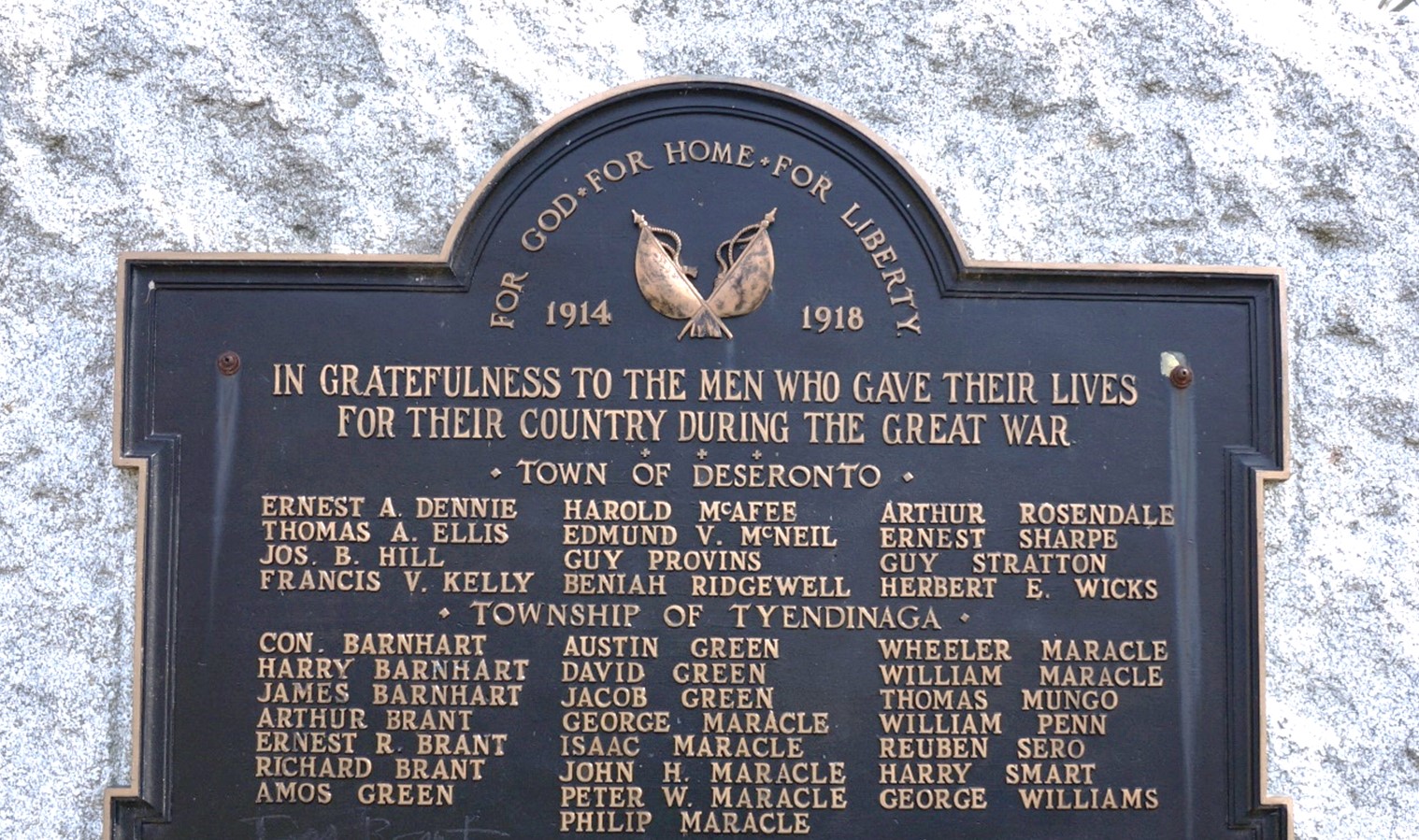
He is also commemorated on the Deseronto war memorial.

Deseronto memorial

Ernest’s widow, Martha Ann Sharpe, married Frank Culhane, another Deseronto veteran of the 21st Battalion, on December 5th, 1919 in Toronto.

Arhtur Brace Spooner signature
On this day in 1918 Arthur Brace Spooner was killed in a flying accident while in training as a cadet at the Royal Air Force’s 42nd Wing at Deseronto. He had joined the Royal Flying Corps on January 10th, 1918 in Winnipeg and was appointed to the Corps in Toronto on January 14th with the regimental number 154175. He was five feet six inches tall and had previously been working as a telegrapher.His accident happened on the morning of August 28th. Spooner had been sent up to practise spinning in aircraft C-1044. He tried to come out of a nose dive over a farm belonging to the McAlpine family of Tyendinaga (they owned property on Lot 28, Concession 1 in 1911). Mr Michael McAlpine described the accident at a Court of Inquiry held the same day:

Detail from Attorney General's 1918 file RG4-32/2062 at the Archives of Ontario

Detail from Attorney General’s 1918 file RG4-32/2062 at the Archives of Ontario

2nd Witness Mr. M. McAlpin, Civilian, states:-

I saw the machine coming down in a nose dive. It then flattened out and the pilot put on his engine and flew over the barns at about 100 feet, his right wing struck an apple tree, the fuselage going on. I rushed over to the accident and had to undo the pilots belt in order to extricate him. He was already dead.

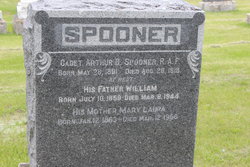
Spooner was born on May 28th, 1892, the son of William and Mary Spooner of Moosomin, Saskatchewan. He was buried in Moosomin’s South Side Cemetery.

Arthur Spooner's headstone

From Find a Grave, courtesy of Dean Weckman


Clayton Herbert Mastin signature

Pharmaceutical chemist Clayton Herbert Mastin enlisted in Aldershot, Nova Scotia on this day in 1918. He was born in Deseronto on September 20th, 1893, the son of Melburn Masten and Minerva Jane (née Bruin). His elder sister, Hattie, had enlisted as a nurse in January 1916 and his younger brothers Percy and Garnet were both serving in the army.

Clayton joined the army with the regimental number 2770006. He was five feet six inches tall, with a fair complexion, blue eyes and brown hair. His service record shows that he caught influenza in Ottawa in October 1918. He recovered and was one of the men who left Vancouver on the SS Protesilaus  on December 26th, 1918 as part of the Canadian Expeditionary Force to Siberia. He returned from Vladivostok on the SS Empress of Japan in May 1919 and was discharged from the army on June 12th, 1919 in Kingston. He was suffering from bronchitis and was classified as medically unfit for further service.

Mastin left Canada for the US on December 22nd, 1926, crossing the border at Detroit to work as a chemist at Parke-Davis and Company.Emigration of Clayton Herbert Mastin

Detail from the McGill honour roll, 1914-1918

Detail from the McGill honour roll, 1914-1918

James McMillan Hacker signature
James McMillan Hacker died in a crash at Camp Rathbun near Deseronto on this day in 1918. He had joined the Royal Flying Corps in Toronto on September 10th, 1917 with the regimental number 74813. There was an interruption in his service in January 1918 when he was thought to have deserted, but he returned at the end of the month and was reinstated. He was in training as a cadet with 90 Canadian Training Squadron.

Hacker was born in Prince Edward Island on November 4th, 1885, the son of Thomas Henry Hacker and Sarah (née McMillan). His parents had both died by the time he enlisted: he gave his sister, Louise, as his next of kin. She was living in Summerside, PEI. Hacker was five feet five and three quarter inches tall. He had been a student at Macdonald Agricultural College at McGill University in Montreal between 1912 and 1916.

The Court of Inquiry into Hacker’s crash, held the next day, found that he had fallen out of aircraft C-1324 while practising spins. Here is the evidence from Second Lieutenant F.R. Winter:

Detail of Attorney General's 1918 file RG4-32/1792 at the Archives of Ontario

Detail of Attorney General’s 1918 file RG4-32/1792 at the Archives of Ontario

2nd. Witness. 2/Lieut. F.R. Winter, 90 C.T.S. R.A.F.

States:- I watched Cadet Hacker do one turn of a spin, in machine C-1324, he came out and dove for about 500 ft. straight down and went past the vertical and went on his back and fell out of the machine from a height of approximately 2500 feet. The machine then glided down and landed upside down.

[signed] F.R. Winter Lieut

The Court found that Hacker had died because his seat belt had somehow become unfastened. It recommended that a new type of belt be used in future.

James was buried in the Summerside People’s Cemetery in Prince Edward Island.

Presqu'ile Beach

Presqu’ile Beach, Northumberland County. Picture by Dave Kellam.

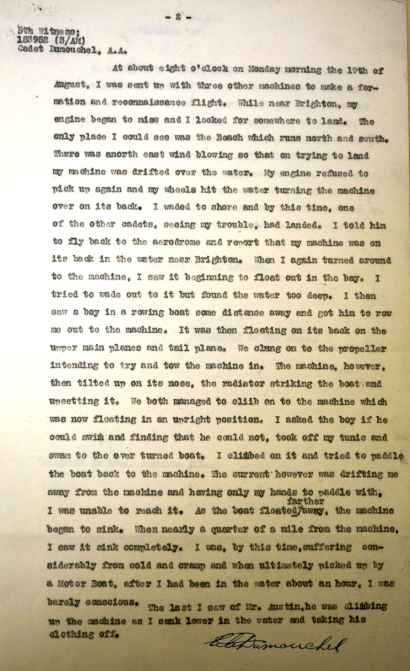
It was not just airmen who died as a result of flying mishaps near Deseronto. On this day in 1918 a young man called Charles Austin lost his life near the beach at Presqu’ile, near Brighton, Ontario. Here is Cadet Albert Alexis Dumouchel’s account of the circumstances leading to Austin’s death.

Detail from file RG4-31/2062 at the Archives of Ontario

Detail from Attorney General 1918 file RG4-31/2062 at the Archives of Ontario

At about eight o’clock on Monday morning the 19th of August, I was sent up with three other machines to make a formation and reconnaissance flight. While near Brighton, my engine began to miss and I looked for somewhere to land. The only place I could see was the Beach which runs north and south. There was a north east wind blowing so that on trying to land my machine was drifted over the water. My engine refused to pick up again and my wheels hit the water turning the machine over on its back. I waded to shore and by this time, one of the other cadets, seeing my trouble, had landed. I told him to fly back to the aerodrome and report that my machine was on its back in the water near Brighton. When I again turned around to the machine, I saw it beginning to float out in the bay. I tried to wade out to it but found the water too deep. I then saw a boy in a rowing boat some distance away and got him to row me out to the machine. It was then floating on its back on the upper main planes and tail plane. We clung on to the propeller intending to try and tow the machine in. The machine, however, then tilted up on its nose, the radiator striking the boat and upsetting it. We both managed to climb on to the machine which was now floating in an upright position. I asked the boy if he could swim and finding that he could not, took off my tunic and swam to the over-turned boat. I climbed on it and tried to paddle the boat back to the machine. The current however was drifting me away from the machine and having only my hands to paddle with, I was unable to reach it. As the boat floated farther away, the machine began to sink. When nearly a quarter of a mile from the machine, I saw it sink completely. I was, by this time, suffering considerably from cold and cramp and when ultimately picked up by a Motor Boat, after I had been in the water about an hour, I was barely conscious.
The last I saw of Mr. Austin, he was climbing up the machine as [it] sank lower in the water and taking his clothing off.

Austin’s body was retrieved from Presqu’ile Bay later that day. The conclusion of the Court of Inquiry into the incident was as follows:

Detail from file RG4-32/2062 at the Archives of Ontario

Detail from file RG4-32/2062 at the Archives of Ontario

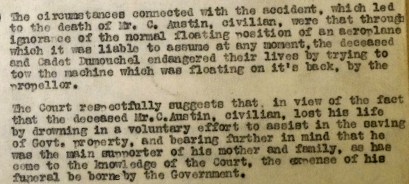
The circumstances connected with the accident, which led to the death of Mr. C. Austin, civilian, were that through ignorance of the normal floating position of an aeroplane which it was liable to assume at any moment, the deceased and Cadet Dumouchel endangered their lives by trying to tow the machine which was floating on it’s back, by the propellor.

The Court respectfully suggests that, in view of the fact that the deceased Mr. C. Austin, civilian, lost his life by drowning in a voluntary effort to assist in the saving of Govt. property, and bearing further in mind that he was the main supporter of his mother and family, as has come to the knowledge of the Court, the expense of his funeral be borne by the Government.

Charles Francis Austin was born in Brighton on September 28th, 1899, the son of Lucien Austin and Bessie (née Proctor). His father, a druggist, had died of influenza in 1904 and at the time of the 1911 census Charles was living with his mother, Bessie, his younger brother John and his mother’s elderly parents. His death registration gave his occupation as bank clerk.

Ernest Russell Brant signature

Ernest Russell Brant died on this day in 1918 of a wound that he received at the Battle of Amiens on August 9th.

Ernest Russell Brant circumstances of casualty

Canada War Graves Registry: circumstances of casualty for Ernest Russell Brant, courtesy of Library and Archives Canada

“Died of Wounds”

This soldier received a gunshot wound in the head, during the attack on ROSIERES on August 9th. He was attended and evacuated to No. 6 General Hospital, Rouen, where he succumbed to his wounds a few days later.

Ernest was buried in the St. Sever cemetery extension in Rouen, France. His brother, Arthur, had died almost exactly a year before.

Ernest is remembered on the Deseronto war memorial.

Deseronto memorial

Lorne Oliver signature

On this day in 1918, Lorne Gould Oliver was killed shortly after the Battle of Amiens in France. He was serving with the 4th Field Ambulance at Warvillers. The war diary for his unit gives Oliver’s date of death as August 13th, but other casualty records state that he was killed on the 15th.

Here is the war diary entry for the 4th Field Ambulance for the day Lorne Oliver’s death was reported:

Lorne Oliver mentioned in war diary

The Commonwealth War Graves Commission’s report on the circumstances of Oliver’s death explains that he was returning from duty when he was killed by shellfire. The corresponding record for John McLachlan, the man he was with (and who was killed at the same time), explains that they were stretcher-bearers.

Lorne Gould Oliver casualty report

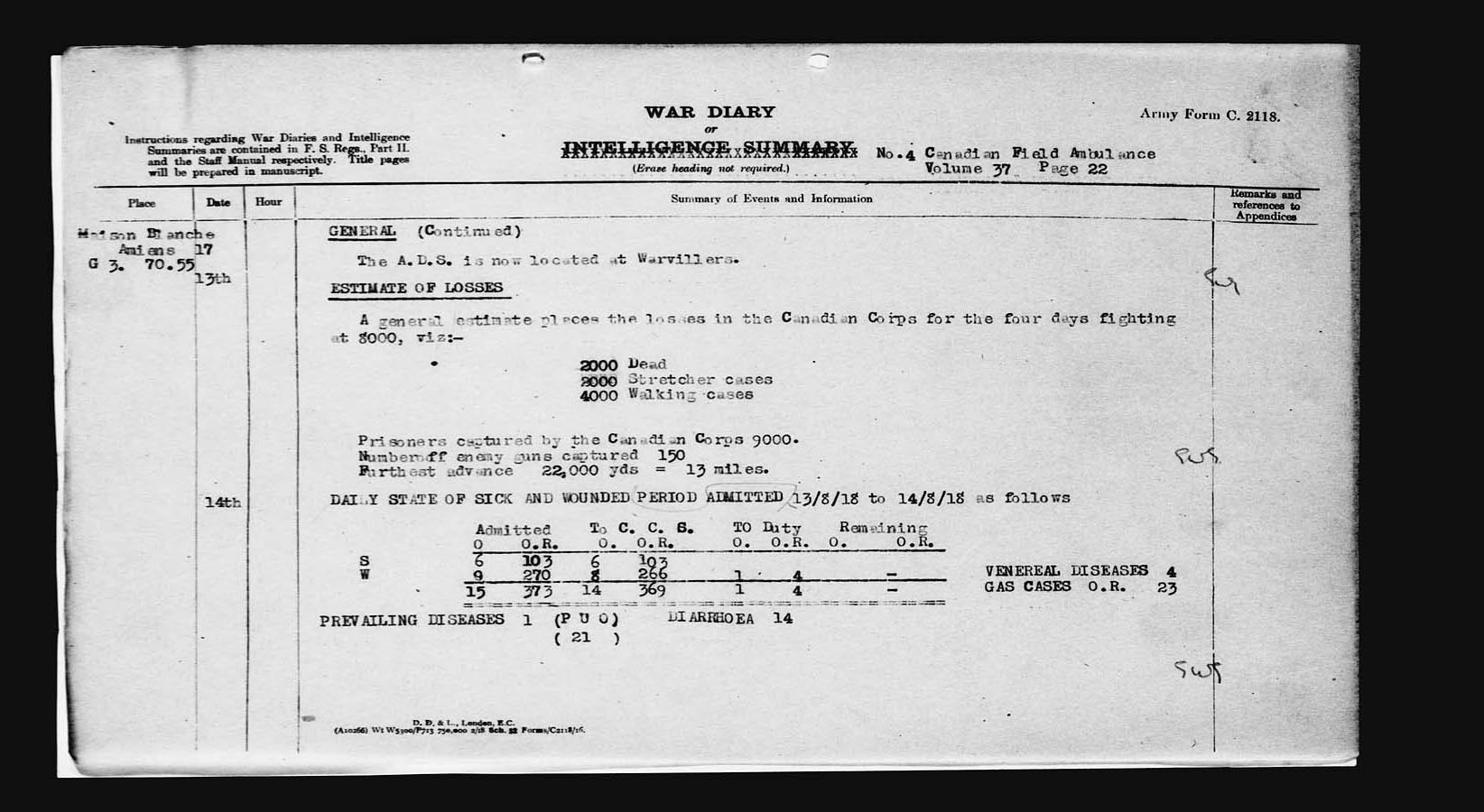
The diary entry for this day in 1918 for the same unit gives some idea of the scale of the Canadian losses in the Battle of Amiens (August 8th-12th), as well as an indication of the amount of work that stretcher-bearers like Oliver and McLachlan were undertaking:

Lorne Oliver's unit report of losses over four days in August 1918

ESTIMATE OF LOSSES

A general estimate places the losses in the Canadian Corps for the four days fighting at 8000, viz:-

2000 Dead

2000 Stretcher Cases

4000 Walking Cases

Oliver and McLachlan were buried beside each other in the Warvillers Churchyard Extension in France. Lorne is remembered on the cenotaph in Napanee.

Napanee cenotaph, east side

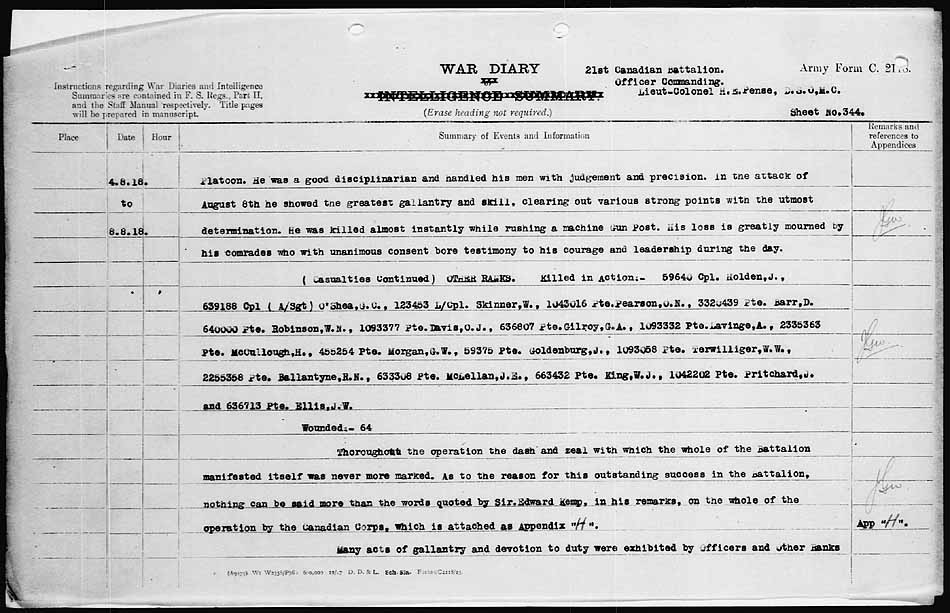
On this day in 1918 Thomas William Ellis was killed in the Battle of Amiens. He was named as a casualty in the 21st Battalion’s war diary entry for the battle.

Originally, Ellis was buried in Midway Cemetery, near Marcelcave, but his body was exhumed in 1920 and transferred to the Villers-Bretonneux cemetery.

Tom is remembered on the Deseronto memorial.
Deseronto memorial

Francis Russell Cook signature
On this day in 1918 Frank (Francis) Russell Cook died in a fall from an aircraft near Napanee, while in training with 81 C.T.S. at Camp Rathbun. The RAF report notes that the aircraft was a Curtiss JN-4, number C189. The Court of Inquiry took evidence from an eyewitness, R. H. McCreer of Napanee:

R. H. McCreer's evidence

Detail from Attorney General’s 1918 file RG4-32/1755 at the Archives of Ontario

1st Witness

R.H.McCreer, Farmer, R.R.No. 5 Napanee, states:-

I saw an aeroplane manoeuvering over my farm about 7.20 a.m. today. I saw a man fall out of the machine and the machine then flew level for about a mile with the engine stopped and then crashed.

The Court of Inquiry found that Cook’s seatbelt had become unfastened during the flight, causing him to fall while manoeuvering at a height of between 3,000 and 4,000 feet.

Cook was born on September 17th, 1898 in Clanwilliam, Manitoba, the son of Andrew Cook and Elizabeth (née Rowat). He had been working as a drug store clerk in Minnedosa, Manitoba when he joined the Royal Flying Corps in Winnipeg on January 3rd, 1918. Four days later he was officially appointed to the Corps in Toronto with the regimental number 153929. He was described as five feet eight and a half inches tall, with a fair complexion, light brown hair and blue eyes.

Frank was buried in Clanwilliam United Church Cemetery.

John Hoppes died in Buffalo, New York on this day in 1918. He was not a veteran of the First World War, but served in the American Civil War between 1862 and 1865. He was born in Quebec in 1846 and was a resident of Deseronto between about 1879 and 1899. He worked as a millwright in one of the Rathbun Company’s mills.

We know about him from a newspaper article published in Deseronto’s Tribune on August 3rd, 1888 (coincidentally, 30 years to the day before he died).
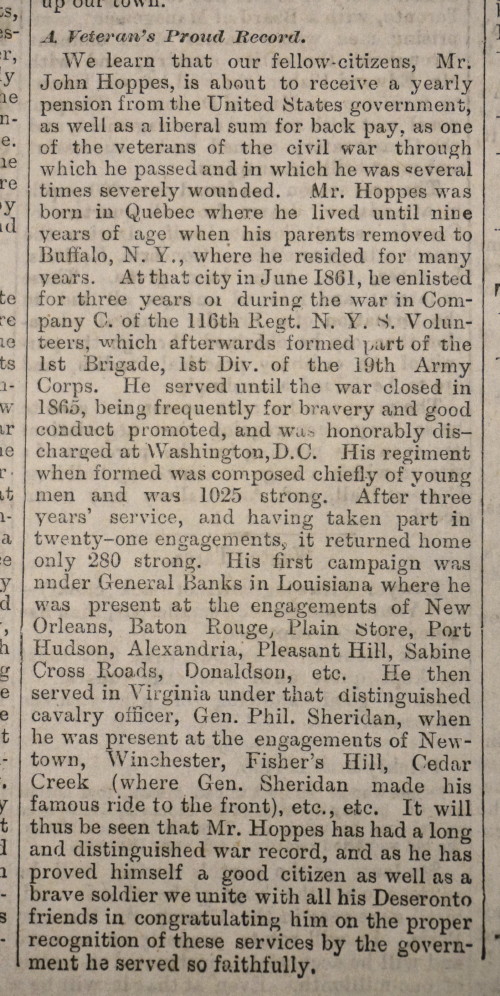
Deseronto Tribune article about John Hoppes


A Veteran’s Proud Record

We hear that [one of] our fellow citizens, Mr. John Hoppes, is about to receive a yearly pension from the U.S. government as well as a liberal sum for back pay, as one of the veterans of the civil war through which he passed and in which he was several times wounded. Mr Hoppes was born in Quebec where he lived until nive years of age when his parents removed to Buffalo, N. Y. where he resided for many years. At that city in June 1861, he enlisted for three years during the war in Company C. of the 116th Regiment New York State Volunteers, which afterwards formed part of the 1st Brigade, 1st Division of the 19th Army Corps.

He served until the war closed in 1865, being frequently for bravery and good conduct promoted, and was honorably discharged at Washington, D.C. His regiment when formed was composed chiefly of young men and was 1025 strong. After three years’ service, and having taken part in twenty-one engagements, it returned home only 280 strong.

His first campaign was under General Banks in Louisiana where he was present at the engagements of New Orleans, Baton Rouge, Plain Store, Port Hudson, Alexandria, Pleasant Hill, Sabine Cross Roads, Donaldson, etc. He then served in Virginia under that distinguished cavalry officer, Gen. Phil. Sheridan, when he was present at the engagements of Newtown, Winchester, Fisher’s Hill, Cedar Creek (where Gen. Sheridan made his famous ride to the front), etc.

It will thus be seen that Mr Hoppes has had a long and distinguished war record, and as he has proved himself a good citizen as well as a brave soldier we unite with all his Deseronto friends in congratulating him on the proper recognition of these services by the government he served so faithfully.

Hoppes enlisted in Buffalo on July 28th, 1862, according to the Grand Army of the Republic records at New York State Archives (available through Ancestry). He moved back to the US from Deseronto in around 1899 and was working as the superintendent of a cement works in Margaretta, Erie, Ohio in 1900. By 1905 he, his wife Margaret and their youngest child, Ida, were living in Buffalo. The last address we have for John was 430 Normal Avenue. He died on August 3rd, 1918 and was buried in Buffalo’s Forest Lawn Cemetery.

Hoppes’s grandson, John James Hoppes, joined the Canadian Expeditionary Force in Kingston in June 1918.

« Previous PageNext Page »