World War I


James Freeman signature

James Freeman enlisted in the Royal Flying Corps in Toronto on this day in 1918. He was born in Deseronto on December 26th, 1891, the son of John Freeman and Julia (née Meagher). He was working as a bookkeeper when he married Catherine Carr in Oshawa on October 4th, 1913. She died on February 9th, 1917 of heart failure after an operation.

When he joined the Royal Flying Corps Freeman gave his address as 707 Bathurst Street, Toronto. His regimental number was 152345 and he was described as being five feet eight inches tall. His papers at the UK National Archives (AIR 79/1372) note that he was granted a temporary commission in the Royal Air Force on May 15th, 1918. Twelve days later, Freeman married Marjorie Baker in Toronto.

In 1921 James and Marjorie were living at 207 Melita Avenue, Toronto, with their one-year-old son. James died in Windsor in 1965.

Rupert Cyril Spencer signature
Rupert Cyril Spencer died of influenza and pneumonia at the Camp Rathbun hospital in Deseronto on this day in 1918. He had joined the Royal Flying Corps in New York on July 2nd, 1917 and was appointed in Toronto two days later with the regimental number 72816. He was a draughtsman by profession and he joined the Corps with the rank of 1st Air Mechanic. Spencer gave his next of kin as his wife, Martha Lenore Spencer, of 1100 Market Street, Berwick, Pennsylvania.

He completed a US draft registration card on June 5th, 1917 on which he was described as tall and slender, with dark brown hair and blue eyes. On his RFC attestation his height was recorded as five feet nine and a half inches. Spencer was born in Oldbury, Worcestershire, England on February 15th, 1890, the son of James Harry Spencer and Alice Jane (née Goring). In 1912 he left England for North America, arriving in New York on October 28th. He married Martha Lenore Bates in Berwick, Pennsylvania on June 14th, 1916. The couple had a daughter in January 1918.

Rupert was buried in Pine Grove Cemetery, Berwick.

Arthur Richardson signature
Arthur Richardson died at Camp Mohawk near Deseronto on this day in 1918. There are conflicting accounts of his death: the registration of his death in the records held by the Archives of Ontario states that he died of a fractured skull after a fall with an aeroplane:Arthur Richardson's death registrationHowever, other records give drowning as the cause of death and there is a file at the Archives of Ontario in the Attorney General’s series with the title “Report re death of Cadet A. Richardson who fell down hole at Camp Mohawk. And as to instituting proceedings for criminal negligence against Works foreman who failed to guard the hole.”The Royal Air Force casualty card for Richardson also notes that he “Drowned at Deseronto, Canada (result of falling into pit)”. This record has the date of the accident as October 4th.The Attorney General’s file at the Archives of Ontario holds details of the inquiry into the accident. It was decided that a criminal prosecution should be pursued against the foreman of the team who dug the hole, George Vanderwater:

Detail of Attorney General's 1918 file RG 4-32/2186 at the Archives of Ontario

Detail of Attorney General’s 1918 file RG 4-32/2186 at the Archives of Ontario

MEMORANDUM FOR THE HONOURABLE THE ATTORNEY GENERAL
Re Cadet Arthur Richardson
Onn the 3rd inst. Arthur Richardson a Cadet at Camp Mohawk near Deseronto fell down a hole or pit about 16 feet deep and was illed. This pit which was constructed for drainage purposes was unguarded and unlighted, owing, in my opinion, to the negligence of George Vandewater the Foreman – Imperial Munitions Board at Camp Mohawk.
The pit lay close to the Cadet Barracks and adjacent to a walk over which 35 men were accustomed to go, 10 to 15 deep and about 10 by 5 feet wide at the top, being narrower at the bottom and containing some water.

Richardson was born in Gateshead, England in 1890, the son of William Summerbell Richardson and Dorothy (née Burn). He attended the Royal Grammar School at Newcastle-upon-Tyne from 1902. He moved to New York in 1913, arriving on the RMS Adriatic on October 3rd, 1913 (five years to the day before he died). He was a chartered accountant by profession.

Arthur joined the Royal Flying Corps on April 11th, 1918 in Winnipeg (technically by then it was the Royal Air Force) and was officially appointed to the Corps on April 15th in Toronto with the regimental number 171458. He was five feet ten and three quarter inches tall, with a dark complexion, black hair and brown eyes.

He was buried in Bellefontaine Cemetery, St. Louis, Missouri. A blog post on the Sacrifice site explains why.

Peter W. Maracle signatureOn this day in 1918, Peter William Maracle died of wounds he received during the Battle of the Canal du Nord.

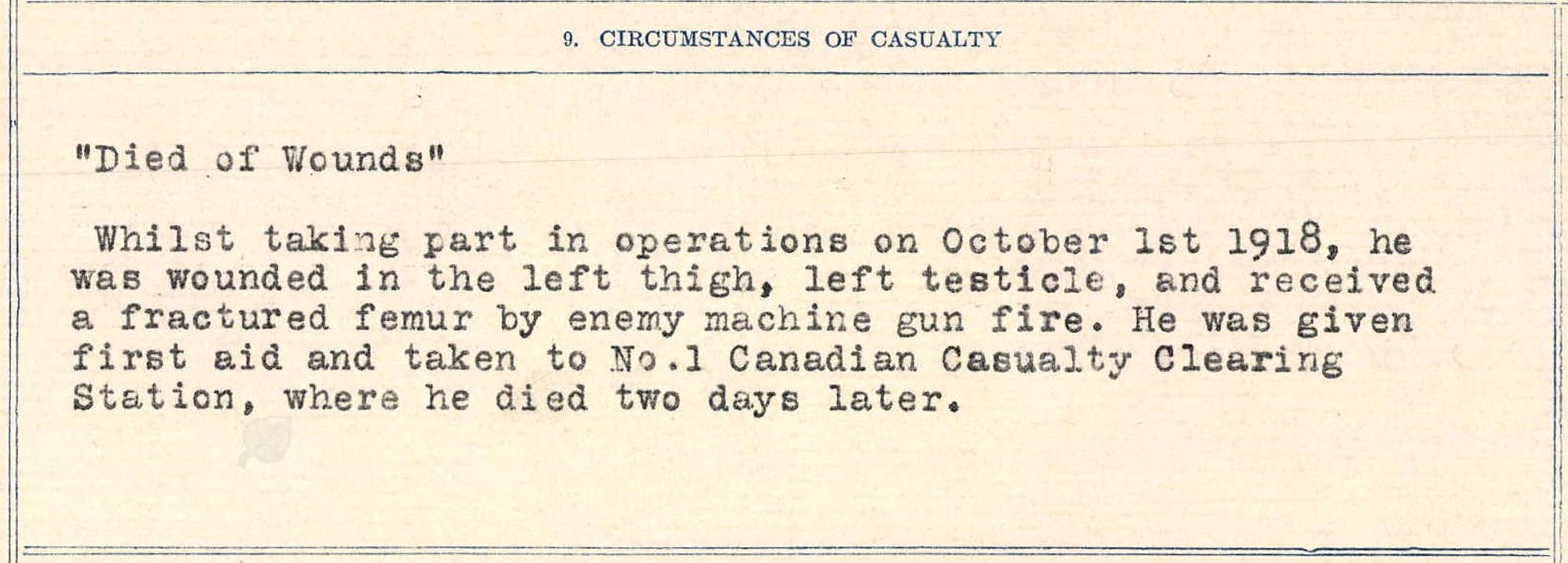
Peter William Maracle circumstances of casualty

Extract from War Graves Registers: Circumstances of Death, held at Library and Archives Canada (RG 150, 1992-93/314; Volume Number: 210)

“Died of Wounds”

Whilst taking part in operations on October 1st 1918, he was wounded in the left thigh, left testicle, and received a fractured femur by enemy machine gun fire. He was given first aid and taken to No. 2 Canadian Casualty Clearing Station, where he died two days later.

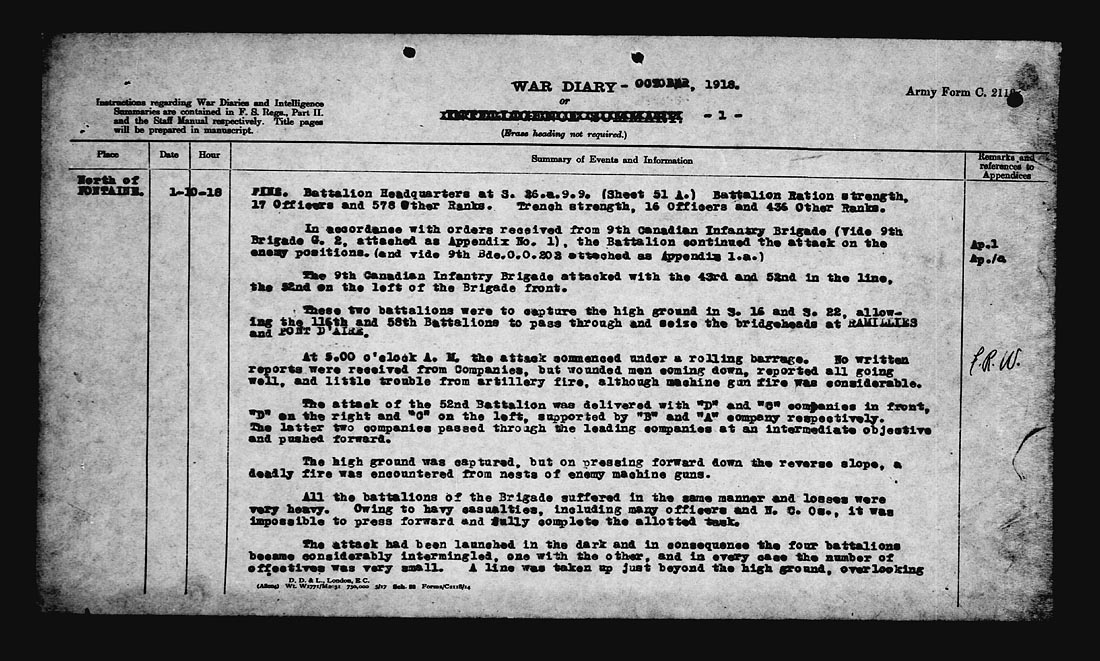
The war diary for the 52nd Battalion for October 1st illustrates the conditions that Maracle’s unit were facing:

Extract from war diary of 52nd Battalion 1 Oct 1918

Extract from war diary for October 1st, 1918 of the 52nd Battalion (courtesy of Library and Archives Canada)

The high ground was captured, but on pressing forward down the reverse slope, a deadly fire was encountered from nests of enemy machine guns.

All the battalions of the Brigade suffered in the same manner and losses were very heavy. Owing to havy [sic] casualties, including many officers and N. C. Os., it was impossible to press forward and fully complete the allotted task.

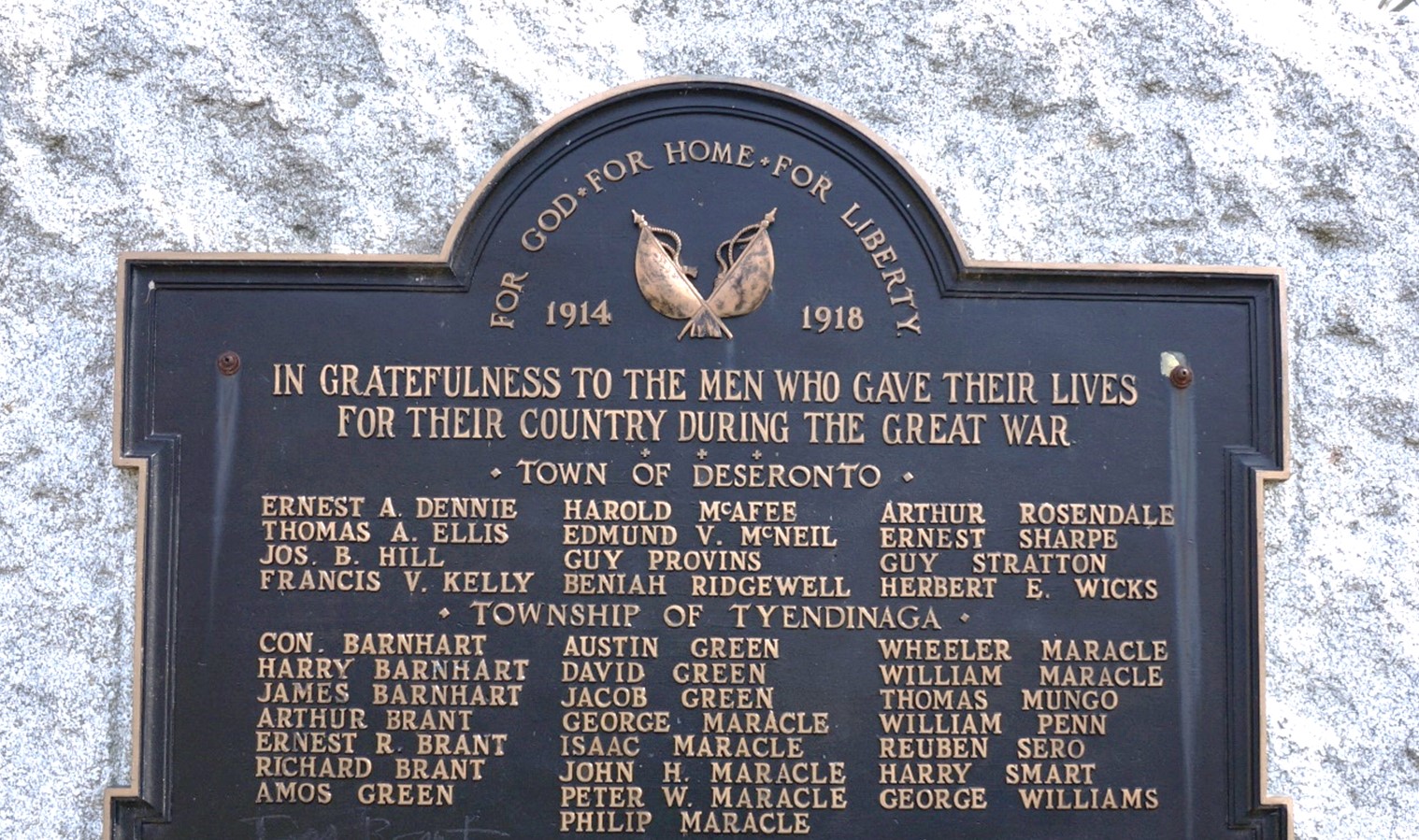
Peter William Maracle was buried in the Duisans British Cemetery near Arras, France. He is commemorated on the Deseronto war memorial.

Deseronto memorial

Frederick WIlliam Grand signature

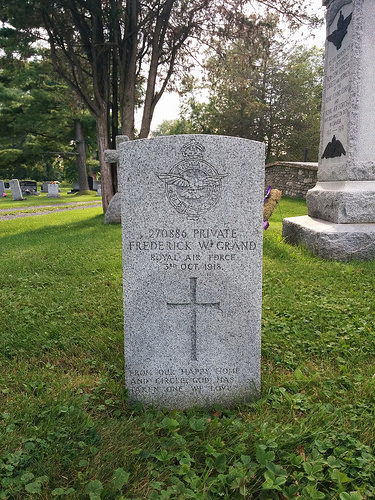
On this day in 1918 Frederick William Grand died in Deseronto of pneumonia (Spanish ‘flu). He had completed a US draft registration card on September 12th, 1918 in Glen Cove, New York and six days later he signed up with the Royal Air Force in Toronto with the regimental number 270886. He was 35 years old and five feet eight inches tall, with a slender build, brown hair and brown eyes. He died just 15 days later in the hospital at Camp Rathbun, one of the Royal Air Force’s training camps in Deseronto.

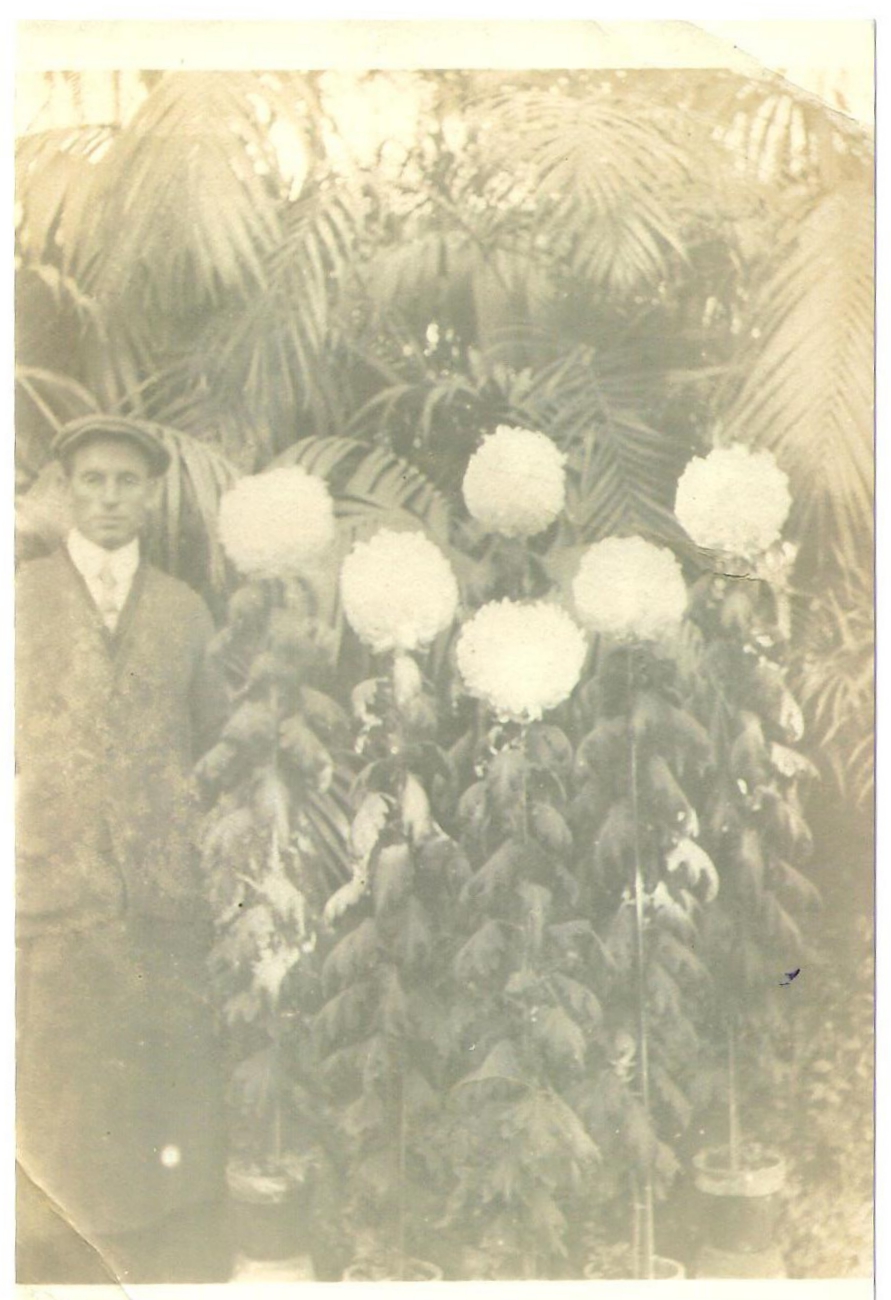
Grand was born in Colton, Norfolk, England on April 21st, 1883, the son of William and Emma Grand. Prior to enlisting he had been living in Oyster Bay, New York, where he was working as a gardener and chauffeur. He arrived in New York aged 23 on the RMS Etruria on June 24th, 1906, giving his occupation as gardener. His destination was the Knickerbocker Hotel, New York (which opened in that year). At one point he worked at the New York Botanical Garden, where this photograph was taken of him in 1914 or 1915:

Frederick William Grand photograph

Photograph of Frederick William Grand, courtesy of Keith Broom, Grand’s great-nephew

Frederick was buried in Deseronto Cemetery.

Frederick William Grand's headstone

Joseph Bernard Hill signature

Joseph Bernard Hill died 100 years ago today. He was in the Canadian Field Artillery and had been promoted to the rank of corporal in October 1916 and awarded the Military Medal for bravery in the field in July 1917.

Joseph Bernard Hill Military Medal citation

Military Medal citation card for Joseph Bernard Hill, courtesy of Library and Archives Canada

For conspicuous gallantry and devotion to duty at FARBUS on May 3rd 1917. This N.C.O. was in charge of the linesmen and kept patrolling the lines despite the intense enemy shell fire and not only supervised the repairing of the lines but also carried messages from the Brigade to the other Batteries whose lines were out. The lines were continuously being broken but communications were never lost for more than a few minutes at a time. Cpl. HILL by his splendid display of courage and coolness under heavy shell fire set a magnificient [sic] example to the men in his charge.

In September 1918 he was involved in the attack on Cambrai in northern France as part of the 17th Battery of the 5th Brigade of the CFA.

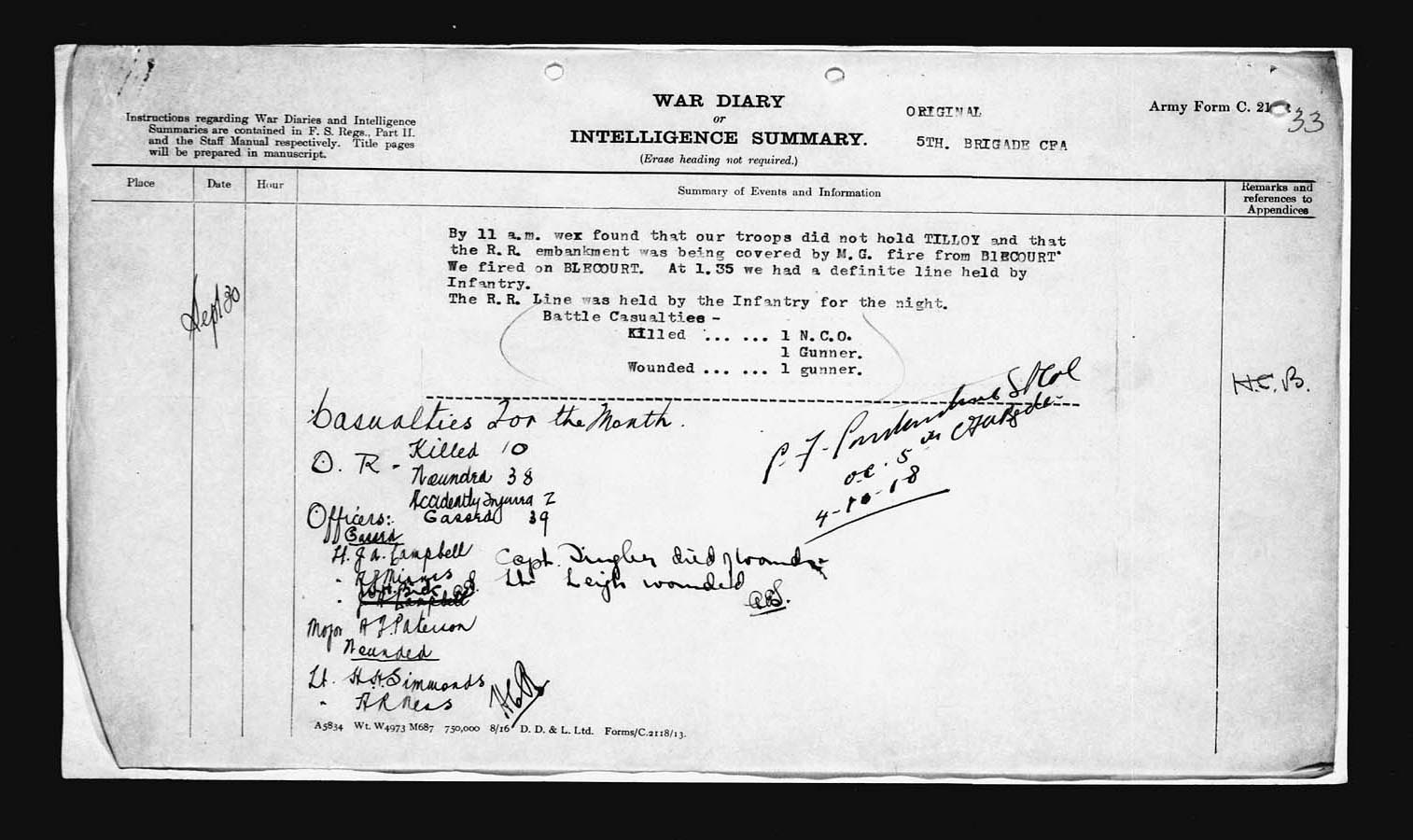
The war diary of his unit notes that on September 30th one N.C.O. (non-commissioned officer) and one gunner were killed. Hill must have been the N.C.O. mentioned here. The previous page records that “at 8.00 a.m. the 17th Battery crossed the DOUAI-CAMBRAI Road and were met by a heavy M.G. [machine gun] and Whizz bang [shell] fire.” This may have been how Hill was killed.

War diary for 5th brigade CFA

Hill’s service record contains his will, in which he left all his possessions to his mother, Bernadetta.

Will of Joseph Bernard Hill

Joseph was buried in the Ontario Cemetery, Sains-les-Marquion, some 14km west of Cambrai. He is remembered on the Deseronto memorial.

Deseronto memorial

Thomas Wilfrid Duncan signature

Thomas Wilfrid Duncan died on this day in 1918 from injuries received in a flying accident in Deseronto. The Royal Air Force casualty card for the incident noted the following facts:

Date of Casualty: 25.9.18
Where occurred: Deseronto, Ontario
Type of Machine: Curtiss JN4 C-1318
Nature and Cause of Accident:
Result of Accident: Acci: Killed
Name of other occupant of machine One other name not given slgt injured

The death registration notes that Duncan survived for 28½ hours after the crash, but died of his brain injuries.

Thomas Wilfrid Duncan photo in The Varsity magazine, Toronto

Photograph of Duncan in The Varsity, 1918 war supplement

Thomas was born in Moore township, Lambton County, Ontario on August 20th, 1896, the son of Thomas Reid Duncan and Isabella (née McDonald). He was a student of Applied Sciences at the University of Toronto when he joined the Royal Flying Corps on October 29th, 1917. He was officially appointed to the Corps on December 5th, with a regimental number of 153319. He was five feet nine and a half inches tall. After his initial training, Duncan was granted a commission in the Royal Air Force on August 15th, 1918 and was working as a flying instructor with 81 Canadian Training Squadron in Deseronto at the time of his death.

Duncan was buried in Bear Creek Cemetery, Brigden, Ontario.

Clement A. Jones signature

Clement Archie Jones died on this day in 1918, after a raid by the United States’ 310th Infantry Battalion on the fortified Mon Plaisir farm near Thiaucourt, France. The World War Service Record of Rochester and Monroe County New York described events in the following way:

He was wounded in action September 22, 1918, in the Argonne Forest, and killed when a shell destroyed the ambulance that was taking him to a casualty clearing station.

Jones was initially buried at Rembercourt, Meurthe-et-Moselle. His body was disinterred and reburied on May 19th, 1919, in Grave Number 156, Section 9, Plot 3, St. Mihiel American Cemetery, Thiaucourt, Meurthe-et-Moselle, France.

Elmer Worden signatureElmer Worden was killed near Camp Rathbun on this day in 1918. He had joined the Royal Flying Corps in Winnipeg on January 31st, 1918 with the regimental number 154631 and was officially appointed to the Corps on February 4th. He was described as five feet nine and three quarter inches tall, with a ruddy complexion, dark brown hair and blue eyes.

The Royal Air Force’s report of the accident noted the following facts:

Date of Casualty: 16.9.18
Where occurred: 2½ miles east of Rathbun aerodrome
Type of Machine: C1363
Nature and Cause of Accident: Killed. Came down in spin, made steep nose dive & turned over on back before striking ground.
Result of Accident: Killed

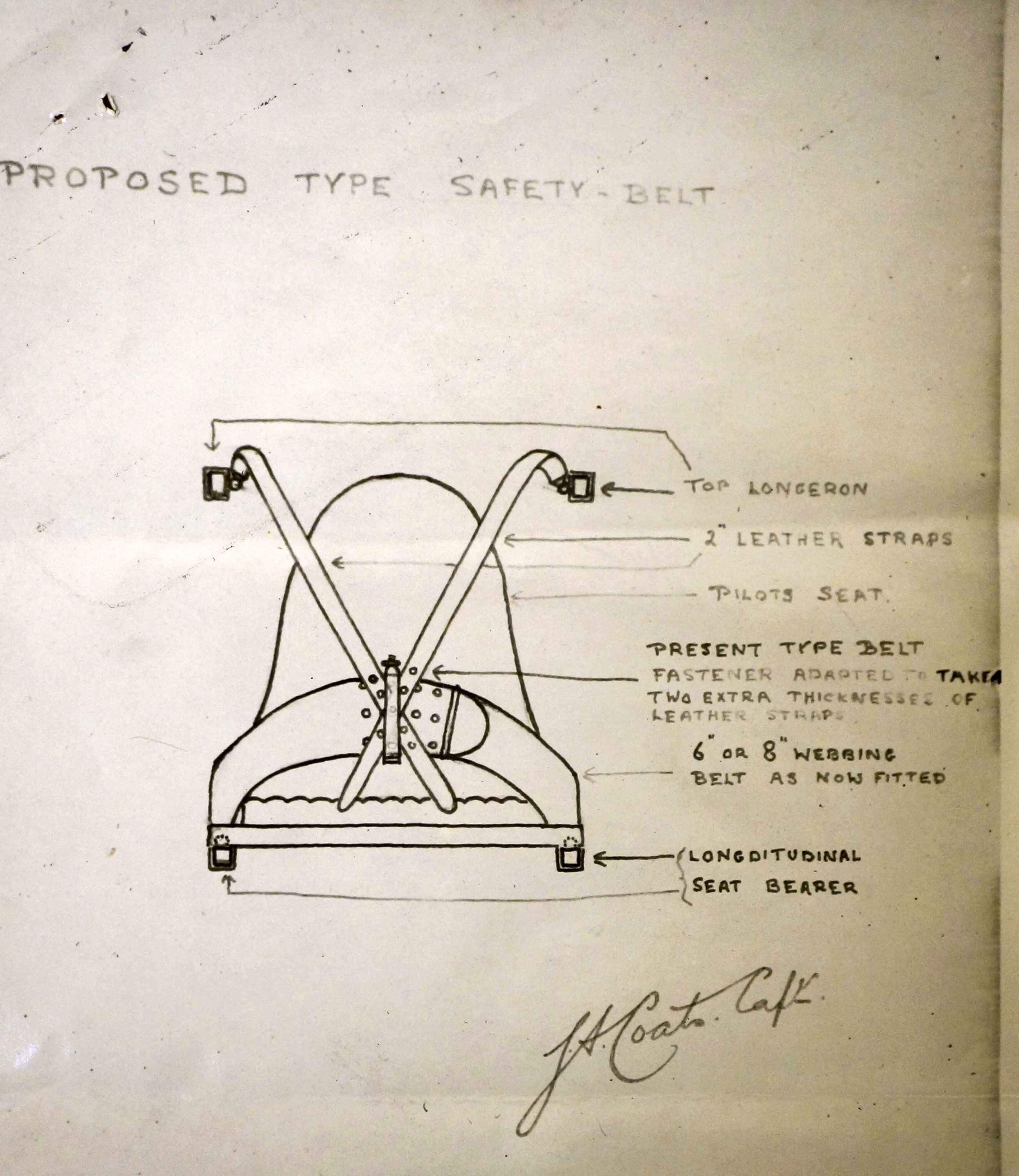
The Court of Inquiry into Worden’s accident found that his head had taken the brunt of the impact because his seat belt did not restrain him enough inside the aircraft. A sketch of a proposed improvement to the seat belt is included in the court record:

Sketch of proposed seat belt by Captain Coats in Attorney General's 1918 file RG 4-32/2610

Sketch of proposed seat belt by Captain Coats in Attorney General’s 1918 file RG 4-32/2610

Worden was born in Plankinton, South Dakota on June 16th, 1892, the son of Lavander Worden and Carrie (née Olson). He had been working as a construction manager in Grande Prairie, Alberta before he enlisted. Elmer’s family were living in Colville, Washington when he died and he was buried in the Highland Cemetery there.

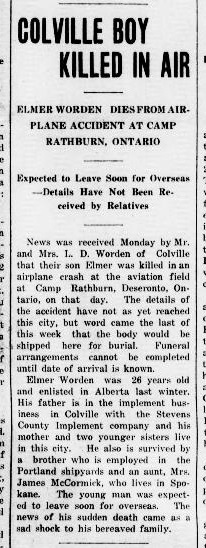
The Colville Examiner reported Worden’s death:

Elmer Worden death report

The Colville Examiner report of September 21st, 1918 on Worden’s death, courtesy of Chronicling America

COLVILLE BOY KILLED IN AIR

ELMER WORDEN DIES FROM AIRPLANE ACCIDENT AT CAMP RATHBURN, ONTARIO

Expected to Leave Soon for Overseas – Details Have Not Been Received by Relatives

News was received Monday by Mr. and Mrs. L. D. Worden of Colville that their son Elmer was killed in an airplane crash at the aviation field at Camp Rathburn, Deseronto, Ontario, on that day. The details of the accident have not as yet reached this city, but word came the last of this week that the body would be shipped here for burial. Funeral arrangements cannot be completed until date of arrival is known.

Elmer Worden was 26 years old and enlisted in Alberta last winter. His father is in the implement business in Colville with the Stevens County Implement company and his mother and two younger sisters live in this city. He also is survived by a brother who is employed in the Portland shipyards and an aunt, Mrs. James McCormick, who lives in Spokane. The young man was expected to leave soon for overseas. The news of his sudden death came as a sad shock to his bereaved family.

Austin Green signatureOn this day in 1918 Austin Green died of wounds caused by shrapnel from a shell when he was serving with the 4th Battalion in France.

Austin Green circumstances of death extract

“Died of Wounds”

Whilst with his Company going forward to its assembly positions about midnight on September 2nd 1918, during an advance on the Canal du Nord, a shell burst nearby and he was hit in the chest by a piece of shrapnel. His wounds were dressed by a comrade and he was taken to No.42 Casualty Clearing Station where he succumbed shortly afterwards.

Austin Green was buried in the Aubigny Communal Cemetery Extension near Arras in France.

He is also remembered on the Deseronto war memorial.

Deseronto memorial

« Previous PageNext Page »