World War I


William George Woodgate signature

On this day in 1916 William George Woodgate signed up in Belleville. He was born in Romford, Essex, England on January 9th, 1880, the son of William Woodgate and Amy (née Smith). The Woodgate family had left England for Canada in 1908 and were living in Deseronto at the time of the 1911 census. By 1913, William was married to Maud Beatrice Rand. In that year the couple had a daughter and William was working as the cemetery caretaker in Deseronto.

Woodgate joined the 155th Battalion of the Canadian Expeditionary Force with the regimental number 637032. He had military experience in the Royal Marines. He was later transferred to No. 3 Special Service Company. He was described as five feet eleven and three quarter inches tall, with a fair complexion, blue eyes and brown/grey/bald hair. He had tattoos on his arms: a lady in pannier dress on his right forearm and a crown with other devices on his left. His service record shows that he served in Canada for the duration of the war and was suffering from an inguinal hernia. William was discharged from Camp Barriefield in Kingston on January 23rd, 1919, with the rank of sergeant. In 1921 he and his wife and three daughters were living in Humberstone, Ontario and William was working as an engineer.

Ambrose Clause signature

Ambrose Clause signed up in Belleville on this day in 1916. He was born in Deseronto on November 29th, 1889, the son of Wellington Clause and Sarah (née Maracle), who were both Mohawks. On July 14th, 1910 he married Mary Brant in Tyendinaga.

Clause joined the 155th Battalion of the Canadian Expeditionary Force with the regimental number 636999. He was five feet nine inches tall, with a dark complexion, brown eyes and black hair.

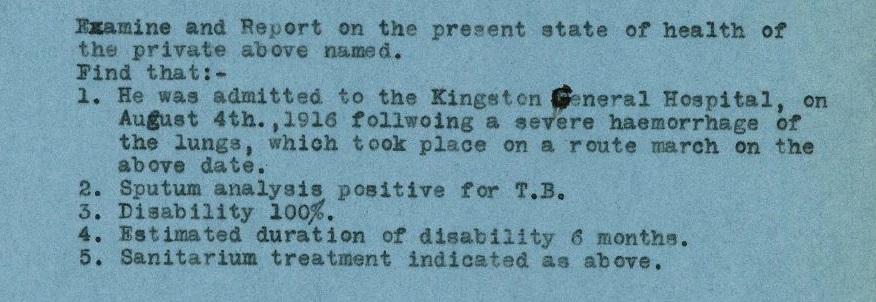
Ambrose’s service record shows that he was discharged from the army on October 5th, 1916 due to being medically unfit for service. A medical board convened at Camp Barriefield in Kingston reported as follows:

Medical report on Ambrose Clause

Examine and Report on the present state of health of the private above named.

Find that:-

1. He was admitted to the Kingston General Hospital, on August 4th., 1916 follwoing a severe haemorrhage of the lungs, which took place on a route march on the above date.

2. Sputum analysis positive for T.B.

3. Disability 100%.

4. Estimated duration of disability 6 months.

5. Sanitarium treatment indicated as above.

Ambrose never fully recovered from tuberculosis, although his record notes that in 1918 he was well enough to be working as a section man for the Canadian National Railway after his discharge.

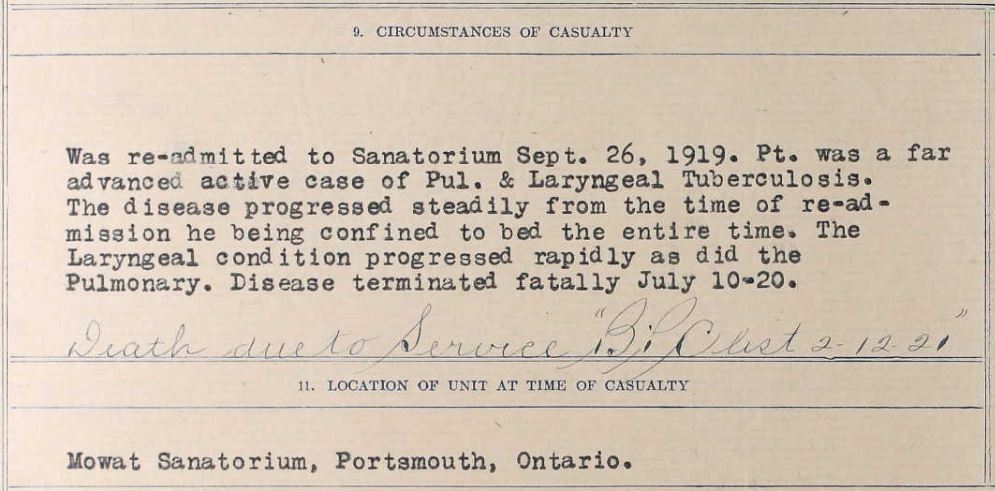
Ambrose Clause circumstances of casualty

Circumstances of casualty for Ambrose Clause, courtesy of Library and Archives Canada

Was re-admitted to Sanatorium Sept. 26, 1919. Pt. was a far advanced active case of Pul. & Laryngeal Tuberculosis. The disease progressed steadily from the time of re-admission he being confined to bed the entire time. The Laryngeal condition progressed rapidly as did the Pulmonary. Disease terminated fatally July 10-20.

Death due to Service “BPC list 2.12.21”

Clause died from the disease on July 10th, 1920 at the Sir Oliver Mowat Memorial Hospital in Portsmouth, Kingston. He was buried in Christ Church Cemetery, Tyendinaga.

George Fayette Palmer signature

On this day in 1916, George Fayette Palmer signed up in Deseronto. He was born in Monticello, Indiana on March 28th, 1868 (he claimed 1871), the son of Samuel Ball and Emma (née Palmer). He described himself as an “expert explosive man” on his attestation paper and gave his next of kin as his wife, Clara L. Palmer, whose home address was 1825 3rd Street West, Seattle, Washington.

Palmer joined the 155th Battalion of the Canadian Expeditionary Force with the regimental number 636973. He was five feet seven and a half inches tall, with a fair complexion, blue eyes and brown and grey hair. His service record shows that served in Canada he rose through the ranks to become Regimental Quarter Master Sergeant and was discharged in Kingston on April 20th, 1918 in order to take up a commission in the 3rd Battalion, Canadian Garrison Regiment.

George signed up again on September 20th, 1918. At this date he had the rank of lieutenant and stated that he had served for six months in the 155th Battalion and one year seven months in No. 3 Special Service Company.1 He gave his occupation as “Lawyer and manufacturer”. This time, he gave his next of kin as Emma J. Palmer, his mother. He was demobilized in Kingston on April 15th, 1919.

Grave of George Fayette Palmer and Edith Pearl Steele, courtesy of FindaGrave.com (uploaded by Carole Sprickerhoff)

Grave of George Fayette Palmer and Edith Pearl Steele, courtesy of FindaGrave.com (uploaded by Carole Sprickerhoff)

After the war, George was living in Thomas Street, Deseronto, married to Edith Pearl Steele and living with her parents and a stepson, Basil Branscombe (Pearl’s son from her first marriage). He was working as a wholesale grocer. His first wife, Clara, was in Seattle with their son and was divorced.

Pearl Steele Palmer died on February 18th, 1932 and George died on November 3rd, 1934. On his death registration, he was described as a newspaper reporter. Both George and Pearl were buried in Deseronto Cemetery.


1Special Service Companies were formed to make use of men whose health was less than perfect (or who were under or over age). They undertook activities such as guard duty.

Albert Arthur Windsor signature

Albert Arthur Winsor signed up in Deseronto on this day in 1916. He was born in Addlestone, Surrey, England, the son of George Winsor and Kathleen (née Taylor) and came to Canada on the SS Canada in February 1913. He married Andrina Campbell in St. Mark’s Church, Deseronto, on January 21st, 1915. Andrina was a Scot who came to Canada in 1913 as a domestic servant with the Women’s Domestic Guild of Canada.

The witnesses to Albert and Andrina’s marriage were Ellen and Arthur Rosendale and in October 1914 Albert and Andrina had been the witnesses at Ellen and Arthur’s wedding. Ellen Glenny and Albert Winsor had travelled to Canada on the same ship in 1913.

Winsor joined the 155th Battalion of the Canadian Expeditionary Force with the regimental number 636960. He was six feet tall, with a fair complexion, grey eyes and fair hair. His service record shows that he left Canada on the SS Northland in October 1916 and joined the Canadian Army Service Corps in France a month later. He was promoted to the rank of sergeant in January 1919. Andrina travelled to England during the war and the couple did not immediately return to Canada: Albert was discharged in London on August 16th, 1919 and was intending to live in Chertsey, Surrey.

He died in Vancouver on July 15th, 1970.

George Leo Smart signature

George Leo Smart signed up in Deseronto on this day in 1916. He was born in Tyendinaga on April 7th, 1898, the son of Henry Smart and Julia Ann (née Moses), who were both Mohawks. His older brother Harold (Harry) had enlisted in February 1915.

Smart joined the 155th Battalion of the Canadian Expeditionary Force with the regimental number 636959. He was five feet seven and a half inches tall, with a dark complexion, brown eyes and brown hair. His service record shows that he was admitted to hospital in Kingston with measles in June 1916, then sailed from Halifax on the SS Northland on October 17th, 1916. George was transferred to the Princess Patricia’s Canadian Light Infantry in France on July 1st, 1917. In October he was admitted to hospital suffering from a fever, and in February 1918 he was injured again when he sprained his ankle. He received a gunshot wound to the right wrist on August 14, 1918 in the attack on Parvilliers and was struck off the strength of the battalion two days later when he was sent back to England to recuperate. The injury resulted in a loss of movement and feeling in George’s right hand.

George Leo Smart travelled back to Canada on the SS Caronia, arriving on April 5th, 1919. He was demobilized in Kingston on April 8th. He married Doris Sero in Tyendinaga on Decemeber 14th, 1920.

Wilbert Brant signature (2)

Wilbert Brant signed up in Deseronto on this day in 1916. He the son of Frank Brant and Mary (née Moses), who were both Mohawks, living in Tyendinaga. Wilbert claimed to have been born on November 27th, 1897. The 1901 census record for his family suggests that he was actually born in December 1899.

Wilbert joined the 155th Battalion of the Canadian Expeditionary Force with the regimental number 636958. He was five feet nine and a half inches tall, with a dark complexion, brown eyes and black hair. Wilbert Brant’s service record shows that he was discharged at Camp Barriefield in Kingston on July 12th, 1916 for being under age. If the census date of birth for him is correct, he would have been 16 years old when he was discharged.

Brant married Harriet Beatrice Claus on September 22nd, 1919 in Oshawa when he was 22. One of the witnesses to the marriage was George Leo Smart, another Mohawk veteran who signed up the day after Wilbert. Wilbert and Beatrice were still in Oshawa at the time of the 1921 census, living with members of the Claus family.

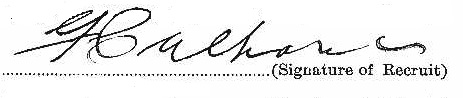
Frank Culhane signature

Frank (Francis) Culhane, a marine engineer, signed up in Deseronto on this day in 1916. He claimed to have been born in Napanee on March 28th, 1878, but his true date of birth seems to have been March 28th, 1873. His parents were Patrick Culhane and Sarah (née McCallum). By 1891 the family were living in Deseronto.

Frank joined the 155th Battalion of the Canadian Expeditionary Force with the regimental number 636951. He was five feet eight inches tall, with a dark complexion, blue eyes and brown hair. His service record notes that he arrived in England on October 28th, 1916 on the SS Northland and was transferred to the 21st Battalion in France on December 6th.

On May 12th, 1917 Culhane received a shell wound to his right shoulder at Thélus, near Vimy. The attack was noted in the 21st Battalion’s war diary:

21st Battalion war diary for date of Frank Culhane's injury

WAR DIARY or INTELLIGENCE SUMMARY

21st Canadian Battalion

Place: T220.9.3

Date: 12.5.17

Summary of Events and Information: The day passed fairly quiet until about 7.00 pm when the enemy artillery opened up for a few moments on our Reserve Line causing 11 casualties

Frank was sent back to England to convalesce for six weeks. He was left with weakness in his right shoulder and hand, and spent the rest of the war attached to the Eastern Ontario Regimental Depot in Seaford, Sussex, except for a period in the spring of 1918 when he was treated in Cambridge for an infection. At a Medical Board held on September 9th, 1918 he was classed as B3, fit for sedentary work abroad. He left England on December 14th, 1918 on the RMS Olympic and arrived in Halifax five days later.

Frank Culhane's grave, courtesy of FindaGrave.com

Frank Culhane’s grave, courtesy of FindaGrave.com

Culhane was discharged in Kingston on February 1st, 1919. He married Martha Ann Sharpe (widow of Ernest Sharpe, another Deseronto veteran, who had also served in the 21st Battalion) on December 5th, 1919 in Toronto. He died on November 5th, 1939 and was buried in Mount Hope Catholic Cemetery, Toronto.

Joseph Sirois signature

Joseph Sirois signed up in Quebec on this day in 1916, the first of three enlistments for this man. He was born in Deseronto on August 10th, 1896, the son of Joseph Sirois senior and Marie Louise (née Bilodeau), who were both born in Quebec.

Sirois joined the 167th Battalion with the regimental number 672461. He was five feet two and a half inches tall, with a dark complexion, brown eyes and black hair. His service record shows that he was struck off as a deserter in May 1916.

Joseph signed up again in 1917, in Sudbury on April 2nd for the No. 1 Forestry Draft (spelling his name Sirroy). He signed up again on April 15th in Brockville. On both of these attestation papers his regimental number was 2198435. He arrived in England on May 14th, 1917 and was in France with the Canadian Forestry Corps by June 17th. In October 1918 he was transferred to the 13th Battalion.

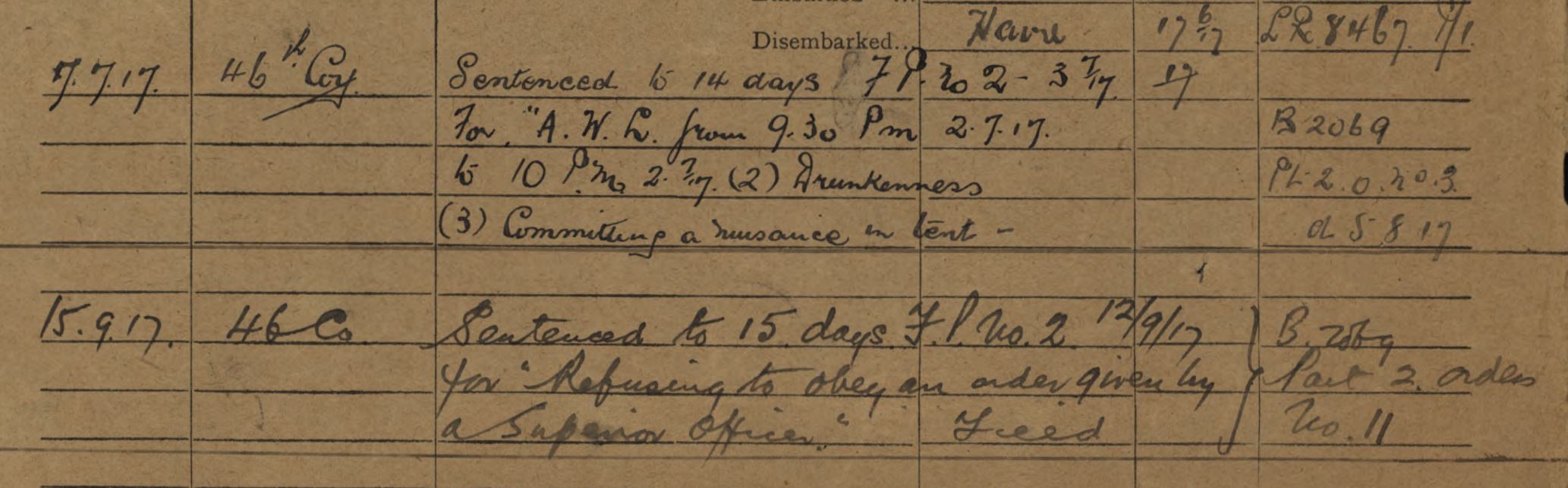
Sirois seems to have had a troubled career in the Forestry Corps. His service record has several instances where he was punished for various infractions.

7.7.17 46th Coy. Sentenced to 14 days F.P. No. 2 for “A.W.L. from 9.30 PM 2.7.17 to 10pm 2.7.17 (2) Drunkenness (3) Committing a nuisance in tent

15.9.17 46 Co. Sentenced to 15 days F.P. No. 2 12/9/17 for “Refusing to obey an order given by a Superior Officer”

Joseph left Liverpool on the SS Baltic on June 26th and was demobilized on July 11th, 1919.

Charles Arthur Brant signature

On this day in 1916 Charles Arthur Brant signed up in Prince Albert, Saskatchewan. He was born in Tyendinaga on October 29th, 1877, the son of Josiah Brant and Elizabeth (née Moses), who were both Mohawks.

Arthur joined the 96th Battalion with the regimental number 204555. He was five feet eight and a half inches tall, with a dark complexion, brown eyes and brown hair. His service record shows that he was transferred to the 15th Battalion when he arrived in France on April 10th, 1917.

Arthur did not make it home.

Isaac Maracle signature

Photo of Isaac Maracle

Photo of Isaac Maracle from Kanhiote Tyendinaga Territory Public Library

Isaac Maracle signed up in Deseronto on this day in 1916. He was born on July 28th, 1898 in Tyendinaga, the son of Eliza Maracle, eldest daughter of Seth Maracle and Christine (née Brant) and John Maracle.

Isaac joined the 155th Battalion of the Canadian Expeditionary Force with the regimental number 636881. He was six feet tall, with a dark complexion, brown eyes and black hair. His service record shows that Maracle was transferred to the Princess Patricia’s Canadian Light Infantry on arrival in France on May 24th, 1917.

Isaac did not make it home.

« Previous PageNext Page »