World War I


Albert Arthur Johnson signature

Albert Arthur Johnson, a yardmaster, signed up in Ottawa on this day in 1917. He was born in Deseronto on October 2nd, 1891, the son of Samuel Johnson and Clarissa (née Hadley). When he enlisted, his home address was 262 George Street, Toronto.

Albert joined the No. 1 Section Skilled Railway Employees with the regimental number 2124812. He was five feet eight inches tall, with a dark complexion, blue eyes and brown hair. Johnson’s unit left Halifax on the SS Ausonia in March 1917 and arrived in England on March 15th. It was redesignated as the 12th (Canadian) Light Railway Operating Company, Royal Engineers on March 16th and No. 58 Broad Gauge Railway Operating Company (Canadians) Royal Engineers on April 7th, 1917. It arrived in France on April 19th, 1917, where it worked to transport troops and supplies behind the lines. The unit was disbanded on April 19th, 1919 in Knotty Ash, England.

Johnson’s service record shows that he travelled back to Canada on the RMS Aquitania in May 1919 and was demobilized in Toronto on May 27th. He married Ruby May Greenwood in Port Colborne on February 11th, 1922. He was still working on the railway: as a conductor. A note on his service file records that he died on November 21st, 1972.


David Stanley Bernhardt signature

On this day in 1917 David Stanley Bernhardt (sometimes written Barnhardt), a machinist, signed up in St. Catharines, Ontario. He was born in Deseronto on January 25th, 1880, the son of Robert James Barnhardt and Catherine (née Maracle), who were both Mohawks. In 1901 the family were still in Deseronto, but they had moved to Midland, Ontario by 1911. Robert died in Midland in 1913. David was living in Port Dalhousie when his daughter, Beatrice Catherine Bernhardt, was born in July 1913. Beatrice’s birth registration states that David married Jennie Gordon in Penetanguishene in 1907.

David joined the 256th Battalion with the regimental number 1099026. He was a quarter of an inch over five feet tall, with a dark complexion, grey eyes and black hair. His service record shows that he arrived in England in April 1917 and was transferred to the 10th Battalion, Canadian Railway Troops, joining them in France in June.

Bernhardt survived the war, travelling back to Canada on the RMS Celtic in March 1919. He was demobilized in Toronto on March 21st.

Stafford Claus signature

On this day in 1916 Stafford Claus signed up in Picton. He was born on May 25th, 1902 (he claimed 1898) in Deseronto, the son of Arthur Claus and Margaret (née Maracle), who were both Mohawks. By 1916 Arthur and Margaret were living in Oshawa and Stafford gave his home address as Picton.

Claus joined the 235th Battalion with the regimental number 1027582. He was five feet four and a half inches tall, with a dark complexion, black eyes and black hair. His service record shows that Stafford was examined by a medical board at Belleville on February 16th, 1917. The board determined that he was under age and should not serve until 1920, when he would be 18.

Stafford Claus Medical Board extract

Extract from medical board report in Stafford Claus’s service record, courtesy of Library and Archives Canada.

10 (a) Disease or disability. Under -age

(b) Date of origin. 1902, May 25th


11. Present Condition (Most Important). Under age but in excellent health and is a good soldier.

Stafford was discharged from the army on March 10th, 1917. He married Ada Violet Maracle on November 18th, 1925 in Christ Church, Tyendinaga. He served in the Second World War and worked at Metcalfe Foods in Deseornto for many years. He and Ada had nine children. Stafford died on December 2nd, 1971 and was buried in Deseronto Cemetery. When he died, he had 31 grandchildren and 71 great-grandchildren.

James Albert Banister signature

James Albert Banister signed up in Belleville on this day in 1916. He was born in Prince Edward County in 1902 (he claimed 1898), the son of Alexander Banister (whose mother was Mohawk) and Mary Louisa (née Smart), a Mohawk. Alexander had left his family in 1913, according to his son. His home address was Shannonville.

Banister joined the 235th Battalion with the regimental number 1027583. He was five feet six and a half inches tall, with a dark complexion, brown eyes and dark brown hair. His service record shows that he arrived in England on the SS Megantic on May 14th, 1917.

Banister never served in France: he seems to have spent much of his time overseas in hospital in England with various infections. In November 1917 he was sent back to Canada. This was explained in a second service file, where it appears that his true age had been detected. He was transferred to No. 3 Special Service Company, but went absent without leave in December 1917 and was struck off as a deserter on January 8th, 1918.

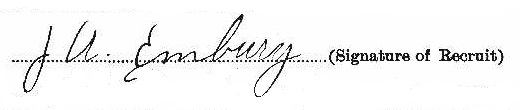
Joseph Allan Embury signature

Joseph Allan Embury, a billing clerk for the Canadian Pacific Railway, signed up in Peterborough on this day in 1916. He was born in Deseronto on October 2nd, 1900, the son of Thomas Embury and Nora (née Meagher), although he claimed to have been born in 1898.

Embury joined the 74th Battery of the Canadian Field Artillery with the regimental number 344926. He was five feet four and a quarter inches tall, with a dark complexion, brown eyes and dark brown hair. His service record shows that he left Canada on April 28th, 1917, aged 16, on the SS Olympic, which arrived in England on May 7th.  On May 16th he was admitted to hospital for a month, suffering from an infection. He served in the Artillery’s reserve brigades in England until December 19th, 1917, when he was sent to France.

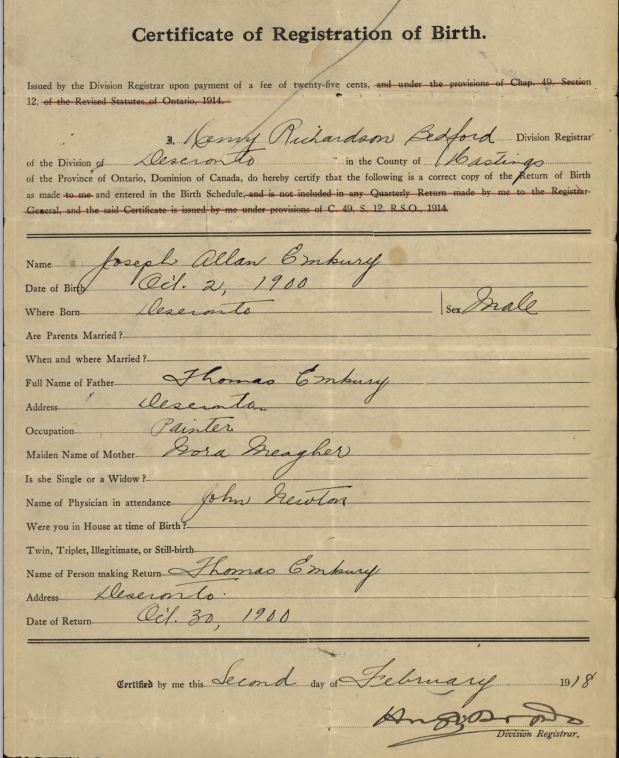
The fact that Embury was underage was detected on January 9th, 1918 and he was transferred back to England as a minor. There is a copy of his birth registration on his file, supplied by the Deseronto Registrar on February 2nd, 1918.

Joseph Allan Embury birth registration copy

In March Joseph was sent home to Canada, where he was discharged from the army on May 14th, 1918 in Kingston, for being underage. He died in Saanich, British Columbia on May 20th, 1961.

David Morley Jackson signature

On this day in 1916 David Morley Jackson, a clerk, signed up in Swift Current, Saskatchewan. He was born in Deseronto on July 16th, 1898, the son of George Ernest Jackson and Elizabeth (née Jamieson). The family were living in Deseronto in 1901 and had moved to Point Anne by 1911.

David joined the 249th Battalion of the Canadian Expeditionary Force, with the regimental number 1069227. He was five feet eight and a half inches tall, with a dark complexion, brown eyes and black hair. His service record shows that attained the rank of lance corporal and he was discharged in Halifax on November 27th, 1918 as he was a railway employee (a telegraphist).

Jackson married Mae Marguerite Kerr in Belleville on November 24th, 1922. Family tree information on Ancestry.ca suggests that he died in Oshawa on September 25th, 1969.

Clarence Merritton Giffin signature

Clarence Merritton Giffin, a railway clerk, signed up in Windsor, Ontario on this day in 1916. He was born in Maitland, Ontario, the son of William Ernest Giffin and Margaret Grace (née McMullen) on September 16th, 1898. In 1901 the family were in Belleville and in 1911 they were in Deseronto, where William was working as a druggist. Clarence attended Deseronto High School.

Clarence Giffin joined the 63rd Depot Battery of the Canadian Field Artillery with the regimental number 334088. He was five feet five inches tall, with a fair complexion, blue eyes and black hair. His service record shows that he arrived in England in December 1917 on the SS Megantic and went to France on April 2nd, 1918. In July he reported sick and he spent the rest of the war in various hospitals, suffering from nephritis. He was invalided home to Canada on the hospital ship Essequibo in January 1919 and discharged as medically unfit for service on May 12th, 1919.

In 1921 Giffen was back in Windsor with his parents and sisters, working as a salesman. He moved to the United States and died in Rocky River, Ohio, in 1974.

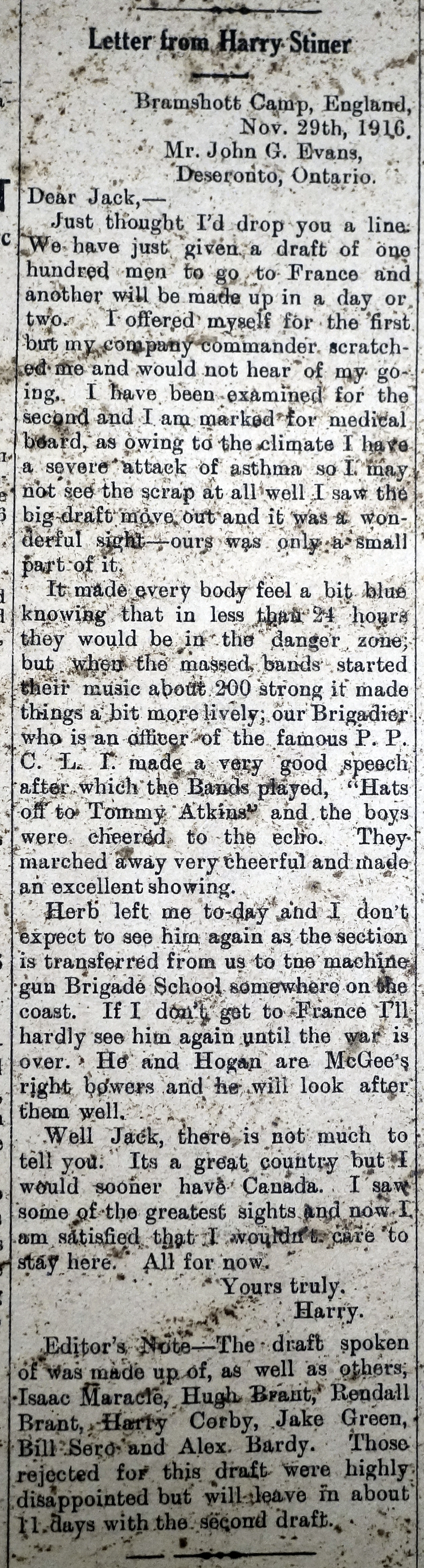
Harry Stiner, who had enlisted on January 15th, wrote a letter home to John ‘Jack’ Evans on this day in 1916. At the time Harry was stationed in Camp Bramshott in Hampshire, England and was hoping to be posted to France. His letter was published in the Deseronto Post of December 14th, 1916:

Deseornto Post 14 Dec 1916 Letter from Harry Stiner

Letter from Harry Stiner
Bramshott Camp, England,
Nov. 29th, 1916
Mr John G. Evans
Deseronto, Ontario.
Dear Jack, —
Just thought I’d drop you a line. We have just given a draft of one hundred men to go to France and another will be made up in a day or two. I offered myself for the first but my company commander scratched me and would not hear of my going. I have been examined for the second and I am marked for medical board, as owing to the climate I have a severe attack of asthma so I may not see the scrap at all well I saw the big draft move out and it was a wonderful sight-ours was only a small part of it.
It made every body feel a bit blue knowing that in less than 24 hours they would be in the danger zone but when the massed bands started their music about 200 strong it made things a bit more lively; our Brigadier who is an officer of the famous P.P.C.L.I. [Princess Patricia’s Canadian Light Infantry] made a very good speech after which the Bands played, “Hats off to Tommy Atkins” and the boys were cheered to the echo. They marched away very cheerful and made an excellent showing.
Herb left me today and I don’t expect to see him again as the section is transferred from us to the machine gun Brigade School somewhere on the coast. If I don’t get to France I’ll hardly see him again until the war is over. He and Hogan are McGee’s right bowers and he will look after them well.
Well Jack, there is not much to tell you. Its a great country but I would sooner have Canada. I saw some of the greatest sights and now I am satisfied that I wouldn’t care to stay here. All for now.
Yours truly.
Harry.

Editor’s Note-The draft spoken of was made up of, as well as others, Isaac Maracle, Hugh Brant, Rendall [Randall] Brant, Harry Corby, Jake Green, Bill Sero and Alex Bardy. Those rejected for this draft were highly disappointed but will leave in about 11 days with the second draft.

Frank Waterbury signature

Frank Waterbury, a carpenter, signed up in Deseronto on this day in 1916. He was born in Deseronto on September 15th, 1890, the son of James Waterbury and Minnie (née Solmes). He gave his next of kin as Bertha Waterbury, his wife.

Frank joined the 235th Battalion of the Canadian Expeditionary Force with the regimental number 1027511. He was five feet nine and a half inches tall, with a fair complexion, brown eyes and brown hair. His service record shows that he and Bertha had two children (Elfrida and Francis) when he enlisted. Waterbury arrived in England on June 9th, 1917 on the SS Olympic and was transferred to the 230th Forestry Battalion in Sunningdale, Berkshire. In March 1918 he was again moved, this time to the Canadian Railway Troops Depot in Purfleet. He went to France on March 29th, 1918 and served there until January 1919.

During the war, Frank Waterbury married Elizabeth Davis in Barnet, Hertfordshire, England in 1917. They had a son, Francis, who was born in Windsor in 1918. There is a note on Frank’s file changing his official next of kin from Bertha to Elizabeth and a record of a letter stating that Bertha had not been Frank’s legal wife.

Frank’s new family travelled to Canada on the SS Metagama, arriving on May 2nd, 1919. Frank was demobilised in Quebec on May 4th. In 1921 the Waterburys were living in Thomas Street, Deseronto, with Francis and another son, Edward. A note on his service file records that Frank died on December 13th, 1960. He was buried in Sunderland, Ontario.

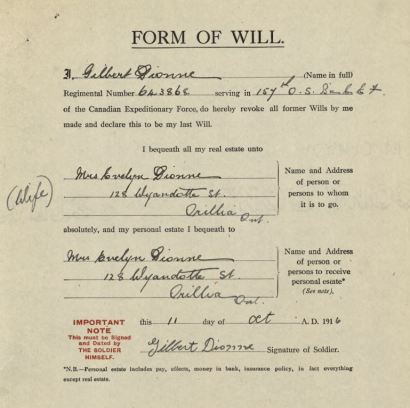
Gilbert Dionne signatureOn this day in 1916 Gilbert Dionne died in No. 12 Canadian General Hospital in Bramshott, England nine hours after an operation to repair a perforated duodenal ulcer. He had made an army will five weeks before his death, just before he left Canada, in which he left all his possessions to his wife, Evelyn.

Gilbert Dionne's will, from his service record at Library and Archives Canada

Gilbert Dionne’s will, from his service record at Library and Archives Canada

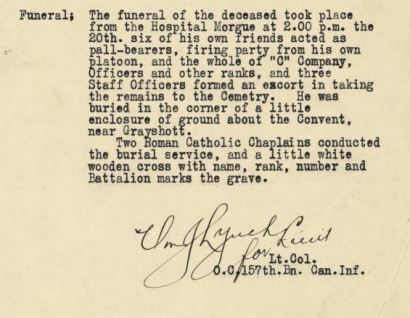
In addition to his will, Dionne’s service file at Library and Archives Canada also contains a description of his funeral, signed by Lieutenant Vincent James Lynch on behalf of the commanding officer of the 157th Battalion:

Description of the funeral of Gilbert Dionne

Funeral: The funeral of the deceased took place from the Hospital Morgue at 2.00 p.m. the 20th. six of his own friends acted as pall-bearers, firing party from his own platoon, and the whole of “C” Company, Officers and other ranks, and three Staff Officers formed an escort in taking the remains to the Cemetry. He was buried in the corner of a little enclosure of ground about the Convent, near Grayshott.

Two Roman Catholic Chaplains conducted the burial service, and a little white wooden cross with name, rank, number and Battalion marks the grave.

Later, the wooden cross described by Lieutenant Lynch was replaced by a War Graves Commission headstone in the St. Joseph’s Roman Catholic Cemetery in Grayshott, Hampshire, England.

Photo courtesy of Findagrave.com (uploaded by Don Knibbs)

« Previous PageNext Page »