On this day in 1918 Jacob Bernhart died of nephritis, a kidney disorder, at No. 4 Casualty Clearing Station in Belgium, where he had been admitted on the previous day.
He was buried at the Dozinghem Military Cemetery in Belgium.
January 18, 2018
On this day in 1918 Jacob Bernhart died of nephritis, a kidney disorder, at No. 4 Casualty Clearing Station in Belgium, where he had been admitted on the previous day.
He was buried at the Dozinghem Military Cemetery in Belgium.
January 17, 2018
On this day in 1918, Vernon Leroy Stoddart died in Belleville General Hospital of a gunshot wound. Stoddart was born in Lawrencetown, Nova Scotia on October 16th, 1893, the son of Lemuel Stoddart and Lillian (née Hunt). In 1911 he was working as a bank clerk.
Stoddart joined the Royal Flying Corps in Halifax, Nova Scotia on November 10th, 1917. His regimental number was 153661 and he was five feet nine inches tall. He was officially accepted into the Corps in Toronto on December 17th. Just a month later, he was killed in a rifle accident while training at Camp Mohawk, aged 24.
On January 18th, the Intelligencer newspaper reported on the inquest in the following way:
CADET STODDART WAS
SHOT BY COMRADE
Shooting Affray at Camp Mohawk Being Investigated – Cadet Moore Fired a Bullet From Gun, When it Was Supposed to be a Blank Cartridge
At Thompson Company’s undertaking parlors in this city last evening. an Inquest was opened before Coroner Dr. Boyce to enquire into the circumstances regarding the tragic death of Flight Cadet Vernon Stoddart. of Camp Mohawk, who died at the hospital here yesterday as the result of a gun-shot wound.
The Jury was composed of Messrs. E. T. Cherry, foreman; Geo Daw, T. F. Wills, Geo. T Woodley, W. A. Woodley, R Zufelt, A Blackburn and C. M. Hall.
Mr. Wm. Carnew. County Attorney, represented the crown in the matter
After the Jury had been sworn in they viewed the body and were shown the wound which had evidently caused death.
Police Officer Sergt. Naphan testified as to the summoning the Jury and that all were qualified to act.
Dr. Tennett gave evidence as to the nature of the wound which had no doubt caused death. He also testified as to deceased being brought to the Belleville hospital from Mohawk Camp to be attended to. Death occurred on Thursday morning about 7 o’clock.
Cadet Alfred Stewart Hunt, a cousin of deceased, testified that he recognised the remains as those of Cadet Vernon Stoddart, whose home was at Lawrencetown. Annapolis County. Nova Scotia, and was a son of Mr. Lemuel H Stoddart. Hunt then gave an explanation as to how deceased came to be shot. He occupied Room 1 of No. 2 Cadet wing. R.F.C. at Camp Mohawk, which was a large sleeping room where some 22 sleep. Considerable time was spent In the room by the cadets. He had heard of no grievances between deceased and Cadet Moore who fired off the gun which caused Stoddart’s death. At about 2.45 or 3 o’clock on Wednesday afternoon. 16th inst., Cadet W. G. Moore, who is a boxer by profession, and had been relieved from all drill on account of some engagements Moore told witness that he was in the club room and picked up one of the guard’s rifle and was demonstrating bow the ejecter and bolt of the rifle would work. For demonstration he used what he supposed was a dummy round or blank cartridge. In the demonstration, the gun was discharged and Moore was In Room No. 5 In rear of No. 1 room where Stoddart was sitting on the bunk occupied by witness. The bullet went through an inch-board partition and struck deceased in the shoulder as he sat with his back to the partition Witness stated that no cadet is allowed to demonstrate with live or dummy ammunition, such being contrary to regulations, unless special authority is given. Whilst Moore was demonstrating the rifle, some fellow cadets were In the room with him. The rifle used was one a guard was to use on duty who was to be posted as guard on the afternoon of the accident. The ammunition apparently came from the aerial gunnery building about half a mile from the barracks. Ammunition is handed out by the instructors. whose duty it is to see that any rounds put out on the tables in this building for use of the machine gun classes in stripping guns are blanks. Moore might have had this cartridge in his pocket. When detained. Moore had no other cartridges in his possession. It is sometimes difficult to detect a live cartridge from a dummy cartridge, as all these are supposed to be dummy. It is against regulations for any cadet to have ammunition. dummy or alive, in his possession, and no cadet has a right to demonstrate a rifle with live or blank cartridges.
This was all the evidence taken at present, and the enquiry was adjourned until Tuesday evening next at thepolice court room.
In the meantime Cadet Moore, who discharged the gun. Is in detention at Mohawk Camp.
Cadet Stoddart. who lost his life, had only been 6 weeks in the service, and only 4 weeks at Camp Mohawk. Tbe remains will be sent to Lawrencetown, N.S.. for interment.

Vernon Stoddart was buried at Fairview Cemetery, Lawrencetown. A transcription of a newspaper article about him is available from the Find a Grave site.
December 23, 2017
On this day in 1917, Ross Ambrose Harrison was killed at Camp Taliaferro in Texas, while training with 78 Canadian Training Squadron, part of the 42nd Wing of the Royal Flying Corps which had moved from Deseronto to Texas for the winter.
Harrison was born in Kingston, Ontario on April 20th, 1892, the son of Thomas Harrison and Bridget (née McCummiskey). He signed up in Toronto on September 1st, 1917. The official casualty card for the incident notes that he was alone in his Curtiss JN4 aircraft at the time of the accident and that its cause was unknown. His body was brought back to Ontario and buried in St. Mary’s Cemetery, Kingston.
November 24, 2017
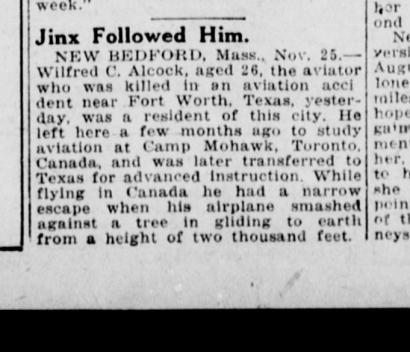
Wilfred Cecil Alcock was a cadet with the 42nd Wing of the Royal Flying Corps when he was killed at Camp Taliaferro, the winter training quarters for the Deseronto pilot trainees. A report in the Tulsa Daily World newspaper noted that he had a previous near miss at Camp Mohawk, where he was attached to 79 Canadian Training Squadron:
Jinx Followed Him
NEW BEDFORD, Mass., Nov. 25 – Wilfred C. Alcock, aged 26, the aviator who was killed in an aviation accident near Fort Worth, Texas, yesterday, was a resident of this city. He left here a few months ago to study aviation at Camp Mohawk, Toronto, Canada, and was later transferred to Texas for advanced instruction. While flying in Canada he had a narrow escape when his airplane smashed against a tree in gliding to earth from a height of two thousand feet.
The official Royal Flying Corps account of Alcock’s fatal accident gives more detail on the cause of the crash:
…Date of Casualty: 24.11.17
Where occurred: Canada Sth of aero field No 2 Camp Taliaferro
Type of Machine: Curtiss J.N.4 C760
Nature and Cause of Accident: Centre section of machine Carried away by under carriage of another machine
Result of Accident: Killed
Name of other Occupant of Machine: Nil…
Alcock was born in Knutsford, Cheshire, England on May 10th, 1891, the son of Frederick Alcock and Harriet (née Jones). In 1911 he was living at 95 King Street, Knutsford, with his parents and working as a printer. He emigrated to New York in 1912, leaving Glasgow on the SS California on October 19th. He joined the Royal Flying Corps in Toronto on September 6th, 1917, giving his home address as 131 Merrimac Street, New Bedford, Massachusetts.
Wilfred was buried in Oak Grove cemetery, New Bedford and is also remembered on the Mobberly Road war memorial at Knutsford in England.
November 16, 2017

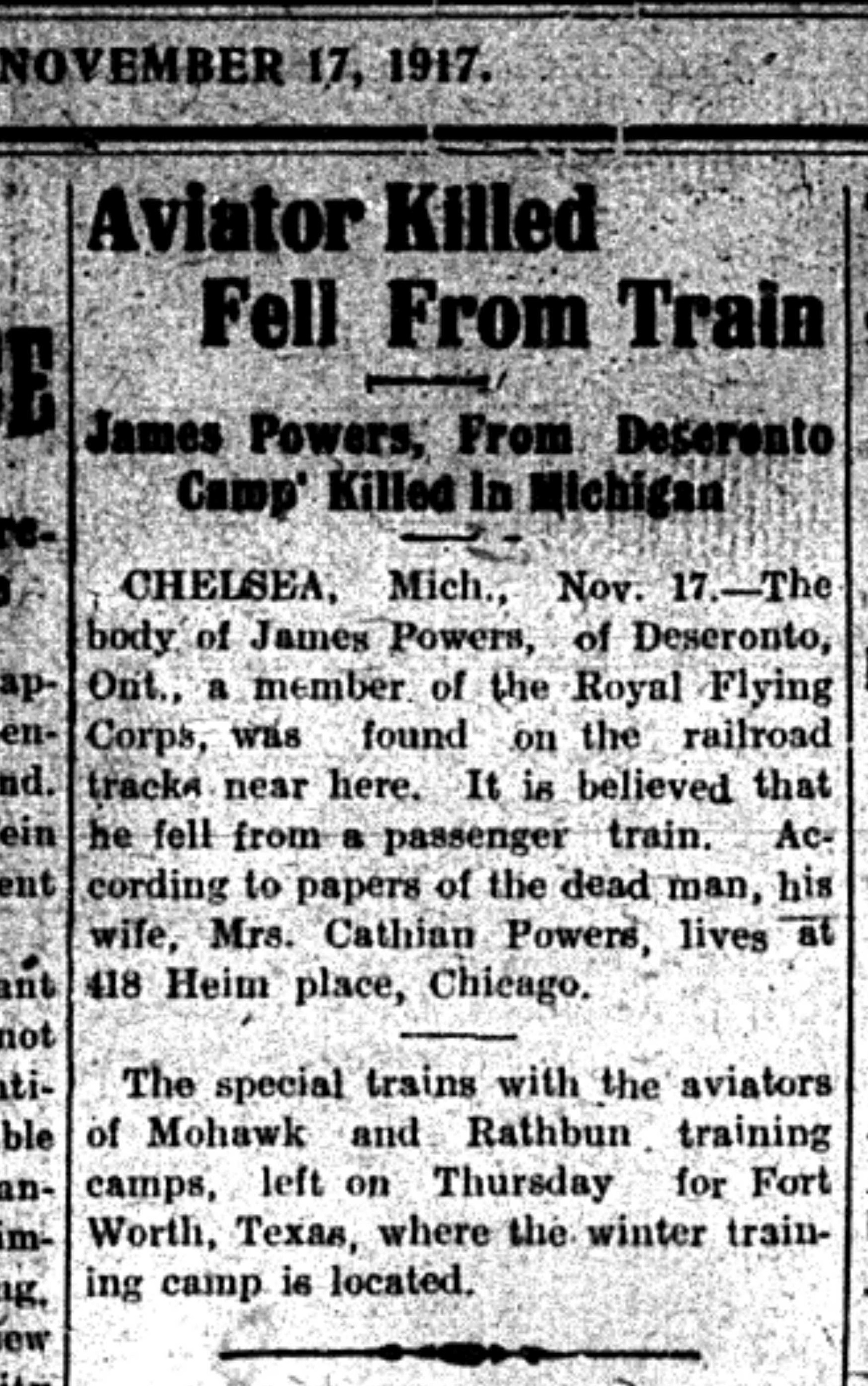
Intelligencer report of November 17th, 1917 on James Power’s death, courtesy of Belleville Public Library
Aviator Killed
Fell From Train
James Powers, From Deseronto Camp Killed in MichiganCHELSEA, Mich., Nov. 17. – The body of James Powers, of Deseronto, Ont., a member of the Royal Flying Corps, was found on the railroad tracks near here. It is believed that he fell from a passenger train. According to papers of the dead man, his wife, Mrs. Cathian Powers, lives at 418 Heim place, Chicago.
—
The special trains with the aviators of Mohawk and Rathbun training camps, left of Thursday for Fort Worth, Texas, where the winter training camp is located.
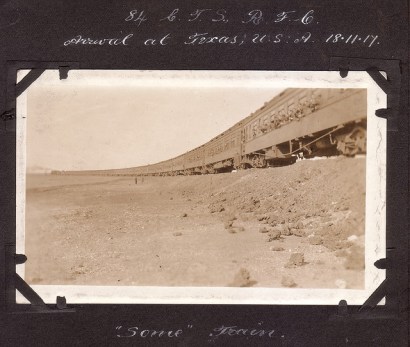
In November 1917 the Royal Flying Corps pilot training camps in Canada relocated to Texas to take advantage of the milder climate. This involved transporting men and equipment by railway from Ontario to Fort Worth, some 1,600 miles or 2,500 kilometres. It took three days to make the journey. The photograph below shows the size of the trains used in this exercise.
Cadet James Powers somehow fell from the train on the way. The Royal Flying Corps casualty card states “Believed to have fallen from train window”. In 1914 Powers had married Kathleen Buckley in Chicago and the couple’s home was in that city. It is possible that he had been trying to get back home to Kathleen when he died.
Powers was born in 1885. He had joined the Royal Flying Corps in Toronto on September 10th, 1917 with the regimental number 150021. He was five feet six and a quarter inches tall and had been attached to 80 Canadian Training Squadron.
He was buried at the Elmwood Cemetery at River Grove, Illinois.
October 30, 2017
Reuben Sero died on this day in 1917 while serving with the Princess Patricia’s Canadian Light Infantry at the Second Battle of Passchendaele.
Sero was buried in the Passchendaele New British Cemetery in Belgium.

Reuben Sero’s grave, courtesy of FindaGrave.com (uploaded by the International Wargraves Photography Project)
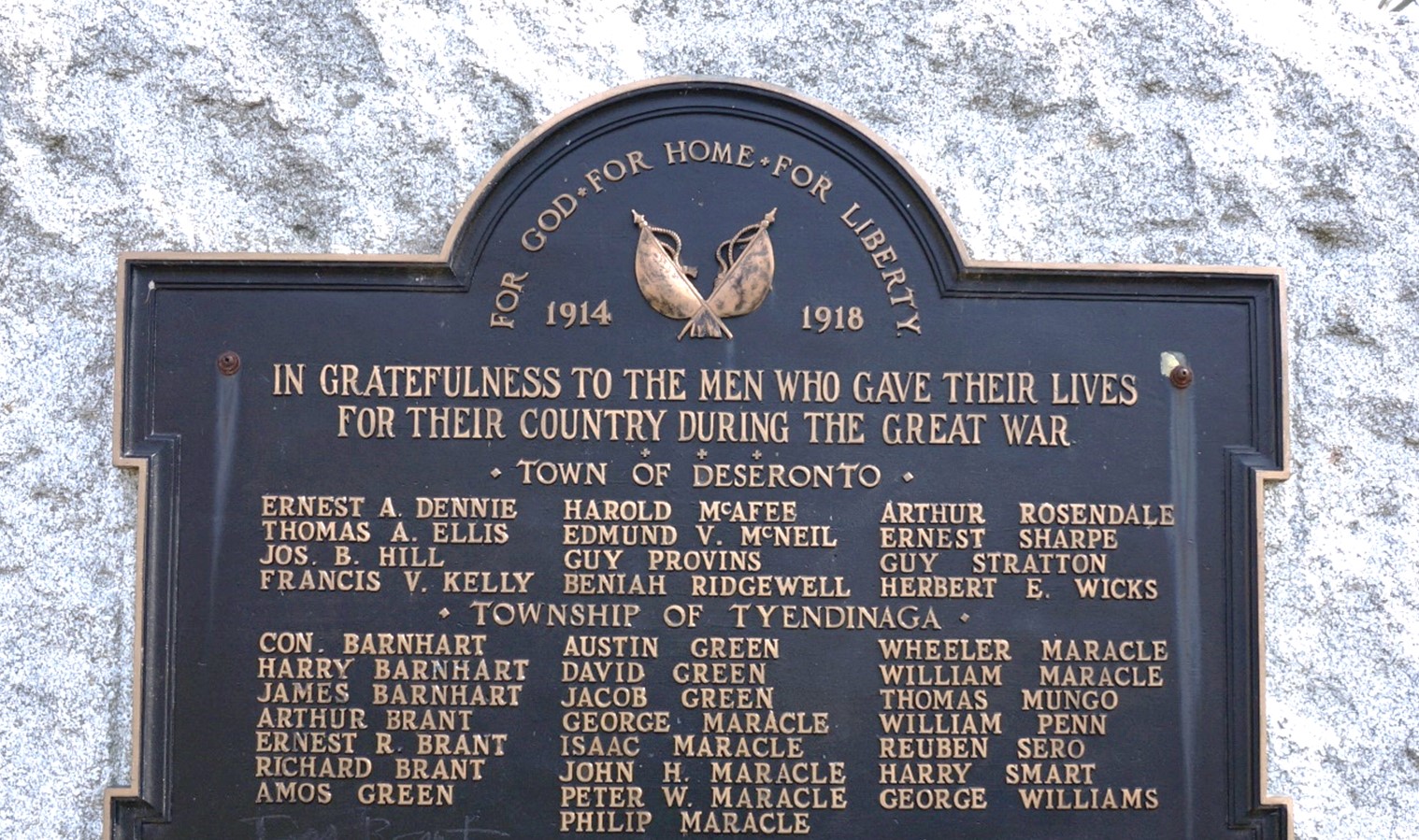
He is also remembered on the Deseronto war memorial.
October 30, 2017


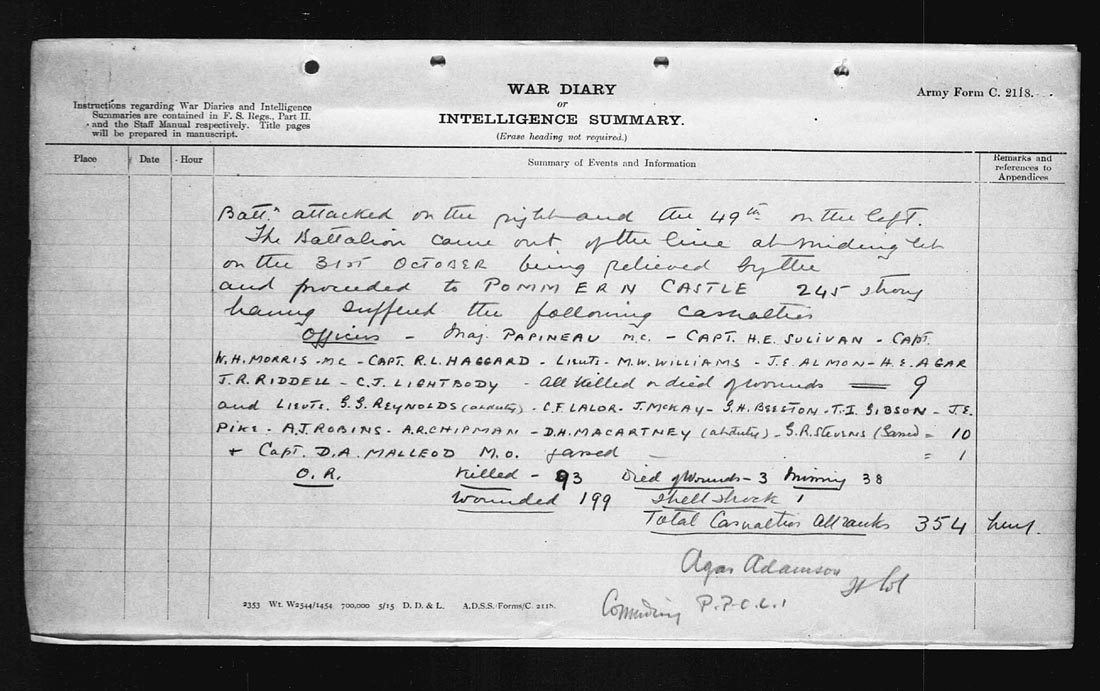
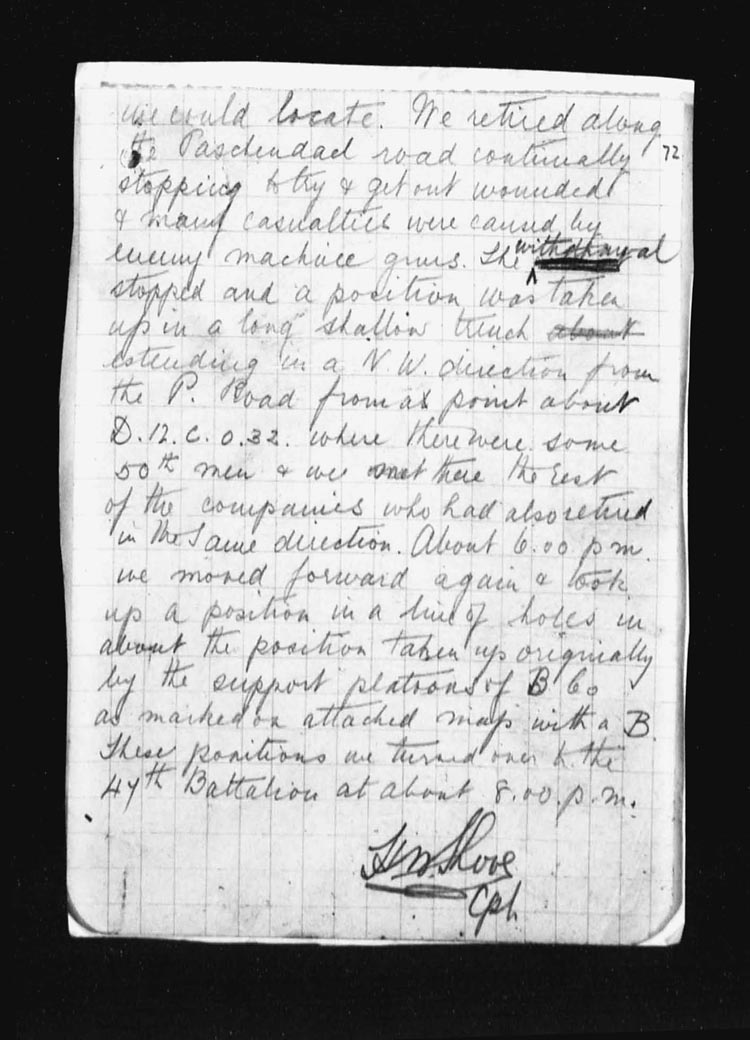
Extract from war diary of Princess Patricia’s Canadian Light Infantry for October 30th/31st, courtesy Library and Archives Canada
Isaac’s body was not recovered. He is remembered on the Menin Gate memorial at Ypres and on the Deseronto war memorial.
October 26, 2017
On this day in 1917, George Williams was reported wounded and missing, later presumed killed in action, at Passchendaele.
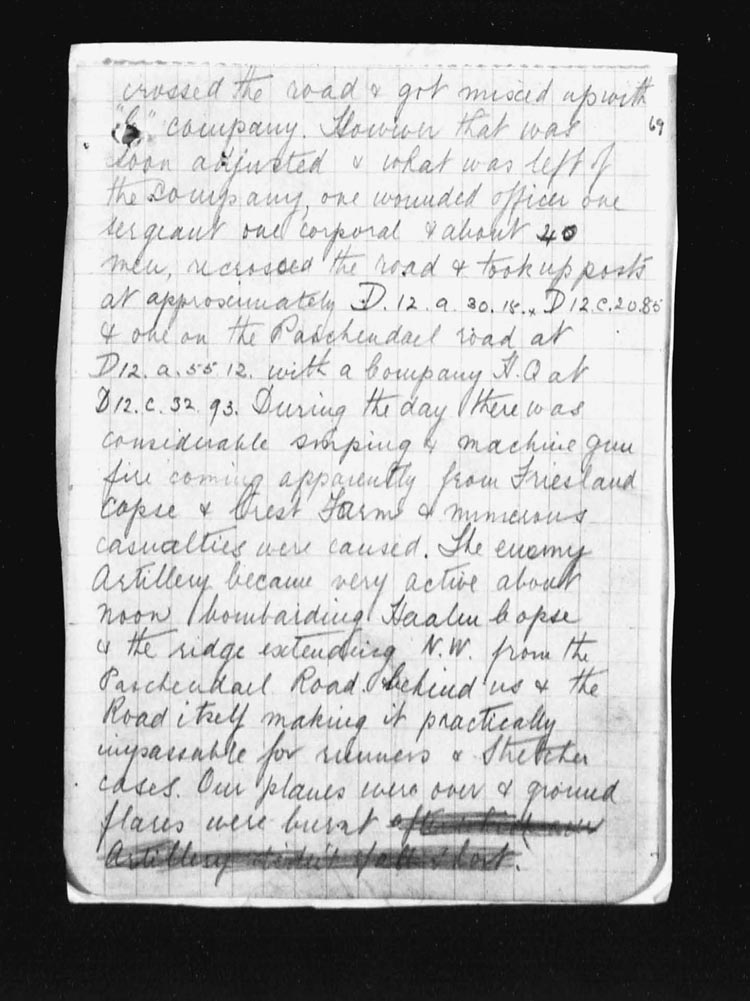
A detailed war diary held at Library and Archives Canada describes the heavy losses of the 46th Battalion on the day of George’s death (page 1, page 2, page 3, page 4, page 5). Below is an extract:
…At 5.40 a.m. of the 26th the Barrage started and remained 8 minutes before the company started to advance. This barrage was very irregular in fact it was impossible to tell where it was supposed to be resting. Many casualties were caused by our shells falling short before the 8 minutes were up. The company started forward 13 platoon in the first wave 14 15 & 16 platoons forming the mopping up party. Owing to the puzzling inaccuracy of our Artillery a certain amount of confusion was caused by the first wave losing so many men… During the day there was considerable sniping & machine gun fire… & numerous casualties were caused
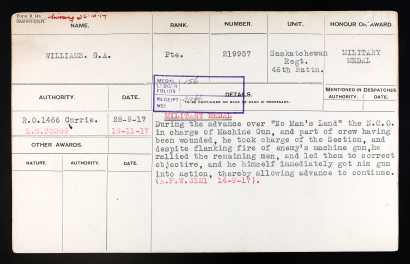
A month before this engagement, Williams was awarded the Military Medal for bravery:
During the advance over “No Man’s Land” the N.C.O. in charge of Machine Gun, and part of crew having been wounded, he took charge of the Section, and despite flanking fire of enemy’s machine gun, he rallied the remaining men, and led them to correct objective, and he himself immediately got his gun into action, thereby allowing advance to continue.
Williams’s body was never found. He is commemorated on the Menin Gate memorial in Ypres, and here in Deseronto.
October 24, 2017
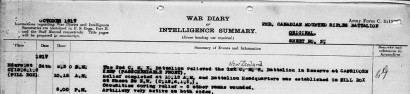
On this day in 1917 Benjamin Ridgwell died of shell wounds at the 3rd Australian Casualty Clearing Station near Ypres in Belgium during the Battle of Passchendaele. Ridgwell had enlisted in Saskatoon in 1915. At the time of his death he was serving in the 2nd Canadian Mounted Rifles Battalion (which, despite the name, was an infantry unit). In relieving a New Zealand battalion at Capricorn Keep at Passchendaele on October 24th 1917, six men were injured, as recorded by the unit’s war diary.
Ridgwell was buried at the Nine Elms British Cemetery, southwest of Ypres. His name appears on the Deseronto war memorial. Benjamin’s father, Charles, was living in Deseronto when his sons (Benjamin and Sidney) enlisted.
October 21, 2017
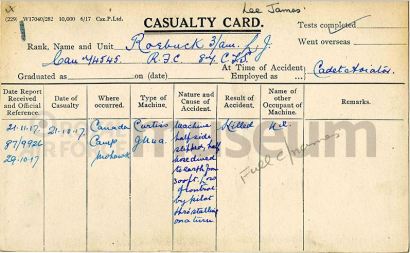
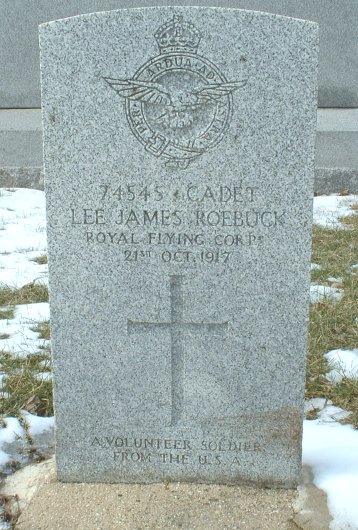
On this day in 1917 Lee James Roebuck died in a flying accident at Camp Mohawk near Deseronto. He had enlisted in Toronto on August 16th, 1917, giving his home address as Bloomington, Illinois. He was born on April 2, 1884, the son of Lewis F. Roebuck and Anna (née Brigham). His regimental number was 74545 and he was five feet ten inches tall. He was attached to 87 Canadian Training Squadron.
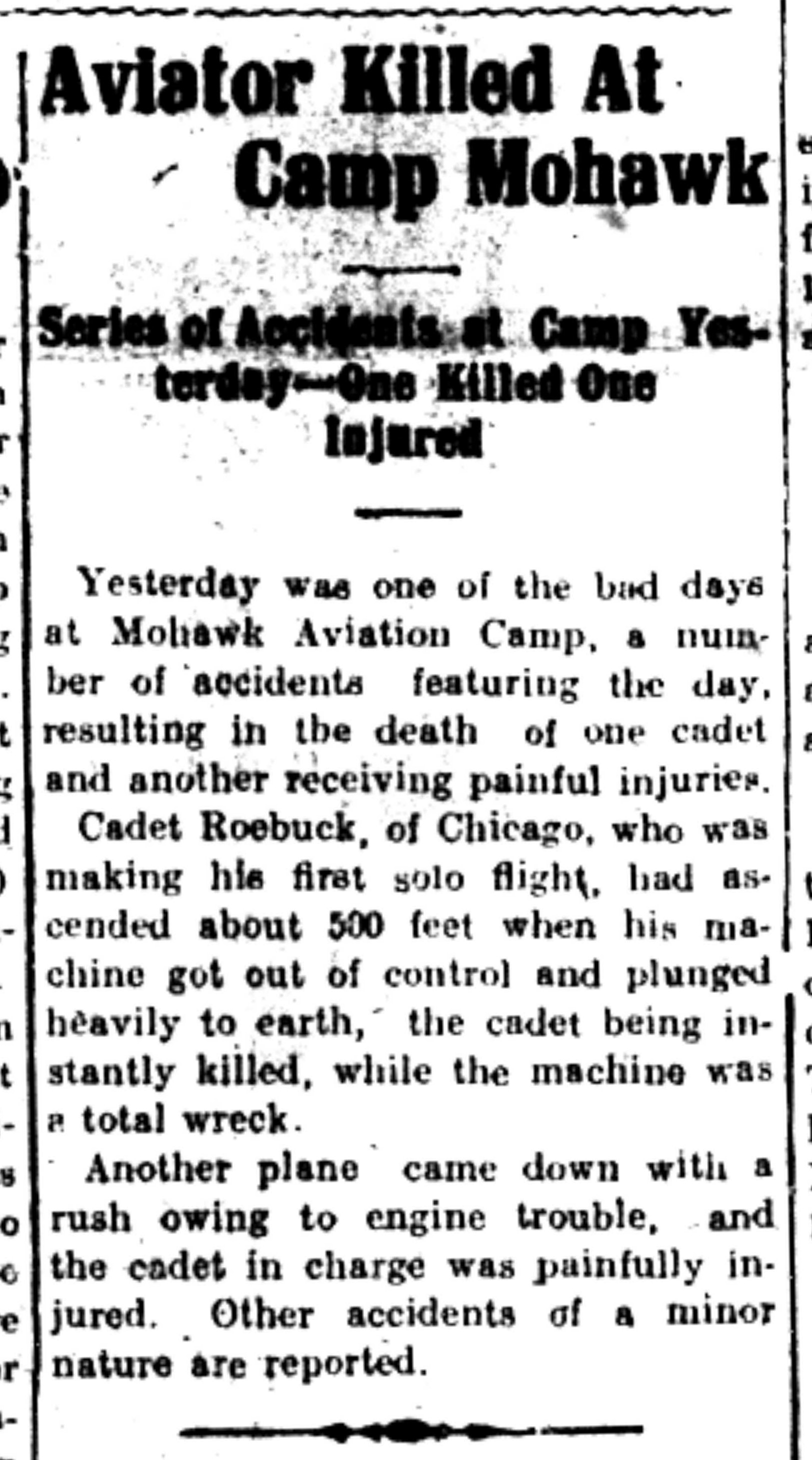
The Intelligencer described the day of Roebuck’s crash in the following way:

Belleville Intelligencer report of Roebuck’s death, October 22nd, 1917, courtesy Belleville Public Library
Aviator Killed at Camp Mohawk
Series of Accidents at Camp Yesterday – One Killed One Injured
Yesterday was one of the bad days at Mohawk Aviation Camp, a number of accidents featuring the day, resulting in the death of one cadet and another receiving painful injuries.
Cadet Roebuck, of Chicago, who was making his first solo flight, ad ascended about 500 feet when his machine got out of control and plunged heavily to earth, the cadet being instantly killed, while the machine was a total wreck.
Another plane came down with a rush owing to engine trouble, and the cadet in charge was painfully injured. Other accidents of a minor nature are reported.
The official Royal Flying Corps record noted:
…Date of Casualty: 21.10.17
Where occurred: Canada Camp Mohawk
Type of Machine: Curtiss JN4a.
Nature and Cause of Accident: Machine half side slipped, half nose dived to earth from 300 ft. Loss of control by pilot thro’ stalling on a turn.
Result of Accident: Killed
Name of other Occupant of Machine: Nil…
Harry McBride, a rigger based at Camp Mohawk took photographs of the crashed plane. He estimated that the aircraft (C639) had fallen 800 feet. McBride stated that the aircraft belonged to 78th Canadian Training Squadron.
Roebuck was buried at Bloomington (Scogin Hill) Cemetery, Illinois.