war dead


Edgar Patrick Le Blanc signature
Edgar Patrick Le Blanc died in Belleville General Hospital on this day in 1918. He was a cadet in the Royal Flying Corps, which he had joined on December 5th, 1917 in Toronto. He was the son of Patrick and Emma Le Blanc of Moncton, New Brunswick and had previously served in the Royal School of Infantry, Halifax, Nova Scotia. The Royal Air Force report of the accident stated:

Date of Casualty: 29.4.18
Where occurred: Canada ⅛ mile Sth of Camp Mohawk Aerodrome
Type of Machine: Curtiss J.N.4 C1001
Nature and Cause of Accident: Failing to get out of spin
Result of Accident: Injured Frac skull Broken jaw Broken collar bone
Name of other Occupant of Machine: 2nd Lt. [Edwin Henry] Menhenitt injured

Belleville’s newspaper, the Intelligencer reported the accident:

Intelligencer report of 1918 Apr 30 on Le Blanc death

Aeroplane Crashed to Earth in Spinning Nose Dive
—–
Young Aviator Dead and Comrade Seriously Injured, Result of Accident at Camp Mohawk Yesterday Afternoon – Both Aviators Brought to Belleville Hospital

Between the hours of two and three o’clock yesterday afternoon, an aeroplane fell just east of Camp Mohawk airdrome with fatal results. Cadet Edward P. Le Blanc and Instructor Secon Lieut. E. H. Menhennit were in the machine at the time and were at a considerable height when it was observed that something was wrong as the plane began falling to the earth, nose first, in a rapid manner. The ambulance from the camp was summoned and soon reached the place where the machine had fallen. The two occupants were found to be terribly injured and as soon as possible were brought to the Belleville hospital for treatment. Shortly after being admitted to the hospital Le Blanc succumbed to his injuries, and for hours Menhennit remained in an unconscious condition. The injuries which caused le Blanc’s death consisted of a fractured skull. His face was also injured. Menhennit was severely cut about the head and face and there is a compound fracture to the right leg. The aeroplane was virtually broken to pieces.
The body of Cadet Le Blanc was subsequently taken to Tickell & Sons undertaking establishment where it was prepared for burial. The unfortunate young aviator was a member of the 8th Squadron, R.A.F. His home was at 97 Alma Street, Moncton, N.B. where his mother resides. She was notified of the sad affair and it is expected that she will come to Belleville and take the body home for interment.
Lieut. Menhennit is an Englishman and the next of kin is his brother, Mr. J. D. Menhennitt, Eastleigh, St. Malyn [Mabyn], Cornwall, England. This morning his condition showed slight improvement, but he is by no means out of danger.

Le Blanc was buried in St. Bernard’s Roman Catholic Cemetery, Moncton.

Lieutenant Menhenitt recovered from his injuries and stayed in Canada after the war. He married Lois Elizabeth Vance on June 2nd, 1920 in Barrie, where he was working as an engineer.

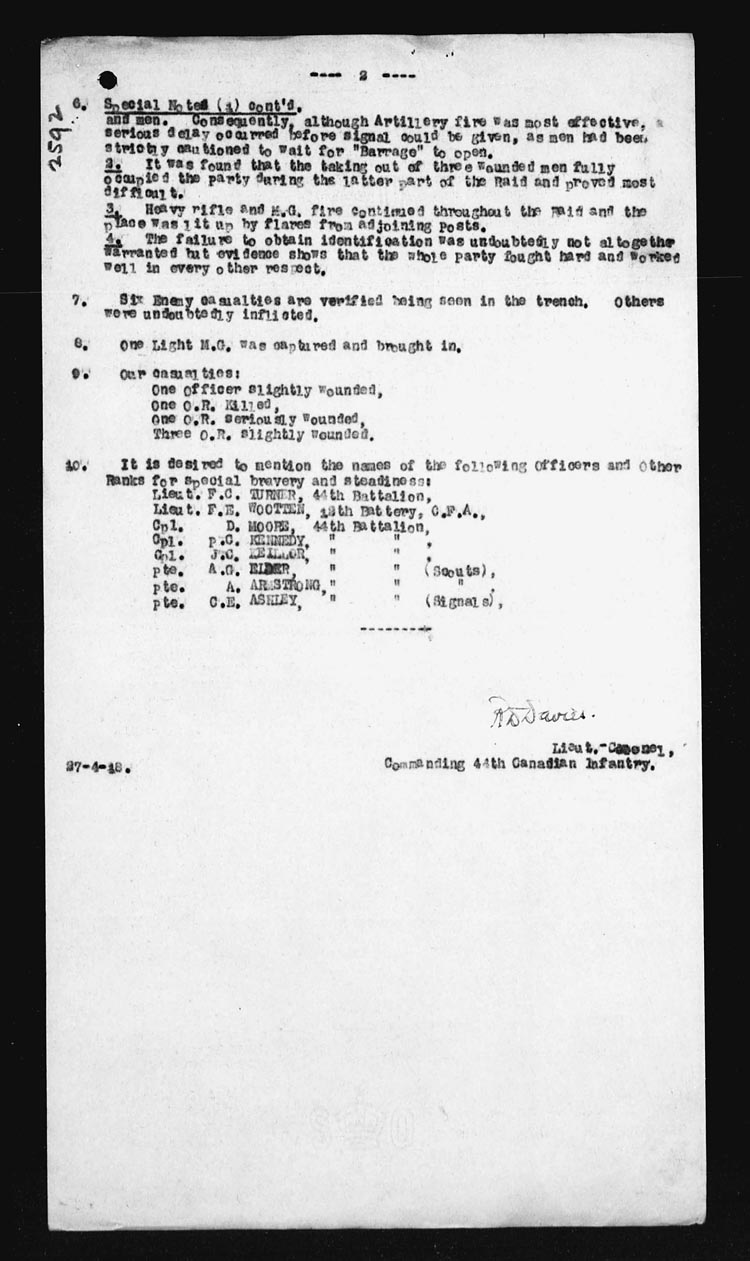
Herbert Edgar Wicks signatureHerbert Edgar Wicks died in France on this day in 1918. He was serving with the 44th Battalion, which was involved in a raid on enemy lines at Marœuil on the night of April 26th/27th in which two men were killed. This action was described in the Battalion’s war diary (page 1 and page 2).

Wicks was buried at the Roclincourt Military Cemetery.

Grave of Herbert Edgar Wicks, courtesy of findagrave.com

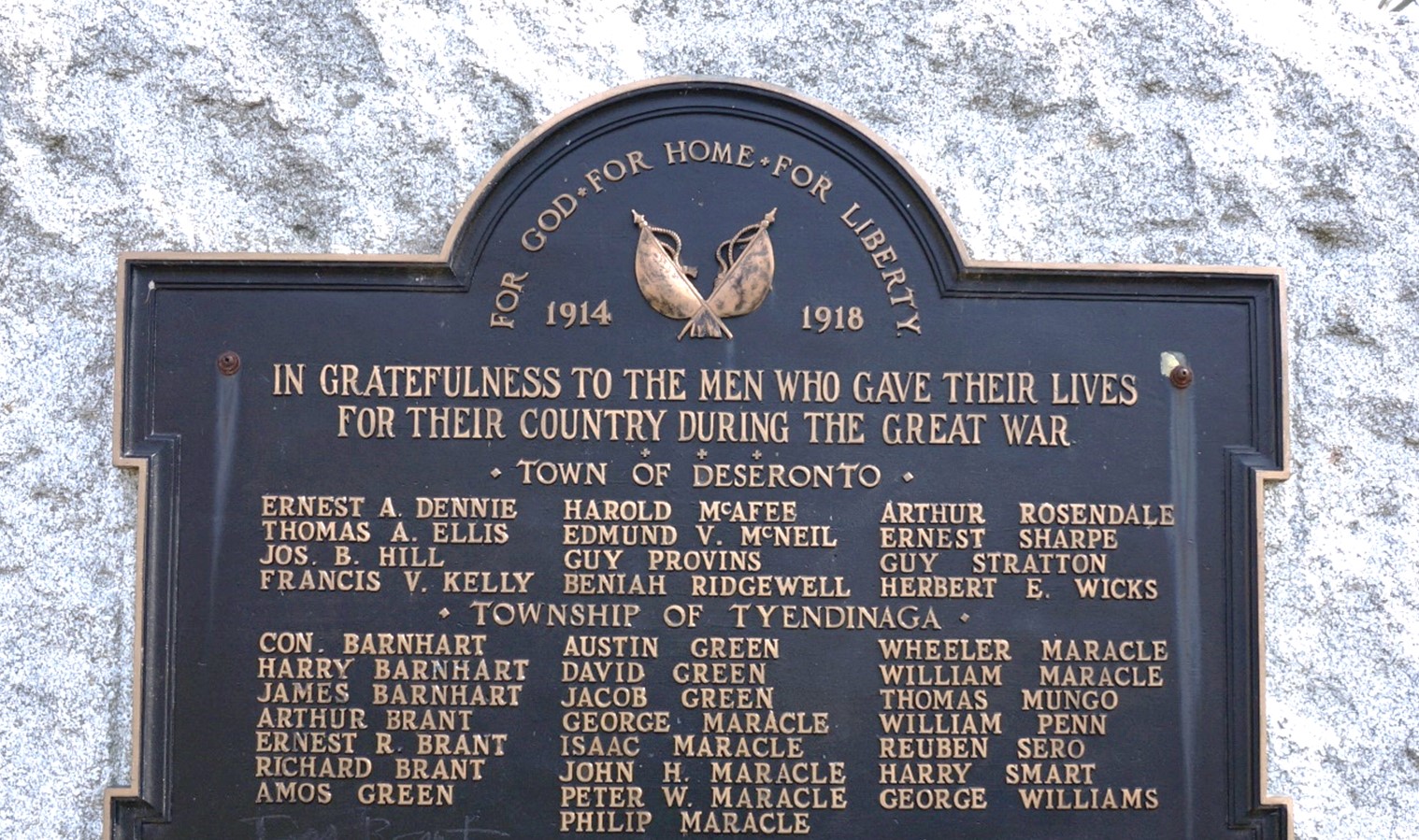
He is also remembered on the Deseronto war memorial.

Deseronto memorial

And on the cenotaph in Napanee.

Napanee cenotaph, west side

Jack William Burman signatureOn this day in 1918, Jack Burman, an electrician, died in Toronto of pneumonia. He was born in Leicester, England in July 1901, the son of William Arthur Burman, a railway worker, and Lucy (née Bartlett). He was baptised in Brackley, Northamptonshire on September 1st, 1901. William left England for Canada in 1905, with Lucy and Jack following in 1906.

Burman joined the Royal Flying Corps in Toronto on May 1st 1917 and served as an air mechanic with the Deseronto Wing. His regimental number was 71808. He was five feet four and a half inches tall and claimed to be 18 when he enlisted, although he was 15 at the time. The family were living at 277 Ashdale Avenue, Toronto. Burman was 16 when he died at the base hospital in Toronto.

Jack was buried in the St. John’s Norway Cemetery in Toronto.

Victor Raymond Evans signature
On this day in 1918 Victor Raymond Evans, a cadet in the Royal Flying Corps, was killed at Camp Mohawk, the pilot training camp near Deseronto. He was born in Bradford, Ontario, on October 18th, 1896, the son of William Evans and Martha (née Neilly).Victor signed up in Toronto on November 14th, 1917 and was accepted into the Royal Flying Corps on December 10th. His regimental number was 153475. He was five feet five and a quarter inches tall. Evans was serving with 79 Canadian Training Squadron at the time of his death. The official Royal Air Force report noted the following facts about the accident which killed him:

Date of Casualty: 24.4.18
Where occurred: Canada Camp Mohawk
Type of Machine: Curtiss J.N.4 C477
Nature and Cause of Accident: Struck on head by propellor while getting out of front of machine
Result of Accident: Killed
Name of other Occupant of Machine: 2nd Lt. J. I. [John Inglis] Bedingfield uninjured

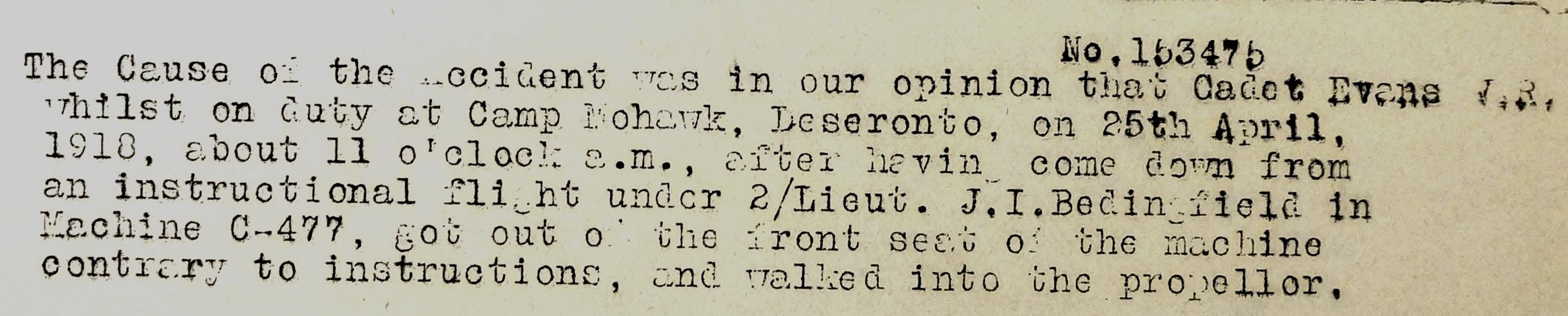
The Court of Inquiry verdict was:

Victor Raymond Evans verdict of Court of Inquiry

Detail from Attorney General’s 1918 file RG4-32/1152 at the Archives of Ontario

The Cause of the accident was in our opinion that Cadet Evans V.R. No. 153475 whilst on duty at Camp Mohawk, Deseronto, on 25th April, 1918, about 11 o’clock a.m., after having come down from an instructional flight under 2/Lieut. J.I. Bedingfield in Machine C-477, got out of the front seat of the machine contrary to instructions, and walked into the propellor.

Victor was buried in Bayfield Cemetery, Ontario.

Roy Edgar Pelton signature

Roy Edgar Pelton died of cavernous sinus thrombosis in Toronto General Hospital on this day in 1918 (although some sources say he died on April 15th). Pelton was serving as a cadet with the Royal Flying Corps’ 42nd Wing, based in Deseronto. He had originally enlisted in the Canadian Expeditionary Force in Vancouver on January 25th, 1917 and had served in the Canadian Army Service Corps for eight months with the regimental number 200223. He joined the Royal Flying Corps in Winnipeg on November 13th, 1917 (number 153779) and was officially appointed to Corps on January 13th, 1918 in Toronto. He was five feet four and a half inches tall, with a dark complexion, black hair and blue eyes.

He would have spent the winter training in Texas with the rest of 42nd Wing, and must have fallen ill on his return to Ontario in April 1918: his death registration notes that he had been ill for two weeks. Initially his death was recorded on his Royal Flying Corps record as a flying accident in Texas. This was later crossed out and replaced with the correct information.

Pelton's UK RFC record

Roy was born in Grandview, Manitoba on July 10th, 1896 (other sources say October 7th), the son of Hiram Whitney Pelton and Edith Abigail (née Powell). Between 1901 and 1911 the family moved from Manitoba to British Columbia: Pelton gave his home address as 833 Pacific Street, Vancouver.

Pelton was buried in Mountain View Cemetery, Vancouver.

Roy Edgar Pelton's headstone

Cadet Pelton’s headstone, courtesy of SusanR at Find a Grave

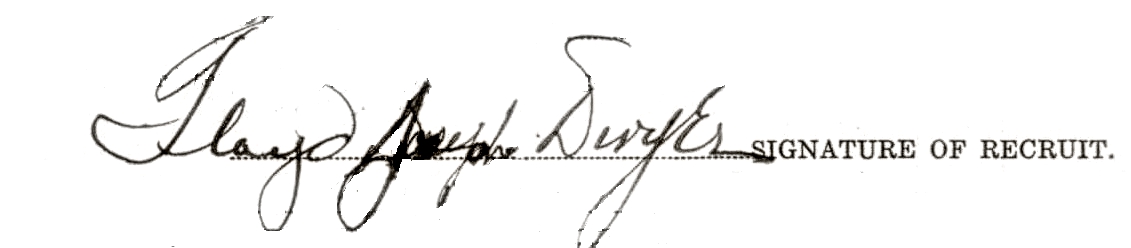
Floyd Joseph Dwyer signature

Floyd Joseph Dwyer of Sturgeon Falls, Ontario, died of a fractured skull in a flying accident at Camp Taliaferro in Texas on this day in 1918. He had joined the Royal Flying Corps in Toronto on July 17th, 1917 and was a member of 87 Canadian Training Squadron, which was part of the Deseronto Wing. He claimed he was 19 when he enlisted, giving the name of a friend, Mr E. O. Bowman of 678 Decarie Boulevard, Montreal, as his next of kin. His regimental number was 74247 and he was five feet five inches tall.

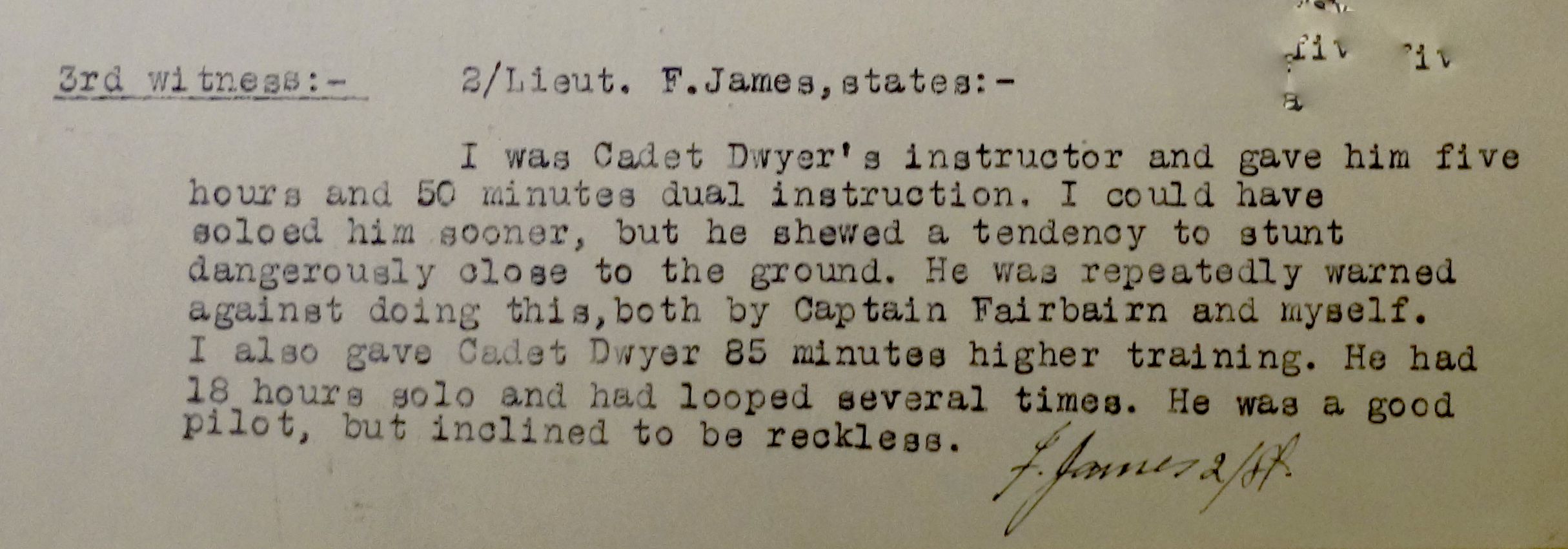
The official report of Dwyer’s accident notes that he was flying alone in a Curtiss JN-4 which crashed upside down in a field to the northwest of the camp; the cause of his crash was unknown. He was attached to 87 Canadian Training Squadron. At the Court of Inquiry held the same day, 2nd Lieutenant James gave the following statement:

Detail of Attorney General's 1918 file RG4-32/800 from the Archives of Ontario

Detail of Attorney General’s 1918 file RG4-32/800 from the Archives of Ontario

3rd witness:- 2/Lieut. F. James, states:-

I was Cadet Dwyer’s instructor and gave him five hours and 50 minutes dual instruction. I could have soloed him sooner, but he shewed a tendency to stunt dangerously close to the ground. He was repeatedly warned against doing this, both by Captain Fairbairn and myself. I also gave Cadet Dwyer 85 minutes higher training. He had 18 hours solo and had looped several times. He was a good pilot, but inclined to be reckless.

[signed] F. James, 2/Lt

Dwyer was buried on May 4th, 1918 in the Notre-Dame-des-Neiges cemetery in Montreal.

Floyd Dwyer was the last casualty of the Deseronto Wing of the Royal Flying Corps in their Texas winter quarters: within three weeks of his death the training squadrons had returned to Camp Mohawk and Camp Rathbun.

Edward Bissell's signature

On this day in 1918, Edward Arthur Bissell (who had enlisted as Edward Griswould) was killed at Les Brebis in France.

The note on his service record reads:

Edward Arthur Bissell report of death

Rept from Base

13-3-18 Killed in Action (Gassed)

Bissell was buried in the Aix-Noullette Communal Cemetery Extension in France.

Joseph Amos Green signature

On this day in 1918, (Joseph) Amos Green died of jaundice in the 14th Canadian General Hospital in Eastbourne, England.  The extract from his service record below shows that he had previously been in hospital in 1916 and 1917 with shrapnel and gunshot wounds to his hands but had otherwise been healthy.

Amos Green's medical history

Jaundice was relatively common disease in First World War soldiers, and Japanese researchers had determined that it was spread through the urine of infected rats (this disease is now known as leptospirosis). Men in the trenches were more likely to be infected in this manner, but Amos Green was with the 13th Reserve Battalion in England when he fell ill.

Green’s medical records show that he had been diagnosed with syphilis in November 1917 and was treated as an outpatient at the 13th Canadian General Hospital in Hastings between November 1917 and February 1918. At this time, treatment for syphilis involved injections of an arsenic-based drug (Novarsenobillon) and mercury. An article in the British Medical Journal of April 20, 1918, described the deaths of two New Zealand soldiers through liver damage after treatment with Novarsenobillon.1 It seems it was the cure for syphilis which killed Amos Green, rather than the disease itself, as his doctor wrote “Jaundice (Arsenical poisoning)” on his notes:

Death of Amos Green

Green was buried in the cemetery in Seaford, Sussex.

Joseph Amos Green's grave

Joseph Amos Green’s grave, courtesy of FindaGrave.com (uploaded by wertypop)

His widow, Margaret, and two daughters, Margaret and Mary were living at 9 Dunedin Street, Toronto at the time of his death. The Toronto Evening Telegram reported his death on March 11th, 1918:

Toronto Telegram report of Joseph Amos Green's death

Amos Green is remembered on the Deseronto war memorial.

Deseronto memorial


1 Fenwick, Sweet & Lowe ‘Two Fatal Cases of Icterus Gravis Following Injections With Novarsenobillon’ British Medical Journal [PDF] 20 April 1918

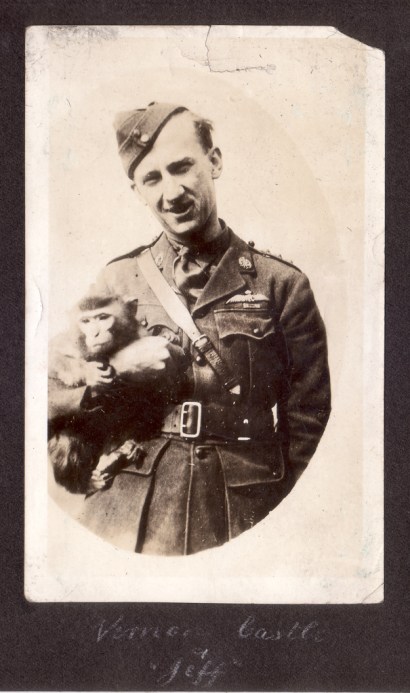
2009.20(55) Vernon Castle and Jeff

On this day in 1918 Vernon William Blyth Castle was killed in a flying accident at Camp Taliaferro in Texas. The official casualty report noted the following details:

…Date of Casualty: 15.2.18
Where occurred: Canada Camp Taliaferro
Type of Machine: Curtiss J.N.4. C663
Nature and Cause of Accident: In trying to avoid a mach[ine] which was taking off the pilot who was about to land took control and stalled his mach.
Result of Accident: Killed
Name of other Occupant of Machine: Cadet R.O. Peters. U.S.A. Injured
Remarks: Capt Vernon Castle instructing in the front seat giving some landings to Cadet Peters before sending him off on solo. C of I [Court of Inquiry] as over.

The finding of the Court of Inquiry on the reverse of the report card reads:

COURT OF INQUIRY 22100/1918 CAPT. VERNON W.B.CASTLE
The Court having examined all witnesses, weighed all evidence and examined machine C.663, is of the opnion that Capt. Vernon Castle, while on duty in machine C.663 No.84 C.T. [Canadian Training] Squadron, in trying to avoid collision with machine C 449 of No. 85 C.T.Squadron did an Immelmann turn from which he was unable to recover before hitting the ground and was killed.

Castle was killed as a result of being in the front seat of the aircraft, a position he often took after being involved in the crash which killed Cadet Allan Walton Fraser in May 1917.

This photograph, from the collection of Sergeant Christopher Paulus Devos, shows the aircraft after the crash.
2009.20(58)
Devos’s annotations read:

Capt. Vernon Castle
—R.F.C—
How this brave man met his death.
Pinned under engine in front seat.

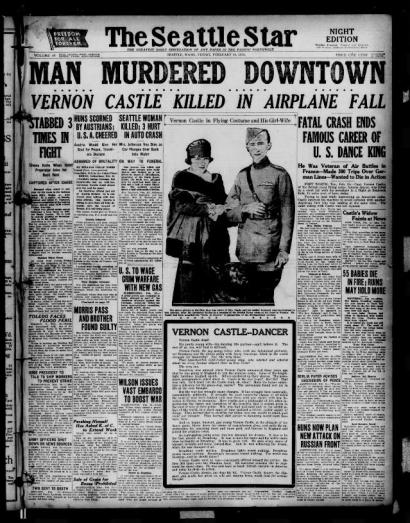
Castle’s death made front-page news around the world. Here’s the Seattle Star‘s report on the evening of the crash:

Seattle Star 15th Feb 1918

Front page of the Seattle Star, February 15th, 1918, courtesy of Chronicling America from the Library of Congress

In the Washington Times‘s version of the story, Castle was described as “America’s most famous dancer” and it was noted that:

Vernon Castle was the highest paid dancer in all dramatic history…During the height of the dancing craze Castle’s salary averaged $6,000 per week.

Castle was born in Norwich, England on May 2nd, 1887, the son of William Thomas Blyth and Jane (née Finley). He arrived in New York in July 1906 and started his career on the stage shortly afterward. He married Irene Foote on May 28th, 1911 and the two established themselves as dance stars in Paris and then on Broadway. Vernon learned how to fly at the Atlantic Coast Aeronautical Station in Newport News, Virginia, in early 1916, as this record from the Royal Aero Club shows:

Royal Aero Club Aviator Certificate details for Vernon Castle, courtesy of the Royal Air Force Museum

Royal Aero Club Aviator Certificate details for Vernon Castle, from Ancestry, courtesy of the Royal Air Force Museum

He travelled back to England to join the Royal Flying Corps in March 1916 and served on the Western Front until the following March, when he was transferred to Canada as an instructor at Camp Mohawk. With the rest of the Deseronto Wing, Castle spent the winter of 1917-1918 training cadets at Camp Taliaferro in Texas.

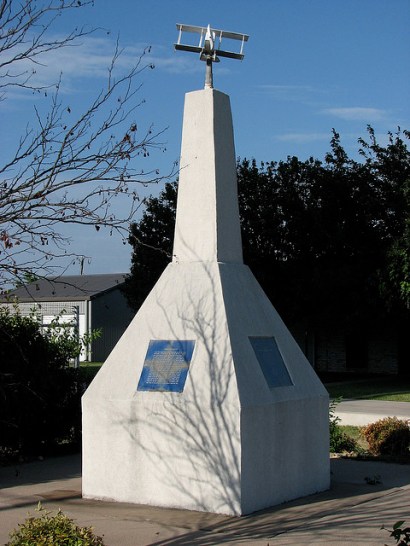
Vernon Castle was buried at Woodlawn Cemetery in New York. In 1966 a memorial to Castle was erected at the site of his death in Benbrook, Texas.

Vernon Castle Memorial in Benbrook, Texas

Vernon Castle Memorial in Benbrook, Texas, courtesy of Flickr user QuesterMark

Ernest Arthur Denee signature

Ernest Arthur Dennee died on this day in 1918 of wounds received while he was serving in France with the 2nd Battalion. He died in Queen Mary’s Hospital in Stratford, London and was buried in Brookwood Military Cemetery, Surrey, England. The headstone is inscribed “Gone but not forgotten by his loving wife”.

Ernest Dennee’s grave, courtesy of FindaGrave.com (uploaded by Charlie)

Ernest left all his possessions to his wife, Eliza, in his army will, which is to be found in his service record:

Ernest Arthur Denee's will

Eliza was living in Deseronto (where she had spent much of her life) when Ernest made his will.  This explains the presence of Ernest’s name on the Deseronto war memorial, even though Ernest himself seems to have had no direct connection with the town.

Deseronto memorial

« Previous PageNext Page »