war dead


John Henry Maracle signature
On this day in 1917, John Henry Maracle was killed by an enemy rifle bullet while cleaning his own rifle at the front line near Vimy, France. He had joined the 44th Battalion at the front line one month earlier, on December 12th, 1916.
Canada War Graves Registers (Circumstances of Casualty) 1914-1948 For John Maracle
The war diary for the days leading up to Maracle’s death show that deaths at the front line were a daily occurrence for the battalion.
War diary entry for John Henry Maracle's death
John was buried in the Villers Station cemetery. He is remembered on the Deseronto war memorial. His widow, Harriet, died on February 3rd, 1918.
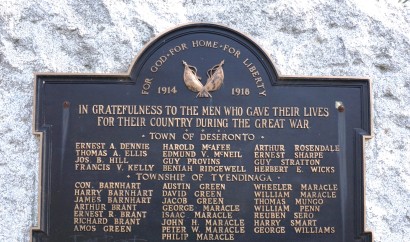
Deseronto memorial

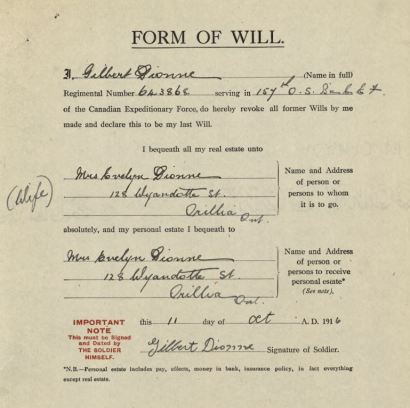
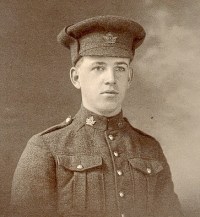
Gilbert Dionne signatureOn this day in 1916 Gilbert Dionne died in No. 12 Canadian General Hospital in Bramshott, England nine hours after an operation to repair a perforated duodenal ulcer. He had made an army will five weeks before his death, just before he left Canada, in which he left all his possessions to his wife, Evelyn.

Gilbert Dionne's will, from his service record at Library and Archives Canada

Gilbert Dionne’s will, from his service record at Library and Archives Canada

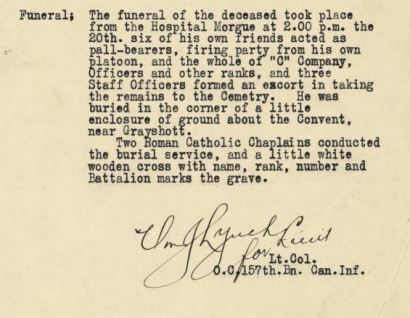
In addition to his will, Dionne’s service file at Library and Archives Canada also contains a description of his funeral, signed by Lieutenant Vincent James Lynch on behalf of the commanding officer of the 157th Battalion:

Description of the funeral of Gilbert Dionne

Funeral: The funeral of the deceased took place from the Hospital Morgue at 2.00 p.m. the 20th. six of his own friends acted as pall-bearers, firing party from his own platoon, and the whole of “C” Company, Officers and other ranks, and three Staff Officers formed an escort in taking the remains to the Cemetry. He was buried in the corner of a little enclosure of ground about the Convent, near Grayshott.

Two Roman Catholic Chaplains conducted the burial service, and a little white wooden cross with name, rank, number and Battalion marks the grave.

Later, the wooden cross described by Lieutenant Lynch was replaced by a War Graves Commission headstone in the St. Joseph’s Roman Catholic Cemetery in Grayshott, Hampshire, England.

Photo courtesy of Findagrave.com (uploaded by Don Knibbs)

Guy Provins signature

Photograph of Guy Provins

Guy Provins (image from the Canadian Virtual War Memorial)

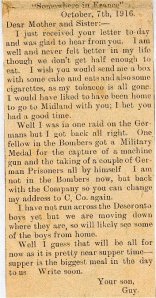
On this day in 1916, Guy Provins was killed in the trenches at Courcelette during the Battle of the Ancre Heights (part of the Battle of the Somme). It was his nineteenth birthday. A letter from Provins was published in the Deseronto Post alongside the report of his death.

Letter from Guy Provins

“Somewhere in France”

October 7th, 1916

Dear Mother and Sister:-

I just received your letter to-day and was glad to hear from you. I am well and never felt better in my life though we don’t get half enough to eat. I wish you would send me a box with some cake and eats and also some cigarettes, as my tobacco is all gone. I would have liked to have been home to go to Midland with you, I bet you had a good time.

Well I was in one raid on the Germans but I got back all right. One fellow in the Bombers got a Military Medal for the for the capture of a machine gun and the taking of a couple of German Prisoners all by himself. I am not in the Bombers now, but back with the Company, so you can change my address to C. Co. again.

I have not run across the Deseronto boys yet, but we are moving down where they are, so will likely see some of the boys from home.

Well, I guess that will be all for now as it is pretty near supper time – supper is the biggest meal in the day to us. Write soon.

Your son,

Guy

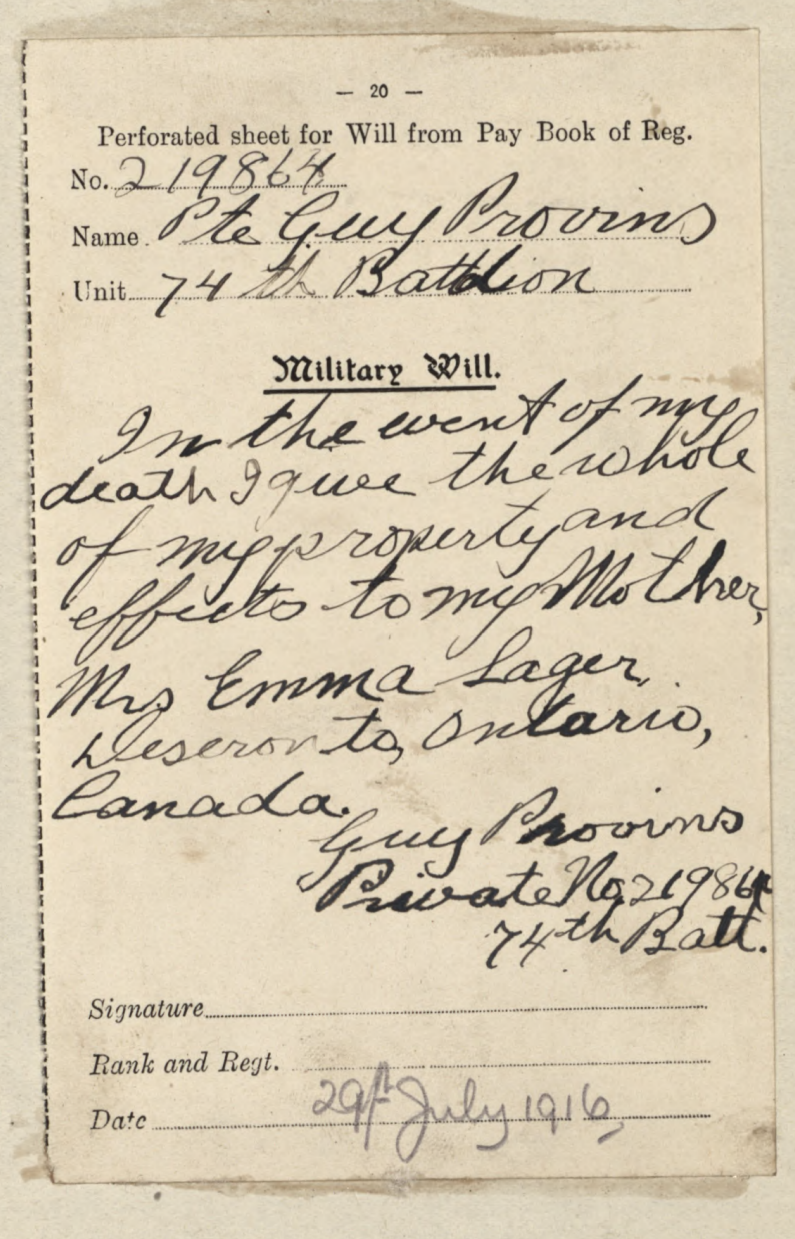
Guy’s will was taken from his army pay book and transferred to his service record. He left all his possessions to his mother, Emma Sager.

Guy’s body was not found. He is remembered on the Vimy Memorial and in Deseronto.

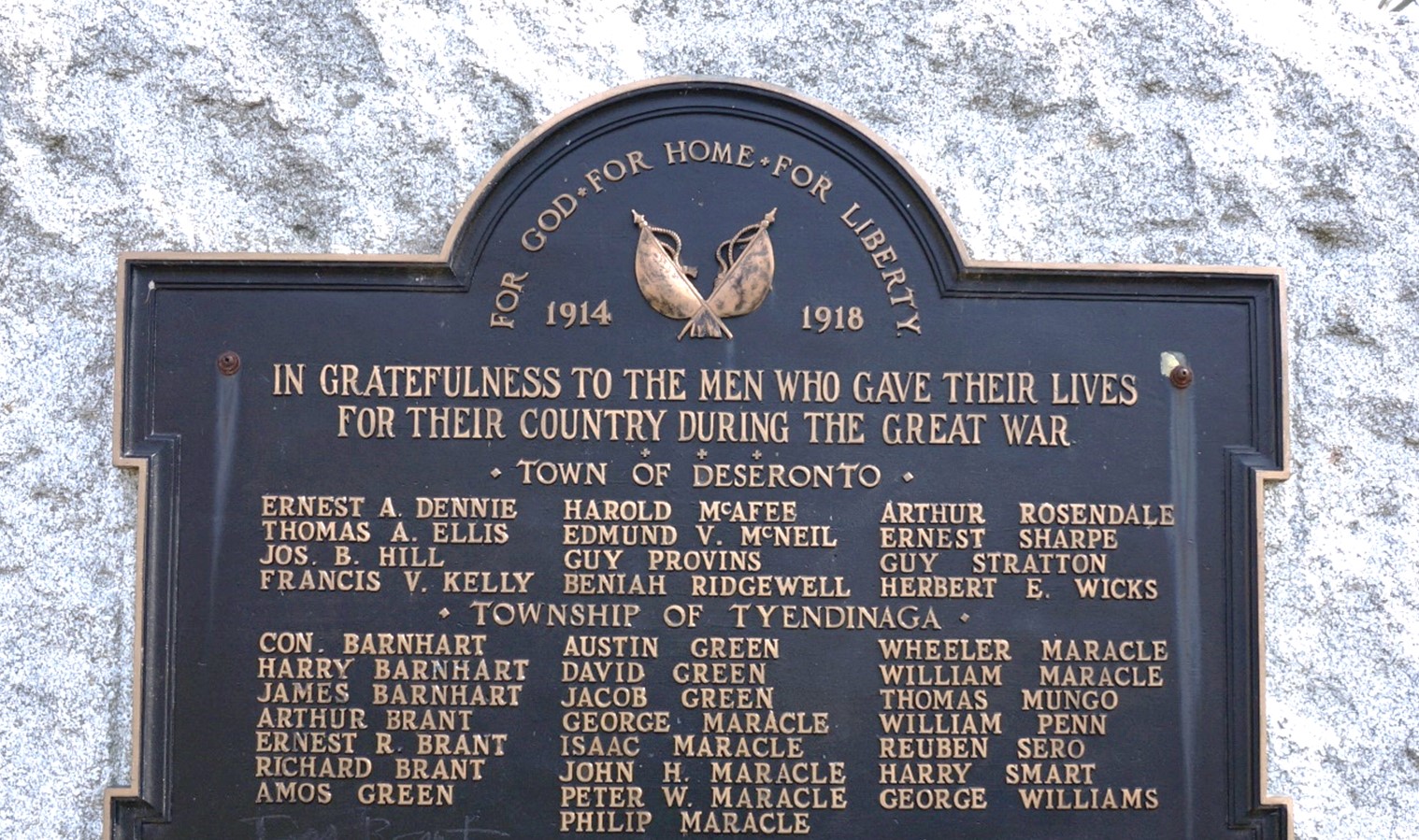
Deseronto memorial

Harold Smart's signatureOn this day in 1916 Harry Smart was killed in action while serving with the 25th Battalion in France at the Battle of Thiepval Ridge.

The Intelligencer reported his death on October 18th:

Killed in Action. In the casualty list today appears the name of Private Harold Smart, of Deseronto, who has been killed in action. He left Belleville with the 39th Battalion and was known to many in the city.

Harry’s body was not recovered after the battle. He is commemorated at Vimy and on the Deseronto war memorial.

Deseronto memorial

Francis Vincent Kelly's signature On this day in 1916 Frank Kelly was killed at Courcelette in France, during the Battle of Thiepval Ridge. This was part of the Battle of the Somme, which lasted for more than four months in late 1916 and in which more than a million men died. Tanks made their first appearance in the war at Courcelette.

Frank Kelly had enlisted in the 28th Battalion in March 1915. A detailed history of this battalion’s First World War experiences compiled and edited by Major Donald George Scott Calder was formerly available online at the University of Saskatchewan. The battalion was assigned a tank on the day of Frank’s death, which Calder notes was “far from popular, becoming much less so when the Fritz gunners selected the Tank as a calibration point for all their guns in the area during the remainder of our stay.”

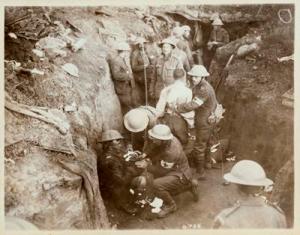
First aid at Courcelette

First aid being rendered at Courcelette (image from the Canadian War Museum)

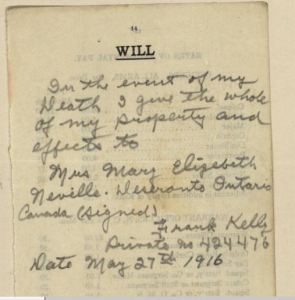
Frank’s service record includes a hand-written will:frank-kellys-willWILL

In the event of my Death I give the whole of my property and effects to

Mrs Mary Elizabeth Neville. Deseronto Ontario Canada (signed)

Frank Kelly

Private No 424476

Date May 27th 1916

The circumstances of Frank’s death were recorded as “Killed in Action” in the trenches at Courcelette.

Casualty report for Frank Kelly
Frank is remembered on the Deseronto war memorial and at the Vimy Memorial. His grave was reported to be in Courcelette, but was not marked.

Deseronto memorial
In 1921 Kelly’s mother, Mary Elizabeth Neville, was living in Dundas Street, Deseronto.

Guy Reginald Stratton signature
On this day in 1916, Guy Reginald Stratton was killed at the Battle of Mount Sorrel near Ypres in Belgium. He was a member of the 2nd Canadian Divisional Ammunition Column. He was seventeen years old and had been at the front line for seventeen days.

Guy’s father, Walter C. Stratton was a former member of the Town Council of Deseronto. The Council minutes of July 18th, 1916 noted that:

The Reeve said he supposed all the members of the Council had heard of the death on the battle field of Guy Stratton, a son of ex-councillor Walter C. Stratton. He was a resident of Deseronto up to the time of his enlistment, and the whole community, while deeply lamenting the untimely fate of the gallant boy feel proud of the fact that he died a noble death, bravely fighting for his King and Country. He moved seconded by Councillor Fox, that his Worship the Mayor and the Town Clerk, be hereby Appointed a Committee to prepare a letter of condolence to the bereaved parents and that the Mayor and Clerk do sign the said letter on behalf of the Council, and that the seal of the corporation be affixed thereto. Carried.

Stratton was buried at Bedford House Cemetery, south of Ypres, but his grave is not marked. He is commemorated on the Menin Gate memorial and in Deseronto.

Deseronto memorial

William Edmund Sterling signature

On this day in 1916, William Edmund Sterling signed up in Ottawa. He was born in Deseronto on May 19th, 1894, the son of Irvine Sterling and Phoebe (née Thompson). He was a watchmaker when he enlisted.

Sterling’s regimental number was 311872. He was described as five feet eight inches tall, with a fair complexion, blue eyes and fair hair. His service record shows that he arrived in England on the SS Olympic on September 25th, 1916 and was transferred to France to join the 6th Brigade of the Canadian Field Artillery on March 18th, 1917. On May 8th he was gassed and was moved back to England to recover. He was discharged from hospital in November and went back to France to join the 5th Brigade in April 1918. He was wounded again on September 7th by a mustard gas shell and sent back to England. On December 21st he left England, arriving back in Halifax on board the SS Carmania.

Sterling was demobilized in Ottawa on January 24th, 1919 and married Alice Annetta Story in Ottawa on May 19th, 1919. He died of a cerebral haemorrhage (which was deemed to be a result of his war service) on April 18, 1941 in Windsor, Ontario. He was buried in the cemetery at South March, Ottawa.

Arthur Markle's signature

On this day in 1915, Arthur Markle was one of 46 men from the 5th Battalion  killed in action in an attack on German trenches at the Battle of Festubert in France. The battalion’s war diary describes the engagement:

5th Battalion war diary for 23-24 May 1915

5th Battalion war diary for 23-24 May 1915 at Library and Archives Canada


…May 24th 1915 K-5 [a German trench and machine-gun redoubt] was attacked at 2.35 a.m.; taken and held until relieved at midnight 24th/25th May.

Casualties:- 13 officers and 259 other ranks

Killed:- Major D. Tenaille; Capt. J.R. Innes-Hopkins; Capt. J. M. Currie; Capt. D. Meikle; Capt. C.E. McGee and 11 N.C.O’s and 30 men

Wounded:-Major N. I. Edgar; Major G. G. Morrris; Major E. Thornton; Capt. Geor. Endacott; Capt. Stanley Anderson; Capt. F. R. Davies, Lieut. D. Rundell; Lieut. B.C. Quinan and 30 N.C.O’s and 174 men

One non-commissioned officer and 13 men were listed missing in addition to these casualties.

As Arthur was buried near the front line his grave was not marked. He is remembered on the Vimy Ridge memorial.

Arthur Markle's casualty record

Circumstances of casualty record at Library and Archives Canada for Arthur Markle


With last week’s post about Jack Martin, we saw the 100th anniversary of the first death of a Deseronto man in World War I. In total, 40 of the Deseronto and Tyendinaga men who signed up to the Canadian Expeditionary Force had died by the end of 1918. Another (Ross MacTavish) died in 1919 and Ambrose Clause died in 1920 as a result of his service. In total in this project we are following the wartime careers of 302 local people (two women and 300 men).

The death of 42 of these people represents a total fatality rate of 14%, which is higher than the national rate of Canadian casualties (around 10%). There is a statistically significant difference, however, between the fatality rate for the Mohawk men in our sample and the rate for non-Mohawks. In our group, Mohawks make up about one third of the total number who enlisted: 98 of the 300. But they were much more likely to die than their non-Mohawk comrades. Twenty-two of the 42 men from the Deseronto area who died were Mohawks, which represents a fatality rate of 22% of those who enlisted. The equivalent rate for non-Mohawk men from the Deseronto area was 10%.

Volunteers were much more likely to be killed than conscripted men: only one man in our group who was drafted under the 1917 Military Service Act was killed during the war. He was also a Mohawk.

The chart below shows the distribution of deaths of Deseronto-area people over the course of the war, beginning in April 1915:
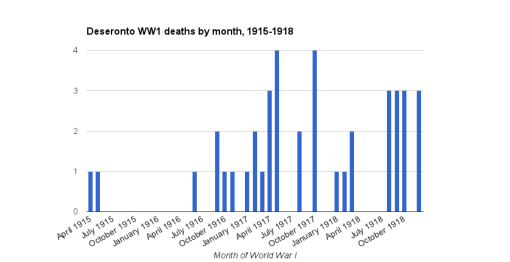
Chart showing the distribution of WW1 deaths by month of the war

Ten of the 42 men who died were killed by illnesses or disease of various kinds. The remaining 32 were killed in action or died of injuries received while fighting. In a later blog post, we’ll look at the corresponding figures for the men of the Royal Flying Corps (later the Royal Air Force) who died while they were attached to the Deseronto pilot training camps.

Jack Martin's signatureJack Martin was reported missing, presumed dead, on April 24, 1915 after the Second Battle of Ypres. This battle was the first in which chlorine gas was used as a weapon by the Germans. It was the first major engagement of the war for the 7th Battalion and nearly two-thirds of the men who fought in it lost their lives. In all, more than 2,000 Canadians were killed in this battle, with another 4,500 wounded or captured.

Jack’s service file shows that he was originally reported missing, then it was thought that he had been taken prisoner by the Germans. It was not until 1917 that he was assumed to be dead.

Gas attack at the Second Battle of Ypres

Gas attack at the Second Battle of Ypres (image from battleofypres.blogspot.com)

Jack’s body was not recovered. His name appears on the Menin Gate memorial.


« Previous PageNext Page »