veterans


Alexander Gowan's signature

On this day in 1914 Alex Gowan, a machinist, signed up in Valcartier, Quebec. He was born on January 5, 1894 in Deseronto, the son of William Gowan and Sarah (née Stewart).

On his attestation paper Alex was described as being five feet and seven inches tall, with a dark complexion, blue eyes and brown hair. Gowan had previously served with the Canadian Army Medical Corps for one and a half years. His regimental number in the 14th Battalion was 26656. Gowan’s service record shows that his unit sailed for England on October 3rd, 1914. He served in France with the 1st Canadian Field Ambulance

Gowan was injured on April 29th, 1915 at the Second Battle of Ypres with a gunshot wound to the shoulder. He spent six weeks in hospital and rejoined his unit in June, serving with them in France for the rest of the war.

Gowan sailed home on the RMS Olympic, leaving Southampton on April 14th, 1919. He was demobilized on April 23rd. After the war Gowan worked as a chauffeur. He married Tera Evelyn Miles in Ottawa on October 4th, 1923. He died on December 29th, 1961.

Jack Martin's signature

On this day in 1914 Jack Martin joined up in Valcartier, Quebec. He was born on June 11, 1893 in Deseronto, the son of William Martin and Harriet (née Salter). He attended Deseronto High School but by 1911 was living with his mother and brother in New Westminster, British Columbia.

On his attestation paper Jack was described as being five feet and nine inches tall, with a dark complexion, brown eyes and brown hair. Martin  joined the 7th Battalion (British Columbia Regiment), No. 4 Company, with the regimental number 17142.

Jack was killed in 1915.

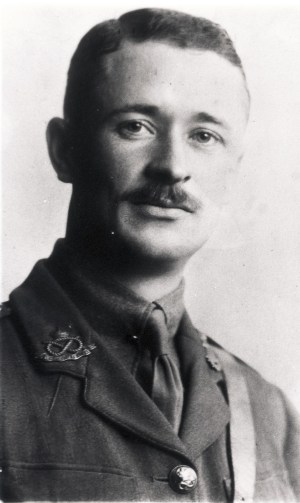
Queen's WWI - MacTavish, Roswell Murray

Roswell Murray MacTavish – image courtesy of Queen’s University Archives

Roswell ‘Ross’ Murray MacTavish was born on September 22, 1888 in St. George, Ontario, the son of William MacTavish and Margaret (née McKay). His father was the Presbyterian minister of Deseronto between 1895 and 1905 and Ross attended both the Deseronto Public School and Deseronto High School.

He studied at Queen’s University, getting his Bachelor of Arts degree in 1907 and a Bachelor of Divinity degree in 1913. He had obtained a travelling scholarship and was in England at the outbreak of World War I. On this date in 1914 he enlisted as a trooper in the 2nd King Edward’s Horse regiment. He obtained a commission as a second lieutenant in the 2nd Battalion of the South Staffordshire Regiment on March 13th, 1915.

MacTavish was the first person with a Deseronto connection to join the armed forces in the First World War. He rose to the rank of Captain and was awarded the Military Cross on January 1, 1919.

MacTavish continued to serve in France after the war, working at the headquarters of the 6th Infantry Brigade. He died of influenza in the No. 3 Canadian Stationary Hospital at Arques on February 6, 1919 and was buried in the Longuenesse Souvenir Cemetery, Saint-Omer.

Ross MacTavish’s younger brother, Wilfrid, named his son (born in Saskatchewan in 1919) Roswell Murray. Roswell Murray MacTavish junior joined the Royal Canadian Air Force during the Second World War as a flying officer and was killed when his Hurricane aircraft crashed in Scotland on March 18th, 1944. He was buried in Ayr cemetery.

Armies of Europe at a glance

Armies of Europe at a glance from the The Sun, New York, August 2nd, 1914: Russia, Germany, Austria, France, Italy, England, Serbia

Today marks the 100th anniversary of the declaration of war by Great Britain on Germany in response to the German invasion of Belgium on that day. At 11pm Greenwich Mean Time that evening (6pm Eastern Standard Time), Britain and its Dominions (including Canada, Australia, New Zealand, India and South Africa) were officially at war. You can hear about people’s memories of their reactions to the declaration in this podcast from the Imperial War Museum.

During the next four years we will be marking the 100th anniversaries of local events in relation to the war on this blog. We plan to commemorate the enlistment and conscription of individual Deseronto and Tyendinaga Mohawk Territory men, women, and boys, their deaths in action and from disease, as well as events associated with the local Royal Flying Corps/Royal Air Force pilot training establishments at Camps Rathbun and Mohawk, which operated between 1917 and 1918.

Our aim is to use archival materials from Deseronto and from around the world to demonstrate the local effects of a global war.

If you have photographs, or letters, or family stories about the First World War in Deseronto and the surrounding area, we’d love to share them here as part of this project: you can email us at deseronto.archives@gmail.com.

August 4th 2014 will mark the 100th anniversary of Canada’s entry into the First World War. Organizations and communities around the world are marking this occasion by examining the effect the war had on their local area. We’ll be doing this in Deseronto, too.

In the Archives we started by researching the 34 names of the First World War casualties named on the town’s war memorial. In the process we found out some interesting facts about the monument itself.


War memorial in Deseronto, April 2014

The memorial, which stands on the South side of Main Street, opposite Rathbun Park, was unveiled in a ceremony on Labour Day (September 3rd) 1923. The event was attended by many of the townspeople, as the photograph below (one of several taken on the day) shows. A piece of land forty feet square was purchased by the Town of Deseronto from the Rathbun Company for the monument’s site, at a cost of $100.

Unveiling ceremony for the Deseronto war memorial

The memorial itself was donated to the town by a former Deseronto resident named Thomas Carson Brown. Thomas was born on 21 April 1870, the son of Thomas Brown and Emily Varty and one of 10 children. His mother died in childbirth in Lennox and Addington County (where the family had a farm) when Thomas was seven years old and by 1881 the family had moved to Mill Point (Deseronto). In the 1891 census, when he was 21, Thomas’s trade is given as bricklayer. His father died just six weeks after the census was taken.

It was through the bricklaying trade that Thomas C. Brown would go on to earn his fortune in New York State, where his firm constructed a number of public buildings, including the Plattsburgh Normal School, pictured here, and a large section of the Clinton Correctional Facility at Dannemora. Deseronto’s newspaper, The Tribune, reported Brown’s marriage in August 1899 to Hattie B. Humphrey, noting that “the groom is well and favourably known in Deseronto, where he passed his boyhood days. He is now engaged in the contracting business in Little Falls. He is a brother of Mrs. Jas. Sexsmith.” Thomas’s sister, Jane Brown, married James Sexsmith in Deseronto in January 1884. She died of pneumonia in 1910.

Plattsburgh Normal School

Brown went on to serve as a Senator in the New York Senate between 1925 and 1930, where he took a keen interest in prison reform issues. He clearly never forgot his home town of Deseronto, as the generous gift of a war memorial demonstrates. It is not just a war memorial, however, as Thomas C. Brown ensured that his parents and five of his sisters (Jane, Ida, Etta, Emma and Annie) were also commemorated on the structure, as you can see in this detail.

Detail of war memorial

Thomas himself died on May 24th, 1952 at his home at 1174 Lowell Road, Schenectady, New York: you can read his obituary in the Schenectady Gazette (PDF made available through the Fulton History site).

Over the next four years we will be marking the 100th anniversaries of local people’s involvement in the First World War here on the blog. There are a lot of stories to be told and we are always keen to hear new ones, so if you have any local World War One information which you would like to share with the world, please let us know!

Joseph Thompson's top hatA new accession takes us back almost one hundred years, to a time when the Rathbun family were still the most influential people in Deseronto. After the death of the Rathbun Company’s driving force, Edward Wilkes Rathbun, in 1903, his eldest son, Edward Walter Rathbun (1865-1940), took over as head of the company. He was also active in provincial and local politics: between 1905 and 1908 E. Walter represented Hastings East in Ontario’s Legislative Assembly.
In the 1901 census the Rathbun household comprised E. Walter, his wife Aileen and his mother-in-law Emma C. C. Blair. Rathbun had married Aileen in Portsmouth, England, in 1893. The family had three servants living with them: a maid, a cook and a coachman. In 1901 the coachman’s name was William Wood, but in later years this position was held by Joseph Thompson. The top hat we’ve just received belonged to Joseph, who was the Rathbuns’ coachman at the beginning of the First World War.

By 1914 E. Walter Rathbun was the Mayor of Deseronto, as his father had been before him. He was also active in the local militia, holding the rank of Lieutenant-Colonel. On February 1, 1915, he joined the Canadian Overseas Expeditionary Force, at the age of 49. He arrived in England in March 1915, when his brigade of the Canadian Field Artillery was transformed into the Canadian Reserve Artillery. Rathbun was transferred to the Canadian Forestry Corps when it was established in 19161: presumably as a consequence of his experience in running the Rathbun Company’s lumbering business in Deseronto. The Forestry Corps was established to harness Canadian expertise in the lumber industry to supply the Western Front with the wood it desperately needed. It operated in England, Scotland and France.

E. Walter Rathbun died in Deseronto on September 6, 1940. His wife, Aileen, was living in Scotland at the time with her brother, Arthur Blair, and Rathbun’s body was transported to Toronto for cremation and his ashes were then shipped overseas. There is a memorial to the couple in the cemetery at Nairn in Scotland. It reads:

In memory of Col Edward Walter Rathbun, Royal Canadian Artillery died 6th Sep 1940 and his wife Aileen Blair who died 1944.

Appropriately enough, the Darnaway Forest near Nairn was the site of one of the Canadian Forestry Corps’ lumber camps during World War One: Nairn therefore seems a fitting location for this Deseronto lumberman’s body to be resting.


1 For a history of the Corps in the First World War, see The Canadian Forestry Corps, by C.W. Bird and J.B. Davies, published in 1919.

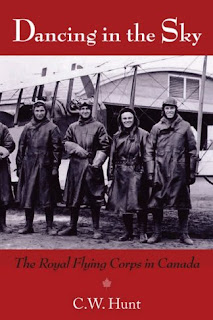
Plans are well under way for the launch of C.W. (Bill) Hunt’s new book, Dancing in the Sky. The book was originally started by Al Smith, who began to write about the World War I training airfields around Deseronto. Al collected stories from people who had worked at (or had otherwise been involved with) the two camps (Camp Mohawk and Camp Rathbun) and amassed a number of photographs. Bill took over the project in 1998 and broadened the research to include the other Royal Flying Corps Canada locations in Ontario. The photographs collected by Al Smith are now available for research in Deseronto Archives (under the name J. Allan Smith Collection). The book is being published by Dundurn Press this month.

The Deseronto Public Library will be the venue for this launch on the 7 March 2009 at 2.00pm. We’ll be mounting a display of photographs and other historic materials relating to the Deseronto camps, and refreshments will be served. Bill Hunt will then talk about his book. Greenley’s Book Store will be there with copies of the book to buy (which I’m sure Bill will be happy to sign!) and there will also be a raffle draw with a chance to win a copy of the book and a selection of other goodies.

It is shaping up to be a great event, so if you have a chance to, please come along that afternoon! The invitation (a PDF file) has more details.

CAMPM-06-05

A recent accession from the Town of Deseronto included this certificate of Public Recognition which was designed to honour those returning from overseas service after World War II.

If you look closely at the document (click on the image to see a bigger version), you will see that the town mentioned is Halifax and the crests are those for Halifax (as it was before 1964) and Nova Scotia. Pencilled annotations state ‘Your crest here’ and ‘Ontario crest here’ and the name Deseronto has been pencilled in next to the main block of text, where it would replace the word Halifax.

What is not clear from the certificate is whether the Town went ahead and ordered their own version of the certificate for servicemen returning to Deseronto. Did any Deseronto veterans receive such a thing? Has anyone seen a certificate like this among the papers of a friend or relative?

« Previous Page