veterans


Fred Hugh Lavery signature

On this day in 1915, Fred Hugh Lavery signed up in Craik, Saskatchewan. He was born in Deseronto on September 26th, 1898, the son of James Lavery and Marie (née Stone). By 1901 the family had moved to Flos in Simcoe County, Ontario and in 1911 they were in Aylesbury, Saskatchewan.

Lavery joined the 68th Battalion of the Canadian Expeditionary Force with the regimental number 105491. He was described as five feet seven inches tall, with a medium complexion, grey-brown eyes and light brown hair. His service record shows that he arrived in England on May 7th, 1916 and joined the 8th Battalion in France on June 21st.

Fred was hit by a bullet at Vimy Ridge on April 28th, 1917, which shattered his left elbow. His lower arm was amputated at a casualty clearing station, and then re-amputated in hospital in Manchester, England on May 2nd. He was invalided home to Canada in March 1918 and had a further operation on his amputated arm in Vancouver in late 1918. Notes on his service file give more detail on his injury:

fred-hugh-lavery-arm-operation

Condition on Admission and Progress of Case
Complaints Loss of left arm
History Wounded by bullet at Vimy Ridge April 1917 in the elbow which was practically shattered. Sent to CCS where arm amputated same night. One month later in Hospital in England a reamputation was done – he returned to Canada April 1918.
Condition on admission No furlough has been granted. Was measured first in April for Carnes arm which was cancelled and again on 2nd July at Davisville. He has had no fitting – left arm is amputated at the level of the upper and middle thirds. Stump is healthy though the wounds are badly puckered, and consequently though healed, are dirty. Movements at shoulder joint are normal. Power of stump is limited particularly forward extension- scar on this stump should be excised. This patient was originally a left handed man, other systems normal.

Lavery was finally discharged from the army as medically unfit on March 19th, 1919. He married Sarah Islay Mattock on February 24th, 1928 in Vancouver. The couple moved to the United States in the same year and Lavery died in San Diego, California on May 7th, 1952.

The focus of our World War I project is the experience of men and women from Deseronto. Many of the people we are tracking were born in Deseronto but had moved away from the town by the time war broke out: Deseronto was entering a period of industrial decline by the 1910s and the lumbering industries which had employed hundreds of people in town in the late nineteenth century were closing down. The map below shows places where Deseronto-connected men and women signed up to serve in the First World War.

Enlistment locations

Below is a detail of enlistment locations in the area around the eastern Great Lakes.

Enlistment locations detail


The bigger the dots, the more people signed up in a particular location. Toronto, Belleville and Kingston were the main sites, but Deseronto people also signed up in BC, Alberta, Saskatchewan, Manitoba, Quebec and Nova Scotia. One Deseronto man signed up in California, one in Michigan and another in London, England. The maps are an interesting reflection of the dispersal of Deseronto’s population in the period before the 1914-1918 war.

Arthur Goodmurphy signature

On this day in 1915, Arthur Barrett Goodmurphy, a glazier, enlisted in Regina, Saskatchewan. He was born in Deseronto on June 23rd, 1896, the son of Ralph Goodmurphy and Annie (née Barrett). From Deseronto the family moved to Collingwood, Ontario and then to Regina.

Arthur joined the 28th Battalion with the regimental number 105410. He was described as being five feet five inches tall, with a medium complexion, blue eyes and fair hair. His service record shows that he arrived in England via the SS Olympic on May 8th, 1916. He was appointed Lance Corporal on May 8th and transferred to the 28th Battalion, which he joined in France on June 29th.

On September 19th, 1916 Goodmurphy received a shrapnel wound to the neck. He rejoined his unit on October 9th. In May 1917 he fell ill with trench fever and was in hospital in England until July 1917. He then served in England with reserve battalions until returning to the 28th Battalion in France on March 28th, 1918. He arrived back in England in April 1919 and left there for Canada on May 19th.

Goodmurphy was demobilized in Regina on June 2nd, 1919. He married Reta Ellen Fisette in Regina on December 29th, 1920. He died in Regina on May 27th, 1987.

Edmund Vincent McNeill signature

On this day in 1915, Edmund Vincent McNeill, a sheet metal worker, enlisted in Toronto. He was born in Marysville on November 13th, 1878, the son of Joseph McNeill and Catherine (née McAllister). The family were living in Deseronto in 1901.

When he signed up, McNeill was described as five feet eight and a half inches tall, with a fresh complexion, blue eyes and brown hair. He joined the 123rd Battalion (Royal Grenadiers) of the Canadian Expeditionary Force with the regimental number 766261. His service record shows that he sailed for England on the SS Cameronia on August 8th, 1916. He went to France to join the 19th Battalion on October 11th, 1916.

Edmund was killed in May 1917.

John Henry Maracle signature

On this day in 1915, John Henry Maracle enlisted in Belleville. He was born on August 1st, 1880 in Tyendinaga, the son of William Maracle and Sarah (née Brant), who were Mohawks. On March 1st, 1905 he married Hattie Maracle and the couple had a daughter in 1909.

On enlisting, Maracle was described as five feet five and a half inches tall, with a dark complexion, brown eyes and black hair. He joined the 80th Battalion with the regimental number 220237.

John’s service record shows that he went absent without leave on March 6th, 1916 and was struck off the battalion’s strength on the 28th. He re-enlisted in Belleville on May 6th, 1916, this time joining the 44th Battalion, with a new number of 219022. He left Canada on May 16th, 1916.

Read more about what happened to John Maracle.

Harold MacDonald Pineo signature

On this day in 1915, Harold MacDonald Pineo enlisted in Virden, Manitoba. He was born in Virden on May 23rd, 1895, the son of William MacDonald Pineo and Mary Ellen (née Sarvis). He initially joined the 99th Manitoba Rangers but on April 15th, 1916 he joined the 181st Battalion as a lieutenant. Pineo was described as white, with brown eyes and brownish hair. He was five feet ten inches tall. His service record shows that he was struck off the strength of the Canadian Expeditionary Force in May 1917 to join the Royal Flying Corps. He joined 42nd Wing in Deseronto on September 19th, 1918.

His time in the Royal Air Force was short.

John Hill signature

On this day in 1915, John Hill enlisted in Brantford, Ontario. He was born in Tyendinaga on April 5th, 1896, the son of Isaac Hill and Elizabeth (née Maracle), who were Mohawks. In 1911 John and his sisters Maud and Meta were living in the Mohawk Institute Residential School in Brantford.

When he signed up, John was described as five feet six and a half inches tall, with a dark complexion, brown eyes and black hair. He joined the 125th Battalion of the Canadian Expeditionary Force with the regimental number 772107. His service record shows that he sailed from Halifax on the SS Scandinavian on August 7th, 1916. Hill was transferred to the 1st Battalion in England in 1916 and was promoted to corporal in that battalion in February 1918.

John Hill married Bernice Brown on June 20th, 1923 in Cochrane, Ontario. He died in North Bay on May 20th, 1966.

Philip Maracle signature

On this day in 1915, Philip Maracle enlisted in Belleville. He was born on August 2nd, 1883 in Tyendinaga, the son of William Edward Maracle and Julia Ann (née Williams), who were Mohawks. He married Bertha Brant in Deseronto on November 16th, 1910. His uncle, George Williams, had enlisted in October 1915.

When he signed up, Maracle was described as five feet seven inches tall, with a dark complexion, brown eyes and black hair. He gave his father as his next of kin (his mother had died in 1912) and his occupation as carpenter. In answer to the question “Are you married?” he answered “No, widower”, although Bertha had not died. Philip joined the 80th Battalion of the Canadian Expeditionary Force with the regimental number 219361.

Maracle’s service record tells us that he sailed from Halifax on the RMS Baltic on May 20th 1916. He was transferred to other battalions while in Europe, joining the 44th Battalion on January 4th, 1917.

Philip was killed in May 1917.

William Doreen signature

On this day in 1915, William Doreen signed up in St. Catharines, Ontario. He was born in Tyendinaga on December 28th, 1890, the son of Peter Doreen and Jane (née Maracle), who were Mohawks.

On signing up Doreen was described as having a dark complexion, blue eyes and dark hair. He had previously served in the 49th regiment for four years. He joined the 114th Battalion of the Canadian Expeditionary Force with the regimental number 739199.

William married Susan Bennett on April 11th, 1916 in Ohsweken. His service record shows that he was absent without leave from Camp Borden from August 4th, 1916 and was discharged from the army as of that date. On November 10th, 1923 he married Una Doris Pearson in Oshawa.

Rev. Alfred Henry Creeggan

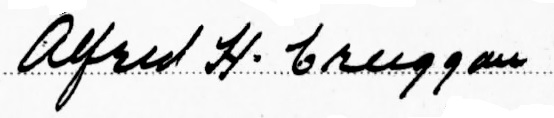
Alfred Henry Creeggan signature.JPG

On this day in 1915 Alfred Henry Creeggan enlisted in London, England at the age of 44. He had been serving as the Chaplain to the Mohawks at Christ Church in Tyendinaga since 1903 and had also served as Chaplain to the Prince Edward Regiment in Ontario. His service record shows that he joined the Canadian Expeditionary Force with the rank of Major and became part of  the Chaplain Services of the 3rd Infantry Division. He was described as five feet ten inches tall, with a fair complexion, grey eyes and light brown hair.

Creeggan was born in Halifax, Nova Scotia on March 22nd, 1871, the son of George Creeggan and Anne (née Young). He married Mary Sheffield on April 28th, 1897 in Lyndhurst, Ontario and by 1911 the couple had four children.

Alfred crossed the Channel to France on January 6th, 1916 and served there for the rest of the war as an honorary major and senior chaplain of the 3rd Infantry Brigade. He was sent back to England on March 26th, 1919 and returned to Canada in May, being demobilized in Ottawa on May 20th, when he returned to Deseronto. He was appointed as the Rector of Gananoque in May 1927 and died there on July 16th, 1933 at the age of 62.

« Previous PageNext Page »