veterans


James Bardy signature

James Bardy signed up in Ohsweken, Ontario on this day in 1916. He was born in Tyendinaga on August 12th, 1895, the son of Peter Bardy and Margaret (née Maracle), who were both Mohawks.

Bardy joined the 114th Battalion of the Canadian Expeditionary Force with the regimental number 739285. He was described as five feet five inches tall, with a dark complexion, brown eyes and black hair. Bardy was later transferred to the. His service record shows that he arrived in England on November 11th, 1916. He was in hospital in England with mumps in February 1917 and  joined the 18th Battalion in France on June 15th, 1917.  On July 21st 1917 he received a gunshot wound to his left forearm, fracturing the ulna bone, and was sent to England to recover. He was granted permission to marry on September 12th, but there was no marriage registered in his name in England in 1918. He left England for Canada on December 12th, 1918.

James was demobilized in London, Ontario on January 6th, 1919 and married Lucretia Ann Brant on December 24th, 1919 in Deseronto. He died in his home on College Street, Deseronto, on July 26th, 1937 of acute nephritis. He was 42. An entry in the Canadian War Graves Registers notes that “Death was the result of a condition incurred on service but not pensionable under the Statute”. James and Lucretia were both buried in Christ Church Cemetery, Tyendinaga.

Harry Aylesworth signature

On this day in 1916, Harry Aylesworth signed up in Belleville. He was born (and named William Henry Aylesworth) in Odessa on June 27th, 1888, the son of William Aylesworth and Jane (née Burley). He married Cora Hestella Carter in Demorestville on September 30th, 1908 and the couple had two children and had moved to Deseronto by the time Harry enlisted.

Harry joined the 155th Battalion of the Canadian Expeditionary Force with the regimental number 636832. He was five feet seven inches tall, with a dark complexion, brown eyes and brown hair. His service record shows that he was transferred to the 21st Battalion after arriving in England.

On August 9th, 1917 Harry received a gunshot wound which fractured one of the bones in his right forearm. There is an x-ray of the injury in his service file.

Harry Aylesworth x-ray

The damage to Aylesworth’s arm was so severe that he was invalided back to Canada as unfit for further service in May 1918. He was living in Belleville with his wife and three children at the time of the 1921 census and was working as a letter carrier. He died on July 23rd, 1935 in the Prince Edward County Hospital in Picton due to complications from a burst appendix, aged 47.

Amos Campbell Masters signature

On this day in 1916, Amos Campbell Masters signed up in Deseronto. He was born in the town on March 24th, 1894, the son of Robert Masters and Eva (née Gilchrist).

Masters joined the 155th Battalion of the Canadian Expeditionary Force with the regimental number 636805. He had a dark complexion, grey eyes and black hair. His service record shows that he arrived in England on October 28th, 1916 and was transferred to the 21st Battalion, which he joined in France on December 8th.

In August 1917 Masters was wounded by a gas shell and admitted to hospital for three months in France. He returned to the 21st Battalion and was wounded by a gas shell again in September 1918.

Amos was demobilized in Kingston on March 22nd, 1919. He was living with his parents in Thomas Street, Deseronto in 1921, working as an electrician. He died of acute myocarditis in Deseronto on January 25th, 1937, aged 42. He was buried in Morven, Ontario.

Wheeler Maracle signature

Wheeler Maracle signed up in Napanee on this day in 1916. He was born in Tyendinaga on April 1st, 1896, the son of Daniel Maracle and Annie (née Brant), who were both Mohawks.

Maracle joined the 80th Battalion of the Canadian Expeditionary Force with the regimental number 220513. He was five feet seven inches tall, with a dark complexion, brown eyes and brown hair. His service record shows that he arrived in England on the RMS Baltic on May 29th, 1916. He was hospitalized by an attack of tonsillitis shortly afterward and was transferred to the 50th Battalion in November, arriving in France on November 29th, 1916.

Wheeler did not come home.

John Jacob Breaugh signature

On this day in 1916 John Jacob Breaugh signed up in Napanee. He was born in Deseronto on March 6th, 1874, the son of Michael Breaugh and Sara (née Nolan). His mother died in 1877 of tuberculosis.

Breaugh joined the 80th Battalion with the regimental number 220500. He was five feet two and a half inches tall, with a fair complexion, blue eyes and light brown hair. He had a tattoo of the letters JB and a small star on his left forearm. His service record reports that he arrived in England via the RMS Baltic on March 29th, 1916 and was transferred to the 51st Battalion in June. He went to France with the 10th Canadian Railway Troops in May 1917 and was transferred to the Canadian Forestry Corps in England in March 1918. While in France, John suffered from myalgia in September and October 1917. When he was in England with the Forestry Corps he was sentenced to 21 days of Field Punishment Number Two for “attempting to force his way into a private house without permission of owner”.

John returned to Canada on the RMS Carmania, leaving England on February 1st, 1919. He was discharged in Kingston as medically unfit for further service on March 8th, 1919. At the time of the 1921 census he was living with his sister, Bridget and her husband in Main Street, Deseronto. Family tree information on Ancestry suggests that he died in 1931. He was buried in the Roman Catholic section of the Deseronto Cemetery.

Ernest Arthur Denee signature

Ernest Arthur Dennee signed up in Belleville on this day in 1916. He was born in Amherst Island on October 9th, 1887 (as James Ernest Dennee), the son of John Dennee and Mary Jane (née Bailey). He married Eliza Luffman (née Tomkins) in Amherst Island on December 28th, 1910 (she was a 50-year-old dressmaker and widow from Deseronto, he was 23 and a fisherman).

Ernest joined the 155th Battalion of the Canadian Expeditionary Force with the regimental number 636792. He was five feet five and a half inches tall, with a fair complexion, brown eyes and brown hair. His service record shows that he arrived in England on the SS Northland on October 28th, 1916 and was transferred to the 2nd Battalion, joining them in France on December 6th.

On February 26th, 1917 Ernest was sentence to two days of Field Punishment No. 2 for “destroying Government property by removing cross pieces from Drain Trench in Bosch Walk”.

On August 18th, 1917 Dennee received a gunshot wound to his left arm: he was initially reported missing, believed killed, but was found to have been admitted to No. 22 General Hospital. He rejoined his unit on November 13th. He had two weeks’ leave in the UK over the Christmas period, returning on January 1st, 1918. Six days later he was sentenced to seven days of Field Punishment No. 2 for being absent without leave for 35 hours between January 7th and 8th.

Ernest did not make it home.

Bert Leaf signature

On this day in 1916 Bert Leaf, a teamster,  signed up in Deseronto. He claimed to have been born in Ottawa on March 31st, 1887, although when he married Mabel Pearson in Napanee in 1904, he gave his place of birth as Watertown, New York and could not give the names of his parents. Bert and Mabel had four children by the time he joined the army.

Bert joined the 155th Battalion of the Canadian Expeditionary Force with the regimental number 636773. He was five feet three and a quarter inches tall, with a fair complexion, blue eyes and brown hair. His service file shows that he sailed from Halifax on October 17th, 1916 on the SS Northland.

On April 22nd 1917 Leaf joined the 21st Battalion in France. In 1918 he spent time in hospital suffering from infections. He returned to duty in June and was reported missing after seeing action on August 26th. Four days later, he was reported as being safely back with his unit. He left England for Canada in September 1919 and was demobilized on September 17th in Kingston.

A note on his service file states that Bert Leaf died on July 3rd, 1954.

Anthony Maracle signature

Anthony Maracle joined up in Mount Forest, Ontario on this day in 1916. He stated that he was born in Deseronto on January 15th, 1886. He was the son of Moses Maracle and Jane Williams, who were both Mohawks.

Maracle joined the 153rd Battalion of the Canadian Expeditionary Force with the regimental number 928669. He was five feet five inches tall with a dark complexion, brown eyes and black hair. His service record shows that he was discharged on May 15th, 1916 as medically unfit for service.

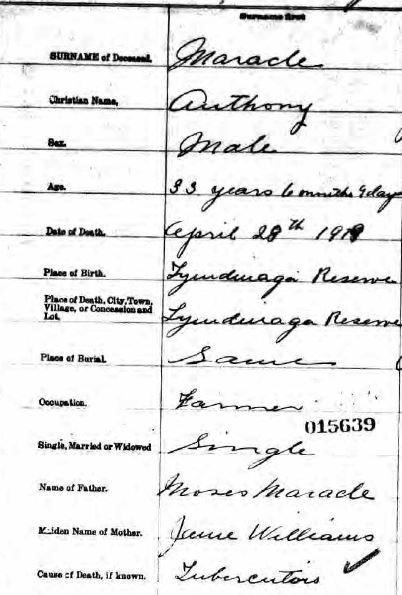
Anthony Maracle died of tuberculosis in Tyendinaga on April 28th, 1919.

Anthony Maracle death register entry

Death registration for Anthony Maracle, courtesy of the Archives of Ontario

Wilfred Couture signature

Wilfred Laurier Couture, an electrician, signed up in Toronto on this day in 1916. He was born in Deseronto on May 10th, 1894, the son of Ephraim Couture and Martha Ann (née Beyette) and he attended the Deseronto High School. He was living at 128 Lisgar Street in Toronto when he enlisted.

Couture joined the Depot Squadron of the Royal Canadian Dragoons, with the regimental number 550129. His service record shows that he arrived in England on the SS Lapland on March 24th, 1916. He served in France from September 22nd, 1916 to April 16th, 1919. He was demobilized in Canada at ‘Dispersal Station B’ on June 5th, 1919.

James Cole signature

James Cole completed an Officer’s Declaration Paper in Marlbank on this day in 1916. He was born in Deseronto on October 20th, 1897, the son of James Cole and Eliza (née Brown). The family were living on Upper Mill Street in Deseronto at the time of the 1911 census. James attended Deseronto High School and described himself as a student when he signed up. His service record notes that he originally enlisted in November 1915 in the 155th Battalion of the Canadian Expeditionary Force.

On June 18th, 1916, while he was at Camp Barriefield, Cole was thrown from a horse, causing bad bruising. A Board of Inquiry was convened six days later, at which Cole and the paymaster, Captain Holton gave evidence about the accident:

James Ezra Cole - inquiry into horse accident

1st Evidence: Lieut. J. E. Cole being duly warned states:

“On Sunday Morning about 11 A. M., June 18th, having received permission to take one of the 155th horses out, I mounted a bay horse, name unknown to me. Immediately the horse became balky and unmanageable. He carried me off the road, (behind the 155th Camp) under the trees, then reared, falling back and on top of me. The weight of the horse falling principally on my left leg and thigh.

[signed] J. E. Cole

Lieut. 155th Battalion, C.E.F.

Evidence: Capt. C. H. Holton, Paymaster, 155th Battalion being duly warned states:

“On Sunday Morning 18th June about 11 o’clock I was standing watching Lieut. Cole, preparing horse for mounting. He mounted: horse reared, standing on hind legs, going under low branch of tree, then rearing again, turned completely over, falling on rider. Someone got help from A. M. C. [Army Medical Corps] and took Lieut. Cole to his tent.

By July 19th Cole had recovered and was declared fit for duty. He travelled to England on the RMS Olympic, arriving on August 30th. He joined the 42nd Battalion in France on September 23rd. On November 29th, 1916 Cole was injured when a high explosive threw him into a wooden support. Shortly afterwards he was admitted to hospital with renal colic, caused by damage to his kidneys in the incident. He was sent to England to recover and was transferred to the 20th Reserve Battalion in March 1917. He reported abdominal pain in April and had his appendix removed on April 11th. He was discharged from hospital on May 17th.

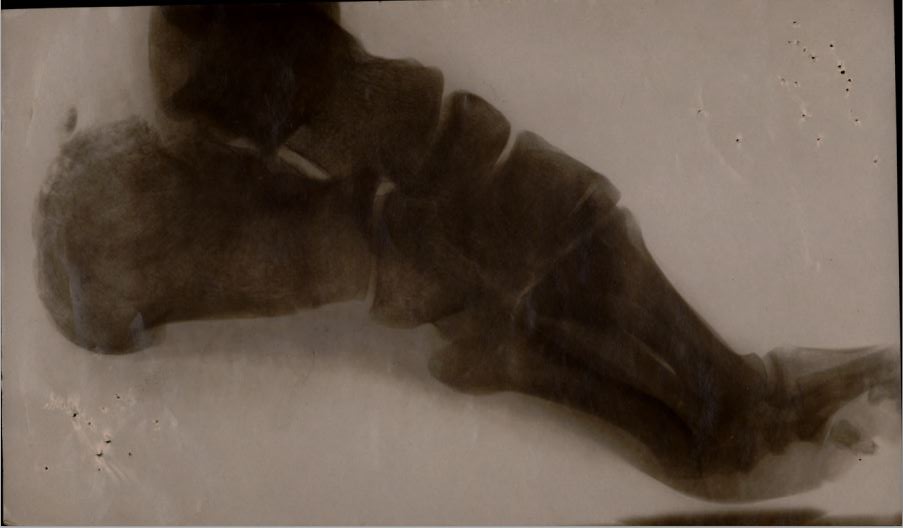
James Ezra Cole - xray of left foot

Xray of James Cole’s left foot, taken from his service record

In October 1917 Cole was  attached to the Royal Flying Corps as an observer. On December 8th he was shot in an air fight over Cambrai in France: the bullet hit his left heel and caused a compound fracture. The Royal Flying Corps casualty card noted that he was in a DH 4 aircraft with a Rolls Royce engine at the time. Cole spent the next two and a half months in hospital in England and was discharged to Canada on March 1st, 1918. On April 11th he was admitted to Kingston General Hospital with pain in his left heel. In September he had an operation at Toronto General Hospital to remove abdominal adhesions. In August 1919 he was admitted to the St. Anne de Bellevue Military Hospital in Quebec complaining of pain in his abdomen and left heel. He was discharged in December 1919.

In 1921 Cole was living with his parents in Main Street, Deseronto, where his father worked as a barber. James’s occupation was given as ‘apprentice barber’. The photograph below shows the Cole’s barbershop at 305 Main Street, on the right of the image.


James died in Penticton, British Columbia on July 14th, 1967.

« Previous PageNext Page »