veterans


Guy Provins signature

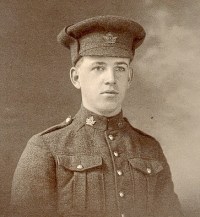
Photograph of Guy Provins

Guy Provins (image from the Canadian Virtual War Memorial)

On this day in 1916, Guy Provins was killed in the trenches at Courcelette during the Battle of the Ancre Heights (part of the Battle of the Somme). It was his nineteenth birthday. A letter from Provins was published in the Deseronto Post alongside the report of his death.
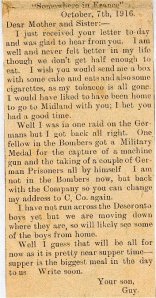
Letter from Guy Provins

“Somewhere in France”

October 7th, 1916

Dear Mother and Sister:-

I just received your letter to-day and was glad to hear from you. I am well and never felt better in my life though we don’t get half enough to eat. I wish you would send me a box with some cake and eats and also some cigarettes, as my tobacco is all gone. I would have liked to have been home to go to Midland with you, I bet you had a good time.

Well I was in one raid on the Germans but I got back all right. One fellow in the Bombers got a Military Medal for the for the capture of a machine gun and the taking of a couple of German Prisoners all by himself. I am not in the Bombers now, but back with the Company, so you can change my address to C. Co. again.

I have not run across the Deseronto boys yet, but we are moving down where they are, so will likely see some of the boys from home.

Well, I guess that will be all for now as it is pretty near supper time – supper is the biggest meal in the day to us. Write soon.

Your son,

Guy
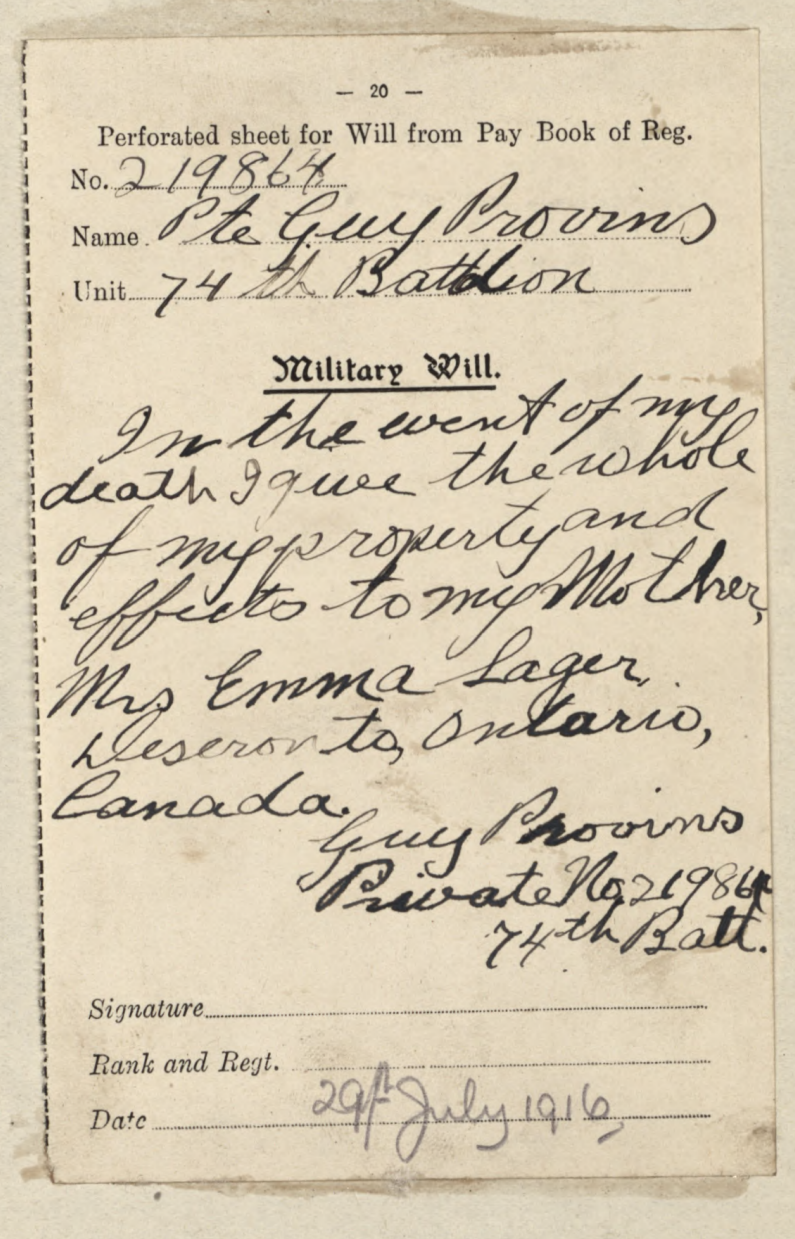
Guy’s will was taken from his army pay book and transferred to his service record. He left all his possessions to his mother, Emma Sager.

Guy’s body was not found. He is remembered on the Vimy Memorial and in Deseronto.
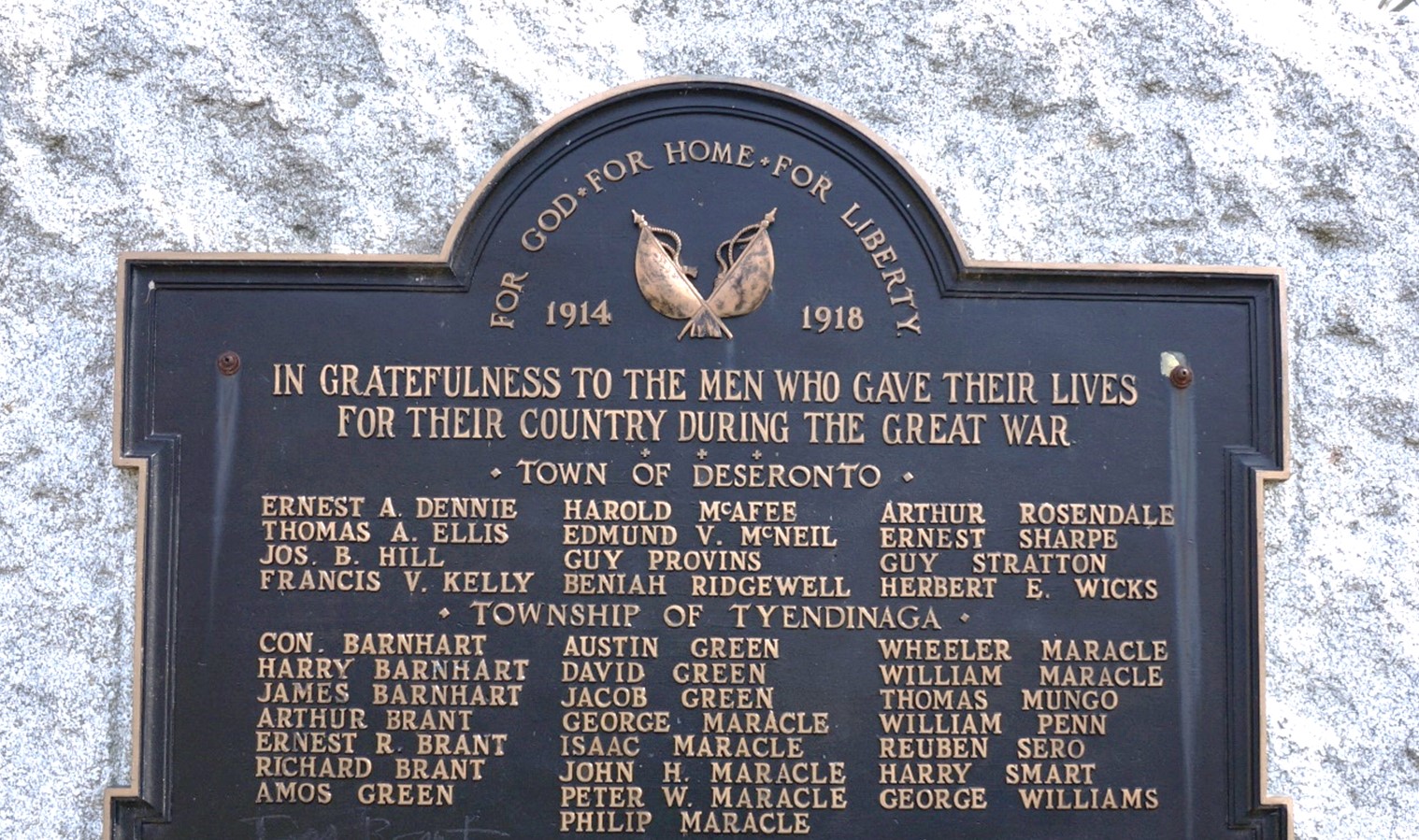
Deseronto memorial

Edward Gardner Craig signature

Edward Gardner Craig, an electrical mechanic, signed up in Kingston on this day in 1916. He was born in Deseronto on April 27th, 1885, the son of Robert John Craig (the Presbyterian minister) and Fanny Gertrude (née Rathbun, sister of Edward Wilkes Rathbun). He married Frances Isabel Butt on December 4th, 1912 in Parry Sound.

Craig joined the Field Ambulance Depot for Military District No. 3 with the regimental number 536053. he had a dark complexion, grey eyes and iron grey hair. His service record shows that he arrived in England on the SS Missanabie on April 7th, 1917. He served with the Canadian Army Medical Corps in England and was admitted to hospital in February 1918 suffering from neurasthenia.

He was invalided home to Canada in October 1918 and was admitted to the Ontario Military Hospital in Cobourg on October 19th with a diagnosis of constitutional neurasthenia. A hospital report in his file dated December 12th, 1918 notes that he was a

7 mo. [month] child (mother had fright) & the youngest child – always delicate. Always hypersensitive and worried over trifles. Had a nervous breakdown about 1911 following overexertion on a hot day…never as well since…was an invalid on enlistment – thought the army life and open air would help him – but they didn’t…health went down while in Eng. Was not in France…always interested in astrology, planetary influences, moroscopes [horoscopes] etc as well as in telepathy, spirit influences etc…These items from civil life probably explain hallucinatory and delusional tendencies noted in Eng.

Craig was discharged as medically unfit for further service on December 26th, 1918. A note on his file reads “Deceased 12-3-1939”.

Harold Smart's signatureOn this day in 1916 Harry Smart was killed in action while serving with the 25th Battalion in France at the Battle of Thiepval Ridge.

The Intelligencer reported his death on October 18th:

Killed in Action. In the casualty list today appears the name of Private Harold Smart, of Deseronto, who has been killed in action. He left Belleville with the 39th Battalion and was known to many in the city.

Harry’s body was not recovered after the battle. He is commemorated at Vimy and on the Deseronto war memorial.

Deseronto memorial

Francis Vincent Kelly's signature On this day in 1916 Frank Kelly was killed at Courcelette in France, during the Battle of Thiepval Ridge. This was part of the Battle of the Somme, which lasted for more than four months in late 1916 and in which more than a million men died. Tanks made their first appearance in the war at Courcelette.

Frank Kelly had enlisted in the 28th Battalion in March 1915. A detailed history of this battalion’s First World War experiences compiled and edited by Major Donald George Scott Calder was formerly available online at the University of Saskatchewan. The battalion was assigned a tank on the day of Frank’s death, which Calder notes was “far from popular, becoming much less so when the Fritz gunners selected the Tank as a calibration point for all their guns in the area during the remainder of our stay.”

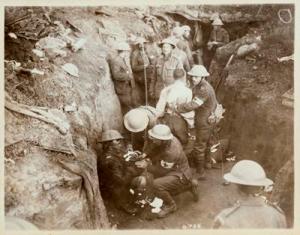
First aid at Courcelette

First aid being rendered at Courcelette (image from the Canadian War Museum)

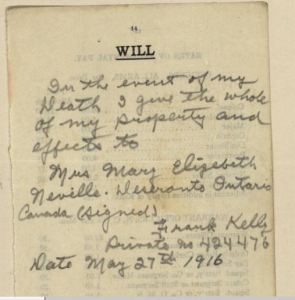
Frank’s service record includes a hand-written will:frank-kellys-willWILL

In the event of my Death I give the whole of my property and effects to

Mrs Mary Elizabeth Neville. Deseronto Ontario Canada (signed)

Frank Kelly

Private No 424476

Date May 27th 1916

The circumstances of Frank’s death were recorded as “Killed in Action” in the trenches at Courcelette.

Casualty report for Frank Kelly
Frank is remembered on the Deseronto war memorial and at the Vimy Memorial. His grave was reported to be in Courcelette, but was not marked.

Deseronto memorial
In 1921 Kelly’s mother, Mary Elizabeth Neville, was living in Dundas Street, Deseronto.

Gerald Cecil Burton signature

On this day in 1916, Gerald Cecil Burton, a fireman, signed up in Toronto. He stated that he was born in Deseronto on July 29th, 1897. At the time of enlisting his mother, Margaret, was living in Elm Street, Sudbury, Ontario.

Gerald joined the 69th Battery of the Canadian Field Artillery with the regimental number 340069. He was five feet seven and three quarter inches tall, with a fair complexion, grey-blue eyes and brown hair. He arrived in England on board the RMS Mauretania on November 30th, 1916. He got to France on March 11th, 1917, serving with the 1st Brigade of the Canadian Field Artillery. His service file notes that he was tried at a court martial on August 29th, 1917:

Gerald Cecil Burton theft

 25.9.17 In confinement awaiting trial 31 days. Tried & convicted by F.G.C.M. [Field General Court Martial] of W.O.A.S. [while on active service] Stealing goods the property of an officer in that he in the field on or about 13 July stole a revolver & Holster the property of H. J. Rolph & sentenced to Hard Labor for 1 year 29.8.17

This sentence was commuted to 90 days of Field Punishment number 1. On March 19th, 1918 Burton was struck off the strength of his unit and sent to England when it was discovered that his true date of birth was July 29th, 1900. He left Liverpool for Canada on May 13th and was examined by a medical board in Toronto on July 11th. This board noted that he was under age (17) and was suffering from bronchitis caused by poison gas. He was discharged as medically unfit on July 25th, 1918.

It is not clear what happened to him after the war, but a Gerald C. Burton with a birthdate of Jul 29th, 1898 died on October 9th, 1976 in Pinellas, Florida.

Reuben Sero signature

Reuben Sero joined up in Belleville on this day in 1916. He gave his place of birth as “Indian Woods, Hastings County”. He was born on October 5th, 1897, the son of Israel Sero and Eliza (née Brant), who were both Mohawks. The family were living in Tyendinaga in 1901 and 1911, but Reuben was living in Market Street, Belleville when he enlisted.

Sero joined the 155th Battalion of the Canadian Expeditionary Force with the regimental number 637184. He was five feet five and a half inches tall, with a dark complexion, brown eyes and black hair. His service record shows that he sailed from Halifax on the SS Northland on October 17th, 1916, arriving in England on the 28th. He was transferred to the Princess Patricia’s Canadian Light Infantry in May 1917 and landed in France on May 24th.

Reuben did not make it home.

George Albert Butler signature

On this day in 1916 George Albert Butler, a civil engineer, signed up in Montreal. He was born near Deseronto on October 31st, 1876 (probably 1874), the son of Tobias Butler, a lumberman for the Rathbun Company, and Elizabeth (née McVey). Tobias died in 1896 and Elizabeth was living in Belleville at 268 George Street when George enlisted.

George joined the No. 1 Construction Battalion with the regimental number 1081681. He was five feet seven inches tall, with a fair complexion, blue eyes and fair hair. His service record shows that he arrived in England on the SS Northland on September 23rd, 1916 and was promoted to be a sergeant on October 21st. He arrived in France four days later. In February 1917 the No. 1 Construction Battalion’s name was changed to 1st Battalion Canadian Railway Troops. On May 22nd 1917 Butler was promoted to the rank of temporary lieutenant.

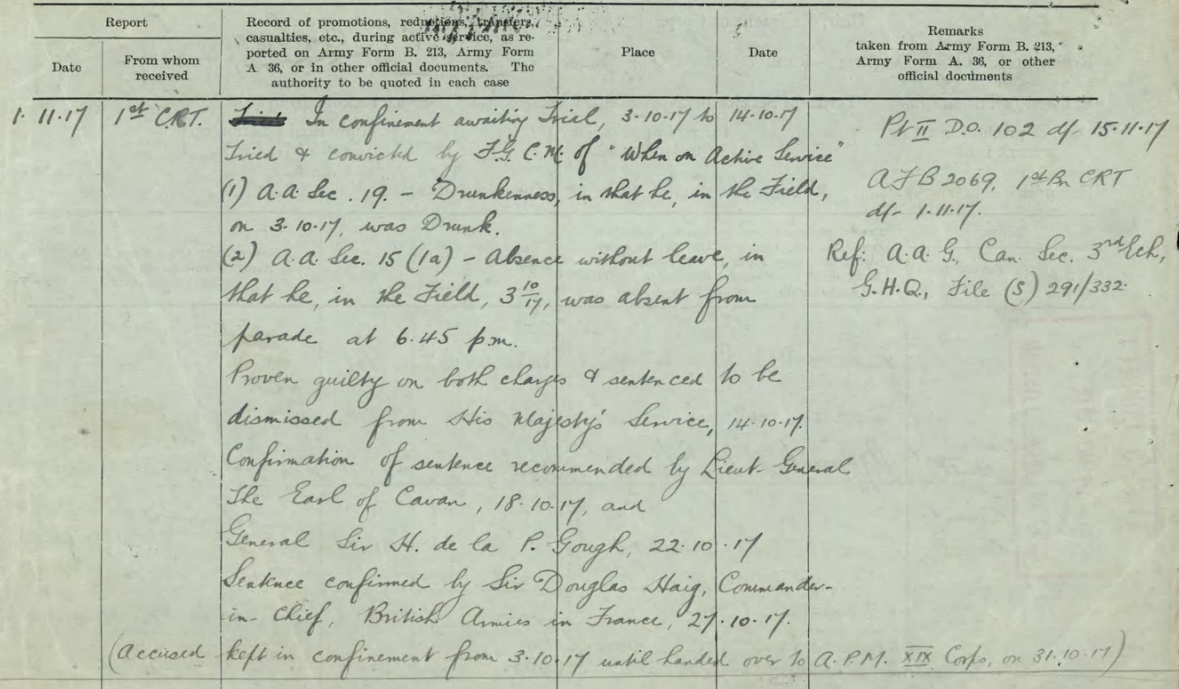
On October 3rd, 1917 Butler was arrested and kept in confinement until October 13th, awaiting trial. His service file records the details of his offence and court martial:

George Albert Butler court martial

1.11.17 1st C.R.T In confinement awaiting trial, 3.1017 to 14.10.17
Tried & convicted by F.G.C.M. [Field General Court Martial] of ‘When on Active Service’
(1) A.A. Sec. 19 – Drunkeness, in that he, in the Field, on 3.10.17 was Drunk.
(2) A.A. Sec. 15 (1a) – Absent without leave, in that he, in the Field, 3.10/17 was absent from parade at 6.45 p.m.
Proven guilty on both charges & sentenced to be dismissed from His Majesty’s Service, 14.10.17
Confirmation of sentence recommended by Lieut. General The Earl of Cavan, 18.10.17, and General Sir H. de la P. Gough, 22.10.17.
Sentence confirmed by Sir Douglas Haig, Commander in Chief, British Armies in France, 27.10.17.
(Accused kept in confinement from 3.10.17 until handed over to A.P.M. [Assistant Provost Marshal] XIX Corps on 31.10.17)

George Butler was sent back to England on November 2nd, 1917. It is not clear what happened to him after that.

James Wilmont Sharpe signature

James Wilmot Sharpe signed up in Deseronto on this day in 1916. He was born on January 8th, 1883 in Deseronto, the son of Philip Sharpe and Sarah (née Smith). On October 19th, 1901, he married Mabel Hayes in Napanee. In 1904 the couple were living in Fourth Street, Deseronto when their son was born. By 1916, when Sharpe enlisted, their home address was 114 Peter Street, Toronto. Sharpe’s three younger brothers, Ernest, Alfred Nelson and Harry had already enlisted.

Sharpe joined the 74th Battery of the Canadian Field Artillery with the regimental number 344822. He was five feet four and a half inches tall, with a dark complexion, brown eyes and dark brown hair. His service record shows that he was discharged on September 8th, 1916 as being medically unfit, due to having a deformed ankle from a fracture two years previously.

He was back at 114 Peter Street in Toronto with Mabel and their son in 1921. James died on February 23rd, 1970 at the age of 88. His obituary in the Quinte Scanner notes that Mabel predeceased him and that the couple had two sons, William and James. He worked as a millwright. James was buried in Deseronto Cemetery.

Joseph Edward Barnhardt signature

Joseph Edward Barnhardt signed up in Kingston on this day in 1916. He was born in Shannonville on March 6th, 1901, the son of David Barnhardt and Susan (née Bey), who were both Mohawks. David had died in December 1913 and Susan had died in May 1916. Barnhardt claimed to have been born in 1898 and he gave his sister Celia as his next of kin.

Joseph joined the 155th Battalion of the Canadian Expeditionary Force with the regimental number 637180. He was five feet six inches tall, with a dark complexion, brown eyes and brown hair.

Joseph’s service record shows that his unit sailed for England on October 17th, 1916. He had been treated for an infection while in Kingston. In England he was transferred to the 4th Battlaion, Canadian Mounted Rifles and he joined them in France on November 29th, 1916.

After six months of active service, Barnhardt was admitted to hospital in Calais suffering from appendicitis. He was treated at the 2nd Western General Hospital in Manchester, England, where he stayed for 92 days. He was discharged from hospital in September 1917, but at some point suspicions about his age must have arisen. There is a copy of his birth registration in his service record, the copy having been made on October 4th, 1917.

Joseph Edward Barnhardt - copy of birth registration

This information proved that at 16 years old, Barnhardt was too young to be serving in the army. He sailed from Liverpool on October 18th, 1917 on the SS Missanabie (this ship was sunk by a German submarine in the following September). Joseph was discharged from the army on March 12th, 1918 six days after his 17th birthday. He was then two inches taller than he had been when he enlisted.

Joseph married Alice Sutton in Shannonville just a few months after leaving the army, on August 16th, 1918. He gave his occupation as mechanic and his age as 18. In 1921 the couple were living in Front Street, Belleville and had two children. Joseph was working as an electrician.

Eldon Roy Wagar signature

Eldon Roy Wagar, a chauffeur, signed up in Montreal on this day in 1916. He was born in Napanee on October 11th, 1896, the son of Sampson Wagar and Mary (née Asselstine). The family were living in Richmond Township, close to Deseronto, in 1901 and 1911 and Eldon attended the Deseronto High School.

Eldon joined the 4th Canadian Divisional Train with the regimental number 515348. Divisional Trains were units responsible for transporting baggage and supplies for an infantry brigade. Wagar was described as five feet nine and a half inches tall, with a fresh complexion, brown eyes and dark brown hair. His service record shows that he went overseas on June 28th, 1916 on the SS Olympic. He served in England until July 1918, with three hospital admissions in that time, for a goitre, boils and influenza. In July 1918 he went to France but returned to England in December 1918, suffering from a second bout of influenza.

Eldon married Ena Mabel Higgins in Kings Norton, England on January 12th, 1919. He left England on the SS Adriatic on September 3rd and was demobilized in Halifax on September 14th, 1919.  He died in Ontario in 1948.

« Previous PageNext Page »