veterans


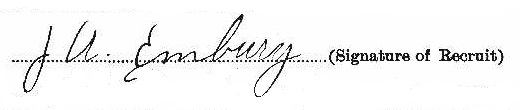
Joseph Allan Embury signature

Joseph Allan Embury, a billing clerk for the Canadian Pacific Railway, signed up in Peterborough on this day in 1916. He was born in Deseronto on October 2nd, 1900, the son of Thomas Embury and Nora (née Meagher), although he claimed to have been born in 1898.

Embury joined the 74th Battery of the Canadian Field Artillery with the regimental number 344926. He was five feet four and a quarter inches tall, with a dark complexion, brown eyes and dark brown hair. His service record shows that he left Canada on April 28th, 1917, aged 16, on the SS Olympic, which arrived in England on May 7th.  On May 16th he was admitted to hospital for a month, suffering from an infection. He served in the Artillery’s reserve brigades in England until December 19th, 1917, when he was sent to France.

The fact that Embury was underage was detected on January 9th, 1918 and he was transferred back to England as a minor. There is a copy of his birth registration on his file, supplied by the Deseronto Registrar on February 2nd, 1918.
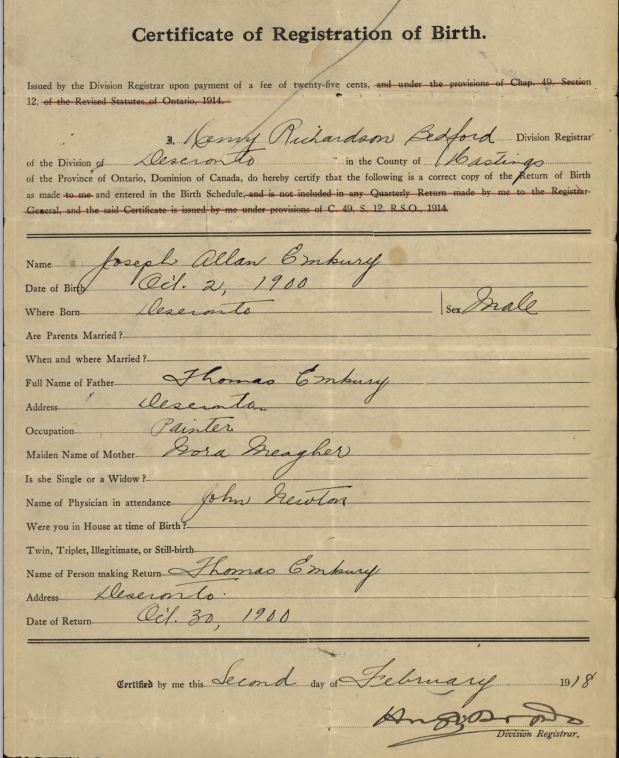
Joseph Allan Embury birth registration copy

In March Joseph was sent home to Canada, where he was discharged from the army on May 14th, 1918 in Kingston, for being underage. He died in Saanich, British Columbia on May 20th, 1961.

David Morley Jackson signature

On this day in 1916 David Morley Jackson, a clerk, signed up in Swift Current, Saskatchewan. He was born in Deseronto on July 16th, 1898, the son of George Ernest Jackson and Elizabeth (née Jamieson). The family were living in Deseronto in 1901 and had moved to Point Anne by 1911.

David joined the 249th Battalion of the Canadian Expeditionary Force, with the regimental number 1069227. He was five feet eight and a half inches tall, with a dark complexion, brown eyes and black hair. His service record shows that attained the rank of lance corporal and he was discharged in Halifax on November 27th, 1918 as he was a railway employee (a telegraphist).

Jackson married Mae Marguerite Kerr in Belleville on November 24th, 1922. Family tree information on Ancestry.ca suggests that he died in Oshawa on September 25th, 1969.

Clarence Merritton Giffin signature

Clarence Merritton Giffin, a railway clerk, signed up in Windsor, Ontario on this day in 1916. He was born in Maitland, Ontario, the son of William Ernest Giffin and Margaret Grace (née McMullen) on September 16th, 1898. In 1901 the family were in Belleville and in 1911 they were in Deseronto, where William was working as a druggist. Clarence attended Deseronto High School.

Clarence Giffin joined the 63rd Depot Battery of the Canadian Field Artillery with the regimental number 334088. He was five feet five inches tall, with a fair complexion, blue eyes and black hair. His service record shows that he arrived in England in December 1917 on the SS Megantic and went to France on April 2nd, 1918. In July he reported sick and he spent the rest of the war in various hospitals, suffering from nephritis. He was invalided home to Canada on the hospital ship Essequibo in January 1919 and discharged as medically unfit for service on May 12th, 1919.

In 1921 Giffen was back in Windsor with his parents and sisters, working as a salesman. He moved to the United States and died in Rocky River, Ohio, in 1974.

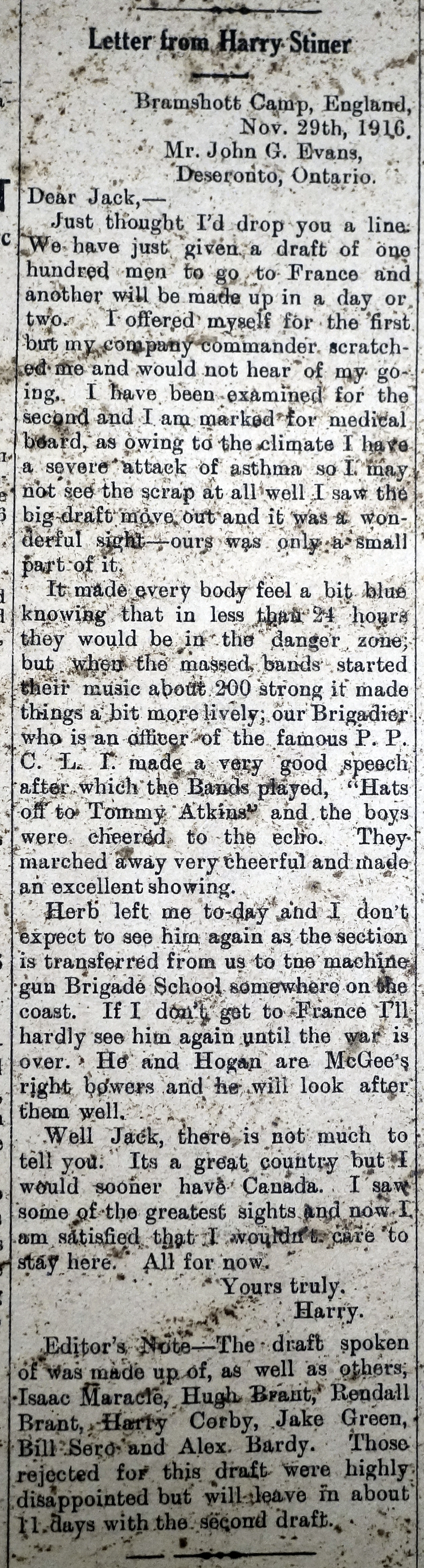
Harry Stiner, who had enlisted on January 15th, wrote a letter home to John ‘Jack’ Evans on this day in 1916. At the time Harry was stationed in Camp Bramshott in Hampshire, England and was hoping to be posted to France. His letter was published in the Deseronto Post of December 14th, 1916:

Deseornto Post 14 Dec 1916 Letter from Harry Stiner

Letter from Harry Stiner
Bramshott Camp, England,
Nov. 29th, 1916
Mr John G. Evans
Deseronto, Ontario.
Dear Jack, —
Just thought I’d drop you a line. We have just given a draft of one hundred men to go to France and another will be made up in a day or two. I offered myself for the first but my company commander scratched me and would not hear of my going. I have been examined for the second and I am marked for medical board, as owing to the climate I have a severe attack of asthma so I may not see the scrap at all well I saw the big draft move out and it was a wonderful sight-ours was only a small part of it.
It made every body feel a bit blue knowing that in less than 24 hours they would be in the danger zone but when the massed bands started their music about 200 strong it made things a bit more lively; our Brigadier who is an officer of the famous P.P.C.L.I. [Princess Patricia’s Canadian Light Infantry] made a very good speech after which the Bands played, “Hats off to Tommy Atkins” and the boys were cheered to the echo. They marched away very cheerful and made an excellent showing.
Herb left me today and I don’t expect to see him again as the section is transferred from us to the machine gun Brigade School somewhere on the coast. If I don’t get to France I’ll hardly see him again until the war is over. He and Hogan are McGee’s right bowers and he will look after them well.
Well Jack, there is not much to tell you. Its a great country but I would sooner have Canada. I saw some of the greatest sights and now I am satisfied that I wouldn’t care to stay here. All for now.
Yours truly.
Harry.

Editor’s Note-The draft spoken of was made up of, as well as others, Isaac Maracle, Hugh Brant, Rendall [Randall] Brant, Harry Corby, Jake Green, Bill Sero and Alex Bardy. Those rejected for this draft were highly disappointed but will leave in about 11 days with the second draft.

Frank Waterbury signature

Frank Waterbury, a carpenter, signed up in Deseronto on this day in 1916. He was born in Deseronto on September 15th, 1890, the son of James Waterbury and Minnie (née Solmes). He gave his next of kin as Bertha Waterbury, his wife.

Frank joined the 235th Battalion of the Canadian Expeditionary Force with the regimental number 1027511. He was five feet nine and a half inches tall, with a fair complexion, brown eyes and brown hair. His service record shows that he and Bertha had two children (Elfrida and Francis) when he enlisted. Waterbury arrived in England on June 9th, 1917 on the SS Olympic and was transferred to the 230th Forestry Battalion in Sunningdale, Berkshire. In March 1918 he was again moved, this time to the Canadian Railway Troops Depot in Purfleet. He went to France on March 29th, 1918 and served there until January 1919.

During the war, Frank Waterbury married Elizabeth Davis in Barnet, Hertfordshire, England in 1917. They had a son, Francis, who was born in Windsor in 1918. There is a note on Frank’s file changing his official next of kin from Bertha to Elizabeth and a record of a letter stating that Bertha had not been Frank’s legal wife.

Frank’s new family travelled to Canada on the SS Metagama, arriving on May 2nd, 1919. Frank was demobilised in Quebec on May 4th. In 1921 the Waterburys were living in Thomas Street, Deseronto, with Francis and another son, Edward. A note on his service file records that Frank died on December 13th, 1960. He was buried in Sunderland, Ontario.

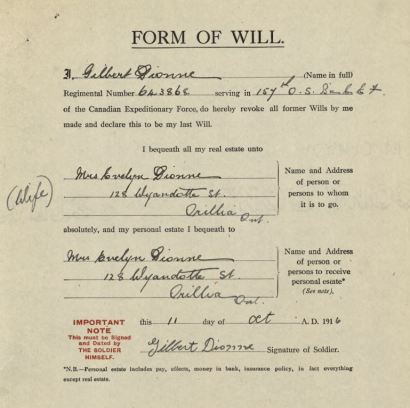
Gilbert Dionne signatureOn this day in 1916 Gilbert Dionne died in No. 12 Canadian General Hospital in Bramshott, England nine hours after an operation to repair a perforated duodenal ulcer. He had made an army will five weeks before his death, just before he left Canada, in which he left all his possessions to his wife, Evelyn.

Gilbert Dionne's will, from his service record at Library and Archives Canada

Gilbert Dionne’s will, from his service record at Library and Archives Canada

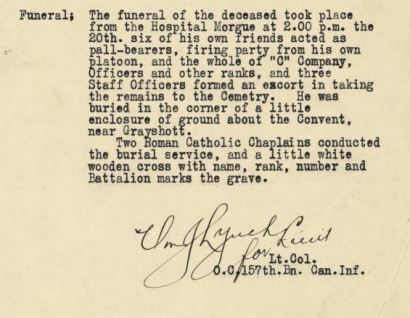
In addition to his will, Dionne’s service file at Library and Archives Canada also contains a description of his funeral, signed by Lieutenant Vincent James Lynch on behalf of the commanding officer of the 157th Battalion:

Description of the funeral of Gilbert Dionne

Funeral: The funeral of the deceased took place from the Hospital Morgue at 2.00 p.m. the 20th. six of his own friends acted as pall-bearers, firing party from his own platoon, and the whole of “C” Company, Officers and other ranks, and three Staff Officers formed an escort in taking the remains to the Cemetry. He was buried in the corner of a little enclosure of ground about the Convent, near Grayshott.

Two Roman Catholic Chaplains conducted the burial service, and a little white wooden cross with name, rank, number and Battalion marks the grave.

Later, the wooden cross described by Lieutenant Lynch was replaced by a War Graves Commission headstone in the St. Joseph’s Roman Catholic Cemetery in Grayshott, Hampshire, England.

Photo courtesy of Findagrave.com (uploaded by Don Knibbs)

James Malcolm Wright signature

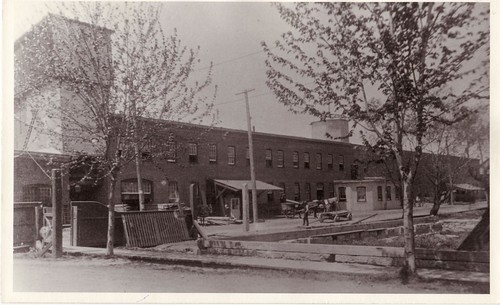
James Malcolm Wright signed up in Kingston on this day in 1916. He was born in Elzevir on September 24th, 1885, the son of John Wright and Sarah Ann (née Juby). By 1901 the family were living in Deseronto and James was a labourer in the Rathbun Company’s sash and door factory in Mill Street. He married Lily May McConnell in Belleville on November 22nd 1909, two weeks after his father had died. His mother died in 1911.

RATHCO-06-28 Rathbun Company’s sash and door factory in Deseronto

Wright had previously served in the 155th Battalion. On this day he joined the 207th Battalion with the regimental number 636838. He was five feet four inches tall, with a medium complexion, grey eyes and brown hair. His service record shows that he left Halifax in May 1917 on the SS Olympic. He arrived in France in January 1918 and served there until September, when he was admitted to hospital, suffering from myalgia in his legs. He was sent home to Canada on the SS Empress of Britain on March 23rd, 1919 and was demobilized in Kingston on April 1st, 1919.

James was living in Adolphustown with Lily May and their three sons in 1921. He died in Toronto on August 28th, 1966.

Leon Henry Morris signature

On this day in 1916 Leon Henry Morris signed up in Deseronto. He stated that he was born in Deseronto on December 17th, 1891. He was the son of Dennis Morris and Laura (née Ruise) and married Nellie Mountenay on August 8th, 1911 in Napanee.

Morris was an ‘automobile driver’ who had previously served in the Canadian Horse Artillery. He joined the 254th Battalion with the regimental number 1093018. He was five feet seven inches tall, with a fair complexion, brown eyes and brown hair. His service record shows that he was transferred to the Nova Scotia Forestry Battalion, stationed in Halifax, where he was appointed acting sergeant in April 1917. He suffered from recurring bouts of appendicitis, and refused to undergo an operation to remove the appendix. The army recommended in July 1917 that he be discharged and his file notes that he deserted in September 1917.

Leon Henry Morris seems to have divorced Nellie, as she left Canada for Detroit in 1925 with their daughter, Margaret.

Thomas Brant (Hill) signature

Thomas Brant signed up in Belleville on this day in 1916. He stated that he was born in Shannonville on March 1st, 1899. Our colleagues at the Mohawks of the Bay of Quinte’s Research Unit have identified him as Thomas Hill.

Thomas joined the 235th Battalion with the regimental number 1027453. He was five feet six and a half inches tall, with a dark complexion, brown eyes and chestnut hair. Thomas’s service record states that his father, also Thomas, was at the front. This is possibly the Thomas Hill who enlisted in February 1915.

Thomas junior was discharged from the army in March 1917 when he was considered to be under age. The medical board which examined him determined that he was fifteen years old, but he may have been even younger (census records suggest that he was born in 1905).

Thomas Brant (Hill) medical board

Extract from medical board report in Thomas Brant/Hill’s service record, courtesy of Library and Archives Canada.


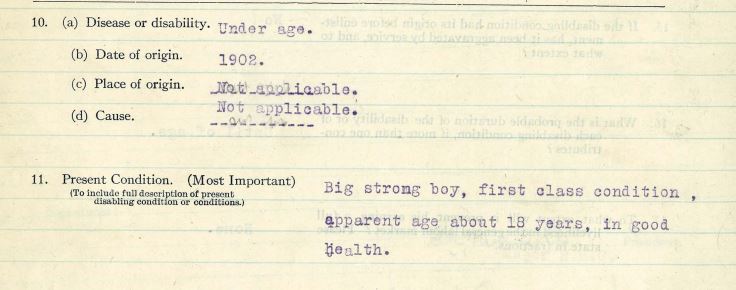
10 (a) Disease or disability. Under age

(b) Date of origin. 1902


11. Present Condition (Most Important). Big strong boy, first class condition, apparent age about 18 years, in good health.

Joseph Maricle signature

On this day in 1916 Joseph Maricle signed up in Hamilton. He gave his date of birth as May 29th, 1872 and his place of birth as Deseronto. His next of kin was his wife, Margaret (née Lickers), with whom he had several children by the time he enlisted. The family lived in Grimsby, Ontario.

Joseph joined the No. 2 Construction Battalion with the regimental number 931593. His service record shows that he was transferred to the 256th Battalion in Nova Scotia in January 1917 but never reported for duty and was struck off the strength of that battalion as a deserter on March 6th, 1917.

Maggie, Joseph’s wife died on February 10th, 1919 at the age of 44 from an infection after childbirth. Family tree information on Ancestry suggests that Joseph died in Tyendinaga in 1954, aged 80.

« Previous PageNext Page »