veterans


Robert Watson signature

Robert Watson, an electrician, was drafted on this day in 1917. He was born in Deseronto on November 13th, 1893, the child of Robert Watson and Marie (née Curlette). When he was conscripted he was living at 1502 Queen Street, Toronto.

Watson was five feet eleven and a half inches tall, with a fair complexion, blue eyes and light brown hair. He joined C Battery of the Royal Canadian Horse Artillery with the regimental number 349849. His service record shows that he left Halifax on the SS Metagama in February 1918 and served in England until October 1918 when we was sent to France. He was there until April 1919 and left England for Canada on the troopship Cedric on May 19th, 1919.

Watson was demobilized in Montreal on May 29th, 1919 and was back in Toronto with his parents, living at 271 Dunn Avenue, in 1921.

Ross Ambrose Harrison signature

On this day in 1917, Ross Ambrose Harrison was killed at Camp Taliaferro in Texas, while training with 78 Canadian Training Squadron, part of the 42nd Wing of the Royal Flying Corps which had moved from Deseronto to Texas for the winter.

View of Camp Taliaferro, Texas (2009.20 (35))

Harrison was born in Kingston, Ontario on April 20th, 1892, the son of Thomas Harrison and Bridget (née McCummiskey). He signed up in Toronto on September 1st, 1917. The official casualty card for the incident notes that he was alone in his Curtiss JN4 aircraft at the time of the accident and that its cause was unknown. His body was brought back to Ontario and buried in St. Mary’s Cemetery, Kingston.

Frederick George Adams signature

Frederick George Adams, a moulder, signed up in Kingston, Ontario, on this day in 1917.  He was born in Deseronto on January 21st, 1895 (the birth registration says January 25th), the son of Joseph Henry Adams and Sarah Helen (née White). His father died of cancer in 1914 in the Rockwood Hospital in Kingston and Sarah married John Bawden in Belleville in 1916.

Adams joined the 73rd Battery of the Canadian Field Artillery with the regimental number 344109. He was five feet eleven inches tall, with a fair complexion, brown eyes and brown hair. His service record shows that Adams arrived in England on board the SS Lapland in February 1918. He was posted to France in September, joining the 5th Brigade of the Canadian Field Artillery.

Frederick received a gunshot wound to the face on October 31st, 1918 and spent the following three weeks in hospital at Le Tréport in France. He returned to Canada, again on the SS Lapland, in June 1919, and was discharged in Kingston on June 11th.

On July 11th, 1922, Adams married Stella McHugh in Belleville. He died of tuberculosis in the Belleville General Hospital on November 8th, 1929 and was buried in Belleville.

Readers of this blog will be very familiar with the exploits of the pilots who trained at Deseronto in the First World War, but may be less aware of the pilot training that took place in the area during the Second. The former Camp Mohawk site on the Tyendinaga Mohawk Territory became part of the British Commonwealth Air Training Plan, as No. 1 Instrument Flying School, during World War II.

A recent visitor to the Community Archives in Belleville brought in some materials which relate to Flight Officer George McCallum Sheppard’s time at the School. Sheppard was from Gananoque, and was stationed in Tyendinaga from 1940 to 1945 as part of ‘B’ Flight as a flight instructor.

This photograph is of an unofficial coat of arms designed by a member of the school, which lists the people who worked there:  J. A. ‘Jack’ Coulter, J. E. ‘Johnnie’ Millard, R. W. ‘Ralph’ Snider, D. K. ‘Mac’ McColl, L. G. ‘Lloyd’ Polden, W. E. ‘Mac’ McKinney, J. H. ‘Joe’ Wiley, R. A. ‘Bob’ Harris, D. H. ‘Sammy’ Wood-Samman, J. H. ‘Jimmy’ Clarke, W. F. ‘Bill’ Veitch, W. H. ‘Bill’ Durnin AFC, P. M. ‘Pete’ Bickett, E. E. ‘Hake’ Hacon, A. A. ‘Art’ Egan, G. J. ‘Fin’ Finlay, G. M. ‘Shep’ Sheppard, W. J. ‘Bill’ Morrison.

Harold Mills, the donor of these materials is interested in knowing whether anyone can identify the location of the house in the image below. It was the scene of a crash that took place on August 3rd, 1943. Flight Officer Sheppard’s Airspeed Oxford lost power to its port engine and clipped two trees before crashing just short of this farmhouse. Mr Mills would love to know where the house was. Please comment if you can help.

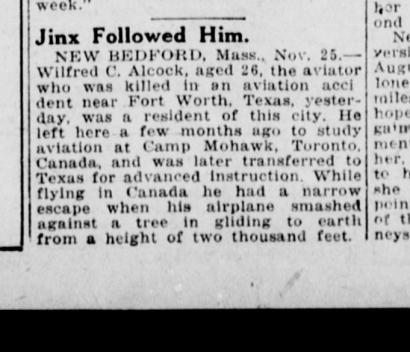
Wilfred C. Alcock signatureWilfred Cecil Alcock was a cadet with the 42nd Wing of the Royal Flying Corps when he was killed at Camp Taliaferro, the winter training quarters for the Deseronto pilot trainees.  A report in the Tulsa Daily World newspaper noted that he had a previous near miss at Camp Mohawk, where he was attached to 79 Canadian Training Squadron:

Tulsa Daily World report on Wilfred C. Alcock's death

Jinx Followed Him

NEW BEDFORD, Mass., Nov. 25 – Wilfred C. Alcock, aged 26, the aviator who was killed in an aviation accident near Fort Worth, Texas, yesterday, was a resident of this city. He left here a few months ago to study aviation at Camp Mohawk, Toronto, Canada, and was later transferred to Texas for advanced instruction. While flying in Canada he had a narrow escape when his airplane smashed against a tree in gliding to earth from a height of two thousand feet.

The official Royal Flying Corps account of Alcock’s fatal accident gives more detail on the cause of the crash:

Wilfred C. Alcock RFC casualty card

…Date of Casualty: 24.11.17
Where occurred: Canada Sth of aero field No 2 Camp Taliaferro
Type of Machine: Curtiss J.N.4 C760
Nature and Cause of Accident: Centre section of machine Carried away by under carriage of another machine
Result of Accident: Killed
Name of other Occupant of Machine: Nil…

Alcock was born in Knutsford, Cheshire, England on May 10th, 1891, the son of Frederick Alcock and Harriet (née Jones). In 1911 he was living at 95 King Street, Knutsford, with his parents and working as a printer. He emigrated to New York in 1912, leaving Glasgow on the SS California on October 19th. He joined the Royal Flying Corps in Toronto on September 6th, 1917, giving his home address as 131 Merrimac Street, New Bedford, Massachusetts.

Wilfred was buried in Oak Grove cemetery, New Bedford and is also remembered on the Mobberly Road war memorial at Knutsford in England.

Alexander Roderick Pye signature

Alexander Roderick Pye was conscripted under the Military Service Act in Toronto on this day in 1917. He was born in St. John’s, Newfoundland, the son of John Pye and Mary (née Stewart) on April 30th, 1889. When he was called up he was working as a bank clerk at the Bank of Montreal in Deseronto.

Bank of Montreal (now Deseronto Town Hall)

He gave his next of kin as his sister, Effie Pye, of Herne Bay, Kent, England. Pye had previously served for three years as a corporal in the 13th Royal Regiment. He was five feet five and a half inches tall, with a dark complexion, dark brown eyes and black hair. He joined the 69th Overseas Battery with the regimental number 340350. His service record shows that he arrived in Scotland on the SS Lapland on February 24th, 1918. He went overseas to join the Canadian Field Artillery in France on October 27th, 1918. He left England to return to Canada on March 19th, 1919 and was demobilized in Toronto on March 30th.

Alexander married Sophie May Jolley in Hamilton on July 3rd, 1923. He died on August 28th, 1958.

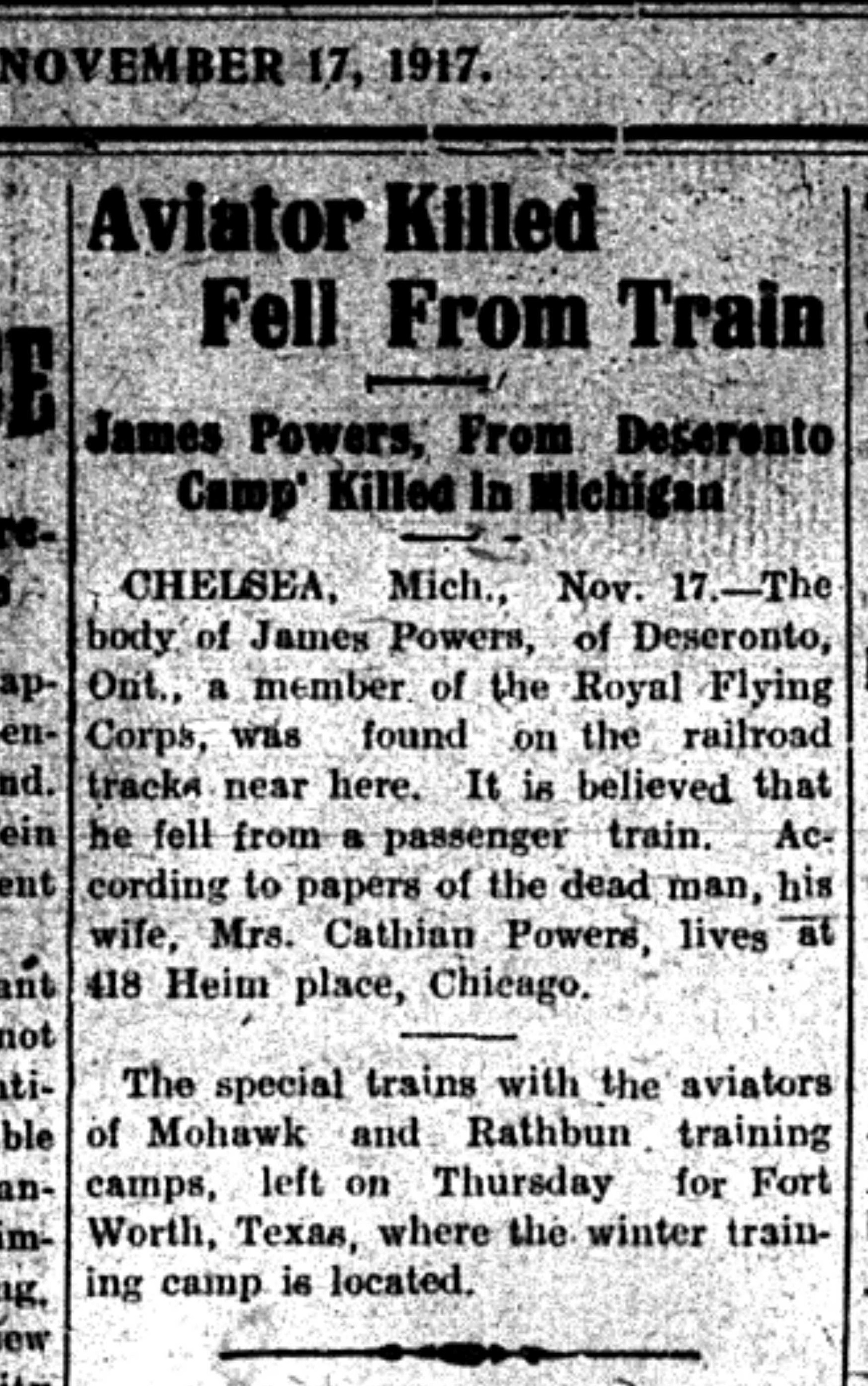
Intelligencer report of 1917 Nov 17 on James Power's death

Intelligencer report of November 17th, 1917 on James Power’s death, courtesy of Belleville Public Library

Aviator Killed
Fell From Train
James Powers, From Deseronto Camp Killed in Michigan

CHELSEA, Mich., Nov. 17. – The body of James Powers, of Deseronto, Ont., a member of the Royal Flying Corps, was found on the railroad tracks near here. It is believed that he fell from a passenger train. According to papers of the dead man, his wife, Mrs. Cathian Powers, lives at 418 Heim place, Chicago.

The special trains with the aviators of Mohawk and Rathbun training camps, left of Thursday for Fort Worth, Texas, where the winter training camp is located.

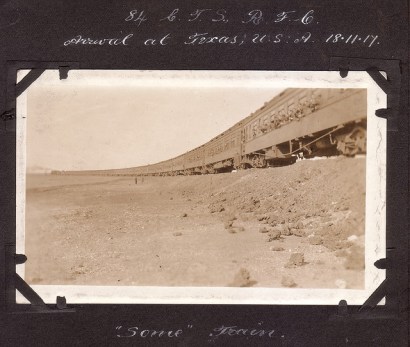
In November 1917 the Royal Flying Corps pilot training camps in Canada relocated to Texas to take advantage of the milder climate. This involved transporting men and equipment by railway from Ontario to Fort Worth, some 1,600 miles or 2,500 kilometres. It took three days to make the journey. The photograph below shows the size of the trains used in this exercise.

2009.20(36)

From the collection of Sergeant C.P. Devos (2009.20(36), courtesy of Denzil Devos

Cadet James Powers somehow fell from the train on the way. The Royal Flying Corps casualty card states “Believed to have fallen from train window”.  In 1914 Powers had married Kathleen Buckley in Chicago and the couple’s home was in that city. It is possible that he had been trying to get back home to Kathleen when he died.

James Powers signature

Powers was born in 1885. He had joined the Royal Flying Corps in Toronto on September 10th, 1917 with the regimental number 150021. He was five feet six and a quarter inches tall and had been attached to 80 Canadian Training Squadron.

He was buried at the Elmwood Cemetery at River Grove, Illinois.

Harold Clement Gracey signature

Harold Clement Gracey, a bank clerk, signed up in Kingston on this day in 1917. He was born in Deseronto on April 4th, 1891, the son of Albert Gracey and Mehetable (née Clement). At the time of the 1911 census he was working in Peterborough.

Gracey joined the 73rd Battery of the Canadian Field Artillery with the regimental number 344090. His attestation form notes “Enlisted under Military Service Act. Reg. No. 918385 P. C.”. He was five feet eight inches tall, with a dark complexion, brown eyes and dark brown hair. His service record shows that Gracey left Canada for England on February 22nd, 1918 on the SS Metagama. He served in England with the Reserve Brigade of the Canadian Field Artillery and in September 1918 was transferred to the 9th Brigade in France, where he stayed until February 1919. Between February and April 1919 he was treated in hospital in England for inflamed connective tissue of the right hand.

Harold left England for Canada on May 11th, 1919 on the SS Saturnia and was demobilized in Kingston on May 23rd. He married Norrine Victoria Schoales in Toronto on April 24th, 1929. He died in Goderich on July 11th, 1971.

Thomas Frederick Stevenson signature

Thomas Frederick Stevenson, an electrician, was drafted into the army in Toronto under the Military Service Act. He was born in Deseronto on December 13th, 1896, the son of John Stevenson and Emma Etta (née Luffman). The family were still in Deseronto in 1911, but by the time Thomas was conscripted they were living in Toronto, at 54 Hamilton Street.

Stevenson joined the 71st Battery of the Canadian Field Artillery with the regimental number 342265. He was five feet ten inches tall, with a fair complexion, blue-grey eyes and auburn hair. His service record shows that he went overseas on October 4th, 1918 on the SS Victoria. He was only in England briefly: he came back to Canada on November 29th on the SS Aquitania. On February 3rd, 1919, he was discharged in Toronto as medically unfit due to a varicocele which required an operation.

Stevenson married Emma Adele Bowles in Toronto on June 20th, 1923. Information from an Ancestry family tree suggests that he died on July 5th, 1961.

Alexander Bey signature

On this day in 1917 Alexander Bey was drafted into the army in Vancouver under the Military Service Act. He was born in Shannonville on August 31st, 1892, the son of George Bey (or Bay) and Cynthia Lucinda (née Maracle), who were both Mohawks. Bey gave his home address as Fernie, British Columbia.

Alexander joined the 1st Depot Battalion of the British Columbia Regiment with the regimental number 2020341. He was five feet seven inches tall, with a medium complexion, brown eyes and brown hair.

Bey’s service record shows that he arrived in Scotland on December 31st, 1917. He served in the 16th and 1st Reserve Battalions before being transferred to France to fight with the 7th Battalion in April 1918. He survived the war and left England for Canada in April 1919 on board the RMS Olympic. He was demobilized in Kingston on April 24th. He later lived in Spokane, Washington.

« Previous PageNext Page »