veterans


Stephen Francis Carroll's signature

On this day in 1918 Stephen Francis Carroll, a shipbuilder, was conscripted in Oshawa under the Military Service Act. His birth was registered in Deseronto as being November 21st, 1887, although he said it was November 22nd, 1888 on his draft form. Carroll was the son of Thomas Carroll and Mary Ellen (née Murphy). The family were still in Deseronto in 1901 but had moved to Tay Township, Simcoe County by the time of the 1911 census, when Thomas and Stephen were both working in a sawmill. Carroll gave his home address as Midland in 1918.

Stephen joined the 2nd Depot Battalion of the 2nd Central Ontario Regiment with the regimental number 3317280. He was described as being five feet seven inches tall, with blue eyes, a dark complexion and medium hair. His service record shows that he arrived in England on April 19th, 1918 on the SS Metagama. He was transferred to the Canadian Machine Gun Depot in Seaford on May 25th, 1918 and went to France on November 2nd, 1918, just nine days before the end of the war. He returned to England on May 9th, 1919 and left Liverpool on the SS Belgic on June 23rd.

Carroll arrived in Halifax on July 1st, 1919 and was demobilized in Toronto on July 3rd. He married Louisa Ella Beam in Pembroke, Ontario on September 8th, 1924.

John Auger signature

John Auger was conscripted in Kingston on this day in 1918. He was born in Deseronto on April 13th, 1891, the son of Thomas Auger and Clarissa (née Larex).

Auger joined the 1st Depot Battalion of the Eastern Ontario Regiment with the regimental number 3055715. He was five feet five inches tall, with a dark complexion, blue eyes and dark hair. His service record shows that he arrived in England on March 4th, 1918 on the SS Melita. He joined the 2nd Battalion at the front line on September 6th, 1918. He left England for Canada on the RMS Olympic on April 15th, 1919 and was demobilized in Kingston on April 24th, 1919.

In 1921 he was back living in Main Street, Deseronto, with his brother Louis’s family.

Jacob Bernhart signature

On this day in 1918 Jacob Bernhart died of nephritis, a kidney disorder, at No. 4 Casualty Clearing Station in Belgium, where he had been admitted on the previous day.

He was buried at the Dozinghem Military Cemetery in Belgium.

Jacob Bernhart’s grave, from FindaGrave.com

Vernon Leroy Stoddart signatureOn this day in 1918, Vernon Leroy Stoddart died in Belleville General Hospital of a gunshot wound. Stoddart was born in Lawrencetown, Nova Scotia on October 16th, 1893, the son of Lemuel Stoddart and Lillian (née Hunt). In 1911 he was working as a bank clerk.

CABHC: HC06291 Belleville General Hospital in 1914

CABHC: HC06291 Belleville General Hospital in 1914

Stoddart joined the Royal Flying Corps in Halifax, Nova Scotia on November 10th, 1917. His regimental number was 153661 and he was five feet nine inches tall. He was officially accepted into the Corps in Toronto on December 17th. Just a month later, he was killed in a rifle accident while training at Camp Mohawk, aged 24.

On January 18th, the Intelligencer newspaper reported on the inquest in the following way:

CADET STODDART WAS

SHOT BY COMRADE

Shooting Affray at Camp Mohawk Being Investigated – Cadet Moore Fired a Bullet From Gun, When it Was Supposed to be a Blank Cartridge

At Thompson Company’s undertaking parlors in this city last evening. an Inquest was opened before Coroner Dr. Boyce to enquire into the circumstances regarding the tragic death of Flight Cadet Vernon Stoddart. of Camp Mohawk, who died at the hospital here yesterday as the result of a gun-shot wound.

The Jury was composed of Messrs. E. T. Cherry, foreman; Geo Daw, T. F. Wills, Geo. T Woodley, W. A. Woodley, R Zufelt, A Blackburn and C. M. Hall.

Mr. Wm. Carnew. County Attorney, represented the crown in the matter

After the Jury had been sworn in they viewed the body and were shown the wound which had evidently caused death.

Police Officer Sergt. Naphan testified as to the summoning the Jury and that all were qualified to act.

Dr. Tennett gave evidence as to the nature of the wound which had no doubt caused death. He also testified as to deceased being brought to the Belleville hospital from Mohawk Camp to be attended to. Death occurred on Thursday morning about 7 o’clock.

Cadet Alfred Stewart Hunt, a cousin of deceased, testified that he recognised the remains as those of Cadet Vernon Stoddart, whose home was at Lawrencetown. Annapolis County. Nova Scotia, and was a son of Mr. Lemuel H Stoddart. Hunt then gave an explanation as to how deceased came to be shot. He occupied Room 1 of No. 2 Cadet wing. R.F.C. at Camp Mohawk, which was a large sleeping room where some 22 sleep. Considerable time was spent In the room by the cadets. He had heard of no grievances between deceased and Cadet Moore who fired off the gun which caused Stoddart’s death. At about 2.45 or 3 o’clock on Wednesday afternoon. 16th inst., Cadet W. G. Moore, who is a boxer by profession, and had been relieved from all drill on account of some engagements Moore told witness that he was in the club room and picked up one of the guard’s rifle and was demonstrating bow the ejecter and bolt of the rifle would work. For demonstration he used what he supposed was a dummy round or blank cartridge. In the demonstration, the gun was discharged and Moore was In Room No. 5 In rear of No. 1 room where Stoddart was sitting on the bunk occupied by witness. The bullet went through an inch-board partition and struck deceased in the shoulder as he sat with his back to the partition Witness stated that no cadet is allowed to demonstrate with live or dummy ammunition, such being contrary to regulations, unless special authority is given. Whilst Moore was demonstrating the rifle, some fellow cadets were In the room with him. The rifle used was one a guard was to use on duty who was to be posted as guard on the afternoon of the accident. The ammunition apparently came from the aerial gunnery building about half a mile from the barracks. Ammunition is handed out by the instructors. whose duty it is to see that any rounds put out on the tables in this building for use of the machine gun classes in stripping guns are blanks. Moore might have had this cartridge in his pocket. When detained. Moore had no other cartridges in his possession. It is sometimes difficult to detect a live cartridge from a dummy cartridge, as all these are supposed to be dummy. It is against regulations for any cadet to have ammunition. dummy or alive, in his possession, and no cadet has a right to demonstrate a rifle with live or blank cartridges.

This was all the evidence taken at present, and the enquiry was adjourned until Tuesday evening next at thepolice court room.

In the meantime Cadet Moore, who discharged the gun. Is in detention at Mohawk Camp.

Cadet Stoddart. who lost his life, had only been 6 weeks in the service, and only 4 weeks at Camp Mohawk. Tbe remains will be sent to Lawrencetown, N.S.. for interment.


Fairview Cemetery, Lawrencetown, Nova Scotia, courtesy of FindaGrave.com

Vernon Stoddart was buried at Fairview Cemetery, Lawrencetown. A transcription of a newspaper article about him is available from the Find a Grave site.

William Albert Reynolds signature

On this day in 1918 William Albert Reynolds, a cigar maker, was conscripted in Vancouver. He was born in Deseronto on August 4th, 1887, the son of Norman Reynolds and Charlotte (née McNamara). By 1901 the family were living in British Columbia, and their address when William Albert was drafted was 1022 Seymour Street, Vancouver.

Reynolds joined the 1st Depot Battalion of the British Columbia Regiment with the regimental number 2020981. He was five feet two and a half inches tall, with a fair complexion, blue-grey eyes and brown hair. His service record shows that he arrived in England on March 11th, 1918 on the SS Metagama. He served in England with the 29th Battalion and returned to Canada in May 1919 and was demobilized on May 24th in Vancouver. He was back in Seymour Street in 1921 with his parents.

Reynolds died on January 13th, 1944.

Harry Douglas Barnhardt signature

Harry Douglas Barnhardt, a steel worker, was conscripted in Kingston on this day in 1918. He was born on in Belleville (or Warkworth) on November 21, 1888 (some sources say 1887), the son of Charles Barnhardt and Euphemia Campbell. His parents married in 1891. Euphemia was born in Scotland and Charles was born in Adolphustown, the son of Hiram Barnhardt, a Mohawk, and Bridget (née Williams), who was of Irish ancestry. They were living at 20 Wharf Street, Belleville, when Harry was drafted.

Barnhardt joined the 6th Canadian Reserve Battalion with the regimental number 3055947 His service record shows that he arrived in England on the SS Melita on March 4th, 1918. He spent April in hospital with mumps. In September he was transferred to the 21st Battalion and served with them in France from September 19th.

William Henry Thompson signature

On this day in 1918 William Henry Thompson, a telegraph operator, was conscripted into the army at Kingston. Thompson was born in Deseronto on November 1st, 1893, the son of Robert Thompson and Mary Ann (née Harvey).

William joined the 1st Depot Battalion of the Eastern Ontario Regiment with the regimental number 3055731. He was five feet seven inches tall, with a dark complexion, blue eyes and brown hair. His service record shows that he left Canada on February 24th on the SS Metagama and served in England until September 1918 when he went to join the Canadian Corps Reinforcement Camp in France.

Thompson returned to Canada on the SS Empress of Britain in July 1919 and was demobilized on July 12th in Kingston. He married Aletha Georgina Joyce on June 2nd, 1926 in Deseronto. He gave his occupation as ‘railway clerk’ and Aletha as ‘clerk’. Family tree information on Ancestry suggests that he died in Oshawa on February 4th, 1973.

Frederick Edward Woodall signature

Frederick Edward Woodall, a toolmaker, was conscripted into the army in Toronto on this day in 1918. He was born in Deseronto on August 12th, 1895, the son of Henry Wellington Woodall and Catherine (née McCann). The family were living at 29 Wade Avenue in Toronto when Frederick was conscripted.

Frederick joined the 1st Depot Battalion of the 1st Central Ontario Regiment with the regimental number 3032260. He was described as five feet five and a half inches tall, with a fair complexion, brown eyes and medium hair. His service record shows that he did not go overseas. On October 9th he was admitted to hospital suffering from influenza, returning to duty a week later. He was discharged in Toronto on December 7th, 1918. Woodall married Margaret Pogue in Toronto on July 19th, 1919.

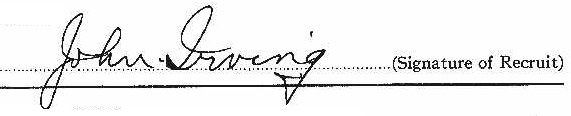
John Henry Irving signature

John Henry Irving, a clerk, was conscripted at Kingston on this day in 1918. He was born in Tamworth on October 30th, 1896 (some sources say 1897), the son of David Irving and Lavinia (née Brown). When he was drafted, Irving was living in Deseronto.

John joined the 1st Depot Battalion of the Eastern Ontario Regiment with the regimental number 3055373. He was five feet three inches tall, with a fair complexion, blue eyes and fair hair. His service record shows that he served in Kingston with No. 3 Battalion, Canadian Garrison Regiment and held the rank of acting sergeant when he was demobilized on December 9th, 1918. He had been suffering from bronchitis and was discharged as being medically unfit for further service.

Irving married Gladys Holmes Becket on November 30th, 1928 in Brockville, at which time he was working as a cashier.

James Green signature

On this day in 1917, James Green, a munition worker, was drafted into the 1st Central Ontario Regiment in Toronto. Green was born in Deseronto on August 4th, 1883 (or 1885, according to the 1891 and 1901 census returns), the son of John Green and Christina (née Maracle), who were both Mohawks. By 1911 the family were living in Midland, Ontario, where the men worked in the sawmill.

When he was conscripted, James was described as five feet three and a half inches tall, with a dark complexion, hazel eyes and dark hair. He had a crushed index finger on his left hand and scars on his right leg and stomach. His regimental number was 3031490. His service record shows that he arrived in England on February 6th, 1918 on the SS Scotian. He went to France with the 75th Battalion on May 11th. On December 4th, 1918 he was awarded the Military Medal.

James left England for Canada on May 31st, 1919, on the SS Mauretania. He was demobilized in Toronto on June 8th. A note on his file states that he died on April 1st, 1954.

« Previous PageNext Page »