World War I


Reverend Dr Allan Miller sent us this letter from The Sarnia Canadian Observer which shows an interesting glimpse of life with 89 Canadian Training Squadron at Camp Rathbun for pilots-in-training. It was written by Cadet William Boyce Mavity to his mother, Emily and published in the newspaper 100 years ago today.

Letter from Camp Rathbun

Camp Rathburn, Deseronto
Dear Mother—Here I am away out at Camp Rathburn, which is about twenty minutes walk from Deseronto. This is a small camp, there being only about 100 cadets in training. Camp Mohawk is about a mile away. This afternoon I went up for my first “joy ride” and it’s almost impossible to describe the sensation. In starting off the bumping of the wheels on the uneven ground can be felt, but as the machine gains speed it gradually lifts itself off the ground and seems to be riding on cushions, there being no jar whatsoever. The ground seems to fall away from the machine until it gains level flying position, when the machine seems to be suspended in the air and the ground moving. The machine I was in attained an altitude of 5,000 feet (the Curtis will not climb over 8,000) and you can’t imagine how strange the earth looked. It was impossible to discern people on the ground, but cows and horses were evident. Houses looked like little blocks and roads like long narrow strips of white ribbon. The farming country looks like a checkerboard and the Bay of Quinte and small lakes look just like pools of melted lead.
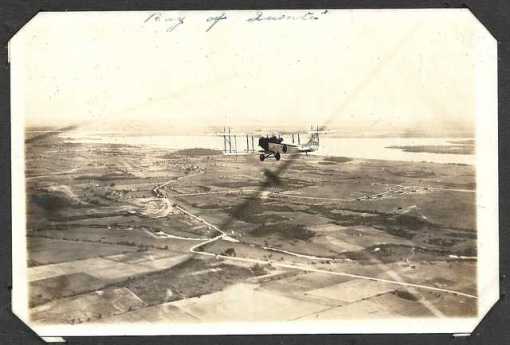
Bay of Quinte from the air

DA 2012.10 (09)

The only thing that bothered me, was when the instructor headed the machine into a straight nose dive. The earth started to rush toward us and I began to feel sick at the stomach. The machine dropped about 4,000 feet before it straightened out. I was up 30 minutes. You can’t imagine how strong the wind is at a high altitude and especially when the machine is falling. I wore a big heavy leather coat, thick gloves, goggles and a crash helmet. The wind exerts such pressure on the helmet and forces it on your head so hard that your head aches. The goggles were not very air tight and the wind nearly blew my eyes out. I will go up again tomorrow and will be allowed to guide the machine myself. This morning a cadet started on his first solo flight. He went up twice and landed twice, but the third time he tried to land, the machine landed on its nose and was completely demolished and he didn’t even get scratched. In fact, he got another machine and went up again.
The meals we get here are swell. We get 90 cents a day extra while flying, but they take $8 a week for board. We have fresh tomatoes, chicken, cake, ice cream, pie fruit—in fact, the best of everything and all is well cooked. We have flowers on the tables and have waiters to wait on us and eat with the officers. At present I am sleeping in a tent with two other fellows. We have a coal oil stove and lantern, too.
Well I will close now, write soon,
lovingly,
HAP
My address is
No. 15300 Cadet W. B. Mavity
89th C.T.S. R.F.C.
Deseronto Ont.

Mavity had originally enlisted in the Canadian Expeditionary Force on February 24th, 1917, but was discharged six weeks later for being under age. He joined the Royal Air Force in 1918 after his nineteenth birthday. He completed his training was granted a temporary commission as a 2nd lieutenant on September 5th, 1918.


Thomas Jerome Toppings signature

Thomas Jerome Toppings, a wheelman on the Great Lakes, was conscripted in London, Ontario, on this day in 1918. His draft paper notes that he was “apprehended” on June 3rd. He was born in Deseronto on December 29th, 1895, the son of John Toppings and Annie (née Hastings). By the time Thomas was conscripted, both of his parents had died (they were buried in Kingston) and he gave his uncle, James Toppings of Montreal, as his next of kin. He listed his own address as 124 Montreal Street, Kingston.

Toppings joined the 1st Depot Battalion of the Western Ontario Regiment with the regimental number 3137596. He was five feet five and three quarter inches tall, with a dark complexion, blue eyes and black hair. His service record shows that he was struck off the strength of the regiment on August 22nd, so that he could join the Royal Naval Canadian Volunteer Reserve.

In 1939 Toppings married Florence Elizabeth Dickert (née Fletcher), a divorced dressmaker, in Toronto.

Alexander Stormes signature

On this day in 1918 Alexander Stormes was conscripted in Camp Barriefield, Kingston. Stormes (sometimes Storms) was born in Violet, Ontario on February 1st, 1894, the son of Norman Stormes and Florence Thompson. By 1911 the family were living in Tyendinaga. Stormes gave his home address as Deseronto when he was drafted.

Alexander joined the 1st Depot Battalion of the Eastern Ontario Regiment with the regimental number 3060358. He was five feet eight inches tall, with a dark complexion, blue eyes and black hair. His service record shows that he did not go overseas and was demobilized at Barriefield Camp in Kingston on January 28th, 1919.

In 1921 Alexander was back with his parents, now in Richmond Township, where he was working as a storekeeper.

John James Hoppes signature

John James Hoppes, a clerk from Kingston, was conscripted on this day in 1918. Hoppes was born in Deseronto on October 17th, 1894, the son of Joseph Hoppes and Katherine ‘Kit’ (née Stokes). The family were still in Deseronto at the time of the 1901 census, but had moved to Kingston by 1911. John James married Julia Beaupre Pound in Kingston on September 11th, 1917.

Hoppes joined the 1st Depot Battalion of the Eastern Ontario Regiment with the regimental number 3060377. He was five feet nine inches tall, with a fair complexion, brown eyes and dark hair. The draft form noted that he suffered from tachycardia and was ‘inclined to obesity’. A medical board determined that he was only fit for home service. Hoppes was taken on the strength of No. 3 Battalion Garrison Regiment in Kingston. He was discharged on November 25th, 1918 as medically unfit for further service.

In the 1930s Hoppes was living in Montreal and working as a merchant and exporter: he made trips across the Atlantic to England in 1939 and 1947.

John Brant signature

On this day in 1918 John Brant was drafted under the Military Service Act, 1917. He was born in Tyendinaga on August 9th, 1895, the son of Cornelius Brant and Catherine (née Maracle), who were both Mohawks. He was living at 97 Cannon Street, Hamilton when he was conscripted and working as a boiler maker. He joined the 2nd Depot Battalion of the 2nd Central Ontario Regiment with the regimental number 3311427. He was five feet seven inches tall, with a dark complexion, brown eyes and black hair.

Brant’s service record notes that he was struck off the strength of the regiment on June 16th at Niagara Camp because he had been “erroneously ordered to report”. Indigenous men had been exempted from conscription by an Order in Council of January 17th, 1918.

In 1921 Brant was back in Tyendinaga with his parents. A note on his service file gives his date of death as March 19th, 1977.

James Alex Kitchen signature

On this day in 1918 James Alexander Kitchen, a printer, signed up in Detroit, Michigan. Kitchen was born in Deseronto on June 25th, 1898, the son of Sidney J. Kitchen and Annie (née Breault).

James A. Kitchen (picture courtesy of John Kitchen)

Kitchen joined the 1st Depot Battalion of the 1st Central Ontario Regiment with the regimental number 2029628. He was five feet nine inches tall, with a medium complexion, brown eyes and brown hair. His enlistment was reported on in the Deseronto Post newspaper, for which he had previously worked, in the July 18th, 1918 edition:

Deseronto Post 1918 Jul 18 James Kitchen's enlistment

PTE. JAS. A. KITCHEN
eldest son of Mr. and Mrs. Sidney J. Kitchen, Deseronto, who is now with the 1st Depot Battalion, 1st C.O.R, Pte. Kitchen is well known in Deseronto and surrounding districts and was at one time an employee of The Deseronto Post before going to Detroit, Mich,. from where he enlisted last 25th of May, training till lately at Niagara Camp.

Kitchen’s service record shows that he arrived in England on the SS Corsican on August 8th, 1918. After training, he was transferred to France on November 6th, 1918. He was back in England in January 1919 and left England for Canada on the SS Empress of Britain in February, arriving on February 25th. He was demobilized on March 17th in Kingston.

James married Detroit native Marie Matilda Brandenburg in Deseronto on June 25th, 1919 (his birthday). In 1921 the couple were living in Dundas Street, Trenton, and James was working as a brakeman on the railway. James’s nephew, John, tells us that he died on August 10th, 1972 in Belleville.

Montaville Sager signature

On this day in 1918, Montaville Sager, a farmer, was conscripted at Camp Barriefield in Kingston. According to his draft paper, he was born in Deseronto on April 28th, 1895. In the 1901 census his date of birth was noted as being April 21st, 1897. His parents were Abraham Sager and Elizabeth (née Lewis), who was a Mohawk. Abraham died on March 11th, 1910, when the family were living in Brant Street, Deseronto.

Two days before joining the army, Montaville Sager married Irene Kimball in Peterborough. He joined the 1st Depot Battalion of the Eastern Ontario Regiment with the regimental number 3060307. He was five feet five and a half inches tall, with a dark complexion, brown eyes and brown hair and a weight of 135 pounds. His service record shows that he was demobilized from Camp Barriefield in Kingston on January 20th, 1919.

Sager registered his mother’s death in Deseronto in 1921 and gave his address at that time as Aurora, Ontario.

Rosenthal and Heintzman report of deaths in New York Tribune

New York Tribune report on Heintzman and Rosenthal’s crash, May 30th, 1918

New York Flier Killed in Canada
Samuel Rosenthal and Lieutenant Heintzman Victims of Accident Near Toronto

DESERONTO, Ont., May 29. – Second Lieutenant T. H. Heintzman, of Toronto, was killed, and Cadet S. Rosenthal, of 28 Pinehurst Avenue, New York City, was so badly injured in an airplane accident near Rathburn aerodrome to-day that he died later.
——-
Cadet Samuel Rosenthal was twenty-four years old and lived with his father and mother Mr. and Mrs. E. L. Rosenthal, and four sisters at the Pinehurst Avenue address. Until last December, when he went to Canada to enlist, he was in business with his father at 820 Broadway.
Rosenthal was born in Montreal, Canada. He came to New York with his parents ten years ago, but was never naturalized. As a result he was not accepted when he tried to enlist in this country, and went to Canada in order to get into the army.
He was placed in the Royal Flying Corps in January, and in letters to his parents told of at least six flights he had made alone in the last few weeks. He expected to go abroad in a short time.

Thomas Herman Heintzman signature

Thomas Herman Heintzman, a piano maker, enlisted in Toronto on November 20th, 1917. He was born in that city on July 26th, 1887, the son of Herman Heintzman and Lucy Ann (née Spink). He joined the Royal Flying Corps with the regimental number 152767. He was five feet eight inches tall. On April 24th, 1918, he was granted a temporary commission with the Royal Air Force, working as a flight instructor for the Deseronto Wing with 81 Canadian Training Squadron.

Samuel Rosenthal signature

Samuel Rosenthal had joined the Royal Flying Corps in Montreal on January 17th, 1918 and was officially appointed to the Corps in Toronto two days later. His regimental number was 154067 and he was five feet four inches tall. He was born in Montreal on November 4th, 1893, the son of Eleazer and Fanny Rosenthal.

The Royal Air Force report of the accident which killed the two men at Camp Rathbun noted:

Date of Casualty: 29.5.18
Where occurred: Canada
Type of Machine: Curtiss JN4a C635
Nature and Cause of Accident: Dropped nose on steep bank at 150ft. Machine caught fire on striking ground.
Result of Accident: Killed
Name of other Occupant of Machine: Cadet S. Rosenthal Died of Inj’s.

Lieutenant Heintzman was killed instantly. Cadet Rosenthal’s death registration tells us that he survived for four and a half hours, before dying of shock from his burns.

Heintzman was interred in Mount Pleasant Cemetery, Toronto. Rosenthal was buried in the Shaar Hashomayin Cemetery in Montreal.

Roy Egerton Payne signature

Roy Egerton Payne, a draftsman, was conscripted at Camp Barriefield in Kingston on this day in 1918. He was born in Deseronto on May 21st, 1894, the son of John Dorman Payne and Harriet Gertrude (née Reynolds). By 1901 the family had moved to Bancroft, Ontario.

Payne was described as five feet four and a half inches tall, with a dark complexion, brown eyes and black hair. He joined the 1st Depot Battalion of the Eastern Ontario Regiment with the regimental number 3060188. His service record shows that he went overseas in July 1918 on the HMT Corsican. He served in England and was admitted to hospital in Eastbourne on November 1st with influenza. He was discharged back to duty on November 18th. In June 1919 he sailed back to Canada on the SS Belgic.

He was demobilized on July 3rd, 1919. He died in Bancroft on July 14th, 1925 of tuberculosis.

Sydney Frederick Tichborne signature

On this day in 1918, Sydney Frederick Tichborne, a physician, was conscripted into the Canadian Expeditionary Force at Kingston. He was a graduate of Queen’s University who joined No. 3 Depot of the Canadian Army Medical Corps with the rank of lieutenant. On his Officer’s Declaration paper he gave his current address as Camp Rathbun, Deseronto, where he was working as a Medical Officer. He was born in Enniskillen, Lambton County on 27th October, 1894, the son of William Frederick Tichborne and Grizella (née Hamilton).

Tichborne was described as six feet two inches tall, with a fair complexion, grey eyes and brown hair. His service record shows that he left Canada in September 1918. He served in Shorncliffe in England and at the Kinmel Park Canadian army camp in Wales. Tichborne left England on the SS Minnekahda on July 4th, 1919 and was demobilized in Ottawa on July 18th.

He married Dorothea Saunders (born Kennell), probably in Carbon, Pennsylvania. On April 1st, 1940 the couple were living there with their daughter, Dorothea’s father, and a housekeeper. Three days later, on April 4th, Sydney Tichborne died in Toronto.

« Previous PageNext Page »




