World War I


George Rice signature
George Rice died on this day in 1918. He was a member of the Royal Air Force’s 42nd Wing in Deseronto, but died in Toronto General Hospital of tongue cancer. He was an electrician who had joined the Royal Flying Corps in Toronto on March 27th, 1917 with the regimental number 70853. He was five feet eight and a quarter inches tall. He was promoted to 1st Air Mechanic on February 1st, 1918. Rice was born in England in 1889. He gave his next of kin as William Rice of Chagford, Devon. When he enlisted, Rice was living in Parry Sound. George was buried in the Toronto Necropolis. There is some disagreement in the records about the date of George’s death, but his RAF record and the death registration entry both state June 28th.

Martin James McKenney signature

On this day in 1918 Martin James McKenney, a grocery clerk, was conscripted at Niagara-on-the-Lake. He was born in Deseronto on March 17th, 1892, the son of James McKenney and Elizabeth (née Caudin). By 1901 the family had moved to Sturgeon Falls, Ontario, which was where McKenney was living when he was drafted. His service record shows that he arrived in England on the SS Carnarvonshire on August 15th, 1918. He served with the 8th Reserve Battalion in England until his return to Canada in May 1919 on the SS Cassandra.

McKenney was demobilized on May 14th, 1919 in Toronto. In 1921 he was back working as a clerk in Sturgeon Falls, living with his mother and younger brother.

Donald John Gault signature

Donald John Gault, a bank clerk, was conscripted into the Canadian Expeditionary Force at Camp Barriefield in Kingston on this day in 1918. He was born in Deseronto on November 2nd, 1898, the son of Thomas Dell Gault and Mary Emma (née Solmes).

Gault joined the 1st Depot Battalion of the Eastern Ontario Regiment with the regimental number 3060708. He was five feet ten and a half inches tall, with a fair complexion, blue eyes and fair hair. His service record notes that he was transferred to the 75th Battery of the Canadian Field Artillery in Petawawa on August 1st, 1918 and subsequently to the 2nd Canadian Artillery Tank Battalion on September 30th. He arrived in England on October 18th, 1918 on HMTS Victoria. He left England just over a month later, on November 22nd, arriving back in Canada on November 29th, 1918. He was demobilized in Kingston on December 31st.

In 1921 Donald was back with his mother and three younger brothers in Prince Street, Deseronto, working as a lumberman. He was still in Deseronto in 1936, married to Alice Cameron. On July 9th of that year their infant son David Cameron Gault died.

Gault also served in the Second World War, enlisting in Toronto on May 16th, 1941 and serving overseas between November 1941 and November 1945. He lived in Deseronto for the rest of his life. He died on February 9th, 1979 and was buried in Deseronto Cemetery.

Evan John Baynes signatureEvan John Baynes, a flying instructor at Camp Mohawk near Deseronto was killed in an accident near Marysville on this day in 1918. This is how the Royal Air Force casualty cards described the event:

Date of Casualty: 26.6.18
Where occurred: Canada
Type of Machine: Curtiss JN4 C1353
Nature and Cause of Accident: Flying accident error of judgement
Result of Accident: Killed
Name of other Occupant of Machine: Cadet C. L. Foote injured

Baynes had joined the Royal Flying Corps on June 5th, 1917 in Toronto with the regimental number 70378. He was selected to hold a temporary commission with the corps on August 31st, 1917, at the end of his training period. Baynes was born in London, England in July 1889, the eldest son of Arthur Evans Baynes and Harriet Clara (née Smith). The family came to Canada in 1909 and Arthur died in Oshawa in November 1910. By 1916 Harriet had moved to Winnipeg with her six children and Evan was working there as a manager for Fitters Ltd when he enlisted.

Jack was buried with his father in Oshawa Union Cemetery.

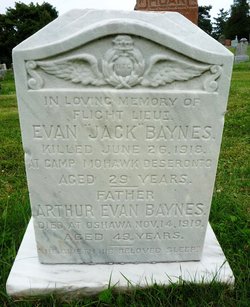
Evan John Baynes headstone

Headstone for Evan John Baynes and Arthur Evans Baynes, courtesy of Kathy L. at FindaGrave.com

View of Deseronto, Ont. From the Air (Sergeant C.P. Devos photograph 2009.20 (68)

View of Deseronto, Ont. From the Air (Sergeant C.P. Devos photograph 2009.20 (68)

On this day in 1918 Deseronto played a small role in a historic moment: the first delivery of mail by air in Canada. The full story of Captain Brian Peck and Corporal C. W. Mathers’ flight is described in Bill Hunt’s 2009 book Dancing in the Sky. Peck and Mathers’ fundamental plan was to avoid Ontario’s Prohibition restrictions by flying to Montreal to pick up a case of whiskey so that they could celebrate a colleague’s wedding. They got permission by arranging to fly over Montreal in an aerobatic display and leaflet drop to encourage recruitment into the Royal Air Force. The Aerial League of the British Empire got involved with the plan: they were keen to demonstrate the use of aircraft to deliver mail and Peck’s trip gave them the opportunity they had been looking for.

Peck and Mathers took off from Leaside in Toronto on June 20th. They refuelled in Deseronto and landed in Montreal at the Bois Franc polo field (Montreal did not have an airfield at the time). Heavy rain prevented the aerobatic display on the 22nd June and they were unable to fly out on the 23rd because of poor visibility. On Monday the 24th, the two men, their crate of Old Mull whiskey, and a sack of 120 letters finally took off. The extra weight of the whiskey prevented them from flying more than 40 feet above the ground and they had to land at Camp Barriefield in Kingston, short of fuel. There was no aviation fuel in Kingston, so regular gasoline was used to refuel the Curtiss JN-4 aircraft. They were then able to fly the short distance to Deseronto, where the tank was drained and refilled with the correct fuel at one of the RAF camps here.

Beck and Mathers were then able to fly back to Leaside. Peck drove the mail by car to the Toronto post office, while Mathers delivered the whiskey. A plaque at  Leaside commemorates the occasion (without any mention of the whiskey!).

Canada's first air mail plaque

Image from Waymarking.com


Archibald Burns Laird signatureArchibald Burns Laird died in training at Camp Mohawk near Deseronto on this day in 1918. The Royal Air Force report of his death notes the following details:

Date of Casualty: 24.6.18
Where occurred: Canada North west corner of aerodrome Camp Mohawk
Type of Machine: Curtiss JN4 C149
Nature and Cause of Accident: Machine got into a nose dive. Same was apparently pulled out too quickly.
Result of Accident: Killed
Name of other Occupant of Machine: Nil

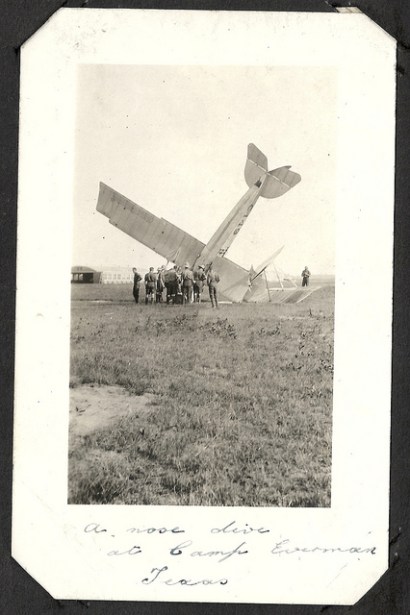
There is a photograph in the Deseronto Archives collection of this aircraft after a nose dive, although this accident happened in Texas. After Laird’s crash, the aircraft was described as “totally damaged”.
Curtiss JN-4 aircraft C149 after a nose dive

Laird joined the Royal Flying Corps in Toronto on November 28th, 1917 with the regimental number 153073. He was five feet nine and a quarter inches tall and was training with 79 C.T.S. at Camp Mohawk when he died. He was born in the town of Essex, Ontario, on March 26th, 1897, one of twin sons of James Steward Laird and Mary (née Beattie). His twin, John Bruce Laird, had joined the Canadian Expeditionary Force on February 2nd, 1916 (he survived the war).

Laird was buried in Cottam Cemetery, Essex, Ontario.

William Robinson Allen signature

On this day in 1918 William Robinson Allen, a liveryman, was conscripted at Camp Barriefield in Kingston. He was born on November 15th, 1886 in Ameliasburgh, Prince Edward County, the son of Samuel Allen and Phoebe (née Allison). By 1901 the family had moved to Deseronto and William attended the High School there.

Allen joined the 1st Depot Battalion of the Eastern Ontario Regiment with the regimental number 3060480. He was five feet five and a half inches tall, with a dark complexion, brown eyes and brown hair. His service record shows that he left Canada on the SS Tunisian on July 6th, arriving in England on July 22nd.

In England, Allen served with the 6th Reserve Battalion and the Central Ontario Reinforcement Depot. On August 3rd he was examined by a medical board for a problem with his feet:

William Robinson Allen contracted feet

Disability: overseas
CONTRACTED FEET
PRESENT CONDITION
Has not been in France. Had Articular Rheumatism as a child and feet have been contracted since & always been lame.
Complt [Complaint] – Crippled feet
Exam – No organic disease detected. Looks older than age given. Feet contracted, boots also turned up at toes showing shape of feet. Should not have been enlisted for overseas service.

Allen was struck off the strength of his unit on November 22nd and arrived back in Halifax on the RMS Aquitania on November 28th. He was demobilized in Kingston on December 26th, 1918.

Every year there is a graveside ceremony in Deseronto, organized by Pat and Murray Hope of 418 Wing Belleville, to remember the airmen who died while serving at the two Royal Flying Corps/Royal Air Force training camps near Deseronto. Seven of the men were buried here.

2018 marks the 100th anniversary of many of those deaths, including that of Lieutenant Colin Goss Coleridge, who was killed on July 23rd, 1918. Colin’s family lived in the village of Snettisham, Norfolk, England and was one of 45 Snettisham men who died during the First World War. The local Parish Council has created the Snettisham Remembers website as a memorial to each of these men.

This weekend three Snettisham residents were able to be in Deseronto. The village’s vicar, The Reverend Veronica Wilson; Norfolk County Councillor Stuart Dark; and Parish Council Chair, Rosalind Pugh came to lay a wreath of Norfolk lavender and rosemary on Coleridge’s grave as part of this year’s service.

Rosalind Pugh laying a Norfolk wreath on Colin Goss Coleridge’s grave

The Archives became involved with this event because we hold a brass plaque remembering Lieutenant Coleridge:

This became part of the Archives’ collection in 2002 when St. Mark’s Anglican Church in Deseronto was deconsecrated. It had been attached to a credence table and was donated to the church by John Coleridge of the Manor House, Snettisham in memory of his son. The table remained in the church when the plaque was sent to the Archives.

As part of the commemorative events this weekend, the plaque and the table were both donated to the National Air Force Museum of Canada. Here are the three visitors from Snettisham, reuniting the two items on Friday:

Photo courtesy of Paul Robertson

The table and plaque will now form part of the collection of the National Air Force Museum of Canada, a permanent reminder of the close connections between the air forces of the United Kingdom and Canada.

Carl August Bender signatureOn this day in 1918 Cadet Carl August Bender was killed in a flying accident near Deseronto. The Royal Air Force casualty card records the following details:

Date of Casualty: 10.6.18
Where occurred: Canada East of Camp Rathbun Aero
Type of Machine: Curtiss JN4 C1004
Nature and Cause of Accident: Failure to come out of spin
Result of Accident: Killed

Bender, a bank clerk, enlisted in the Royal Flying Corps in Winnipeg on November 17th, 1917 with a regimental number of 153630. He was five feet seven inches tall, with a medium complexion, light brown hair and blue eyes. He was officially appointed to the Corps in Toronto on December 14th.

Bender was born in Montmagny, Quebec on May 28th, 1894, the son of Eugene Bender and Kate (née Forrest). By 1911 the family had moved to Winnipeg. At the time of his death Carl was in training with 81 Canadian Training Squadron, part of the Deseronto Wing at Camp Rathbun.

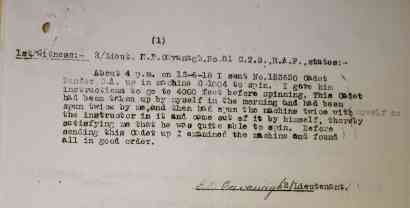
At the Court of Inquiry convened on June 11th to investigate the accident, 2nd Lieutenant E. P. Cavanagh reported that:

Detail of file RG4-32/1334 at the Archives of Ontario

Detail of file Attorney General 1918 file RG4-32/1334 at the Archives of Ontario

About 4 p.m. on 12-6-18 I sent No.154630 Cadet Bender C.A. up in machine C-1004 to spin. I gave him instructions to go to 4000 feet before spinning. This Cadet had been taken up by myself in the morning and had been spun twice by me, and then had spun the machine twice with the instructor in it and came out of it by himself, thereby satisfying me that he was quite able to spin. Before sending this Cadet up I examined the machine and found all in good order.

Carl was buried in the Roman Catholic section of the Deseronto Cemetery.

Grave of Carl A. Bender in Deseronto Cemetery

Stillman Gurnsey Kimmerly signature

Stillman Gurnsey Kimmerly, a farmer, signed up in Regina, Saskatchewan on this day in 1918. Stillman was born in Deseronto (or Mill Point, as it was known then) on October 13th, 1878, the son of Benson Kimmerly and Almira Finkle. By 1891 the family were living in the Assiniboia East district of Saskatchewan.

Kimmerly’s younger brother, Walter Wilford Kimmerly, had been called up on May 21st, 1918. He was eighteen years younger than Stillman. Stillman joined his brother’s unit: the 1st Depot Battalion Saskatchewan Regiment with the regimental number 277009. He was described as being five feet eleven inches tall, with a light complexion, blue eyes and light hair. Stillman’s service record reveals that he arrived in England on August 15th, 1918. He and his brother both served in the 15th Canadian Reserve Battalion until June 1919, when they returned to Canada. Stillman contracted influenza in October 1918 and spent a month in hospital. Both men were demobilized on June 26th, 1919 in Regina.

After the war, both Stillman and Walter were granted 160 acres of land in adjacent parts of Township 49 in Saskatchewan under the Soldier Settlement Act. Stillman died in 1935 and was buried in Edmonton Cemetery. Walter died in 1961 and was buried in Beechmount Cemetery, Edmonton.

« Previous PageNext Page »