World War I


Harold Smart's signature

On this day in 1915 Harold Smart signed up in Belleville. He was born on April 26th, 1893 in Tyendinaga, the son of Henry Smart and Julia (née Moses), who were both Mohawks.

Harry was described as five feet five inches tall, with a dark complexion, brown eyes and dark brown hair. His regimental number was 412306 and he had previously served as a volunteer in the 49th Regiment (Hastings Rifles). His service record shows that he left Canada on June 24th, 1915 on the SS Missanabie. He joined the 25th Battalion in France on November 8th, 1915.

He was killed in 1916.

Clarence Maracle's signature

Clarence Maracle signed up in Belleville on this day in 1915. He was born on January 30th, 1896 (he said 1897 when he enlisted) in Shannolville. His parents were Seth Maracle and Catherine (née Leween). There is a four-year-old Clarence living with Seth and Catherine Maracle and younger brother Wesley in the 1901 census in Tyendinaga. The family were Mohawks.

Clarence is described as five feet four and a half inches tall, with dark complexion, brown eyes and black hair. He joined the 39th Battalion with the regimental number 412270. His service record shows that he joined the 25th Battalion in France in November 1915. He was hospitalized for German measles in 1916 and with influenza followed by broncho-pneumonia and emphysema in 1918 and 1919.

Clarence was invalided home to Canada on May 21st, 1919 and spent time at Queen’s University Hospital in Kingston. He was demobilized in Kingston on July 14th, 1919. He married Nellie Leween on September 22, 1920. He died on December 23rd, 1942 of chronic bronchitis and pneumonia which was determined to be a consequence of his war service.

Sam Corby's signature

Sam Corby was a mill hand who was born on October 2nd, 1897 (he said 1896 when he enlisted in Belleville on this day in 1915). He was the son of Joseph Corby and Mary (née Maracle) who were Mohawks. (Sam’s name is spelled Courby in army records, but elsewhere Corby was the usual form.)

On his attestation paper he is described as five feet five inches tall, with dark brown eyes, a dark complexion and black hair. Sam joined the 39th Battalion of the Canadian Expeditionary Force with the regimental number 412205.

Corby’s service record shows that he arrived in England on July 3rd, 1915 and was transferred to the 25th Battalion. While serving with this battalion, Corby was awarded the Military Medal.

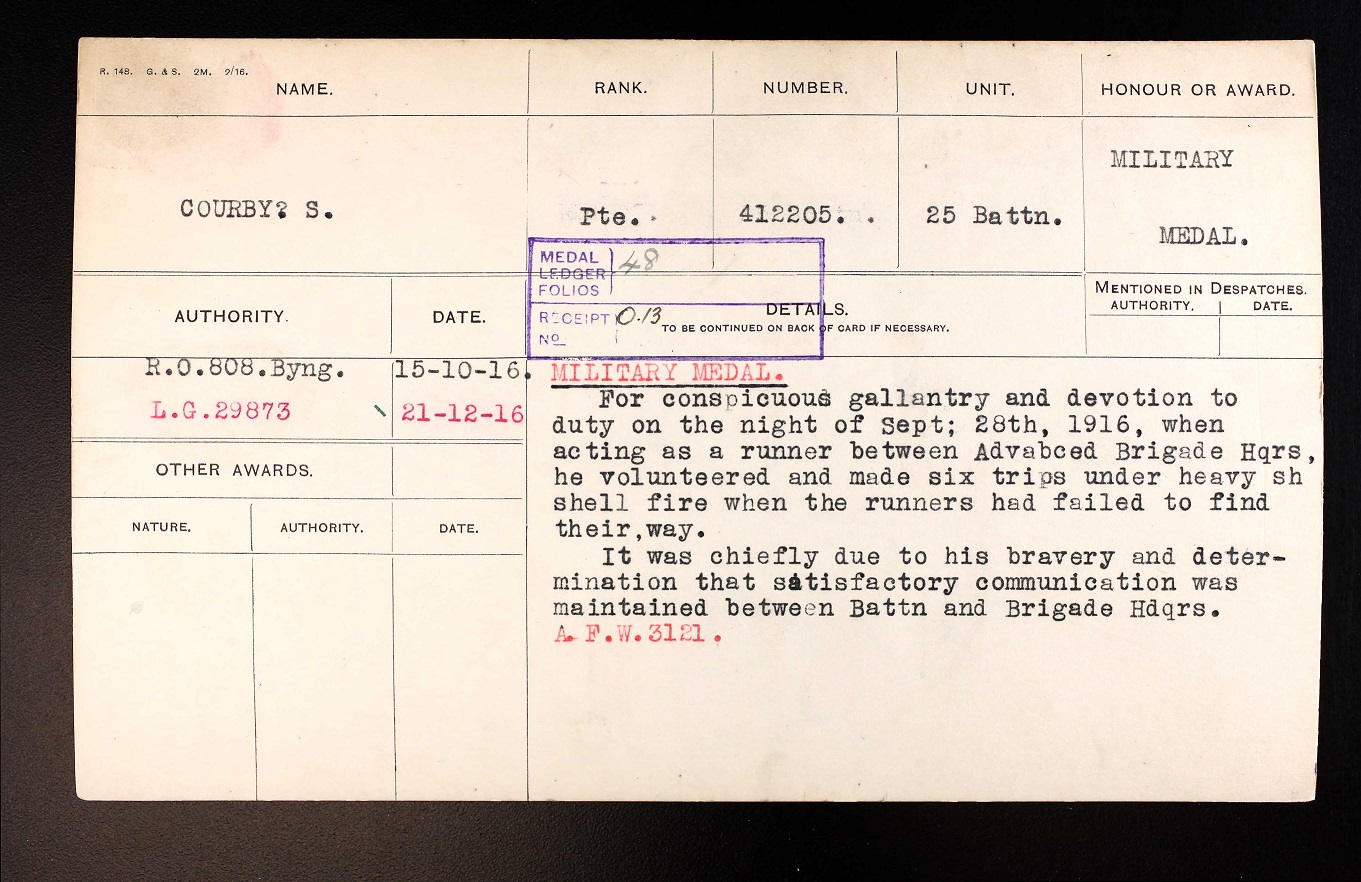
Sam Corby medal citation

Citation card for Sam Courby [Corby], courtesy of Library and Archives Canada

For conspicuous gallantry and devotion to duty on the night of Sept: 28th, 1916, when acting as a runner between Advabced [Advanced] Brigade Hqrs, he volunteered and made six trips under heavy sh shell fire when the runners had failed to find their way.

It was chiefly due to his bravery and determination that satisfactory communication was maintained between Battn and Brigade Hdqrs.

Sam Corby survived the war and married Ethel Blanchard on July 19th, 1923, when his occupation was trackman for the Canadian National Railway. He died on August 1st, 1936, after falling under the wheels of a moving railway car.

Solomon Maracle's signature

Solomon Maracle was born July 22nd, 1895, the son of William Edward Maracle and Julia Ann Williams (who had died in 1912), who were Mohawks.

Solomon enlisted in Belleville on this day in 1915. His gave his occupation as machinist and was described as five feet eight inches tall, with a dark complexion, dark eyes and dark black hair. He joined the 39th Battalion of the Canadian Expeditionary Force with a regimental number of 454929. He arrived in England on September 5, 1915.

His service file shows that Maracle suffered multiple injuries on May 20th, 1918 when a bomb was dropped from an aircraft when he was working as an orderly for the Canadian Army Medical Corps in Etaples, France. He was invalided home to Canada on December 17th of that year, travelling on the hospital ship Essequibo (pictured below) and was discharged on March 3rd 1919 as being medically unfit for further service.

HMHS Essequibo

HMHS Essequibo, from the Casgliad Y Werin Cymru/People’s Collection Wales site

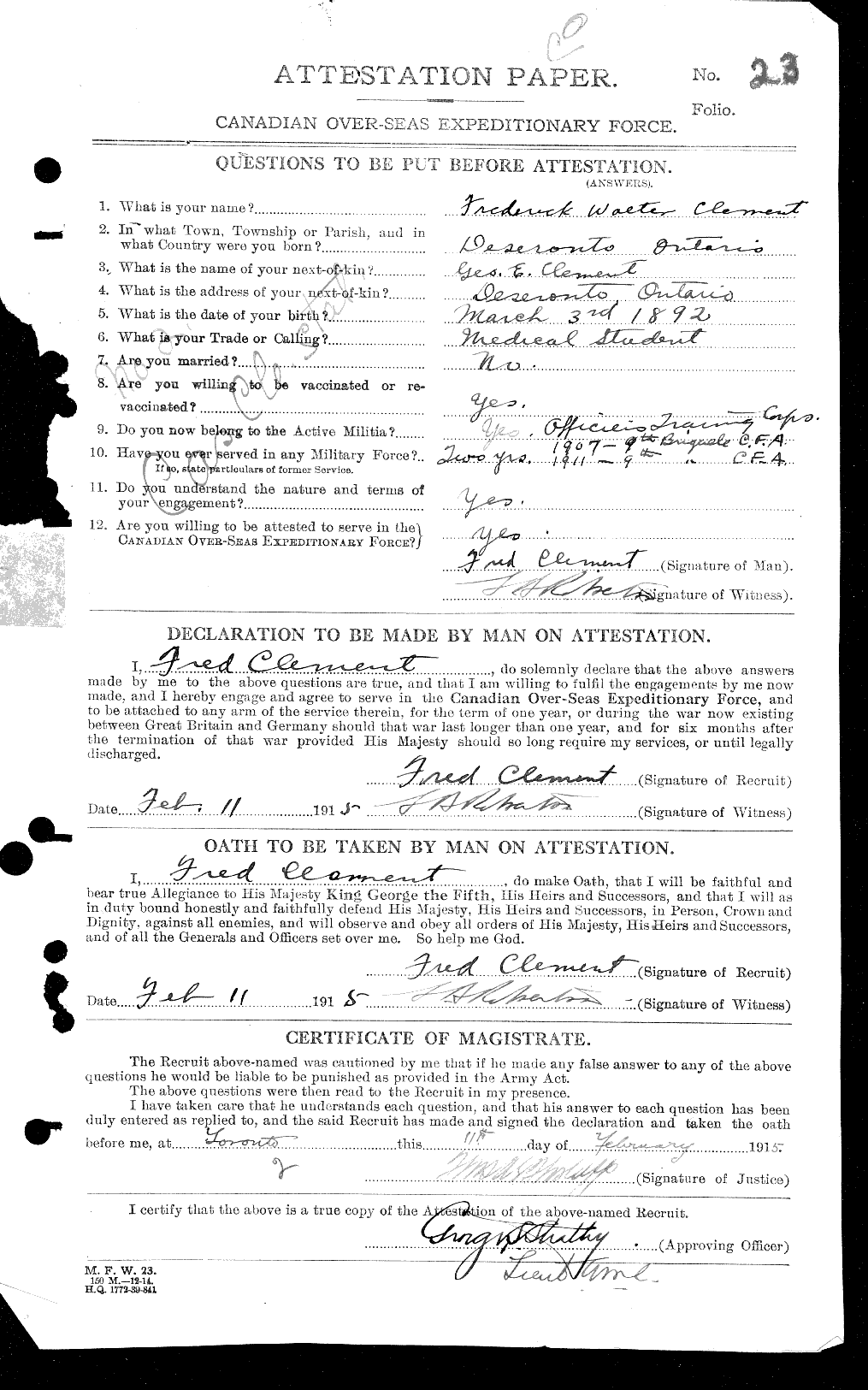
Fred Clement's signature

Fred Clement was born in Deseronto on March 3rd, 1892, the son of George Edmund Clement, a builder and member of Deseronto Town Council, and his wife, Mary Jane (née Porter). He was a student in Toronto when he signed up there on this day in 1915.

Clement had some experience with the military before he signed up: his attestation paper notes that he was in the Officer Training Corps and that he had served in the 9th Brigade of the Canadian Field Artillery in 1907 and 1911. He was five feet 11½ inches tall, with a fair complexion, grey eyes and brown hair. He served in the Canadian Army Medical Corps, then obtained a commission as a lieutenant in Britain’s Royal Army Medical Corps (RAMC) in May 1915. He was appointed as a captain in the Canadian Army Medical Corps on July 15th, 1918.

Clement’s service record shows that he left Canada on the SS Northland in April 1915. He served in France with the RAMC from July 1915 until July 1918, then was transferred back to Canada. There is a mention of his suffering malaria in East Africa in 1917 in his records.

After the war, when he was still working as an army doctor, Fred married Marion Lois Locke, a nurse from Weston, in Brampton, Ontario on June 25th, 1919. He was demobilized on August 31st, 1920. In the 1921 census we find the Clements at 440 Shaw Street, Toronto, with their ten-month-old daughter Jean and an English maid called Sable. In 1930 the family were at 2417 Middlesex Road [now Middlesex Drive], Toledo, Ohio, and had another child, [Frederick] Locke, who was five years old and had been born in Ohio.

Fred Clement died on March 5th, 1979 in Naples, Florida at the age of 87.

Edward Walter Rathbun's signature

E. Walter Rathbun, MPP, 1905 (CABHC: 2017-73/1)

Edward Walter Rathbun enlisted on this day in 1915. He was born in Deseronto on December 28th, 1865, the eldest son of Edward Wilkes Rathbun and his first wife, Elizabeth How Burt. After the death of his father in 1903, E. Walter Rathbun took over the running of the Rathbun Company. He was mayor of Deseronto, like his father before him, in 1914 and was also active in provincial and local politics: between 1905 and 1908 E. Walter represented Hastings East in Ontario’s Legislative Assembly.

In the 1901 census the Rathbun household comprised E. Walter, his wife Aileen and his mother-in-law Emma C. C. Blair. Rathbun had married Aileen Blair in Portsmouth, England, in 1893.

Rathbun was active in the local militia, holding the rank of Lieutenant-Colonel when he enlisted at the age of 49. Belleville’s paper, The Intelligencer, reported his departure in the following way on February 15th, 1915:

Farewell to Colonel Rathbun
At Deseronto, on Saturday night the opera house was filled with an enthusiastic audience of well-wishers to Col. Rathbun and his gallant comrades, who are going to the front with the guns of the 6th Brigade. An address was presented by those associated with him from boyhood, and patriotic music by local talent, led by Mr. Hercher [Herchimer] Aylesworth—a host in himself—stirred all present.

Colonel Ponton, of Belleville, carried the greetings of the Bay of Quinte District and comrades-in-arms west of Deseronto, and congratulated both the gallant Colonel and the Town on having the honor of furnishing a commander of a Brigade, which General Lessard has pronounced one of the best ever inspected in the whole Dominion in organization, spirit and efficiency.

A bountiful supper was served at the close and another of Canada’s soldier sons left for the post of duty.1

He arrived in England in March 1915, when his brigade of the Canadian Field Artillery was transformed into the Canadian Reserve Artillery. Rathbun himself was transferred to the Canadian Forestry Corps when it was established in 19162: presumably as a consequence of his experience in running the Rathbun Company’s lumbering business in Deseronto. The Forestry Corps was established to harness Canadian expertise in the lumber industry to supply the Western Front with the wood it desperately needed. It operated in England, Scotland and France. His service record shows that he was struck off in September 1917 and returned to Canada on the SS Carmania.

Grave stone for E. Walter RathbunE. Walter Rathbun died in Deseronto on September 6, 1940. His wife, Aileen, was living in Scotland at the time with her brother, Arthur Blair, and Rathbun’s body was transported to Toronto for cremation and his ashes were then shipped overseas. There is a memorial to the couple in the cemetery at Nairn in Scotland. This image of it is from the Scottish War Graves Project‘s site. The incription reads:

In memory of Col Edward Walter Rathbun, Royal Canadian Artillery died 6th Sep 1940 and his wife Aileen Blair who died 1944.


1 Our thanks to the Community Archives of Belleville and Hastings County for this information
2 For a history of the Corps in the First World War, see The Canadian Forestry Corps, by C.W. Bird and J.B. Davies, published in 1919.

Frederick John Sager's signature

On this day in 1915 Frederick John Sager, a boxmaker, enlisted in Ottawa. He was born in Deseronto on June 8th (or 9th, or 10th, depending on the source), 1886, the son of John Sager and Millie (née Bradshaw).

Frederick joined the 38th Battalion of the Canadian Expeditionary Force with the regimental number 410610. He was five feet five inches tall, with a fair complexion, blue eyes and fair hair. His service record shows that he served in Bermuda between January 1915 and May 1916, then arrived in England in June 1916 on the SS Grampian. He was transferred to France on August 14th, 1916.

In April 1917 he was admitted to hospital with a minor gunshot wound to the neck.  He rejoined his unit in May, only to be wounded again in early June at Vimy, when the bridge of his nose was destroyed. He was sent back to England to recover but this injury left him with continuing problems such as headaches, dizziness, and sinusitis. Sager had his appendix removed in 1917.

Sager left England for Canada in December 1918 and was demobilized in Kingston on January 13th, 1919. At the time of the 1921 census Sager was living in Thessalon, Ontario, where he was working as a labourer in a box factory. He died on October 20th, 1970.

Frank Bardy's signature

Frank Bardy enlisted on this day in 1914 in Estevan, Saskatchewan. He gave his date of birth as March 23rd, 1896 in Shannonville. He was five feet five and a half inches tall, with a dark complexion, brown eyes and black hair. Frank was a Mohawk and our colleagues in the Mohawks of the Bay of Quinte Research Unit have determined that Frank’s mother was Lydia Hill and that he was raised by Peter Bardy and Lydia (née Doxtator). He was working as a labourer in Estevan when he enlisted. On his attestation paper he named his next of kin as Lillie Deans of Shannonville (mother).

Frank joined the 46th Battalion and his regimental number was 426204. His service record shows that he arrived in England on September 9th, 1915 and was transferred to the 27th Battalion, with which he served in France from November 1915. Frank died at the Battle of Vimy Ridge.

Our First World War project is now in full swing, with research under way on 300 people with Deseronto connections who served in the war. There are excellent online resources available for such research and this post explains more about the ones we have been using for our project.

Attestation paper

Library and Archives Canada

Service files of individuals are rich sources of information about the war service of Canadian men and women. Library and Archives Canada (LAC) are in the process of digitizing all of the World War I service files they hold and many are already available. There’s a helpful LAC Cenotaph research guide to interpreting these records, which explains the military organizations, the abbreviations used in the records and has a timeline of the major battles Canadian troops were involved in.

Attestation papers are available online for nearly all veterans of the war. These documents give the name of the enlisting person, their next of kin, their place of birth, occupation and home address. They also hold information about the individual’s height, chest size, and hair, skin and eye colour. Attestation papers also carry the signature (in some cases just the mark) of the enlistee, which we have been using in our project to illustrate each blog post.

War diaries for the various military units are also available at Library and Archives Canada – these have all been digitized and can be read online. These are invaluable for finding out more about where a particular battalion was and what it was doing at a particular time.

Ancestry

Public libraries in Ontario have subscriptions to the library edition of Ancestry, the commercial genealogical site. Ancestry holds a number of digitized record groups which are useful for researching First World War veterans, including:

War Graves Registry Circumstances of Death records

These records from Library and Archives Canada provide details of the circumstances of a soldier’s death, if known, and information on his burial or memorial site

Ontario vital statistics records

Births, marriages and deaths in Ontario from the Archives of Ontario. These are useful for establishing who a veteran’s parents were and whether the veteran was married.

Canadian census records

Provided to Ancestry by Library and Archives Canada. Useful for discovering dates of birth (particularly the 1901 census), family members, locations, ethnicity, and occupations of veterans.

Ancestry also holds copies of the attestation papers from Library and Archives Canada.

Canadian Great War Project

This site brings together information about many of the men who died in the First World War. It includes links to the Canadian Virtual War Memorial and the Commonwealth War Graves Commission entries for individual soldiers.

Canadian Virtual War Memorial

A site maintained by Veterans Affairs Canada which commemorates fallen Canadian soldiers from all conflicts. Users can upload digital materials about a soldier.

Chronicling America

Digitized local American newspapers from 1866 to 1922, free to access in a service provided by the Library of Congress. This site is useful for finding reports on some of the airmen who died in the Royal Flying Corps camps.

Commonwealth War Graves Commission

This site holds information on cemetery locations, graves and memorials. For individual solders, there are digitized registers with brief details about each man and information about what was recorded on their headstones.

Find a Grave

This site has many veterans’ graves listed, particularly those in the European war cemeteries. Several have photographs of the headstones.

findmypast

This UK-focused site requires a subscription. It holds records relating to men who served in the Royal Flying Corps and Royal Air Force in the First World War.

Royal Air Force Museum Storyvault

Allan Walton Fraser RFC casualty cardThe Storyvault contains freely-accessible* digitized records of death and injury reports relating to the Royal Flying Corps and the Royal Air Force between 1914 and 1928. For the period of operation of the two Royal Flying Corps pilot training camps near Deseronto, these records are extremely helpful in explaining the causes of the accidents which befell the young men who died in training during the First World War.

[*Update, January 29th 2015: Low resolution copies are still accessible, but you now have to pay £3.00 for high-resolution images.]

Wikipedia

There are articles in Wikipedia on most of the military units which took part in World War One. The site also holds information on military campaigns, ships used to transport soldiers between Canada and England, and information on the diseases suffered by soldiers on the Western Front.

Fred Huntley Cole signature

Fred Huntley Cole, a bank clerk, signed up in Kingston on this day in 1914. He was born in Deseronto on July 22nd, 1889, the son of George Arthur Cole and Mary Amelia (née Huntley).

Fred joined the 6th Brigade of the Canadian Field Artillery with the regimental number 85599. He was five feet five and a half inches tall, with a fair complexion, grey eyes and light brown hair. His service record shows that he joined the 1st Canadian Divisional Ammunition Column in France on May 13th, 1915 and served with them throughout the war. He was promoted to Bombardier on March 1st, 1915 but reverted to Gunner in June 1917 at his own request. While he was serving , he was treated for myalgia and impetigo.

Cole left France for England on March 19th, 1919 and sailed from England on April 23rd. He was discharged from the army in Toronto on May 9th, 1919. He married Florence Merle Flood in Harrow, Ontario on February 19th, 1921. He died on January 12th, 1941 and was buried in Colchester Memorial Cemetery, Colchester, Ontario.

« Previous PageNext Page »