World War I


John Charles Pearson signature

John Charles Pearson enlisted on this day in 1915 in Calgary, Alberta, where he was working as a stockman. He was born in Deseronto on October 21st, 1883, the son of Robert Pearson and Sarah (née Wilson). In 1911 he was living in Battleford, Saskatchewan with his wife, Anna Maud and three children.

When he enlisted, Pearson was five feet seven inches tall, with a medium complextion, grey eyes and brown hair. He joined the Canadian Army Service Corps with a regimental number of 49481. His service record shows that he arrived in England in May 1915 and served in France between June and October. In November he was sent to England, where he served with the 101st Remounts Battalion. In November 1917 he was admitted to hospital with digestive problems. In March 1918 he was sent back to Canada and was discharged as medically unfit in Calgary on April 20th, 1918.

After the war, in 1924, Pearson left Canada for the United States. In May 1940 he was living in Richmond, California and he died in California on June 8th, 1959.

John Hetherington signature

On this day, John Hetherington signed up in Kingston, Ontario. He was born in Napanee on February 15th, 1895, to Robinson Hetherington and Mary Ann (née Bell). At the time of the 1901 census the family were living in Deseronto: John attended Deseronto High School. The Hetheringtons were back in Napanee in 1911 and living in Thomas Street, Deseronto in 1921.

On joining up, Hetherington was five feet ten inches tall, with a fair complexion, blue eyes and light hair. His regimental number was 411131. He sailed from Montreal on the SS Missanabie on June 24th, 1915 and joined the Princess Patricia’s Canadian Light Infantry in France in July.

On June 2, 1916 Hetherington received back injuries when he was buried in a dugout by a shell at Ypres, in the Battle of Mount Sorrel. The extract from his unit’s war diary below describes the engagement:
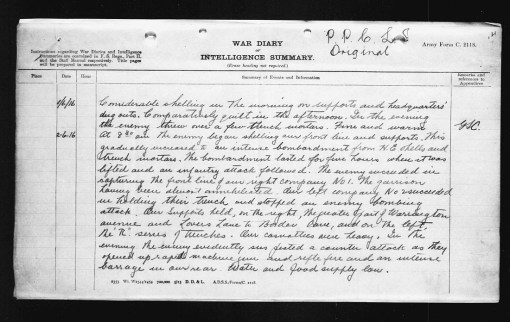
War diary for the Princess Patricia's Canadian Light Infantry for June 2, 1916

2-6-16 At 8.30 am the enemy began shelling our front line and supports. This gradually increased to an intense bombardment from H.E. [high explosive] shells and trench mortars. The bombardment lasted for three hours when it was lifted and an infantry attack followed. The enemy succeeded in capturing the front line of our right company No. 1. The garrison having been almost annihilated. Our left company No. 2 succeeded in holding their trench and stopped an enemy bombing attack. Our supports held, on the right, the greater part of Warrington avenue and Lovers Lane to Border Lane, and on the left, the “R” series of trenches. Our casualties were heavy. In the evening the enemy evidently suspected a counter attack as they opened up a rapid machine gun and rifle fire and an intense barrage in our rear. Water and food supply low.

Hetherington returned to duty on July 17th, 1916. He spent the rest of the war in England and was appointed to the rank of corporal in June 1918. He left England for Canada in August 1919 and was demobilized at Kingston on August 26th. His parents were still living in Deseronto in 1921.

In 1931 John was living in Scarborough with his wife, Bessie (Hoover), and two young sons. His occupation was “Drugless Practitioner”.

On September 9th, 1939 he enlisted again, this time in Innisfail, Alberta, to fight in the Second World War. He was demobilized on September 6th, 1946.

Hetherington died in 1961 and was buried at Mount Pleasant Cemetery in Toronto.

Earl Grant Berry's signatureOn this day in 1915 a fourth-year medical student named Earl Grant Berry enlisted in Toronto. Berry had been born in Deseronto on December 4th, 1887, the son of Robert James Berry and Ida Jean Grant.

On enlisting, Berry was described as five feet nine and a half inches tall, with a fair complexion, blue eyes and brown hair. He had a tattoo on the front of his right forearm which read ‘E.E.G.B.”. Berry joined the Canadian Army Medical Corps with the regimental number 910. He gave his mother as his next of kin: her address was 44 Kippendavie Avenue, Toronto.

His service record shows that Berry arrived in England on the SS Corinithian on May 27th, 1915. His first posting was to Moore Barracks in Shorncliffe, Kent, where he was appointed to the rank of sergeant on July 1st, 1915. In October he was transferred to the Mediterranean, leaving Devonport for Salonika in Greece, where he arrived on November 21st. He remained in Greece until April 14th, 1916, when he went back to England. He returned to Canada to complete his medical training in June 1916, travelling on the SS Sicilian.

Berry was discharged from the army in Quebec on June 8th, 1916. He married Agnes Ellen Sheather, a nurse, on September 1, 1922 in Toronto. They lived in Oshawa for a while and moved to Merlin, Ontario in 1938 where Berry worked as a physician and Medical Health Officer for the county of Kent. He died in a car accident on October 14th, 1961.


James Robert Sager's signatureOn this day in 1915 (James) Robert Sager joined up in Ottawa. He was a box-maker, living in Midland, Ontario. He was born in Deseronto on June 1st, 1889, the son of Nicholas Sager and Annie (née Smith). Annie died in Deseronto in 1899 and by the time of the 1911 census the Sager family had moved to Simcoe County, Ontario. Robert Sager married Lena Beatrice Hoag in Midland on June 23rd, 1911.

Sager was five feet six inches tall, with a dark complexion, brown eyes and dark hair. He joined the 38th Battalion of the Canadian Expeditionary Force with the regimental number 410611. His service record shows that he arrived in England on the SS Grampian  in June 1916, where he was promoted corporal. In August he went to France. In February 1917 he received a severe gunshot wound to his left upper arm and was sent back to England to recover. By July 1917 he was back at the front, but was injured again in September, this time in the right leg and left ankle. He was transferred to the Canadian Forestry Corps as a result of the damage to his ankle.

Sager left England on the SS Cretic, arriving back in Halifax on March 22nd, 1919. He was demobilized in Toronto on March 29th and was back in Midland with Lena in the 1921 census, working as a longshoreman and with a three-year-old daughter, Dorothy. He died in Midland on February 28th, 1960 and his wife died there on March 2nd, 1962.

On this day in 1915, Benjamin Ridgwell (sometimes Redgwell) signed up in Saskatoon, Saskatchewan. He was born in Walthamstow, England on July 24th, 1895 to Charles Redgwell and Alice (née Jaggard). The family (Charles, Alice, their four sons: Beniah, Sidney, Frederick and John and their daughter, Lilly [Lillian]) left Liverpool, England for Canada on the SS Dominion which arrived in Montreal on July 14th, 1907.

Postcard of SS Dominion

SS Dominion, courtesy of GreatShips.net

Ben’s younger brother Sidney had signed up in Kingston in October 1914. Ben was described as having a medium complexion, brown eyes and brown hair when he enlisted. He was five feet, three and three quarter inches tall and had scars on his face. He joined the 53rd Battalion of the Canadian Expeditionary Force with the regimental number 440095. He gave his next of kin as his father, Charles, in Deseronto. His service record shows that he left Canada on March 29th, 1916 on the SS Empress of Britain and joined the 2nd Canadian Mounted Rifles in France on June 10th.

He would not come home.

Joseph Bernard Hill signature

On this day in 1915, Joseph Bernard Hill enlisted in Kingston. Hill was born in North Tonawanda, New York on November 26th, 1895, the son of Joseph Hill (a Mohawk) and Bernadetta (née Leveque). By 1911 Joseph’s father had died and he was living with his mother and younger brother, Harvard, in Thomas Street, Deseronto.

Joseph joined the 7th brigade of the Canadian Field Artillery and was later transferred to the 5th brigade. He was five feet three and a half inches tall, with a fair complexion, brown eyes and black hair. His regimental number was 89648.

Hill would not make it home.

Louis Bardy's signature

On this day in 1915, Louis Bardy enlisted in the Canadian Expeditionary Force in Kingston. Louis was born in Tyendinaga on February 12th, 1894, the son of Alexander Bardy and Margaret (née Brant), who were Mohawks.

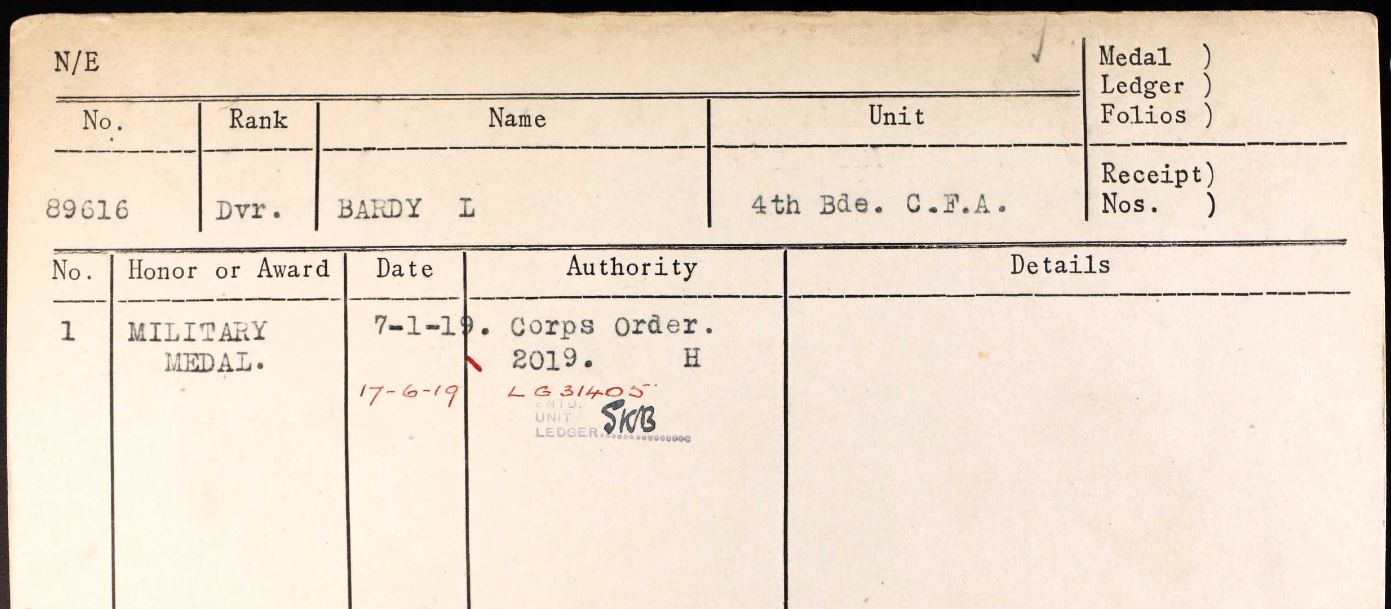
Louis was five feet six and a quarter inches tall, with a dark complexion, brown eyes and black hair. He joined the 26th Battery of the Canadian Field Artillery 7th Brigade with the regimental number 89616. His service record shows that he was in France from May 1916 and was transferred to the 4th Brigade in March 1917. He received a good conduct badge in that month and in January 1919 he was awarded the Military Medal:

Louis Bardy military medal award

Military Medal award for Louis Bardy, courtesy of Library and Archives Canada

Bardy left England on June 23rd, 1919 on the SS Belgic and was demobilized in Kingston on July 3rd.

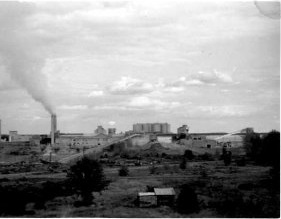
Louis Bardy died of a fractured skull at Belleville General Hospital on August 24th, 1920, after an accident at the Point Anne cement works. He was buried at Christ Church in Tyendinaga three days later.

Point Anne Cement Works

Point Anne Cement Works (image courtesy of Belleville Public Library)

Francis Vincent Kelly's signature On this day in 1915 Frank Kelly enlisted in the Canadian Expeditionary Force. He was born in Kingston on July 10th, 1893 and was working as a ‘telephone-line man’ when he signed up. He is described as having a fair complexion, blue eyes and brown hair. His next of kin was given as Elizabeth Neville of Deseronto. Kelly’s father, James Dennis Kelly, had also been a telephone line man, and had died of electrocution in Peterborough on July 27th 1898. His mother, Mary Elizabeth Kelly, married Michael Neville in Napanee on February 10th, 1902.

Frank Kelly joined the 28th Battalion which sailed for Britain on May 29th, 1915. His regimental number was 424476. His service record shows that he arrived in France on February 4th, 1916. He was killed later that year.

On this day in 1915, James Joseph Farrell joined the Canadian Expeditionary Force in Deseronto with the regimental number 49662. Farrell was born on May 8th, 1895 in Lonsdale, the son of Patrick Farrell and Ellen Bauman. The Farrell family lived in Deseronto (in Maple Street) from 1901, when Joseph’s father was a lumber labourer, to 1921, when he was a night watchman.

When he enlisted, Joseph Farrell was five feet, nine and a quarter inches tall, with a fair complexion, blue eyes and dark hair. His service record shows that he was initially with the Remount Depot Squadron at Hautot, France, where he arrived in July 1915. This squadron was responsible for obtaining and training horses for use by the army. He also served in the Canadian Forestry Corps and in the Canadian Machine Gun Corps in France. He spent several weeks in hospital over the course of the war with an infectious disease and on July 3rd, 1917 he was accidentally injured in the leg while operating a saw mill. A report on the file notes that he was “in no way to blame”.

Farrell left England for Canada on May 14th, 1919 and was demobilized in Toronto on May 25th. After the war, he married Dora Wartman on June 13th 1921 in Toronto.

Thomas Hill's signature

Thomas Hill was born on January 25th, 1876, the son of Henry Hill and Mary (née Loft), who were Mohawks. He married Sarah Brant on December 17th, 1902 and the couple had five sons before Thomas joined the army.

On enlisting on this day in 1915 in Belleville, Hill reported that he had served for 16 years in the 49th Regiment (Hastings Rifles). He joined the 59th Battalion of the Canadian Expeditionary Force, with the regimental number 454078. He is described as five feet six inches tall, with a dark complexion, brown eyes and black hair.

Thomas’s service record shows that he arrived in England on April 11th, 1916, where he was transferred to the 21st Battalion. He was invalided home to Canada in March 1918, suffering from dilatation (enlargement) of the heart.

Thomas survived the war and in the 1921 census we find him back in the reserve at Tyendinaga, as a farmer, with Sarah, four sons and a three-day-old daughter. He died on July 6th, 1949 and it was determined that this was a consequence of his war service. The following letter was sent to Sarah after Thomas’s death:

Letter of sympathy on death of Thomas Hill

Dear Mrs. Hill:
The Honourable, the Minister of Veterans Affairs, wishes to extend his sincere sympathy on learning that the death of your husband, Private Thomas Hill, was related to his service in the Canadian Expeditionary Force.
You are also advised that the death of your husband being related to his service you will shortly receive a Silver Memorial Cross given by the Canadian Government as a slight token of appreciation of the sacrifice you have made.
As the mother of the late Private Hill will, if living, also be entitled to the Memorial Cross, I am to ask that you be so good as to furnish her full name and present address, or in the alternative, the approximate date of her death.
Yours truly,
G. Robertson,
for Director,
War Service Records

« Previous PageNext Page »