World War I


Ernest Brennan's signature

On this day in 1915 Ernest Brennan signed up in Kingston. He was born in Deseronto on July 9th, 1896, the son of Frank Brennan and Annie (née Hogan). He had attended Deseronto High School and was working as a chauffeur when he enlisted. His younger brother, Clarence, had signed up in May. Ernest was five feet seven and a half inches tall, with a dark complexion, blue eyes and dark brown hair.

He joined the 5th battery of the Canadian Field Artillery with a regimental number of 300283. His service record shows that he was treated for a sprained ankle in May 1916. Brennan served in the 3rd Ammunition Sub-Park of the Canadian Army Service Corps in France from July 1916. He went on leave to England in November 1917 and was admitted to hospital suffering from sciatica and myalgia, with pains in his lower back and legs. He was discharged in March 1918, classed as B3 (fit for sedentary work abroad), but then had a further three months in hospital in the spring and summer of 1918 being treated for an infection.

Brennan left Scotland on the SS Saturnia on July 1919 and was demobilized in Kingston on August 8th. He was living with his parents in Green Street, Deseronto in 1921, when he and his father were both working as cheese makers. He married Mary Loreto Doré on June 21, 1921 in Deseronto. Information from public family trees suggests that he died in Kemptville, Ontario, on February 11th, 1966.


Joseph Amos Green signatureOn this day in 1915, Joseph Amos Green enlisted in Toronto. His mother was Margaret Green, a Mohawk, and in 1891 he was living with her in Deseronto, aged seven. By the time of the 1911 census he was married (to another Margaret) and living in Gananoque, working as a sailor. His mother died in 1912 in Brant Street, Deseronto. By the time Amos Green enlisted, he and his wife had two children, Margaret and Mary.

When he enlisted, Green was five feet eight and a half inches tall, with a dark complexion, light brown eyes and black hair. He joined the 83rd Battalion of the Canadian Expeditionary Force with the regimental number 171101. His occupation was tent maker and he was living at 87 Wilton Avenue in Toronto.

Green’s service record shows that he sailed from Montreal on the SS Corsican on September 25th, 1915, arriving in England on October 5th. He was later transferred to the 39th Reserve Battalion and the 26th Battalion.

Green did not make it home.

Horace Thompson's signature

Horace Alexander Thompson signed up at Camp Barriefield on this day in 1915. He had been born on April 14, 1896 in Deseronto, the son of Elizabeth (née McCormack) and David Thompson.

On enlisting, Thompson gave his occupation as student. He was five feet five and three-quarter inches tall, with a light complexion, blue eyes and brown hair.  His regimental number was 510085. His service record shows that he went overseas on the SS Scandinavian on October 1st, 1915 and served with the Canadian Army Service Corps. He was admitted to hospital in May with a broken right wrist after an injury received when cranking the engine of a car. He arrived in France in September 1916. In March 1917 he returned to England to take up a commission as a lieutenant. He was treated for an infection in January 1918. In June 1918 he returned to France to join the 3rd Battalion. He was injured by a gas shell in September and sent to England to recover, where he remained until the war ended.

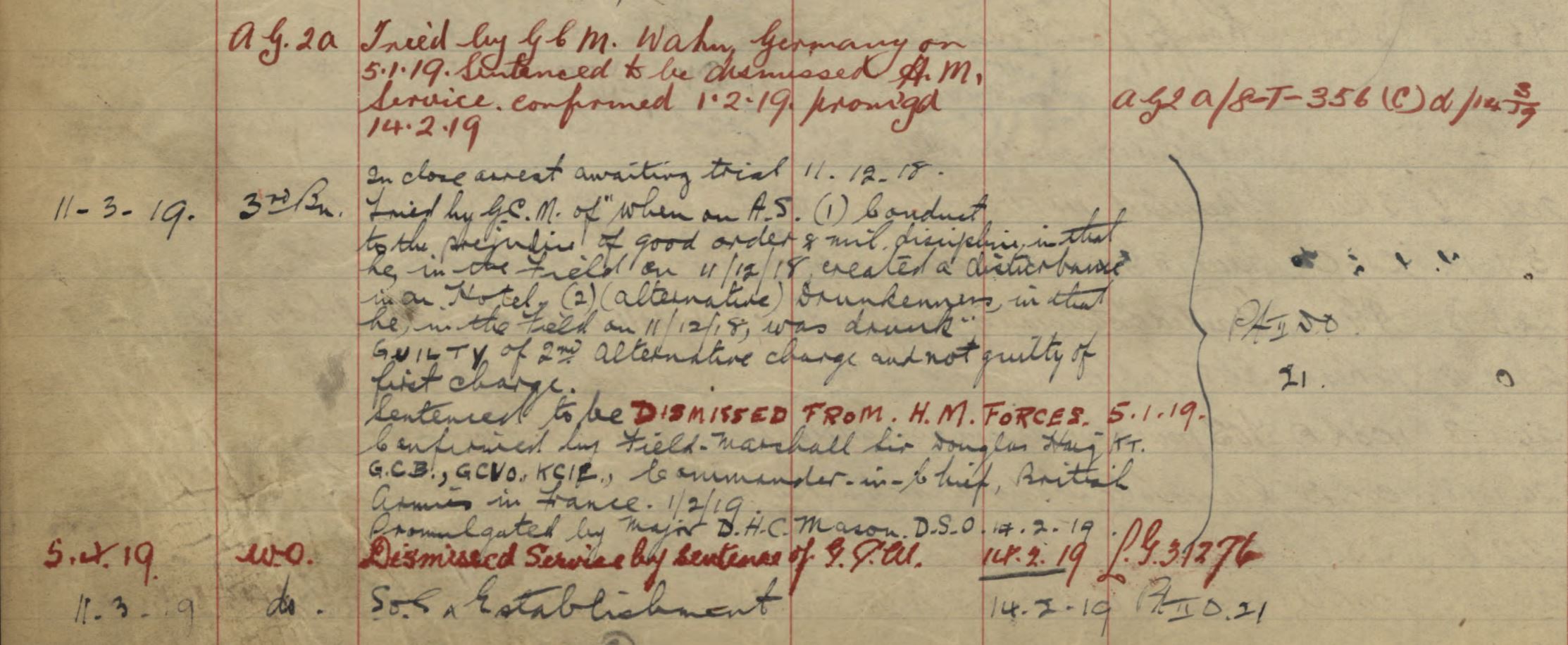
On November 12th, the day after the war ended, Thompson was arrested for creating a drunken disturbance in a hotel. His record shows that he was tried in January 1919 and dismissed from the forces.

Thompson returned to Canada as a civilian on the SS Cretic in March 1919. He is found living with his parents at the time of the 1921 census in Thomas Street, Deseronto, working as a mechanic. John Boyd, Thompson’s grandson, tells us that he worked for Bell Canada and worked in Chicago for a time and that he served in the Second World War. He retired to Green Point, Prince Edward County and later lived in Ottawa, where he died in around 1971.

Walter James Hawes signature

On this day in 1915, Walter James Hawes enlisted in Napanee. He was born in Colchester, Essex, England on August 13th, 1874 and married Emma Darling in Paddington, London in 1899. In 1901 they were living in Willesden, Middlesex with their baby daughter, Rose and by 1911 the family (now with three sons, as well as Rose) were living in College Street, Deseronto, where Walter was working as a pipe fitter. The family had arrived in Quebec on the SS Canada in May 1907.

When he enlisted, Hawes was described as five feet two and a half inches tall, with a dark complexion, blue eyes and dark brown hair. He joined the 77th Battalion with the regimental number 144679 but his service record shows that he was discharged as medically unfit for service on October 2nd. Walter died in Victoria, B.C., on April 8th, 1937.

Edward Bissell's signature

Edward Arthur Bissell was born in Trenton, Ontario to Isabella (née Coulter) and William Bissell on July 2nd, 1882. He signed up in Camp Barriefield, Kingston on this day in 1915, under the assumed name of Edward Griswould, claiming to have been born in Deseronto in 1893 (although it appears he had always lived in Trenton). He gave his next of kin as Mrs James L. Wright of Rochester, New York – this was his older sister, Minnie, who was born in 1871.

When he enlisted, Bissell was described as five feet eight and a half inches tall, with a fair complexion, brown eyes and fair hair. He joined the 2nd Battalion of the Canadian Expeditionary Force and was given the regimental number 455218. His service record shows that he arrived in England on November 23rd, 1915. He sprained his right ankle and damaged his knee on June 13th, 1916 at Ypres and spent four months in hospital in England. In November 1917 he was admitted to hospital again, with myalgia. He returned to the 2nd Battalion in France in January 1918.

Bissell would not make it home.

Garnet Hopper's signature

On this day in 1915 Garnet Hopper tried to enlist in Toronto. He had been born in Deseronto on December 31st, 1893, the son of Mary (née Sexsmith) and John Hopper, a miller.

Garnet Hopper was a student, five feet seven inches tall, with a dark complexion, brown eyes and dark hair. ‘Medically unfit’ has been written across the top of his attestation paper: his service record at Library and Archives Canada shows that he was discharged on August 23rd, 1915 for being deaf.

Medically unfit

Hopper married Daisy Catherine Jenner in Toronto on May 17th, 1921 and was living with her in Stamford, Ontario, at the time of the 1921 census. His occupation then was civil engineer. He died on June 27th, 1952.

Charles Arthur Stevens signature

On this day in 1915 Charles Arthur Stevens, a refrigeration engineer, signed up in Smiths Falls. He was born in Deseronto on September 25th, 1895, the son of Charles Stevens and Teresa (née Hunt). They were living in Toronto when he enlisted.

Stevens joined the 59th Battalion with the regimental number 454715. He was five feet five inches tall, with a dark complexion, brown eyes and brown hair. His service record shows that he arrived in England on September 5th, 1915. He served for a year before being discharged as medically unfit. His file notes that he was physically underdeveloped, weighing only 110 pounds and “should never have been enlisted”.  He came back to Canada on the SS Sicilian on March 24th, 1916.

Stevens enlisted again in Toronto on January 9th, 1918 and was accepted, but did not go back to Europe. He was discharged as being unfit for overseas service on August 20th, 1918, due to general debility and deafness due to otosclerosis. He was back with his parents in Toronto in 1921, living at 1 Audley Avenue. He left Canada for Detroit, Michigan on August 2nd, 1925. Stevens died on March 17th, 1952.

Francis Vincent Callaghan signature

On this day in 1915, Frank Callaghan, a fireman from Deseronto, signed up in Napanee. He was born in Richmond Township, Lennox and Addington County on July 10th, 1889, the son of Denis Callaghan and Nora (née Pelkington). He married Vera Richardson of Napanee on March 3rd, 1914 in Toronto.

Callaghan was five feet eight and a half inches tall, with brown hair, blue eyes and a fair complexion. He had previously served for three years with the 5th Canadian Field Artillery. He joined the 59th Battalion of the Canadian Expeditionary Force with the regimental number 454676. He gave his mother, Nora, as his next of kin and a note on the attestation paper next to his marital status reads “wife has left bed and board”. His service record, however, shows that Vera was in receipt of Callaghan’s pay from the army.

Callaghan arrived in England on September 5th, 1915 and joined the 20th Battalion in France in February 1916. He received a severe gun shot wound to his right arm on October 2nd, 1916 near Courcelette and was hospitalized in England for a month. On November 10th of 1917, Frank was awarded the Military Medal. Here is the citation card:

Citation card for Francis Vincent Callaghan's Military Medal, courtesy of Library and Archives Canada

Citation card for Francis Vincent Callaghan’s Military Medal, courtesy of Library and Archives Canada

MILITARY MEDAL

For conspicuous gallantry and devotion to duty. On 10th of Nov: 1917 though on duty in an advanced first aid post, this stretcher bearer hearing that his comrades, who could not be evacuated from the WRATH FARM ROAD at the time, were in need of first aid treatment, volunteered to go to their assistance. He worked with the utmost skill and disregard for his own safety, dressing and cheering these casualties, although in the midst of gas shells whilst doing to. Later in the day he showed the same devotion to his wounded comrades until overcome by gas his removal from the line became necessary.

[On the reverse of this card] He has consistently performed similar services to his comrades in previous actions.

Frank left England in March 1919 and was demobilized on March 27th in Kingston. His wife died on March 6th, 1922 in Kingston General Hospital and was buried in Napanee. Frank was listed as the informant on her death registration, living in Point Anne. He got married again shortly afterward, on June 9th, 1922 to Helen Selden, also of Point Anne. He died on September 30th, 1961 and was buried in Pine Hill Cemetery, Scarborough.

Robert Edward Large signature

On this day in 1915, Robert Edward ‘Teddy’ Large enlisted at Camp Barriefield in Kingston. He was born in Belleville on April 6th, 1898, the son of Robert Large and Eliza (née Clark). In the 1901 and 1911 censuses, the family were living in Deseronto and Teddy attended Deseronto High School.

When he signed up, Large was five feet nine inches tall, with a medium complexion, brown eyes and dark hair. His regimental number in the Canadian Engineers was 500226. His service record shows that Teddy arrived in France on January 18th, 1916. On June 14th of that year he was buried by soil after a shell explosion, injuring his right knee. He then spent several months in hospital being treated for synovitis. He was discharged back to his unit in January 1917 and served in England for the rest of the war. He arrived back in Halifax on July 1st, 1919 and was demobilized on July 3rd in Kingston.

Teddy Large died on November 27th, 1926 at Toronto General Hospital of kidney failure. He was buried in Newmarket, Ontario.

If you missed the history talk on the nineteenth century development of Deseronto this weekend, there’s a chance to catch it again on YouTube:

Due to a technical hitch on the day, the visuals weren’t available, but this version includes the slides!

« Previous PageNext Page »