World War I


Harry Randolph Fraser signature

On this day in 1915, Harry Randolph Fraser enlisted in Barrie, Ontario. He was born in Brighton, Ontario on May 11th, 1897, the son of James Fraser and Ida (née Wannamaker). By 1901 the family were living in Deseronto, where James was a merchant.

On enlisting, Harry was described as five feet six inches tall, with a fair complexion, blue eyes and brown hair. He joined the 157th Battalion of the Canadian Expeditionary Force with the regimental number 642147. His service record shows that he arrived in England on the SS Cameronia on October 28th, 1916. He was transferred to the Canadian Forestry Corps in February 1917 and arrived in France with 28th Company in April. In October 1918 Fraser was transferred to England to take a commission in the Royal Air Force at Sunningdale. On January 8th, 1919 he was granted permission to marry. Harry married Edith Purser in Eton, England, on February 11th, 1919. He had been serving as a bugler from January 25th.

The couple returned to Canada on the SS Metagama on August 12th, 1919 and Harry was demobilized on August 14th in Quebec. The Frasers ran an ice-cream parlour at 349 Main Street (where the United Restaurant is today). Harry was also Deseronto’s postmaster for a time. Harry and Edith both died in 1978 and they were buried in the Deseronto cemetery.

Guy Provins signature

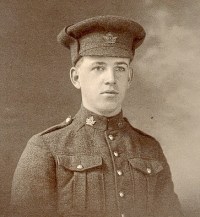
Photograph of Guy Provins

Guy Provins (image from the Canadian Virtual War Memorial)

On this day in 1915, Guy Provins enlisted in Kingston, Ontario. He was born in Deseronto on October 15th, 1897, the son of George Austin Provins and Emma (née Wright).

On signing up, Guy was described as five feet eight and three quarters inches tall, with a fair complexion, blue eyes and brown hair. He joined the 80th Battalion with the regimental number 219864 and was later transferred to the 54th Battalion. His service record shows that his unit sailed on May 16th, 1916. He arrived in France on August 14th, 1916.

He was killed on October 15th, 1916.

The Deseronto Public Library and Deseronto Archives were delighted to welcome Frances Itani back to town to mark the culmination of the Tri-County Reads events for 2015. Tri-County Reads is a joint program of the Public Libraries of Northumberland, Hastings and Prince Edward County and this year the book chosen was Frances Itani’s Deafening, a First World War novel which is partly based in Deseronto.

Guided tour walkers at the Dockside Tavern, Deseronto

The Deseronto event on October 17th began with a guided walk for around 45 people around Mill and Main Streets. The photograph shows the tour group as it passed what is now the Dockside Tavern. This building was originally the Empress Hotel, owned by William Jamieson. Jamieson’s widow sold the lot to John Freeman, Frances Itani’s great-grandfather, who ran it as the Arlington Hotel. Itani’s grandmother, Gertie Freeman,  was born in the house adjoining the hotel in 1898. Gertie became deaf at 18 months and her life experiences formed the inspiration for Grania, the main character in Deafening. Like Grania, Gertie attended the Ontario Institution for the Education of the Deaf and Dumb (now the Sir James Whitney School for the Deaf) in Belleville.

The house where Gertie Freeman was born can be seen in this late nineteenth century photograph of the property, taken by Herbert A. Osborne:

The Empress (later Arlington) Hotel, c.1895

At the time the Freemans owned the hotel, Deseronto was at its industrial peak. This picture was taken from an upstairs window, and shows the mills and factories of Mill Street:

View from Arlington Hotel, c.1895

The walking tour also stopped outside the Post Office and Naylor’s Theatre, both of which featured in Deafening and its sequel, Tell. Afterwards, the group convened for lunch at the Legion, followed by a fascinating talk from Frances Itani on the inspiration and process of writing the novel Deafening and Tell.

Frances Itani

Frances Itani

Fans of the novelist will be pleased to hear that Frances is currently working on the third novel  in the Deseronto trilogy.  This one will take a particular interest in the experiences of people who are adopted and Frances is keen to interview individuals who are adopted and who are willing to share their thoughts with the author. Please email the Archives at deseronto.archives@gmail.com if you were adopted and would be happy to be interviewed by Frances for her next Deseronto-based book.

Lorne Oliver signature

On this day in 1915, Lorne Gould Oliver signed up in Calgary, Alberta, where he was working as a druggist. Lorne was born on June 8th, 1882 in Napanee, the son of Allen Oliver and Rhoda (née Gould). He attended Deseronto High School. Oliver married Minnie Morrison in Winnipeg on June 20th, 1906.

On enlisting, Oliver was five feet nine and a half inches tall, with a dark complexion, brown eyes and grey-brown hair. He joined the Canadian Army Medical Corps with the regimental number 435843. His service record shows that he sailed from Halifax on the SS Orduña on October 27th, 1915. He served with various medical units in England and was twice promoted, but reverted to the rank of private at his own request. In  March 1918 he was transferred to the 4th Canadian Field Ambulance in France.

Lorne did not make it home.

George Albert Williams signature

On this day in 1915, George Albert Williams enlisted in Kingston, Ontario. He was born in Tyendinaga on December 8th, 1877, the son of William Barnabus Williams and Mary Ann (née Claus), who were Mohawks.

George joined the 80th Battalion of the Canadian Expeditionary Force, with the regimental number 219957. He was described as five feet two inches tall, with a dark complexion, brown eyes and black hair. His service record shows that he left Halifax on the SS Baltic in May 1916. He was transferred to the 46th Battalion (also known as the Suicide Battalion) and arrived in France on August 11th, 1916. In March 1917 he was admitted to hospital, suffering from mumps. He returned to his unit and in September was granted two weeks of leave in England. He was killed in action in October 1917.

Charlie Maracle signature

John 'Charlie' Maracle (image courtesy of Christina Carlton)

John ‘Charlie’ Maracle (image courtesy of Christina Carlton)

John Charles ‘Charlie’ Maracle signed up on this day in 1915 in Picton. He was born in Tyendinaga in 1899, the son of Albert Maracle and Annie (née Hill), who were Mohawks.

On signing up, Charlie was described as five feet five inches tall, with a sallow complexion, brown eyes and black hair. He joined the 80th Battalion with the regimental number 220131. Like Goldie Maracle, who signed up in Picton on the same day, he was transferred to the 50th Battalion after arriving in England on May 30th, 1916 on the SS Baltic. His service record shows that he went to France in August 1916. He was wounded in the face in February 1917 and suffered a gunshot wound to the hand in October 1918. He returned to England in April 1919 and sailed for Canada on August 16th.

Maracle was demobilized in Kingston on August 26th, 1919. He married Clementina Smart at St. Mark’s Church in Deseronto on August 30th, 1927.

Goldie Maracle signature

On this day in 1915, Goldie Maracle enlisted in Picton. He was born on December 10, 1898 in Tyendinaga, the son of Daniel William Maracle and Charlotte (née Bardy), who were Mohawks.

Maracle joined the 80th Battalion of the Canadian Expeditionary Force with the regimental number 220132. When he signed up, he was described as five feet five inches tall, with a sallow complexion, brown eyes and black hair.

Goldie’s service record shows that his unit sailed from Canada on May 16th, 1916. In England he was transferred to the 50th Battalion and he arrived in France in August 1916. He was wounded on November 16th of that year at the Battle of the Ancre with a shrapnel wound to his lower back and was hospitalized for some months. He was treated for an infection in May 1917 and returned to the front in September 1917. Maracle contracted trench fever in December 1917. In January 1918 he was admitted to hospital with pains in his legs and back. He was diagnosed with lymphadenitis. It was decided in July 1918 that he should be sent back to Canada. He arrived  on October 8th 1918 and was admitted to the Queen’s Military Hospital in Kingston to be treated for a recurrence of the earlier infection. He was clear of disease in February 1919 and was discharged in Kingston on March 24th, 1919, classed as medically unfit.

After the war, Goldie married Elsie Vanward in Picton on October 30th, 1924.

Burton Brant signature

On this day in 1915, Burton Brant signed up in Sudbury, Ontario. He was born in Tyendinaga on November 26th, 1892 (or 1891), the son of David and Eliza Evelyn Brant, who were Mohawks.

Brant was described as five feet six and a half inches tall, with a dark complexion, dark brown eyes and black hair. He joined the 2nd Canadian Pioneer Battalion with the regimental number 166477. His service record shows that he arrived in England on December 14th, 1915 and embarked for France on March 9th, 1916.

While working near Dikkebus, southwest of Ypres, Brant suffered a compound fracture of the face and nose when he was kicked by a mule. Below is the accident report from the battalion’s commanding officer, Lieutenant Colonel Sanders:

Burton Brant accident report

This soldier was a driver in Transport Section in charge of team of mules. While leading them  to water mid-day 27th June [July] 1916 at Micmac Camp one of them jerked headrope out of Brants hand and on his attempting to recover was kicked in the face. Brant was careful man and in no way to blame.

Burton Brant was sent to London to have his injuries treated and was out of action for two months while he recovered. He was transferred to a reserve battalion at first, then rejoined the 2nd Pioneers in February 1917 and was back in France on the 22nd of that month. He left England for Canada in May 1919, with the rank of Lance Corporal.

A note on his service record states “Deceased, 8-6-60”.

William James Reid signature

On this day in 1915 William James Reid enlisted for the first time in Winnipeg, Manitoba. He was born on May 26th, probably in 1866, in Shannonville, the son of James Reid and Nancy (née Crothers), who were both Irish. Both his parents had died by 1915 and William was 49 when he tried to sign up, though he claimed to be 44.

His first enlistment was short-lived: his attestation paper notes that he was discharged on November 18th as “not likely to become efficient”.


William James Reid discharged


William was not discouraged, however. On November 22nd, 1915 he enlisted again, at St. Boniface. He was given the regimental number 291767 and was described on this form as five feet eight inches tall, with a fair complexion, blue eyes and grey hair. He had “Tattooage on left arm” of “English flag, guns, carriage, heart, women, head, hope”.

William Reid enlisted for a third time on April 17th, 1917. On this form he said that he had served in the 53rd Battalion for four months. His regimental number on this form was 2184307. His service record shows that he went overseas on September 5th, 1917 on the SS Megantic.  He served in England with the 1st Reserve Battalion until February 1918. He was sent back to Canada in March 1918 and was discharged in Winnipeg as medically unfit on April 8th. A note on his file states that he died on September 13th, 1919.

Dan Deforge signature

On this day in 1915, Dan DeForge enlisted at Camp Hughes in Manitoba. He and his twin brother, Charles, were born in Deseronto on August 2nd, 1896, sons of Frederick DeForge and Margaret (née McMahon).

When he signed up, DeForge was five feet four inches tall, with a medium complexion, blue eyes and brown hair. He joined the 34th Fort Garry Horse with the regimental number 476302. His service record shows that he was transferred to the 27th Battalion, joining them in France on October 14th, 1916. He was admitted to hospital on four occasions with infections of one kind or another, including a severe bout of influenza in February 1919. He left England for Canada on May 21st, 1919 and was demobilized in Winnipeg on June 1st.

On July 23rd 1921 he married Jessie Mae Stevenson in Sault Ste. Marie, where he was working as a dispenser. In 1930 the couple and their children were in Detroit, where DeForge was working as a candy salesman. They were still in Detroit in 1940, with Deforge a salesman for motion picture equipment. He died in Florida on October 5th, 1985.

« Previous PageNext Page »




