World War I


Mark Maracle signature

On this day in 1915 Mark Maracle joined up in Belleville. He was born on May 15th, 1900 in Tyendinaga, the second son of Daniel Maracle and Charlotte (née Bardy), who were Mohawks. His older brother Goldie had signed up in October 1915.

Mark joined the 80th Battalion with the regimental number 220323. He was five feet four and a half inches tall, with a dark complexion, black eyes and black hair. His service record shows that he arrived in England on May 30th, 1916. The army realized in July 1916 that he was under age and decided to keep him in training until he was nineteen. He was thought to be eighteen at the time, but was actually only sixteen years old.
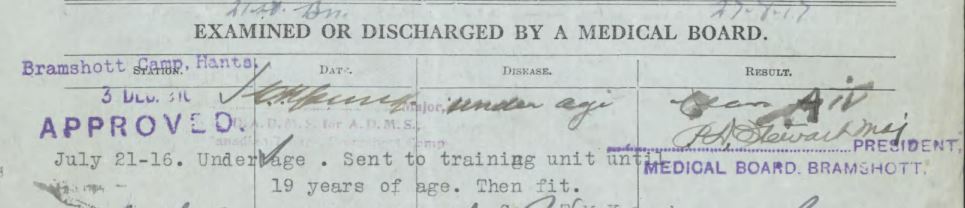
Mark Maracle under age

Maracle was transferred to the 21st Battalion in August 1917 and suffered a shrapnel injury to the left side of his face at Passchendaele on November 4th, 1917. As a consequence, he lost most of the sight in his left eye, but this did not stop him from joining the army again during the Second World War. The photograph below (loaned for scanning by Shirley Maracle, Mark’s daughter-in-law) shows Mark and his wife Vellis (née Brant). They got married in Deseronto on October 15th, 1919.

Mark and Vellis Maracle

Mark and Vellis Maracle, early 1940s, courtesy of Shirley Maracle

Charles Clinton Brant signature

On this day in 1915, Charles Clinton Brant enlisted in Belleville. He was born in Tyendinaga on April 11th, 1900, the son of Alexander and Annie Brant, who were Mohawks.

He joined the 80th Battalion of the Canadian Expeditionary Force with the regimental number 220324. He was five feet two inches tall, with a dark complexion, brown eyes and black hair. Charles’s service record shows that he arrived in England on May 30th, 1916 and after three months there, the fact that he was under age was detected. He continued to serve in various units in England and in 1917 he was transferred to the Canadian Forestry Corps, with which he served in France from August 1917 until the end of the war.

Brant arrived back in Halifax on the RMS Celtic on March 18th, 1919 and was demobilized in Kingston two days later. He married Alice Leafe in Belleville on October 26th, 1921.

Ira Alfred Claus signature

On this day in 1915, Ira Alfred Claus signed up in Gananoque, Ontario. He was born on March 1st, 1884 in Tyendinaga, the son of Samuel Claus and Ellen (or Elinor), née Loft, who were Mohawks.

Claus joined the 59th Battalion of the Canadian Expeditionary Force with the regimental number 455812. He had previously seen service in the 49th Hastings Rifles and the 5th Field Battery. On signing up he was described as five feet three and a half inches tall, with a dark complexion, brown eyes and black hair.

Ira Claus’s service record shows that he arrived in England on April 11th, 1916 and was transferred to the 26th Battalion when in Europe. He seems to have spent much of 1916 in hospital, and was sent back to England with appendicitis in September of that year. After recovering from the operation he served in reserve battalions and in the Canadian Forestry Corps in England until the end of the war. He married Bertha Sarah Brown, a domestic cook, in England on July 11th, 1918.

Claus was discharged as medically unfit for further service in Toronto on March 3rd, 1919. He died in 1957.

Philip Brant signature

On this day in 1915, Philip Brant enlisted in Waterford, Ontario. He was born in Shannonville on May 20th, 1885 to Joshua Brant and Mary (née Hill), who were Mohawks.

Brant joined the 133rd Battalion with the regimental number 797517. He was five feet five and a half inches tall, with a dark complexion, brown eyes and dark hair. His service record shows that he sailed for England on October 30th, 1916. He was hospitalized for a month with influenza in December 1916 and January 1917. When he recovered, he was transferred to the 123rd Battalion which he joined in France in April 1917. He was moved to the 7th Battalion in the following month.

Philip Brant survived the war and returned to Canada in April 1919. He was demobilized in Toronto on May 9th, 1919. He married Martha Walker in Belleville on March 30th, 1920. In the 1921 census he and Martha were living in Brantford, Ontario, with their son and daughter. Philip died on June 2nd, 1922 following an operation for a lung disorder.  (His death registration names his mother as Annie Culbertson.)

On this day in 1915, Joseph William Smart enlisted in Brandon, Manitoba. He was born on September 4th, 1899 in Chelmsford, Ontario, son of Joseph Laheed Smart (whose father was a Mohawk) and Philomène (née Rauney[?]).

Smart joined the 101st Battalion with the regimental number 700161. He was described as five feet seven inches tall, with a dark complexion, brown eyes and black hair. His service record shows that he left Canada on the SS Olympic on June 28th, 1916. He was transferred to the 43rd Battalion in France in October 1916. On June 30th, 1917 Smart suffered a gunshot wound to his left shoulder and was sent to England to recover. He rejoined the 43rd Battalion in November, but in December it was discovered that he was under age (18) and he was sent back to England. On February 23rd, 1918 Smart returned to Canada. He was discharged from the army in Toronto on April 26th, 1918 as physically unfit due to his age and due to continuing weakness in his wounded shoulder.

Information supplied by members of Ancestry suggests that Joseph married Phoebe Harly, had several children with her and that he died in Sudbury in 1992.

Harold Podger signature

On this day in 1915, Harold Podger enlisted in Lethbridge, Alberta. He was born in Deseronto on December 3rd, 1891, the son of Robert Podger and Almeda Irwin. The family were still in Deseronto at the time of the 1901 census, but had moved away by 1911, at which time Robert was working at a foundry in Oshawa.

Podger joined the 113th Battalion with the regimental number 736158. He was described as five feet ten inches tall, with a ruddy complexion, blue eyes and dark brown hair. His service record shows that he sailed from Halifax on the SS Tuscania on September 25th, 1916 and served in England with the 17th Battalion and the Nova Scotia Regimental Depot. He was admitted to hospital in 1917, suffering from arthritis.

The family story is that he met his future wife while in hospital in London. He married Florence Edith Oakley in London on March 30th, 1918. He was demobilized on September 16th, 1919 in Halifax. The couple moved to the US in April 1920 and lived in Flint, Michigan and Syracuse, New York. Podger died in Syracuse in June 1942.

Marvel Galveston Bernhardt signature

On this day in 1915, Marvel Galveston Bernhardt enlisted in St. Catharines, Ontario. He was born on December 15th, 1895, in Thurlow Township, Hastings County, the son of Robert Bernhardt and Catherine (née Maracle), who were Mohawks. The family were living in Deseronto in 1901 and had moved to Midland, Ontario, by 1911.

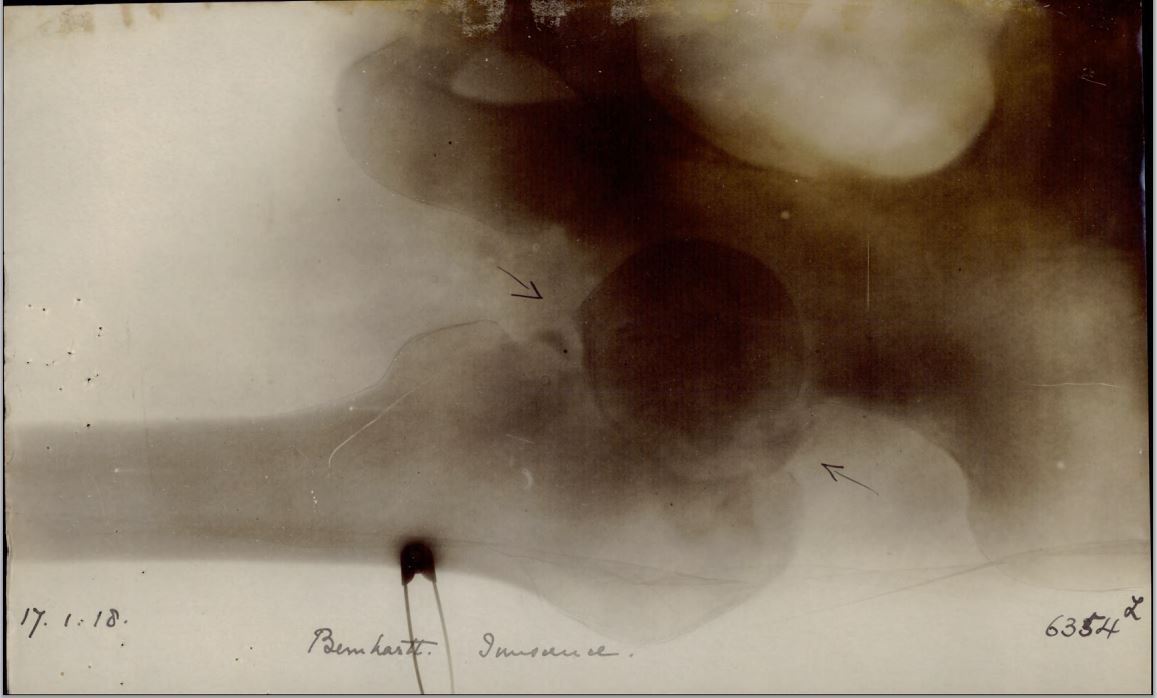
Marvel Galveston Bernhardt's xray

X-ray photograph of Marvel Galveston Bernhardt’s hip

Marvel was a saw mill worker when he joined the 98th Battalion of the Canadian Expeditionary Force with the regimental number 210075. He was described as five feet nine inches tall, with a dark complexion, black eyes and black hair. His service record shows that he arrived in England on July 12th, 1916. He served in France with the 58th Battalion from September 1916. On October 26th, 1917 he suffered a gunshot wound to the hip at the second Battle of Passchendaele. The bullet destroyed the top of the bone in his left thigh and Bernhardt spent the next twelve months in hospital in England, much of it with his leg in plaster. He was sent back to Canada in October 1918 and spent another nine months in hospital here. His left leg ended up three inches shorter than his right.

In 1921 Marvel was living in Port Dalhousie with his mother and his brother, Cornelius. He married Loretta Mae Maracle in 1931 in Deseronto and the couple lived in Brant Street for the rest of their lives, raising ten children. Marvel died in 1967. Loretta Mae’s memories of his First World War experiences featured in an article published in the Belleville Intelligencer in 2009. She died in 2012.

Bertram Fuller signature

On this day in 1915, Bertram Fuller signed up in Brantford, Ontario. He was born in Shannonville in February 1898, son of Samuel Fuller and Louisa (née Maracle). Louisa was a Mohawk and so was Samuel Fuller’s mother, Catherine (née Brant).

Bertram joined the 125th Battalion of the Canadian Expeditionary Force with the regimental number 772289. When he signed up he was described as five feet five and three-quarter inches tall, with a dark complexion, brown eyes and black hair.

Fuller’s service record shows that he landed in England on August 8th, 1916 on the SS Scandinavian. He was transferred to the 1st Battalion and arrived at the front line in France on November 4th, 1916.

Bertram Fuller was wounded twice in 1918, but he survived the war and travelled back in Canada on the RMS Olympic in January 1919. He married Theresa Dean on May 15th, 1919 in Shannonville. Fuller died on June 5th, 1969 in Hamilton, Ontario.

Fred Hugh Lavery signature

On this day in 1915, Fred Hugh Lavery signed up in Craik, Saskatchewan. He was born in Deseronto on September 26th, 1898, the son of James Lavery and Marie (née Stone). By 1901 the family had moved to Flos in Simcoe County, Ontario and in 1911 they were in Aylesbury, Saskatchewan.

Lavery joined the 68th Battalion of the Canadian Expeditionary Force with the regimental number 105491. He was described as five feet seven inches tall, with a medium complexion, grey-brown eyes and light brown hair. His service record shows that he arrived in England on May 7th, 1916 and joined the 8th Battalion in France on June 21st.

Fred was hit by a bullet at Vimy Ridge on April 28th, 1917, which shattered his left elbow. His lower arm was amputated at a casualty clearing station, and then re-amputated in hospital in Manchester, England on May 2nd. He was invalided home to Canada in March 1918 and had a further operation on his amputated arm in Vancouver in late 1918. Notes on his service file give more detail on his injury:

fred-hugh-lavery-arm-operation

Condition on Admission and Progress of Case
Complaints Loss of left arm
History Wounded by bullet at Vimy Ridge April 1917 in the elbow which was practically shattered. Sent to CCS where arm amputated same night. One month later in Hospital in England a reamputation was done – he returned to Canada April 1918.
Condition on admission No furlough has been granted. Was measured first in April for Carnes arm which was cancelled and again on 2nd July at Davisville. He has had no fitting – left arm is amputated at the level of the upper and middle thirds. Stump is healthy though the wounds are badly puckered, and consequently though healed, are dirty. Movements at shoulder joint are normal. Power of stump is limited particularly forward extension- scar on this stump should be excised. This patient was originally a left handed man, other systems normal.

Lavery was finally discharged from the army as medically unfit on March 19th, 1919. He married Sarah Islay Mattock on February 24th, 1928 in Vancouver. The couple moved to the United States in the same year and Lavery died in San Diego, California on May 7th, 1952.

The focus of our World War I project is the experience of men and women from Deseronto. Many of the people we are tracking were born in Deseronto but had moved away from the town by the time war broke out: Deseronto was entering a period of industrial decline by the 1910s and the lumbering industries which had employed hundreds of people in town in the late nineteenth century were closing down. The map below shows places where Deseronto-connected men and women signed up to serve in the First World War.

Enlistment locations

Below is a detail of enlistment locations in the area around the eastern Great Lakes.

Enlistment locations detail


The bigger the dots, the more people signed up in a particular location. Toronto, Belleville and Kingston were the main sites, but Deseronto people also signed up in BC, Alberta, Saskatchewan, Manitoba, Quebec and Nova Scotia. One Deseronto man signed up in California, one in Michigan and another in London, England. The maps are an interesting reflection of the dispersal of Deseronto’s population in the period before the 1914-1918 war.

« Previous PageNext Page »