World War I


George Anderson Morton signature

On this day in 1917, George Anderson Morton, a grain merchant, died at Camp Mohawk near Deseronto as the result of a flying accident. George was born in Winnipeg on September 20th, 1895, the son of Thomas Morton and Mary (née Anderson). Mary died in 1904. Morton joined the Royal Flying Corps in Toronto on June 26th, 1917 with the regimental number 74036. He gave his home address as Grande Pointe, Manitoba. He was five feet five and a half inches tall.

The accident in which he was killed was reported in Belleville’s Intelligencer newspaper in the following way:

Intelligencer report of G. A. Morton's death

BELLEVILLE, ONTARIO, MONDAY AUGUST 13, 1917
Aviator Killed at Deseronto
On Saturday at the local Aviation Camp another fatal accident occurred, resulting in the death of Flight Cadet Morton, of Winnipeg. The young aviator was up at a height estimated at about 2,000 feet, when from some unknown cause the plane plunged to the ground and was totally wrecked. It is surmised that Morton fainted while in the air and in this manner lost control of the machine. The unfortunate victim was dead when taken from his seat and his body was badly mangled. Many bones of the body were broken. The body was prepared for burial and shipped to Winnipeg.

This is the official casualty record from the Royal Flying Corps, which notes that Morton was in 84 Canadian Training Squadron.:

George Anderson Morton RFC casualty card

Casualty Card for George Anderson Morton, courtesy of the Royal Air Force Museum

…Date of Casualty: 11.8.17
Where occurred: Camp Mohawk aero. Canada
Type of Machine: Curtiss J.N.4a.
Nature and Cause of Accident: Machine nosedived vertically & continued in this position until it hit the ground completely wrecking the machine
Result of Accident: Killed
Name of other Occupant of Machine: Nil
Remarks: Cadet Morton had shut of[f] his engine preparatory to making a landing at a height of 2000 ft. A Court of Inquiry found no constructional fault in the machine

This photograph shows what remained of the aircraft after the accident:

George Anderson Morton's crash

From Sergeant Devos’s photographic collection, 2009.09(45), courtesy of Denzil Devos

George Anderson Morton was buried in Elmwood Cemetery, Winnipeg.

Leo Bernard O'Rourke signature

On this day in 1917 Leo Bernard O’Rourke, a machinist, signed up in Toronto. He was born in Deseronto on October 26th, 1895, the son of Hugh O’Rourke and Beatrice (née Brown). The family were still in Deseronto in 1901, but by 1911 had moved to Princess Street, Kingston, where Leo was working as an apprentice machinist in the locomotive works. They were living in Toronto in 1917 when Leo signed up (he said in Raybaold Avenue – possibly Raybould Street).

O’Rourke joined the York & Simcoe Foresters (part of the Canadian Forestry Corps) with the regimental number 2498018. He was five feet four and a half inches tall, with brown eyes and brown hair. He was missing the top joint of the first finger on his right hand. O’Rourke’s service record shows that he arrived in England on September 15th, 1917 on the SS Megantic and was posted to the 80th Company of the Canadian Forestry Corps in France, where he arrived on October 17th. On October 25th he was sentenced to ten days of field punishment number two for “giving a false name to a picquet”. He received the same punishment on December 1st for neglect of duty: “absent from stable at 4pm”.

In January 1918 Leo was admitted to hospital suffering from a hydrocele. He rejoined his unit on February 2nd. In January 1919 he was transferred to the Forestry Corps’ headquarters in England and had an operation at the Military General Hospital in Epsom to remove the hydrocele in April 1919.

Leo Bernard O’Rourke left England on June 2nd, 1919 and  was demobilized on June 10th in Toronto. married Clara Boungard (née Reid) in Toronto on July 21st, 1920. They had two daughters. He died on November 16th, 1968 and was buried in the Riverside Cemetery at Shannonville.

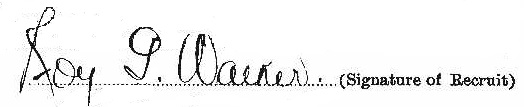
Roy Galbraith Walker signature

Roy Galbraith Walker, a bookkeeper, enlisted in Toronto on this day in 1917. He was born in Deseronto on March 24th, 1893, the son of George Walker and Martha (née Galbraith). George was a baker; he died in Deseronto in 1904. In 1910 Roy and Martha were living in Rochester, New York, where Roy was working as an optical grinder. In 1911 they were living in Oso, Frontenac and Roy was working as an agent for the Kingston and Pembroke Railway. He was in Rochester again by 1915, married to Harriet Mary Dill.

Walker joined the No. 2 Canadian Army Medical Corps Training Depot with the regimental number 528289. He was five feet eight and three quarter inches tall, with a medium complexion, grey eyes and brown hair. His service record shows that he served out the war in Toronto and that he was suffering from arthritis in his left ankle as a result of an earlier hockey injury.

Walker was demobilized on March 10th, 1919 and in 1920 was living in Chicago, where his first child was born. In 1922 he and Harriet and their son arrived in New York State from Canada at Morristown, from where they moved back to Rochester, where Roy worked as a real estate salesman. In the 1940 US census he was living in Ann Arbor, Michigan, working as a salesman in the field of international research.

Robert Charles Teasdall signature

On this day in 1917 Robert Charles Teasdall died at Camp Rathbun in Deseronto. He was born in Toronto on December 14th, 1897, the son of Robert Charles Teasdall and Marie (née Laughton). He joined the Royal Flying Corps in Toronto on May 30th, 1917, with the regimental number 70331. His home address was 600 Yonge Street and he had been working as a bookkeeper before he enlisted.

Belleville’s newspaper, The Intelligencer reported the accident that killed Teasdall in the following way:

Intelligencer 1917 Jul 13 Cadet Teasdall's death

Report in the Intelligencer of July 13th, 1917 on Cadet Teasdall’s death

FLIGHT CADET TEASDALL INSTANTLY KILLED

Fatal Accident at Camp Mohawk in Which Young Aviator From Toronto Lost His Life – Machine Crashed to Ground From Considerable Height

A fatal accident occurred yesterday afternoon at the Deseronto section of Camp Mohawk, resulting in the death of Cadet Teasdall of Toronto, a young man who has been at the camp under instruction in aviation since July 3.

The young cadet had taken one of the aeroplanes up for a flight, and when at a considerable height something went wrong, and he lost control of the flying machine, which crashed to earth. The unfortunate young aviator was almost instantly killed and the machine was practically destroyed.

The accident was witnessed by a number of spectators, principally motor car parties, who had arrived at the borders of the camp to watch the interesting incidents of aviation training, and the rapid descent of the machine with the practical certainty of death or serious injury for the young aviator was a terrible spectacle which will not soon be forgotten by those who witnessed it.

Cadet Teasdall came to the camp from Toronto, and his body will be forwarded to that city for interment.

The Royal Flying Corps own records confirm the newspaper’s report, except that the accident occurred at Camp Rathbun, rather than Camp Mohawk:

Robert Charles Teasdall's RFC casualty card

Royal Flying Corps casualty card for Robert Charles Teasdall, courtesy of the Royal Air Force Museum

…Date of Casualty: 12.7.17
Where occurred: Canada, Camp Rathbun, Deseronto
Type of Machine: Curtiss J.N.4
Nature and Cause of Accident: Fl[yin]g acc[ident] – Machine Collapsed at height of 4000ft
Result of Accident: Killed
Name of other Occupant of Machine: None
Remarks: Machine Completely Wrecked

The Royal Flying Corps’ Court of Inquiry received the following evidence from Captain Aird:

Detail from Attorney General's 1917 file RG 4-32/2006 at the Archives of Ontario

Detail from Attorney General’s 1917 file RG 4-32/2006 at the Archives of Ontario

1st witness:Captain J. Aird. R.F.C. (S.R.)

Cadet Teasdale flying at about 5,000 feet nosed his machine C.591 down (intending to loop as I assume because from what I gathered from the Cadets he intended to try a loop.)

He left the engine on and dived about 500 feet gaining an enormous speed, and just as he tried to pull the machine up, the left wing broke away. The machine then began to spin, then the right wing collapsed, then the tail and fell to earth.

I got into a horse and rig and drove half way to the accident, then ran. When I arrived Teasdale’s body had been removed and taken away in a tender.

I examined the machine and found all controls intact and I think the accident was due to the stress in diving the machine.

(Signed) J. M. Aird, Captain.

Robert was buried in St. James’s Cemetery, Toronto.

On June 10th we were delighted to have our first historical plaque unveiling in Deseronto. As part of a day of activities, Mayor Norm Clark and Major Bill March of the Royal Canadian Air Force revealed this new commemorative part of Deseronto’s town landscape.

Plaque unveiling event

Deseronto Archives Board Chair, Paul Robertson introduced our two guests. This is the first of a planned series of plaques that will be installed around Deseronto, sharing different aspects of our town’s history. The plaque uses images from the Deseronto Archives collection, beautifully arranged by graphic designer Darren Young of youngdesigns and is situated next to the Town Hall, in Rathbun Park.

New plaque in place (photo by Paul Robertson)

Peter Barnhardt signature

Peter Barnhardt signed up in Sudbury, Ontario on this day in 1917. He was born in Tyendinaga on March 11th, 1890, the son of Joseph Barnhardt and Annie (née Doreen), who were both Mohawks.

Barnhardt joined the Toronto Forestry Draft with the regimental number 2251054. He was five feet nine and a half inches tall, with a dark complexion, brown eyes and dark brown hair. His service record shows that he arrived in England on the SS Missanabie on August 23rd, 1917 and was transferred first to the Canadian Forestry Corps and then to the Canadian Railway Troops Depot. He served in England and in France and returned to Canada in 1919, being demobilized on May 7th, 1919 in Montreal.

Peter enlisted to serve again in the Second World War and was invalided by war wounds. He died on April 12th, 1966 in the Belleville General Hospital and was buried in the Deseronto Cemetery.

Curtiss JN4A C593 upside-down

As part of a day of commemorative events on June 10th, Mayor Norman J. Clark will unveil a commemorative plaque in Rathbun Park, Deseronto, to mark the town’s involvement in the First World War.

Some 300 local people served in the Canadian Expeditionary Force, and more than 50 men lost their lives while they were attached to the two pilot training camps, either side of Deseronto.

The commemorative plaque was funded by the Council of the Town of Deseronto and coordinated by the Deseronto Archives Board. It is the first of a planned series of plaques aimed at bringing Deseronto’s colourful past to life on the present-day streets of the town.

We hope you will be able to join Mayor Clark and the Deseronto Archives Board in Rathbun Park at 3pm on June 10th for the unveiling of the plaque.

Media release – Deseronto plaque unveiling.

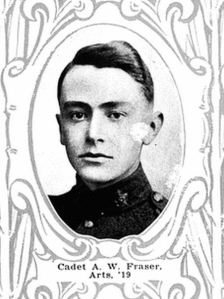
Allan Walton Fraser photograph from University of Manitoba Roll of Honour

Allan Walton Fraser photograph from University of Manitoba Roll of Honour

Allan Walton Fraser signatureAllan Walton Fraser died at Camp Mohawk near Deseronto on this day in 1917. He was born in Emerson, Manitoba on January 30th, 1898, the son of William Fraser and Annie Matilda (née Baskerville) of 215 Spence Street, Winnipeg. He joined the 196th Battalion of the Canadian Expeditionary Force on March 1st, 1916 when he was a student at the University of Manitoba, with the regimental number 910044. He was five feet seven inches tall, with a dark complexion, grey eyes and brown hair. On April 26th, 1917 he transferred to the Royal Flying Corps with a new regimental number of 70175. He was a cadet in 84 Canadian Training Squadron, learning how to fly at the recently-opened pilot training camp to the west of Deseronto, when he died. This was the first fatality at Camp Mohawk.

The accident was reported in The Hartford Herald newspaper in Kentucky in the following way:

Report of Allan Walton Fraser's death at Camp Mohawk in the Hartford Herald

Report of Allan Walton Fraser’s death at Camp Mohawk in the Hartford Herald newspaper, courtesy of Chronicling America


BRITISH AVIATOR BURNED TO DEATH

Deseronto, Ont.—While flying with Vernon Castle at Camp Mohawk, Cadet W. E. Fraser, of Winnipeg, Man., was burned to death. Castle escaped with slight injuries. The two were ascending for instructional purposes when Fraser was seized with nervousness and lost control. The machine swept backward into the hangar and the gasoline tank exploded, setting fire to the hangar. Castle was thrown out when the aeroplane hit the shell.

This photograph shows the burning hangar after the crash.

Allan Walton Fraser crash

From Sergeant Devos’s photographic collection, 2009.09(38), courtesy of Denzil Devos

The official report from the Royal Flying Corps gives a slightly different version of events:

Allan Walton Fraser RFC casualty card

Casualty Card on Allan Walton Fraser’s death, courtesy Royal Air Force Museum

…Date of Casualty: 30.5.17
Where occurred: Camp Mohawk Deseronto
Type of Machine: Curtiss JN4a.
Nature and Cause of Accident: Machine whilst making a turn at the height of 200 ft suddenly put her nose down, frightened pupil who gripped control wheel & pilot unable to right machine which struck roof of hangar and burst into flames.
Result of Accident: Killed
Name of other Occupant of Machine: 2/Lt W.B.T. [V.W.B.] Castle (Injured)…

Vernon Castle was a well-known Broadway dancer who had travelled to England to join the Royal Flying Corps in 1916. He was one of the flight instructors at Camp Mohawk. After experiencing this accident, Castle insisted on taking the more dangerous front seat in the cockpit of the Curtiss JN-4 training aircraft used by the Royal Flying Corps in North America.

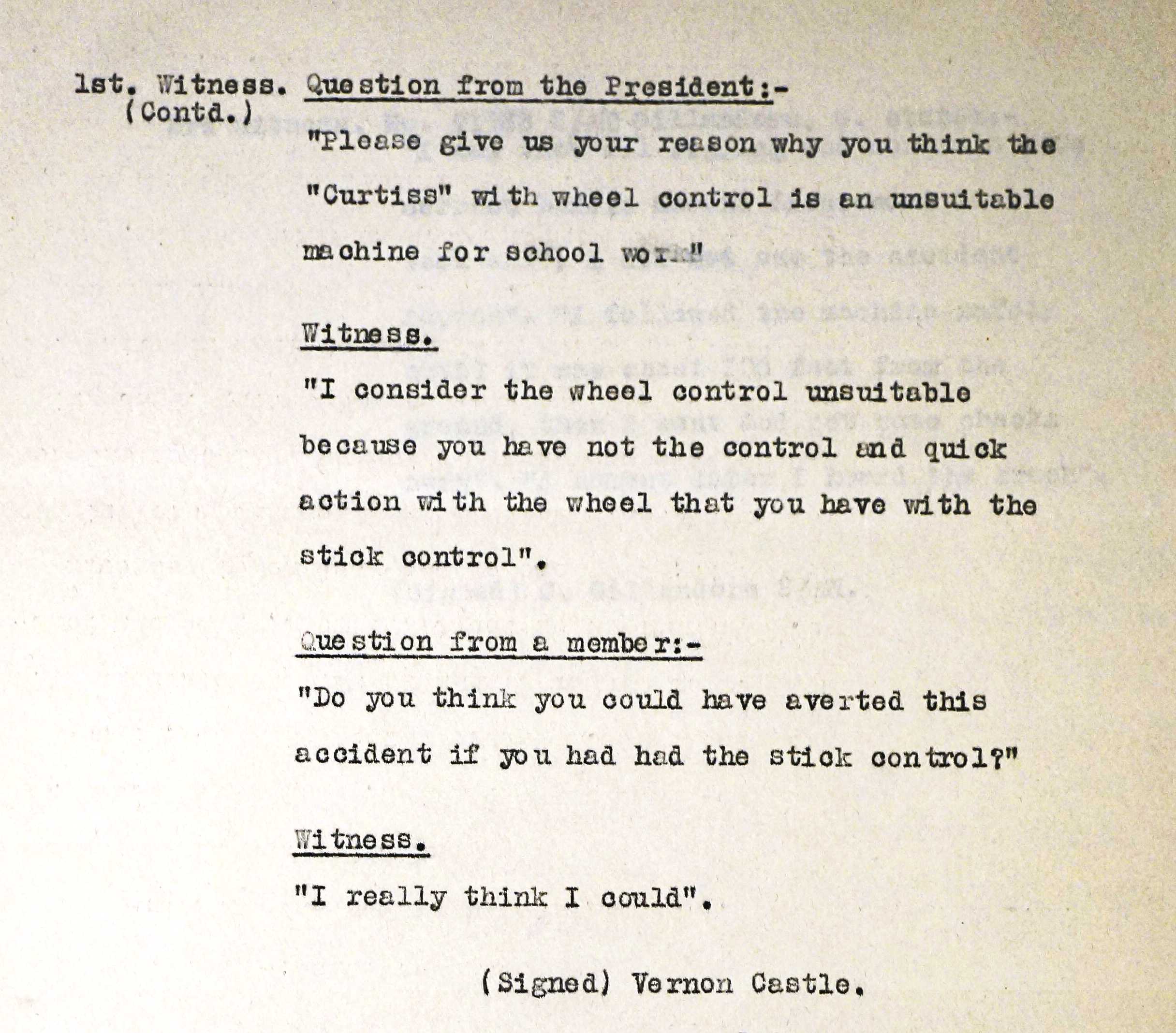
A Court of Inquiry was held on June 1st, at which Vernon Castle described the accident and gave his views on the wheel versus stick controls for training aircraft:

Allan Walton Fraser Court of Inquiry - Vernon Castle's evidence

Detail from Attorney General’s 1917 file RG4-32/1145 at Archives of Ontario

1st. Witness. (Contd.) Question from the President:-

“Please give us your reason why you think the “Curtiss” with wheel control is an unsuitable machine for school work”

Witness

“I consider the wheel control unsuitable because you have not the control and quick action with the wheel that you have with the stick control”.

Question from a member:-

“Do you think you could have averted this accident if you had had the stick control?”

Witness.

“I really think I could”.

(Signed) Vernon Castle.

It was also noted by the Court of Inquiry that this aircraft had no instruments. Castle did not believe that instruments would have prevented this accident, but the Court expressed the opinion that stick controls offered more safety than wheel controls and that “all school machines of this type should be fitted with instruments”.

Allan Walton Fraser was interred in the mausoleum at Glen Eden Memorial Garden/Riverside Cemetery in Winnipeg.

Joab Walter Powles signature

Joab Walter Powles, a bushman, signed up in Toronto on this day in 1917. He stated that he was born in Newport, Brant, Ontario on March 11th, 1872 and that his current address was Deseronto. He gave his next of kin as his father, Isaac. Joab may be the son of Isaac and Julia Powless (both Mohawks) who was born in Tyendinaga in 1869.

Joab joined the Toronto Forestry Draft with the regimental number 2250975. He had previously served as a private in the Simcoe Foresters for two years. He was five feet five and a half inches tall, with a medium complexion, grey eyes and black hair. His service record shows that he arrived in England on July 5th, 1917 on the SS Jusiticia. He joined the 58th Company of the Forestry Corps in France on July 27th. On August 8th he was admitted to hospital in Le Havre, suffering from bronchitis. He was transferred back to England to convalesce and then sent home to Canada. He left Liverpool on November 17th, 1917 on the SS Saxonia and spent time in the Spadina Military Hospital in Toronto. He was discharged from the army as medically unfit due to being over age (48) and having emphysema on January 30th, 1918.

Thomas Bernard Marrigan signature

On this day in 1917 Thomas Bernard Marrigan, a bookkeeper, signed up in Kingston, Ontario. He was born in Deseronto on November 13th, 1892, the son of John Marrigan and Margaret (née Hayes). Margaret died of pneumonia in Mill Street, Deseronto in 1907. When Marrigan enlisted he gave his home address as 425 Jarvis Street, Toronto and his next of kin as his father, John, who was still living in Deseronto.

Marrigan joined the Royal Canadian Horse Artillery with the regimental number 349757. He was five feet six inches tall, with a medium complexion, blue eyes and brown hair. His service record shows that he was transferred to the garrison at St. Lucia in the West Indies in September 1917, where he served until May 1919, when he returned to Canada on the SS Chignecto. He was demobilized at St. John, New Brunswick on May 30th.

Thomas Bernard Marrigan died in Kingston at the Hotel Dieu Hospital on October 6th, 1934 of endocarditis. He was buried in Deseronto.

« Previous PageNext Page »