World War I


Joseph Amos Green signature

On this day in 1918, (Joseph) Amos Green died of jaundice in the 14th Canadian General Hospital in Eastbourne, England.  The extract from his service record below shows that he had previously been in hospital in 1916 and 1917 with shrapnel and gunshot wounds to his hands but had otherwise been healthy.

Amos Green's medical history

Jaundice was relatively common disease in First World War soldiers, and Japanese researchers had determined that it was spread through the urine of infected rats (this disease is now known as leptospirosis). Men in the trenches were more likely to be infected in this manner, but Amos Green was with the 13th Reserve Battalion in England when he fell ill.

Green’s medical records show that he had been diagnosed with syphilis in November 1917 and was treated as an outpatient at the 13th Canadian General Hospital in Hastings between November 1917 and February 1918. At this time, treatment for syphilis involved injections of an arsenic-based drug (Novarsenobillon) and mercury. An article in the British Medical Journal of April 20, 1918, described the deaths of two New Zealand soldiers through liver damage after treatment with Novarsenobillon.1 It seems it was the cure for syphilis which killed Amos Green, rather than the disease itself, as his doctor wrote “Jaundice (Arsenical poisoning)” on his notes:

Death of Amos Green

Green was buried in the cemetery in Seaford, Sussex.

Joseph Amos Green's grave

Joseph Amos Green’s grave, courtesy of FindaGrave.com (uploaded by wertypop)

His widow, Margaret, and two daughters, Margaret and Mary were living at 9 Dunedin Street, Toronto at the time of his death. The Toronto Evening Telegram reported his death on March 11th, 1918:

Toronto Telegram report of Joseph Amos Green's death

Amos Green is remembered on the Deseronto war memorial.
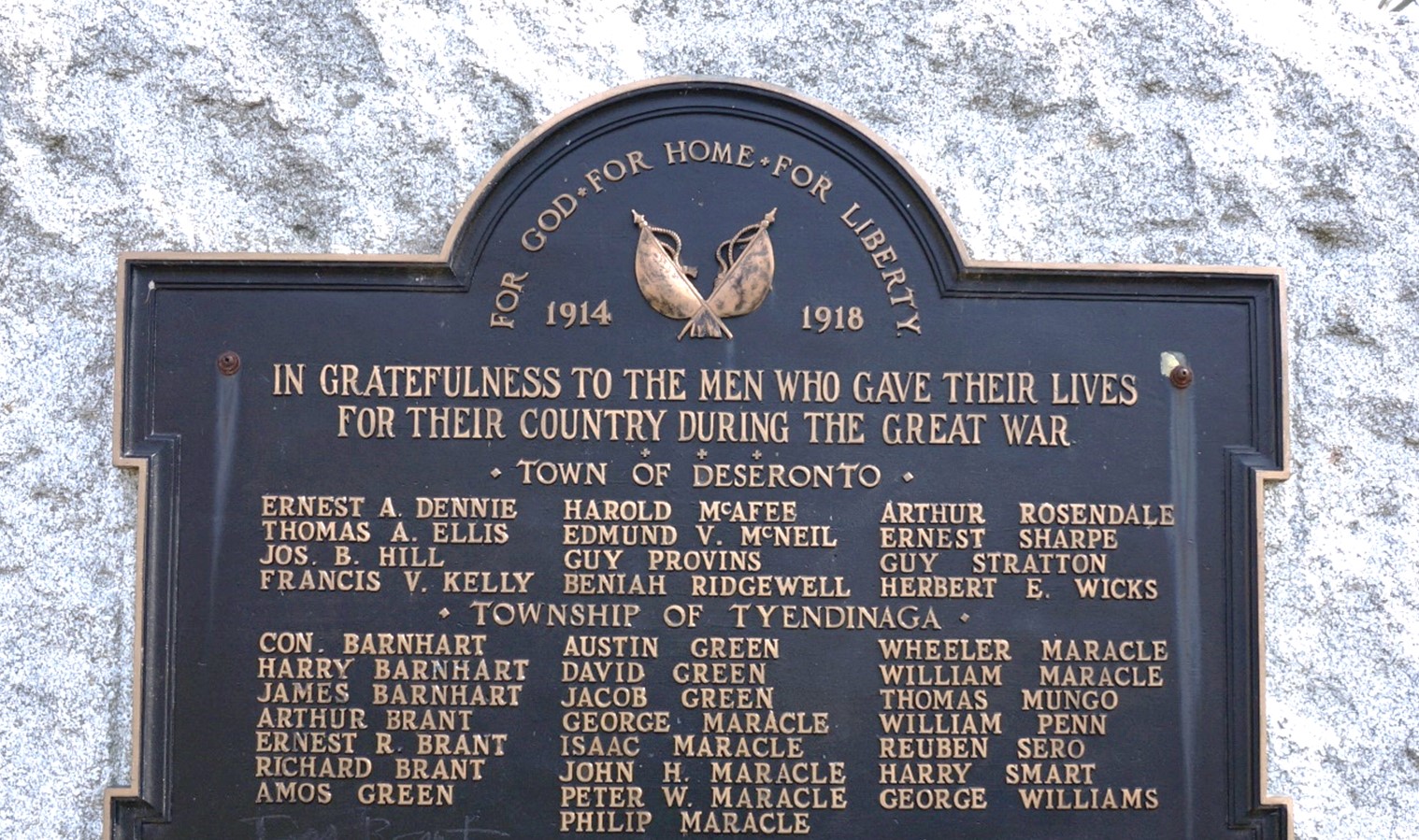
Deseronto memorial


1 Fenwick, Sweet & Lowe ‘Two Fatal Cases of Icterus Gravis Following Injections With Novarsenobillon’ British Medical Journal [PDF] 20 April 1918

Edward Mckenney signature

Edward Mckenney, a butcher, was conscripted in Kingston on this day in 1918. He was born in Richmond Township, Lennox and Addington County on March 20th, 1891 (he said 1893 on his form), the son of Edward Mckenney and Annie (née Leonard). By 1901 his father had died and Mckenney’s mother and her five children were living in Deseronto.

Mckenney joined the 1st Depot Battalion of the Eastern Ontario Regiment with the regimental number 3057016. He was five feet three inches tall, with a fair complexion, blue eyes and dark brown hair. His service record shows that he was demobilized on October 13th, 1918 and a medical board in Belleville determined that he was suffering from chronic bronchitis on October 28th.

In 1921 Edward was back working as a butcher in Deseronto, living with his mother in Brant Street.

Arthur Bull signature

On this day in 1918 Arthur Bull, a steamboat fireman, was conscripted in Kingston. He was born in Deseronto on January 3rd, 1896 (although he said 1898 on his draft paper), the son of Charles Bull and Augusta (née Gardner). By 1901 the family had moved to Trenton, which is where they were living when Arthur was drafted. His mother died in 1904.

Arthur joined the 1st Depot Battalion of the Eastern Ontario Regiment with the regimental number 3057037. He was five feet four inches tall, with a fair complexion, grey eyes and light brown hair. His service record shows that he originally left Halifax on the SS City of Vienna on June 28th, 1918. This ship hit rocks at Sambro Island on July 2nd, with all on board rescued. Arthur re-embarked on the SS Thongwa on July 10th, arriving in England on July 22nd.

Bull served in Seaford, England, with the 6th Canadian Reserve Battalion. He was in hospital in Eastbourne with influenza between October 20th and November 8th. He left Liverpool on the SS Belgic on June 21st, 1919 and was demobilized in Kingston on July 3rd. He married May Evelyn Brown on January 8th, 1921 in Toronto.

Ernest Wilmot Howard signature

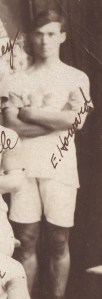
Ernest Howard in 1914Ernest Wilmot Howard, a teamster, was conscripted in Kingston on this day in 1918. He was born in Deseronto on March 18th, 1896, the son of Henry Howard and Bertha (née Luffman). In 1914 Ernest was a member of the Deseronto Fire Team and had his photograph taken with the rest of the team by James Fairbairn. He married Marietta Bradshaw on August 17th, 1917 in Belleville.

Howard joined the 1st Depot Battalion of the Eastern Ontario Regiment with the regimental number 3056835. He was five feet eight inches tall, with a dark complexion, grey eyes and brown hair. His service record shows that he served in Kingston with No. 3 Depot Field Battery and was demobilized with the rank of corporal on December 2nd, 1918.

In the 1921 census Ernest and Marietta were living in Oshawa with their two daughters, where he was working as a brakeman. He died in Oshawa on August 29th, 1961 and is buried in the Mount Lawn Cemetery in Whitby.

Charles Herbert Froste signature

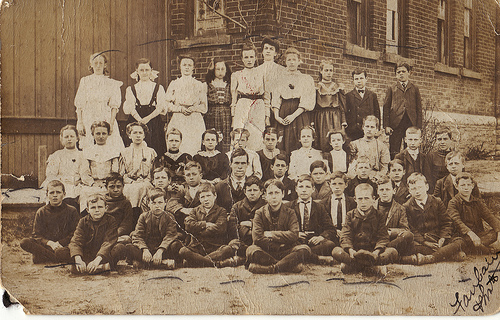
On this day in 1918 Charles Herbert Froste, a store-keeper, was conscripted in Kingston. He was born in Thurlow Township, Hastings County on August 14th, 1894, the son of Frederick Froste and Nancy (née Brooks). By 1901 the family were in Deseronto, where Frederick was working as an engineer. Charles was attending Deseronto Public School and has been identified as one of the boys in this school photograph, taken in around 1900 by James Fairbairn:

DPS-06-02

In 1911 Frederick was running a dry goods store in St. George Street, Deseronto. He died in 1913 and Charles took over the running of the store. He joined the 1st Depot Battalion of the Eastern Ontario Regiment with the regimental number 3056847. Froste was five feet nine and a half inches tall, with a dark complexion, blue eyes and brown hair.

Froste’s service record notes that he was admitted to hospital in Kingston on March 11th, suffering from deafness caused a narrowing of the eustachian tubes in his ears, caused by a bout of scarlet fever when he was a child. He was treated with politzerization and released a month later, with his condition improved. Froste was appointed Lance Corporal on May 6th, 1918. He served in Canada with the 3rd and 2nd Canadian Garrison Regiments.

Charles was demobilized in Toronto on February 4th, 1919. He married Gladys Gertrude Clokey, a bank clerk, in Toronto on June 8th, 1920. At the time of the 1921 census the couple were back in the store in Deseronto, with a young son.

HMR2-09-45b

Adrian Storm Rathbun signature

On this day in 1918 Adrian Storm Rathbun, a railway clerk for the Southern Pacific Company, enlisted via the British Canadian Recruiting Mission, presumably in San Francisco, where he was living at the time, at 1105 Bush Street. He was born in Deseronto on February 11th, 1887, the son of Edward Wilkes Rathbun and Bunella (née McMurrich).

The photograph above was taken on April 11th, 1909 on the veranda of the Rathbun family’s home on Main Street, Deseronto, and shows Adrian on the left, with Betty Caldwell, John Gzowski and Marjorie Braithwaite (on the right). In 1909 Adrian graduated from McGill University. John Gzowski graduated from the University of Toronto in 1910 and enlisted on November 13th, 1914, ending the war with the rank of Captain.

Adrian joined the 68th Battery of the Canadian Field Artillery with the regimental number 2557478. He was five foot six and three quarter inches tall, with a fair complexion, blue eyes and brown hair. His service record shows that he arrived in England on the SS Tunisian on April 19th, 1918 and crossed the Channel to France in October. On December 28th he joined the 3rd Brigade of the Canadian Field Artillery. He was back in England in April and left for Canada on the SS Aquitania on May 19th, 1919. When he arrived back in Halifax he was treated for scabies at the Cogswell Street Military Hospital. He was demobilized in Toronto on June 3rd, 1919.

In 1921 Rathbun was living in Burnaby Street, Vancouver. He married Robina Elizabeth Morrison on March 30th, 1922 in New Westminster. In 1930 the couple were living at 918 South Beacon Street in Los Angeles, where Adrian was working as an office clerk in an oil plant, according to the US census (taken on April 14th, 1930). He died three months later, aged 43, on June 30th, 1930 in Los Angeles.


Charles Frederick Dougherty signature

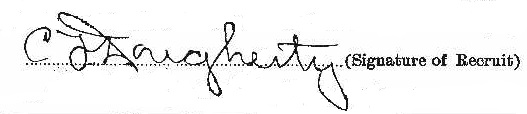
Charles Frederick Dougherty, a shipping clerk, signed up in Ottawa on this day in 1918. He was born in Deseronto on December 6th, 1887, the son of John Dougherty and Emma (née Woodcock). By 1911 the family had moved to Ottawa and on May 27th, 1915 Dougherty married Marie Anne St. Amand. They had a one-year-old son at the time of Charles’s enlistment.

Charles joined the 74th Battery of the Canadian Field Artillery with the regimental number 345187. He was described as having a fresh complexion, brown eyes and brown hair and was five feet ten inches tall. His service record shows that he embarked the SS Metagama in Halifax just one week later, arriving in Scotland on March 11th. He trained in Witley Camp until August, when he was posted to the 5th Brigade of the Canadian Field Artillery, which he joined in France on the 29th of that month. Dougherty returned to England on April 14th, 1919 and sailed back to Canada on the SS Minnekahda, disembarking on May 23rd. He was demobilized in Ottawa on May 26th.

Charles Dougherty died in Ottawa on April 13th, 1955 and was buried in Beechwood Cemetery.

Clarence Edmund Snider signature

On this day in 1918 Clarence Snider, an optician, was conscripted in Vancouver. He was born in Deseronto on March 24th or 25th, 1890, the son of George Edmund Snider and Ida (née Wartman). Clarence’s older brother, Leo, had enlisted in October 1917. When he was drafted, Clarence was living at 666 12th Avenue East in Vancouver.

Snider joined the 1st Depot Battalion of the British Columbia Regiment with the regimental number 2021635.He was five feet six and a half inches tall, with a fair complexion, brown eyes and light brown hair. His service record shows that he was transferred to 11 Special Service Company in Vancouver and served there until December 11th, 1918, when he was demobilized.

Clarence married Elizabeth Grey on November 2nd, 1932 in Vancouver, when he was working as an optometrist. He died in Vancouver on December 13th, 1972.

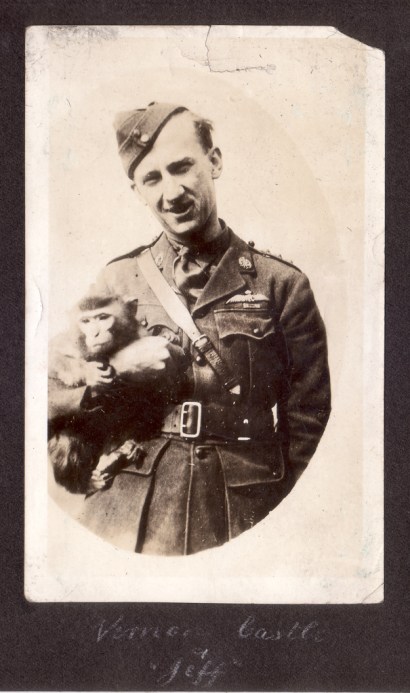
2009.20(55) Vernon Castle and Jeff

On this day in 1918 Vernon William Blyth Castle was killed in a flying accident at Camp Taliaferro in Texas. The official casualty report noted the following details:

…Date of Casualty: 15.2.18
Where occurred: Canada Camp Taliaferro
Type of Machine: Curtiss J.N.4. C663
Nature and Cause of Accident: In trying to avoid a mach[ine] which was taking off the pilot who was about to land took control and stalled his mach.
Result of Accident: Killed
Name of other Occupant of Machine: Cadet R.O. Peters. U.S.A. Injured
Remarks: Capt Vernon Castle instructing in the front seat giving some landings to Cadet Peters before sending him off on solo. C of I [Court of Inquiry] as over.

The finding of the Court of Inquiry on the reverse of the report card reads:

COURT OF INQUIRY 22100/1918 CAPT. VERNON W.B.CASTLE
The Court having examined all witnesses, weighed all evidence and examined machine C.663, is of the opnion that Capt. Vernon Castle, while on duty in machine C.663 No.84 C.T. [Canadian Training] Squadron, in trying to avoid collision with machine C 449 of No. 85 C.T.Squadron did an Immelmann turn from which he was unable to recover before hitting the ground and was killed.

Castle was killed as a result of being in the front seat of the aircraft, a position he often took after being involved in the crash which killed Cadet Allan Walton Fraser in May 1917.

This photograph, from the collection of Sergeant Christopher Paulus Devos, shows the aircraft after the crash.
2009.20(58)
Devos’s annotations read:

Capt. Vernon Castle
—R.F.C—
How this brave man met his death.
Pinned under engine in front seat.

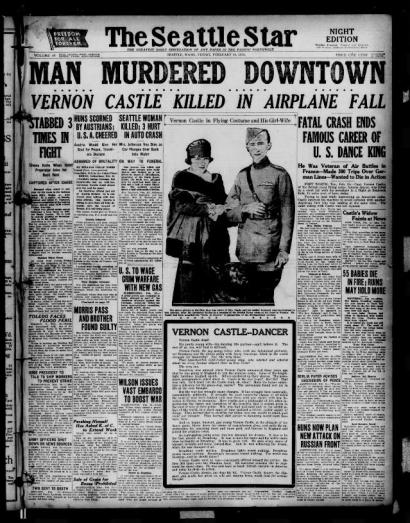
Castle’s death made front-page news around the world. Here’s the Seattle Star‘s report on the evening of the crash:

Seattle Star 15th Feb 1918

Front page of the Seattle Star, February 15th, 1918, courtesy of Chronicling America from the Library of Congress

In the Washington Times‘s version of the story, Castle was described as “America’s most famous dancer” and it was noted that:

Vernon Castle was the highest paid dancer in all dramatic history…During the height of the dancing craze Castle’s salary averaged $6,000 per week.

Castle was born in Norwich, England on May 2nd, 1887, the son of William Thomas Blyth and Jane (née Finley). He arrived in New York in July 1906 and started his career on the stage shortly afterward. He married Irene Foote on May 28th, 1911 and the two established themselves as dance stars in Paris and then on Broadway. Vernon learned how to fly at the Atlantic Coast Aeronautical Station in Newport News, Virginia, in early 1916, as this record from the Royal Aero Club shows:

Royal Aero Club Aviator Certificate details for Vernon Castle, courtesy of the Royal Air Force Museum

Royal Aero Club Aviator Certificate details for Vernon Castle, from Ancestry, courtesy of the Royal Air Force Museum

He travelled back to England to join the Royal Flying Corps in March 1916 and served on the Western Front until the following March, when he was transferred to Canada as an instructor at Camp Mohawk. With the rest of the Deseronto Wing, Castle spent the winter of 1917-1918 training cadets at Camp Taliaferro in Texas.

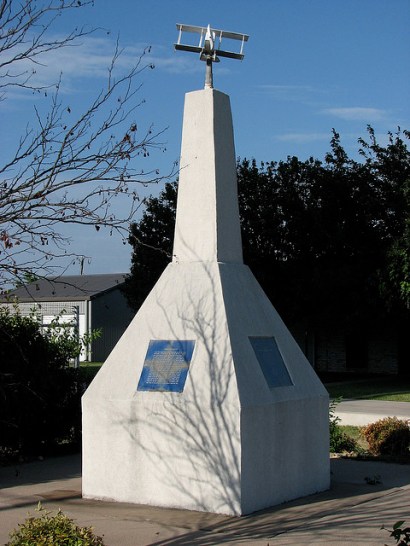
Vernon Castle was buried at Woodlawn Cemetery in New York. In 1966 a memorial to Castle was erected at the site of his death in Benbrook, Texas.

Vernon Castle Memorial in Benbrook, Texas

Vernon Castle Memorial in Benbrook, Texas, courtesy of Flickr user QuesterMark

Ernest Arthur Denee signature

Ernest Arthur Dennee died on this day in 1918 of wounds received while he was serving in France with the 2nd Battalion. He died in Queen Mary’s Hospital in Stratford, London and was buried in Brookwood Military Cemetery, Surrey, England. The headstone is inscribed “Gone but not forgotten by his loving wife”.

Ernest Dennee’s grave, courtesy of FindaGrave.com (uploaded by Charlie)

Ernest left all his possessions to his wife, Eliza, in his army will, which is to be found in his service record:

Ernest Arthur Denee's will

Eliza was living in Deseronto (where she had spent much of her life) when Ernest made his will.  This explains the presence of Ernest’s name on the Deseronto war memorial, even though Ernest himself seems to have had no direct connection with the town.

Deseronto memorial

« Previous PageNext Page »