military training


William Kellock Domville signatureOn this day in 1918 William Kellock Domville died in Kingston General Hospital as a consequence of a flying accident which happened at Camp Mohawk near Deseronto on July 4th, 1918. The casualty cards from the Royal Air Force for this incident supply the following information:

Date of Casualty: 4.7.18
Where occurred: Canada
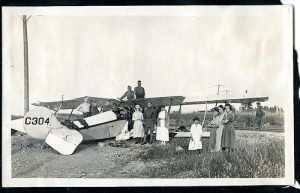
Type of Machine: Curtiss JN4 C304
Nature and Cause of Accident: Flying accident error of judgement
Result of Accident: Killed
Name of other Occupant of Machine: 153345 Cadet C. J. Schultz slightly injured

William Domville had joined the Royal Flying Corps as a cadet on October 10th, 1917 in Toronto with the regimental number 152405. He was five feet nine and three quarter inches tall and had previously been a student at the Royal Military College in Kingston. He had been granted a commission in the Royal Air Force on May 1st, 1918 and was working as a flying instructor with 82 Canadian Training Squadron at Camp Mohawk. He was born in Hamilton on March 2nd, 1899, the son of Percy Domville and Mary Elizabeth (née Jarvis).

This photograph from the collections of the Community Archives of Belleville and Hastings County shows the aircraft involved in Domville’s crash. This may have been the crash which killed him.
30332611382_eec0a0fcd2

CABHC: HC00021

Domville was buried in Hamilton Cemetery.

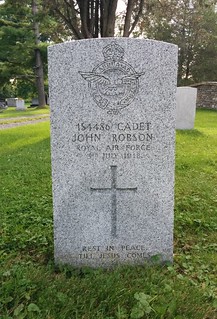
John Robson signatureJohn Robson was killed in a flying accident at Camp Mohawk on this day in 1918. He joined the Royal Flying Corps on January 23rd, 1918 in Winnipeg with the regimental number 154486 and was officially appointed in Toronto five days later. He was described as five feet eleven inches tall, with a ruddy complexion, blue eyes and brown hair. He was 21 years old and had been serving in the North-West Mounted Police for three years. He gave his home address as Lairhope, Teviothead, Hawick, Scotland. His parents were Walter Robson and Isabella (née Laidlaw). The Royal Air Force report of the accident is as follows:

Date of Casualty: 3.7.18
Where occurred: Canada Deseronto Ontario Camp Mohawk
Type of Machine: Curtiss JN4a
Nature and Cause of Accident: Aeroplane accident. Error of judgement
Result of Accident: Killed
Name of other Occupant of Machine: None

A Court of Inquiry held on the day of the accident found that Robson had got into a spin and been unable to get out of it. His aircraft (C-595) got into a vertical nose dive and crashed on its back just north of Camp Mohawk.1

Robson was buried in Deseronto Cemetery.

John Robson's grave in Deseronto

John Robson’s grave in Deseronto

He is also remembered on the war memorial in Teviothead, Scotland.


1 Records held in Attorney General’s 1918 file RG 4-32/1792 at the Archives of Ontario

George Rice signature
George Rice died on this day in 1918. He was a member of the Royal Air Force’s 42nd Wing in Deseronto, but died in Toronto General Hospital of tongue cancer. He was an electrician who had joined the Royal Flying Corps in Toronto on March 27th, 1917 with the regimental number 70853. He was five feet eight and a quarter inches tall. He was promoted to 1st Air Mechanic on February 1st, 1918. Rice was born in England in 1889. He gave his next of kin as William Rice of Chagford, Devon. When he enlisted, Rice was living in Parry Sound. George was buried in the Toronto Necropolis. There is some disagreement in the records about the date of George’s death, but his RAF record and the death registration entry both state June 28th.

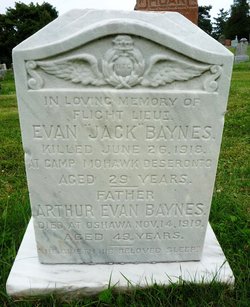
Evan John Baynes signatureEvan John Baynes, a flying instructor at Camp Mohawk near Deseronto was killed in an accident near Marysville on this day in 1918. This is how the Royal Air Force casualty cards described the event:

Date of Casualty: 26.6.18
Where occurred: Canada
Type of Machine: Curtiss JN4 C1353
Nature and Cause of Accident: Flying accident error of judgement
Result of Accident: Killed
Name of other Occupant of Machine: Cadet C. L. Foote injured

Baynes had joined the Royal Flying Corps on June 5th, 1917 in Toronto with the regimental number 70378. He was selected to hold a temporary commission with the corps on August 31st, 1917, at the end of his training period. Baynes was born in London, England in July 1889, the eldest son of Arthur Evans Baynes and Harriet Clara (née Smith). The family came to Canada in 1909 and Arthur died in Oshawa in November 1910. By 1916 Harriet had moved to Winnipeg with her six children and Evan was working there as a manager for Fitters Ltd when he enlisted.

Jack was buried with his father in Oshawa Union Cemetery.

Evan John Baynes headstone

Headstone for Evan John Baynes and Arthur Evans Baynes, courtesy of Kathy L. at FindaGrave.com

Archibald Burns Laird signatureArchibald Burns Laird died in training at Camp Mohawk near Deseronto on this day in 1918. The Royal Air Force report of his death notes the following details:

Date of Casualty: 24.6.18
Where occurred: Canada North west corner of aerodrome Camp Mohawk
Type of Machine: Curtiss JN4 C149
Nature and Cause of Accident: Machine got into a nose dive. Same was apparently pulled out too quickly.
Result of Accident: Killed
Name of other Occupant of Machine: Nil

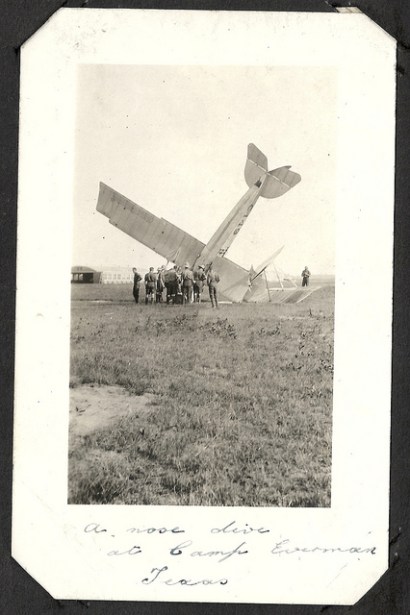
There is a photograph in the Deseronto Archives collection of this aircraft after a nose dive, although this accident happened in Texas. After Laird’s crash, the aircraft was described as “totally damaged”.
Curtiss JN-4 aircraft C149 after a nose dive

Laird joined the Royal Flying Corps in Toronto on November 28th, 1917 with the regimental number 153073. He was five feet nine and a quarter inches tall and was training with 79 C.T.S. at Camp Mohawk when he died. He was born in the town of Essex, Ontario, on March 26th, 1897, one of twin sons of James Steward Laird and Mary (née Beattie). His twin, John Bruce Laird, had joined the Canadian Expeditionary Force on February 2nd, 1916 (he survived the war).

Laird was buried in Cottam Cemetery, Essex, Ontario.

Every year there is a graveside ceremony in Deseronto, organized by Pat and Murray Hope of 418 Wing Belleville, to remember the airmen who died while serving at the two Royal Flying Corps/Royal Air Force training camps near Deseronto. Seven of the men were buried here.

2018 marks the 100th anniversary of many of those deaths, including that of Lieutenant Colin Goss Coleridge, who was killed on July 23rd, 1918. Colin’s family lived in the village of Snettisham, Norfolk, England and was one of 45 Snettisham men who died during the First World War. The local Parish Council has created the Snettisham Remembers website as a memorial to each of these men.

This weekend three Snettisham residents were able to be in Deseronto. The village’s vicar, The Reverend Veronica Wilson; Norfolk County Councillor Stuart Dark; and Parish Council Chair, Rosalind Pugh came to lay a wreath of Norfolk lavender and rosemary on Coleridge’s grave as part of this year’s service.

Rosalind Pugh laying a Norfolk wreath on Colin Goss Coleridge’s grave

The Archives became involved with this event because we hold a brass plaque remembering Lieutenant Coleridge:

This became part of the Archives’ collection in 2002 when St. Mark’s Anglican Church in Deseronto was deconsecrated. It had been attached to a credence table and was donated to the church by John Coleridge of the Manor House, Snettisham in memory of his son. The table remained in the church when the plaque was sent to the Archives.

As part of the commemorative events this weekend, the plaque and the table were both donated to the National Air Force Museum of Canada. Here are the three visitors from Snettisham, reuniting the two items on Friday:

Photo courtesy of Paul Robertson

The table and plaque will now form part of the collection of the National Air Force Museum of Canada, a permanent reminder of the close connections between the air forces of the United Kingdom and Canada.

Carl August Bender signatureOn this day in 1918 Cadet Carl August Bender was killed in a flying accident near Deseronto. The Royal Air Force casualty card records the following details:

Date of Casualty: 10.6.18
Where occurred: Canada East of Camp Rathbun Aero
Type of Machine: Curtiss JN4 C1004
Nature and Cause of Accident: Failure to come out of spin
Result of Accident: Killed

Bender, a bank clerk, enlisted in the Royal Flying Corps in Winnipeg on November 17th, 1917 with a regimental number of 153630. He was five feet seven inches tall, with a medium complexion, light brown hair and blue eyes. He was officially appointed to the Corps in Toronto on December 14th.

Bender was born in Montmagny, Quebec on May 28th, 1894, the son of Eugene Bender and Kate (née Forrest). By 1911 the family had moved to Winnipeg. At the time of his death Carl was in training with 81 Canadian Training Squadron, part of the Deseronto Wing at Camp Rathbun.

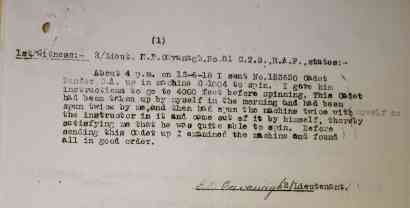
At the Court of Inquiry convened on June 11th to investigate the accident, 2nd Lieutenant E. P. Cavanagh reported that:

Detail of file RG4-32/1334 at the Archives of Ontario

Detail of file Attorney General 1918 file RG4-32/1334 at the Archives of Ontario

About 4 p.m. on 12-6-18 I sent No.154630 Cadet Bender C.A. up in machine C-1004 to spin. I gave him instructions to go to 4000 feet before spinning. This Cadet had been taken up by myself in the morning and had been spun twice by me, and then had spun the machine twice with the instructor in it and came out of it by himself, thereby satisfying me that he was quite able to spin. Before sending this Cadet up I examined the machine and found all in good order.

Carl was buried in the Roman Catholic section of the Deseronto Cemetery.

Grave of Carl A. Bender in Deseronto Cemetery

Reverend Dr Allan Miller sent us this letter from The Sarnia Canadian Observer which shows an interesting glimpse of life with 89 Canadian Training Squadron at Camp Rathbun for pilots-in-training. It was written by Cadet William Boyce Mavity to his mother, Emily and published in the newspaper 100 years ago today.

Letter from Camp Rathbun

Camp Rathburn, Deseronto
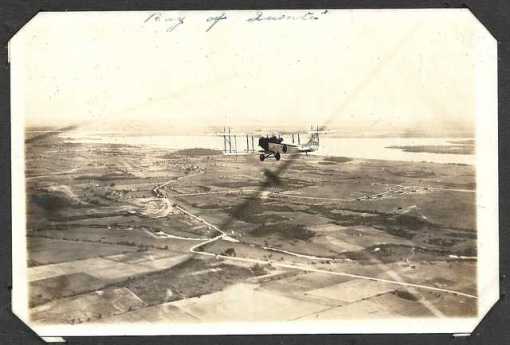
Dear Mother—Here I am away out at Camp Rathburn, which is about twenty minutes walk from Deseronto. This is a small camp, there being only about 100 cadets in training. Camp Mohawk is about a mile away. This afternoon I went up for my first “joy ride” and it’s almost impossible to describe the sensation. In starting off the bumping of the wheels on the uneven ground can be felt, but as the machine gains speed it gradually lifts itself off the ground and seems to be riding on cushions, there being no jar whatsoever. The ground seems to fall away from the machine until it gains level flying position, when the machine seems to be suspended in the air and the ground moving. The machine I was in attained an altitude of 5,000 feet (the Curtis will not climb over 8,000) and you can’t imagine how strange the earth looked. It was impossible to discern people on the ground, but cows and horses were evident. Houses looked like little blocks and roads like long narrow strips of white ribbon. The farming country looks like a checkerboard and the Bay of Quinte and small lakes look just like pools of melted lead.

Bay of Quinte from the air

DA 2012.10 (09)

The only thing that bothered me, was when the instructor headed the machine into a straight nose dive. The earth started to rush toward us and I began to feel sick at the stomach. The machine dropped about 4,000 feet before it straightened out. I was up 30 minutes. You can’t imagine how strong the wind is at a high altitude and especially when the machine is falling. I wore a big heavy leather coat, thick gloves, goggles and a crash helmet. The wind exerts such pressure on the helmet and forces it on your head so hard that your head aches. The goggles were not very air tight and the wind nearly blew my eyes out. I will go up again tomorrow and will be allowed to guide the machine myself. This morning a cadet started on his first solo flight. He went up twice and landed twice, but the third time he tried to land, the machine landed on its nose and was completely demolished and he didn’t even get scratched. In fact, he got another machine and went up again.
The meals we get here are swell. We get 90 cents a day extra while flying, but they take $8 a week for board. We have fresh tomatoes, chicken, cake, ice cream, pie fruit—in fact, the best of everything and all is well cooked. We have flowers on the tables and have waiters to wait on us and eat with the officers. At present I am sleeping in a tent with two other fellows. We have a coal oil stove and lantern, too.
Well I will close now, write soon,
lovingly,
HAP
My address is
No. 15300 Cadet W. B. Mavity
89th C.T.S. R.F.C.
Deseronto Ont.

Mavity had originally enlisted in the Canadian Expeditionary Force on February 24th, 1917, but was discharged six weeks later for being under age. He joined the Royal Air Force in 1918 after his nineteenth birthday. He completed his training was granted a temporary commission as a 2nd lieutenant on September 5th, 1918.

Rosenthal and Heintzman report of deaths in New York Tribune

New York Tribune report on Heintzman and Rosenthal’s crash, May 30th, 1918

New York Flier Killed in Canada
Samuel Rosenthal and Lieutenant Heintzman Victims of Accident Near Toronto

DESERONTO, Ont., May 29. – Second Lieutenant T. H. Heintzman, of Toronto, was killed, and Cadet S. Rosenthal, of 28 Pinehurst Avenue, New York City, was so badly injured in an airplane accident near Rathburn aerodrome to-day that he died later.
——-
Cadet Samuel Rosenthal was twenty-four years old and lived with his father and mother Mr. and Mrs. E. L. Rosenthal, and four sisters at the Pinehurst Avenue address. Until last December, when he went to Canada to enlist, he was in business with his father at 820 Broadway.
Rosenthal was born in Montreal, Canada. He came to New York with his parents ten years ago, but was never naturalized. As a result he was not accepted when he tried to enlist in this country, and went to Canada in order to get into the army.
He was placed in the Royal Flying Corps in January, and in letters to his parents told of at least six flights he had made alone in the last few weeks. He expected to go abroad in a short time.

Thomas Herman Heintzman signature

Thomas Herman Heintzman, a piano maker, enlisted in Toronto on November 20th, 1917. He was born in that city on July 26th, 1887, the son of Herman Heintzman and Lucy Ann (née Spink). He joined the Royal Flying Corps with the regimental number 152767. He was five feet eight inches tall. On April 24th, 1918, he was granted a temporary commission with the Royal Air Force, working as a flight instructor for the Deseronto Wing with 81 Canadian Training Squadron.

Samuel Rosenthal signature

Samuel Rosenthal had joined the Royal Flying Corps in Montreal on January 17th, 1918 and was officially appointed to the Corps in Toronto two days later. His regimental number was 154067 and he was five feet four inches tall. He was born in Montreal on November 4th, 1893, the son of Eleazer and Fanny Rosenthal.

The Royal Air Force report of the accident which killed the two men at Camp Rathbun noted:

Date of Casualty: 29.5.18
Where occurred: Canada
Type of Machine: Curtiss JN4a C635
Nature and Cause of Accident: Dropped nose on steep bank at 150ft. Machine caught fire on striking ground.
Result of Accident: Killed
Name of other Occupant of Machine: Cadet S. Rosenthal Died of Inj’s.

Lieutenant Heintzman was killed instantly. Cadet Rosenthal’s death registration tells us that he survived for four and a half hours, before dying of shock from his burns.

Heintzman was interred in Mount Pleasant Cemetery, Toronto. Rosenthal was buried in the Shaar Hashomayin Cemetery in Montreal.

Arlof David Hewson signature

Arlof David Hewson died in a flying accident while training with the Royal Air Force at Camp Mohawk near Deseronto. Hewson was born in Windsor, Ontario, on November 18th, 1898, the son of Frank Hewson and Eliza (née Tansley). He joined the Royal Flying Corps on January 15th, 1918 in Toronto with the regimental number 154244. He was five feet four inches tall.

There is a great deal of disagreement in the records as to the exact date of his death. The death registration by local physician Elgin Vandervoort gives May 23rd, but the RAF casualty record has May 20th and other sources have May 5th, May 22nd or 24th. The RAF Court of Inquiry report shows that the accident happened on May 22nd.

Arlof was attached to 81 Canadian Training Squadron of the Royal Air Force’s 42nd Wing in Deseronto. His accident is described in the RAF records as follows:

Date of Casualty: 20.5.18
Where occurred: Canada Camp Mohawk Deseronto
Type of Machine: Curtiss JN4
Nature and Cause of Accident: Fly[ing] acc[ident] failure to come out of accidental spin
Result of Accident: Killed 22.5.18* [*addition made 23/3/59]
Name of other Occupant of Machine: 2nd Lt C. A. [Cyril Arthur] Robotham injured

Lieutenant Robotham gave evidence at the Court of Inquiry held on May 23rd. He had suffered compound fractures of the bones in his left leg and shock.

Detail from Attorney General's 1918 file RG4-31/1276 at the Archives of Ontario

Detail from Attorney General’s 1918 file RG4-31/1267 at the Archives of Ontario

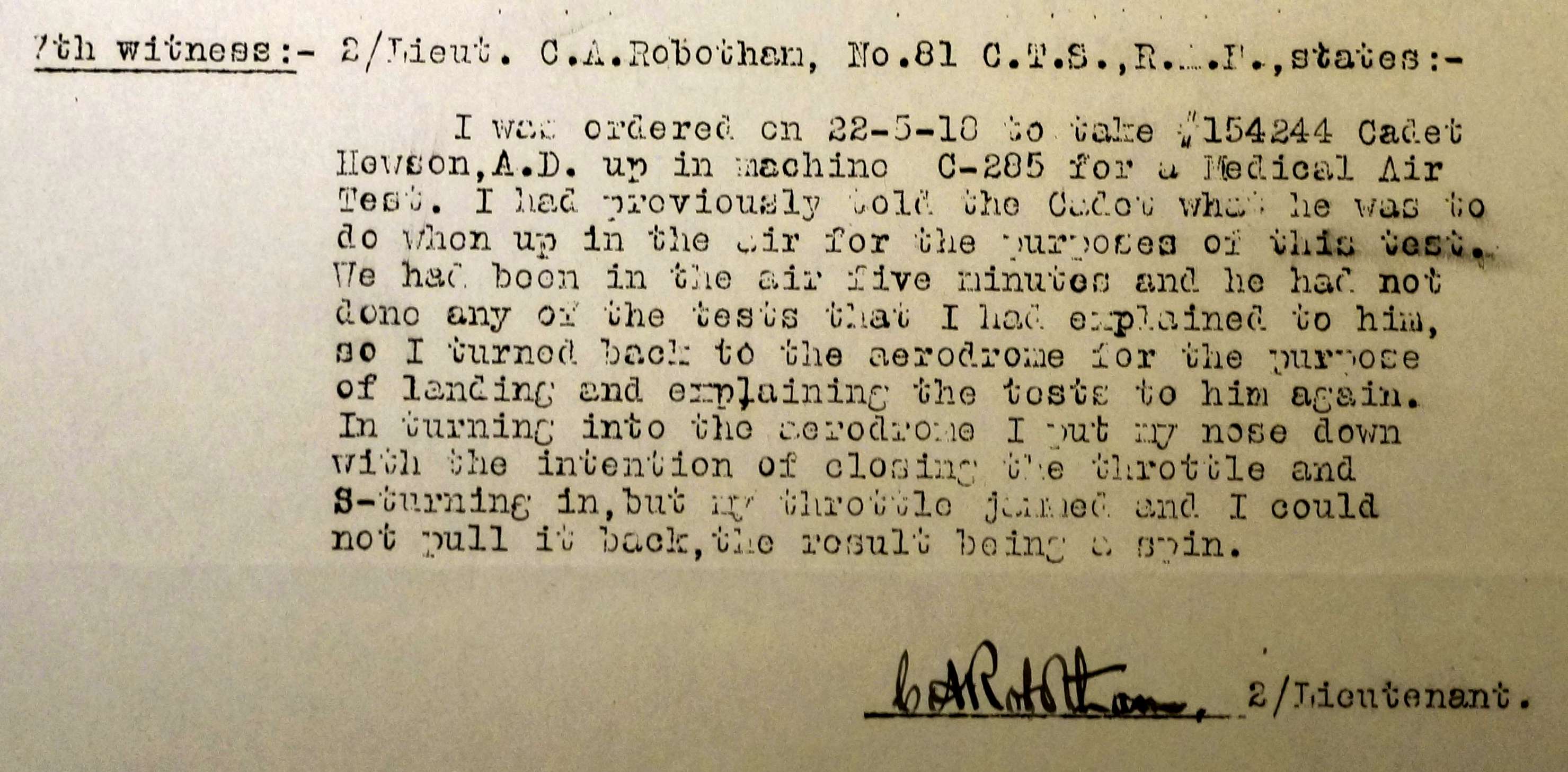
7th witness:– 2/Lieut. C.A.Robotham, No. 81 C.T.S., R.A.F., states:-

I was ordered on 22-5-18 to take 154244 Cadet Hewson,A.D. up in machine C-285 for a Medical Air Test. I had previously told the Cadet what he was to do when up in the air for the purposes of this test. We had been in the air five minutes and he had not done any of the tests that I had explained to him, so I turned back to the aerodrome for the purpose of landing and explaining the tests to him again. In turning into the aerodrome I put my nose down with the intention of closing the throttle and S-turning in, but the throttle jammed and I could not pull it back, the result being a spin.

The aircraft was examined after the accident and all controls were found to be intact. The court recommended that:

…all pilots be instructed not to make gliding turns with the engine “on”, and that in getting into a spin close to the ground, they switch off rather than close the throttle.

Arlof was buried in St. John’s Anglican Church Cemetery in Windsor.

« Previous PageNext Page »