News


A glimpse of what life was like in Deseronto in 1906 and 1907 has come to us courtesy of a conversation recorded in 1967. Bill and Jack Duncan were taped as they reminisced about their arrival in Deseronto and Bill’s early experiences of work in Canada. Their father, John Duncan, had been a shoe laster in Leicester, England, but his involvement in the trade union movement meant that it was difficult for him to find work there and the family relied on their oldest son, Bill, for their income (26 shillings a week).

John and his wife Maria decided to move their five surviving children across the ocean to Canada. The family spent less than a year in Deseronto before moving on to Stirling and then Toronto, but Bill and Jack had some strong memories of their time here, including loitering in the Post Office in order to get warm in the winter!

Library and Archives Canada have made the 1921 census available through Ancestry.ca. The census has not yet been indexed (which means it can’t be searched by name at present), but it is available to browse. You need to sign up for a free Ancestry account in order to see this, or you can get access without having to sign up if you use Ancestry from a public library which has a subscription to the Ancestry service (most libraries in Ontario do).

To see the entries for Deseronto, you’ll need to select ‘Ontario’ from the menu on the left of the Ancestry 1921 page, then go to the ‘Hastings East’ district. You’ll find that Deseronto is covered by three sub-districts: 44 (Centre Ward), 45 (East Ward) and 46 (West Ward of the town). This census was taken on June 1st, 1921.

And speaking of libraries and 1921, we’ve just digitized the first ten pages of Deseronto Public Library’s register of books borrowed in March, April and May 1921. This volume was maintained by Deseronto’s fourth librarian, Flossie Hall.1 So if you do find a Deseronto relative in the 1921 census, you can also check the borrowing register and see what they were reading!

Register of books issued in 1921

The books aren’t available in the library itself these days, but you can find scanned copies of many of them online through Project Gutenberg, the Internet Archive and the Open Library, to get a taste of what people were enjoying back in 1921.


1 There’s a photograph of Flossie featured in this earlier post.

When an archives’ focus is geographical, as ours is, there is often reason to be thankful for the fact that a town has a fairly unique name. This makes it easy to take advantage of the increasing number of online resources around the world which allow searching of historical materials by keywords: there aren’t any other Deserontos, so when we find a hit, we can be fairly sure that the article or book in question is about this town.

This week, the resource we were plundering was the National Library of Australia’s Trove service. This is an incredibly rich seam of information from Australian and international sources, including digitized newspapers, manuscripts, maps and photographs. Among the results for a search on Deseronto was this interesting snippet about a hard-fought and arduous event held in Deseronto in June 1897, the year of Queen Victoria’s Diamond Jubilee:

Great Tug of War

A story of an extraordinary tug-of war comes from Canada. At an athletic meeting held at Deseronto, Canada, on Jubilee Day, two teams, styled Picton and Deseronto, were down for a tug-of-war, seven men aside, one pull of 3ft. to a finish : and for the record time of 2h. and 10min. those fourteen men strained every muscle in the glaring sun without any apparent advantage. Picton secured eight inches in the first hour, which Deseronto reduced to nil, but could not get it over scratch 1/16th of an inch.

They, however, held it there for half an hour, when Picton again, by fractional parts, got 7in. ; and the judge, after consulting the captains, decided to call it a draw in Picton’s favor, as the condition of some of the contestants did not warrant a continuation, although they were all averse to a draw. Stimulants had to be administered to every man frequently, and applications of cold water and rubbings were in order.

This story appeared in Victoria’s Traralgon Record and Bairnsdale Advertiser newspapers in October 1897, some four months after the event itself took place. News evidently travelled more slowly in 1897 than it does today.

The tug-of-war was one of a series of events held on June 22nd. The advertisement in Deseronto’s own newspaper, The Tribune, on June 18th proudly proclaimed that “This will be one of the most imposing celebrations ever held in the Bay of Quinte District”.

Diamond Jubilee celebration
In its post-event coverage on June 25th, The Tribune noted that the tug-of-war was “a magnificent exhibition of strength and endurance”. It went on to add that

the Picton team was organized by Mr. Taylor of the Bank of Montreal in 1892 and…has never been beaten. Mr. Taylor only induced them to come here on the understanding that he would not captain or coach their opponents, so that there might be fair play for all. He did, however, show the home team the correct position for pulling, a most important point. To those who think the pull should have had a time limit we are informed that it was conducted on precisely the same lines as the great international pull at Madison Square garden New York in 1892.

We missed the opportunity of organizing a rematch at last year’s Diamond Jubilee celebrations, but maybe if Queen Elizabeth II is still on the throne in 2022 we could arrange a re-run of the event for her Platinum Jubilee. With nine years in which to practice, perhaps this time Deseronto will win!

April 27th, 1881, local item about the cemetery in the Deseronto Tribune

Correspondence with a family historian this week has shed some light on this cryptic comment in the ‘Local items’ section of Deseronto’s newspaper, The Tribune, in the April 27th, 1888 edition.

The decision to build a cemetery in the town had been taken earlier that year: on Monday, February 6th, 1888 a meeting was held in Deseronto’s Town Hall to discuss the establishment of a Cemetery Company under the terms of the Cemeteries Act. It was agreed that the Deseronto Cemetery Company should be formed, with a capital of $4,500. Within a week a prospectus had been issued and shares were being sold at $100 each.

The Tribune  reported the outcome of the meeting in the following way:

The prospect of the early opening of a cemetery in this vicinity is everywhere hailed with satisfaction. The people of Deseronto and neighbourhood have in the past been compelled to bury their dead here, there and everywhere, a state of affairs in no way creditable to their public spirit. We are glad to know that so many are taking shares in the company. The Tribune, February 10th, 1888

Forty acres of land to the east of Deseronto were purchased by the Rathbuns for the cemetery in April 1888. “Before long, it would be a ‘pleasure’ for anyone to be buried in the Cemetery”, reported The Tribune, chirpily, on April 6th.

A. J. Hopkins, a landscape architect from Oswego, New York, was hired to design a layout for the site in early May of the same year. The choice of an Oswego landscape architect reflected the industrial interests of the Rathbuns in that town and the fact that there were no landscape architects in Canada at that time.  By the summer of 1888 the cemetery was in use.

As the cemetery was not yet open in April 1888, the comment in The Tribune about a birth there seems odd, but our correspondent was able to share another newspaper clipping with us (probably from the Napanee Express) which gave some more information:

Newspaper birth announcement of William Langton

Edwin R. Langton was the son of an English grave digger called William Langton and was born in Hanwell, Middlesex (just to the west of London) in 1852. He came to Canada in 1883 and married Martha Penney in Sillery, Quebec, on October 26th, 1886. On their marriage record, Langton is described as a gardener from Deseronto and a widower.1 In 1891 the family are listed on the census in Deseronto, with Edwin as a gardener.

The cemetery originally had a cottage just inside the gates, which was occupied by the cemetery caretaker. Perhaps the Langtons were in occupation of this building when William was born and the new cemetery was taking shape around it. Edwin, with his gardening experience, may even have been the first caretaker of the cemetery grounds.

By 1901 the Langtons had moved back to Sillery with their five children. The eldest (the one born in the cemetery) was called William. It does seem appropriate that a child born in a cemetery should be named after a grave digger!


1 It turns out that this wasn’t true: my correspondent informs me that Langton’s first wife, Ruth (née Winkworth), died in England in 1894 (read more in his article about this family [PDF]). This is the second bigamist we’ve come across in Deseronto.

It’s not every day that a small municipal archives is featured alongside a national institution, but today is one of those days. We are delighted to be able to share the news that Deseronto Archives is now part of the Flickr Commons, a place for institutions to share their photographic collections and a place where people can add tags and comments to the photographs to help describe and interpret them.

Flickr Commons participating instutions

Some of the institutions participating in Flickr Commons

We’re already seeing new comments and tags being added to the Flickr photographs, such as this one of Lieutenant Ned E. Ballough, ‘the wing-walker’ performing a daring stunt during the First World War:

Man standing behind the cockpit of a Curtiss JN-4 training aircraft

Ned Ballough, ‘wing-walking’ 2012.10(05)

And the usage statistics on the account have also taken a dizzying skyward trajectory in the 16 hours since we officially joined the Commons!

Usage statistics from Flickr

Regular readers of this blog will probably be aware by now that here at Deseronto Archives we have fairly advanced views about opening up our collections and making as much of them as possible available online, both through this blog and through our Flickr account.

Tay Bridge, Dundee

At the moment I am in Dundee, Scotland, at day one of a conference with the theme ‘Democratising or Privileging: the Future of Access to Archives‘. The programme is absolutely packed with talks about providing online access to archives and the role of digitization in making materials available to as wide an audience as possible.

Some of the most intriguing perspectives have come from users of archives. Dr Alan MacDonald spoke of his frustration about lack of published policies on what materials will be chosen for digitization and the lack of clarity over charging for access to online archives. (In the UK it is much more common for archives to charge genealogists for searching and reading records than it is in Canada.) He called for consistency in access to materials and for as much as possible to be open and free for all uses. A website designed for family historians, for example, may not be useful for other researchers if the only access to it is by name indexes.

Chris Paton is a professional genealogist and his pleas to archivists included a request for free wi-fi in archives, permission to take digital photos, longer opening hours and simpler user registration and photocopying policies. He also thought it was important for archives to make use of social media tools like Facebook and Twitter. Both Chris and Alan emphasized that although digitization is useful for accessibility, detailed online [item-level*] cataloguing is even more so, especially in a time of financial constraints for researchers (and everyone else!), although they both recognized that this is much harder to get funding for than ‘sexy’ digital imaging projects.

There is a strong Canadian contingent at this conference and Sara Allain from the University of Toronto Scarborough gave an interesting analysis of what she termed the ‘Digitization Rhetoric’ currently being advanced at Library and Archives Canada as the solution to the problem of access to materials there. Jenny Seeman of Memorial University of Newfoundland also looked at digitization, wondering about whether selectively digitizing a collection unfairly privileges one narrative about its contents over others, using the case of the Dr. Cluny MacPherson collection as her example.

Professor Wendy Duff of the University of Toronto talked about social media use in archives and ways of using elements of gaming theory to encourage public engagement with archival material online. I particularly liked the mental picture of online archives as rhizomes, providing multiple entry points to the material and different paths through it, which would vary from user to user. She also described archivists as walking finding aids, a point also echoed by Alan MacDonald, who agreed that the knowledge of archivists is priceless, and that it is hard to replicate that in online resources.

All in all, a fascinating day and plenty to think about!

Day 2

Many of the themes in the first day of the conference continued to be mentioned during the second. The difficulty of balancing public demand for materials with the cost of digitizing them came through loud and clear from representatives of the National Records of Scotland. Historian Professor Allan MacInnes gave an intriguing analysis of archival managers in relation to Calvanistic theology. According to Allan, administrators of archives fall into categories of the Church Invisible, the Church Visible and Reprobates. I can’t remember the precise details of the first two (they weren’t very complimentary!), but found myself warming towards his Reprobates: archivists “who believe that research and scholarship are more important than policy and procedure”. The issue of trust between archive managers and users was a strong theme of Allan’s keynote, along with a call for more collaboration between them.

More Canadians appeared in later sessions: Michael Moir of York University examined the ethical issues of access to confidential and sensitive information in personal papers. I liked Michael’s point that use of archival materials can be seen as a return on the investment of the institution in giving them shelf space: the cost of archival storage at York had been estimated at $80 a year for a box. Dr Jean Dryden reported on her research into archivists’ approaches to dealing with copyright restrictions. There’s a lot of caution in the community about putting things online and accidentally infringing copyright, so it was reassuring to hear from Jean that there have been no instances in North America of archives being sued for putting images online: any disputes have been settled amicably. I was interested to hear from Jean about the Smithsonian Archives of American Art’s approach, where entire collections are being digitized on the basis that “access trumps everything”.

François Cartier gave a thorough overview of recent developments at Library and Archives Canada, with a strong call for archivists to be part of the policy-making processes at their institutions. He quoted Carl Sagan: “extraordinary claims require extraordinary evidence” and Christopher Hitchens: “that which can be asserted without evidence, can be dismissed without evidence” as important principles to remember in response to claims made in the name of the modernization agenda at LAC.

Dr Cathryn Spence of the University of Guelph talked about her research on wills of women in the late sixteenth century. She had to pay for printouts of  these (digitized) records in Scotland (and actually ended up asking her parents to get some of them for her as a Christmas present!). Other parts of her research were undertaken in a relatively poorly-funded archives service: Edinburgh City Archives.  Cathryn was full of praise for the staff of this small repository, with whom she built up an excellent and trusting working relationship in a way that is very difficult in the larger, impersonal surroundings of the National Records of Scotland. This echoed Allan MacInnes’s observations made earlier in the day. The worrying part about the situation in the City Archives is the reliance of researchers on the knowledge of one archivist. One thing I’m hoping to achieve by writing blog posts here is to avoid having everything I’ve learnt about Deseronto’s archives leaving the Archives when I do! (Not that I’m planning to, just yet…)

Dr Vivienne Dunstan gave us a valuable insight into the problems faced by researchers who are wheelchair users. She described herself as “a big fan of online catalogues”, the more detailed the better (continuing another of the previous day’s themes). It was pleasing to hear that Vivienne found many archive services were willing to be flexible in giving her access to materials above what might have been usually offered. This was something else Allan MacInnes had called for: flexibility over standard procedures, where that is appropriate.

All in all, the conference was extremely interesting. Calls for archival policies based on evidence, on collaboration and on user needs were the main themes of the two days. And judging from the users who spoke, detailed catalogues; online resources which are explorable in a range of ways; mutual respect between staff and users; and adaptable procedures were top of their list of requirements. Thanks to colleagues at the University of Dundee’s Centre for Archive and Information Studies for organizing a fascinating event!

There’s further coverage of the conference over at British GENES and Viv’s Academic Blog.

*Postscript: Chris didn’t actually say ‘item-level’ – he was talking about cataloguing in general. My apologies!

Naylor's Theatre in 2009

It’s hard to believe these days, but Naylor’s Theatre in Deseronto was once on a theatrical circuit which included far more famous venues such as Washington’s National Theatre, Philadelphia’s Orpheum Theater and New York’s Broadway.

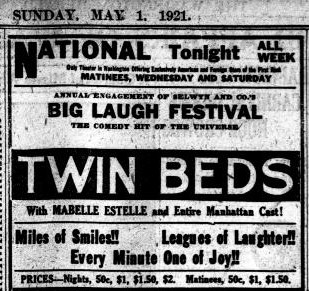
This advertisement from The Deseronto Post of November 24, 1920, is for a touring bedroom farce called Twin Beds, starring actress Mabelle Estelle (who was originally from Scranton, Pennsylvania).

Twin Beds

Twin Beds was written by Salisbury Field and Margaret Mayo and was produced by Selwyn & Company, owners of the Selwyn Theater at 229 West 42nd Street in New York (later the American Airlines Theater and from 2024 the Todd Haimes Theater). Edgar Selwyn (1875-1944), who had founded the company, was also a co-founder of Goldwyn Pictures. Margaret Mayo was his wife. The play was based on a novel and was also turned into a movie four times.

The show was obviously a popular one: it appears seven times in the timeline of plays at the National Theatre between 1915 and 1925 and had run on Broadway for a year before that. It returned to Washington D.C. in the May of 1921, where it was favourably reviewed in the Washington press. We can find all this out from the Library of Congress, which  has an excellent online newspaper service called Chronicling America. This allows searching across a range of digitized American newspapers from 1836 to 1922. You can also download images of the newspapers which interest you. The picture below is from The Washington Times of May 1, 1921 and shows Mabelle Estelle. You can click on the image to go to the page of the newspaper on the Chronicling America site.

Mabelle Estelle in the Washington Times

And, from the same site, here is the listing from The Washington Herald for Twin Beds:

Twin Beds advert in the Washington Herald

Naylor’s Theatre is now silent and empty, unlike its Washington and New York counterparts. It’s difficult now to imagine a time when stars of the American stage would have been staying in Deseronto on a regular basis!

A month ago, we received a new accession of photographs  from Dave Stapley, whose family once owned a farm on the Boundary Road, at the eastern side of Deseronto. The farm was close to the World War One pilot training site, Camp Rathbun, and many of the 33 photos depict men, buildings, and aircraft of the camp.

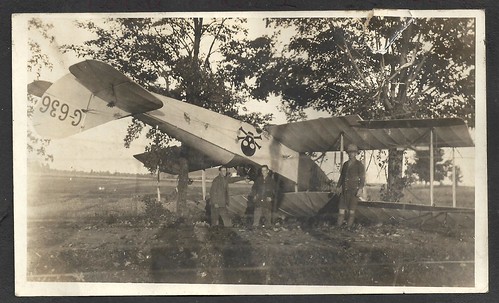
As usual, there are pictures of crashes on the ground (look closely at the trees on this one in relation to the aircraft):

Crashed aircraft

Crashes into hangar buildings at the camp:

Aircraft crashed into hangar door

And into water (you can see the Foresters’ Island Orphanage in the background of this shot):

There are also several photographs of (mainly) unidentified individuals, including this lovely shot of a man crossing the finishing line of a race:

Man crossing finishing line

The skull-and-crossbones motif seen on the aircraft and on the tops of the runners here is a symbol used by the men of 90 C.T.S. (Canadian Training Squadron), which was based at Camp Rathbun. We know nothing about the creator of these photographs, but we can  surmise that he was a member of 90 C.T.S. who left his photographs behind him after he left the area.

One of the most prominent Mohawks associated with Deseronto was Dr Oronhyatekha (1841-1907), originally from the Six Nations Reserve near Brantford. He studied at the University of Oxford for a while and trained to become a doctor at the University of Toronto in 1867. He became involved in the Independent Order of Foresters and successfully transformed the finances of the organization. Oronhyatekha married Ellen Hill, a Mohawk from Tyendinaga Reserve. They had a house in Tyendinaga and the doctor also built properties on Foresters’ Island, which is situated in the Bay of Quinte, opposite Deseronto. These included ‘The Wigwam’, his elaborate summer residence; a hotel, and pleasure grounds. The postcard below shows the orphanage on the Island which Oronhyatekha constructed for the Foresters’ Order, and which operated from 1906 to 1907.

Imperial Order of Foresters' orphanage

Imperial Order of Foresters’ orphanage

[Postcard loaned for scanning by R.N. Goodfellow]

Oronhyatekha’s fame overshadows history’s awareness of his Mohawk colleague, Kenwendeshon, who was born in Tyendinaga on April 8th, 1855,  the son of Cornelius Maracle and Nancy Hill (a great-granddaughter of Deserontoyon). We have recently been in contact with a descendant of Kenwendeshon, who has been gathering information about his ancestor from a variety of sources, including the Kanhiote Library and the Legacy Center of Drexel University College of Medicine. He has kindly agreed to let us share the information he has obtained, to allow us cast some more light on this man, the first of the Mohawks of the Bay of Quinte to graduate from a university.

Kenwendeshon (also known as John C. Maracle) trained as a physician at the Eclectic Medical College of Pennsylvania and American University of Philadelphia (which has an intriguing history of its own), graduating in  1878. One of the items in the possession of Kenwendeshon’s descendant is a 1953 letter from the London Public Library which refers to a diary entry about an incident in 1874, when Kenwendeshon helped to turn the tide of a smallpox epidemic at the Moravian Indian mission at Fairfield (Moraviantown). The date is interesting, as he would only have been 18 at the time, and presumably unqualified: perhaps his association with Oronhyatekha began before he went to Philadelphia. Oronhyatekha had moved from Tyendinaga to London to begin a new practice in 1874, so may well have met the Maracles when he had been working in this area.

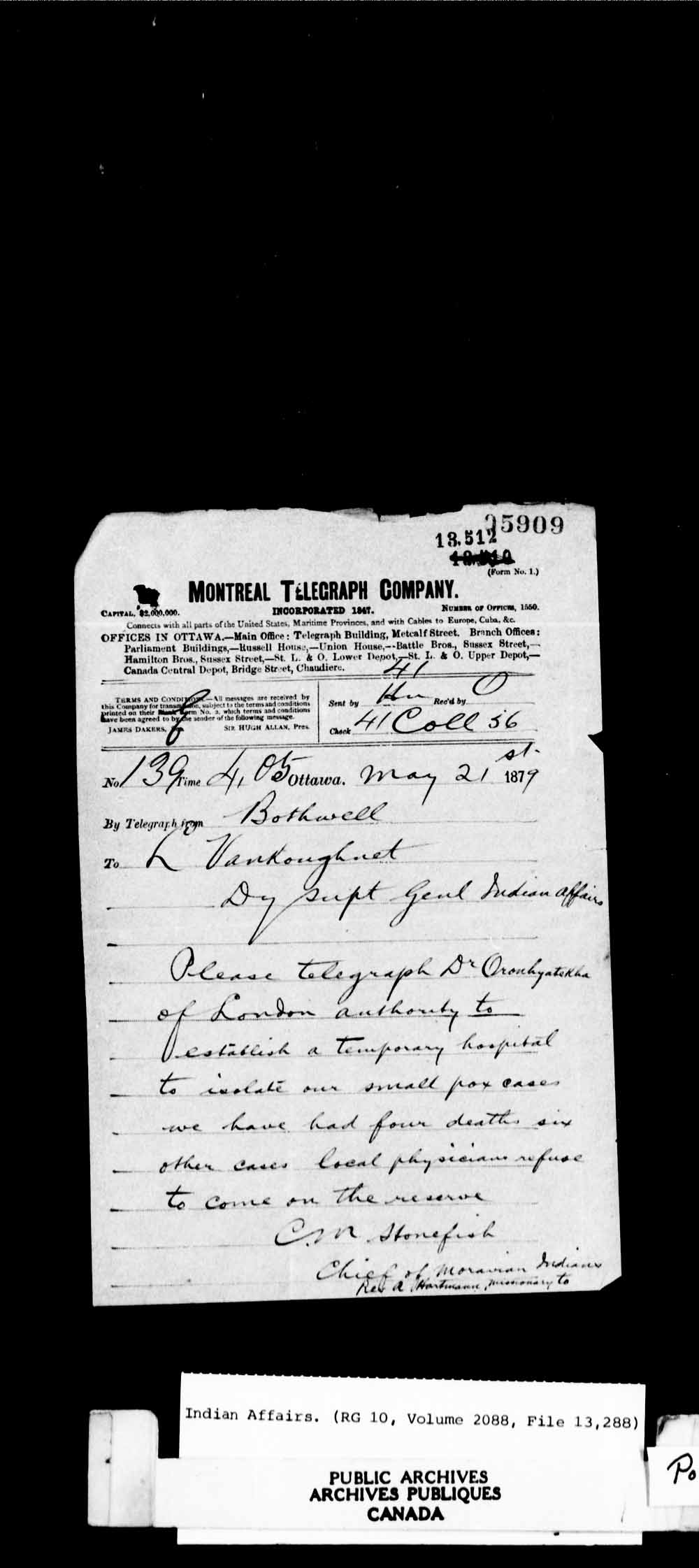
UPDATE, 25 May: Professor Michelle A. Hamilton of the University of Western Ontario has informed us that the epidemic was actually in 1879 and that Kenwendeshon left his practice in Syracuse, New York when Oronhyatekha asked for his assistance. Professor Hamilton also provided us with links to a file of digitized correspondence with the Indian Branch of the Department of the Interior held at Library and Archives Canada which details the response to the epidemic. Here is an example of the correspondence: a request from the Chief of the Moravian Indians to allow Dr Oronhyatekha to establish a temporary hospital “to isolate our small pox cases we have had four deaths six other cases local physicians refuse to come on the reserve”.

Telegram from Chief Stonefish, 21 May 1879

Telegram from Chief Stonefish, 21 May, 1879

A report from Oronhyatekha in this correspondence explains the circumstances of Kenwendeshon’s appointment:

…I have also employed a young physician who was formerly a student in my office & who himself has had the small pox to proceed to the reserve and be in constant attendance and to personally supervise the disinfecting of the clothing and houses of those Indians who have had the small pox.

[Professor Hamilton is currently co-writing a biography of Dr. Oronhyatekha with Keith Jamieson. This is going to be published by Dundurn Press in 2014.]

On November 20th, 1879 Kenwendeshon married Julia Hill Thompson in London and the couple had two children: Lillian, born in London in November 1880, and John Albert (Bert), born in Roscommon, Michigan, in August 1882. A note written in 1953 by Bert (reproduced below), suggests that Kenwendeshon worked with Oronhyatekha in London and Stratford before moving to Roscommon.

Note by Bert Maracle about Dr. Kenwendeshon

Note by Bert Maracle about Dr. Kenwendeshon

According to this note, Julia died in Roscommon when Bert was 14 months old (late 1884). We have not been able to track down a death record for her, but the two children were subsequently adopted into two different families, 400 kilometers apart. Lillian went to live with her mother’s two unmarried older sisters, Caroline and Georgina, and her grandmother, Henrietta Thompson, who lived in Queen’s Avenue, London, Ontario. Her brother, Bert, went back to Tyendinaga to live with his aunt, Susan in the household of his grandfather, Cornelius.

Kenwendeshon appears to have continued to working as a doctor  in Michigan: in Roscommon and, later, in Beaverton. He died in Beaverton on September 22, 1899 at the age of 44 and was buried at Christ Church in Tyendinaga. His mentor, Oronhyatekha, died eight years later.

Circle Six Orchestra

Accession 2012.07(6): The Circle Six Orchestra

Here is a brief numerical summary of our activities in Deseronto Archives over the course of 2012.

New accessions received: 16

These included a photograph of the Circle Six Orchestra, a scrapbook relating to the Deseronto United Church, a photograph album from an airman who trained at Camp Mohawk in World War One and a list of Deseronto voters from 1914.

Email queries answered: 63

Telephone queries answered: 25

Visits to the archives by researchers: 101

Images uploaded to www.flickr.com/deserontoarchives: 105

Visitors to the blog in 2012:15,293 (13,058 in 2011)

Blog posts written : 17

Our thanks to all our patrons and donors and best wishes to you for 2013!

« Previous PageNext Page »