News


August 4th 2014 will mark the 100th anniversary of Canada’s entry into the First World War. Organizations and communities around the world are marking this occasion by examining the effect the war had on their local area. We’ll be doing this in Deseronto, too.

In the Archives we started by researching the 34 names of the First World War casualties named on the town’s war memorial. In the process we found out some interesting facts about the monument itself.


War memorial in Deseronto, April 2014

The memorial, which stands on the South side of Main Street, opposite Rathbun Park, was unveiled in a ceremony on Labour Day (September 3rd) 1923. The event was attended by many of the townspeople, as the photograph below (one of several taken on the day) shows. A piece of land forty feet square was purchased by the Town of Deseronto from the Rathbun Company for the monument’s site, at a cost of $100.

Unveiling ceremony for the Deseronto war memorial

The memorial itself was donated to the town by a former Deseronto resident named Thomas Carson Brown. Thomas was born on 21 April 1870, the son of Thomas Brown and Emily Varty and one of 10 children. His mother died in childbirth in Lennox and Addington County (where the family had a farm) when Thomas was seven years old and by 1881 the family had moved to Mill Point (Deseronto). In the 1891 census, when he was 21, Thomas’s trade is given as bricklayer. His father died just six weeks after the census was taken.

It was through the bricklaying trade that Thomas C. Brown would go on to earn his fortune in New York State, where his firm constructed a number of public buildings, including the Plattsburgh Normal School, pictured here, and a large section of the Clinton Correctional Facility at Dannemora. Deseronto’s newspaper, The Tribune, reported Brown’s marriage in August 1899 to Hattie B. Humphrey, noting that “the groom is well and favourably known in Deseronto, where he passed his boyhood days. He is now engaged in the contracting business in Little Falls. He is a brother of Mrs. Jas. Sexsmith.” Thomas’s sister, Jane Brown, married James Sexsmith in Deseronto in January 1884. She died of pneumonia in 1910.

Plattsburgh Normal School

Brown went on to serve as a Senator in the New York Senate between 1925 and 1930, where he took a keen interest in prison reform issues. He clearly never forgot his home town of Deseronto, as the generous gift of a war memorial demonstrates. It is not just a war memorial, however, as Thomas C. Brown ensured that his parents and five of his sisters (Jane, Ida, Etta, Emma and Annie) were also commemorated on the structure, as you can see in this detail.

Detail of war memorial

Thomas himself died on May 24th, 1952 at his home at 1174 Lowell Road, Schenectady, New York: you can read his obituary in the Schenectady Gazette (PDF made available through the Fulton History site).

Over the next four years we will be marking the 100th anniversaries of local people’s involvement in the First World War here on the blog. There are a lot of stories to be told and we are always keen to hear new ones, so if you have any local World War One information which you would like to share with the world, please let us know!

The past does seem a strange place, sometimes. An item which made its way to the archives this week is a case in point. This object was originally given out as a prize at the Lucky Strikes Lanes, the bowling alley which was where the Deseronto Public Library (and the Archives) is now. It was run by Ernie and Gladys Luck – and Gladys’s apple pie was legendary, it seems.

Green ashtray

Even as recently as the 1960s or 1970s, it was perfectly fine to hand out an ashtray as a prize. It’s hard to imagine this happening today!

We’re not sure who donated this object to the Library – so please let us know if it was yours!

It’s surprising just how often people discover items of historical interest in the walls of their properties. Today’s accession arrived in the Archives as a result of renovation work going on in a house in Mill Street in Deseronto. Grateful thanks to Shelley Dupont for bringing them in!

Three items were found inside a wall of the house. The first is a photograph of an unidentified family. The picture has suffered some damage from being inside the wall for perhaps 100 years, but the image is still fairly clear. There is nothing on the back of the photograph to identify the group.

Unidentified family portrait

The second photograph has more information – these three children are identified as  Hazel Annie Cole, aged 3 years and 5 months; Murney Nelson Cole, aged 1 year, 9 months and Edna Kathleen Cole, aged 6 months. Hazel was born July 27 1910 in Milford, Prince Edward County – dating the picture to late 1913/early 1914. Their parents were Jesse Abbot Cole  and Alta Theresa Viale.

Cole children

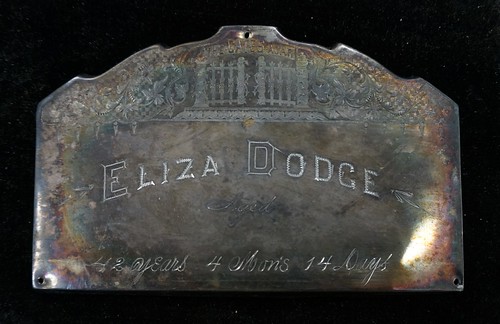
The third item also has a Prince Edward County connection. It is a wooden rectangle, covered with black felt, and with a tin plaque, bearing the name of Eliza Dodge. This is a coffin plate. Eliza died in South Marysburgh on March 1st, 1890.

Memorial for Eliza Dodge

A little digging through the census and vital statistics records shows us that Eliza was married to Frederick Dodge and her maiden name was Thompson. In the census taken in 1891, the year after Eliza’s death, Frederick is working as a telephone and telegraph operator and living with his two daughters, Rosa Bell Dodge, aged seven, and Sarah Ann Cole, aged 19. Yes, Cole again. A bit more digging yields up information on a connection between Sarah Ann and the three children in the photograph: Sarah Ann, Eliza Dodge’s daughter (known as Annie),  married Claude Wilmot Aylsworth Cole on December 11th, 1890. Claude was the older brother of Jesse Abbot Cole, the father of the three children

Annie Cole is the link between the last two items: she’s Eliza’s daughter and aunt to the three Cole children. Perhaps the first photograph has a Cole family connection, too? Claude and Jesse came from a family of four sons and one daughter, which just happens to be the configuration of the family in the first photograph. We’re entering into the realms of wild supposition here, but it’s just possible that this photograph represents Simon Aylsworth Cole (1844-1922), his wife Sarah Letitia Boulter (1848-1922) and their five children: Claude (1870-1938), Edna (1873-1929), George (b.1876), Arthur (1877-1941) and Jesse (1879-1937). If so, it would have been taken in around 1885.

Or they could be other people entirely!

UPDATE (Feb 15th, 2014): Thanks to Claudia (Cole) Grendon for adding some more details to this story in the comments. She tells us that Annie Cole was her grandmother and that Annie moved to Mill Street in around 1939 with her son, Wilmot Havelock Cole and his family. She died in around 1946 and (additional information from Tammy Cole Peterson) was buried in Glenwood Cemetery in Picton, where her husband, Claude, had also been laid to rest.

Cyril BettsThe Deseronto Archives Board would like to express its deep sympathy to the family of Cyril Betts, who died this morning. Cyril was a long-serving member of the Board and an influential supporter of the Archives and its work. Board meetings attended by Cyril always went on too long as Cyril had an apparently endless supply of highly entertaining stories, accumulated during his long career as an Anglican minister.

You can still hear some of these stories in the interview Cyril gave us for the ‘About Deseronto’ project on September 10th, 2010.

We are hugely grateful for Cyril’s contributions to the work of Deseronto Archives and will miss him very much.

A couple of Flickr-related news items today, one local, one not-so-local.

This morning we passed one million views on the Deseronto Archives Flickr account, according to the statistics generated by that service:

Graph showing one million views on the Deseronto Archives Flickr account

And in the not-so-local news, the British Library has just released a million illustrations from digitized versions of 65,000 17th, 18th and 19th century books. Like the Deseronto images, these are in the Flickr Commons, which means they are freely available for re-use in whatever way you choose. Sadly, Deseronto doesn’t feature in any of these images, but there are a number of drawings of other Canadian towns and cities, including this image of Toronto, showing “a bird’s eye view of Toronto industrial exhibition, 1899”.
Bird's eye view of Toronto Industrial Exhibition, 1899
This is from page 22 of an 1899 book called Toronto, historical, descriptive, and pictorial, etc by Alexander Fraser. Its reference number at the British Library is HMNTS 10470.ff.24.

And here’s a reproduction of Guy Johnson’s 1771 map showing the territories of the Six Nations in what is now New York state:

Map of Six Nations territories

This is from A History of the Schenectady Patent in the Dutch and English times; being contributions toward a history of the lower Mohawk Valley, by Jonathan Pearson, published in 1883 (HMNTS 10409.cc.2).

You can search over all the images that the British Library has shared.

More than 80 people gathered in Belleville’s Quinte Sports and Wellness Centre on Saturday for a day exploring historical aspects of European and First Nations attitudes to “the land that supports our feet”. The Warden of Hastings County (and Reeve of Tyendinaga Township), Rick Phillips; the Chief of the Mohawks of the Bay of Quinte, R. Donald Maracle; and the Mayor of Deseronto, Norman Clark, all gave official welcomes to the group.

Nathan Brinklow introducing the Opening AddressThe traditional Six Nations Opening was performed by Nathan Brinklow, who provided an English translation of his words so that everyone could understand. As Nathan explained in his introduction, the Opening is all about the relationships between the land, waters and living things, so it was a particularly appropriate way of starting a day of proceedings focused on human interactions with land.

The keynote address was given by Marlene Brant Castellano, who gave a moving account of the way that her formal education in the Tyendinaga Mohawk Territory, Shannonville, and Belleville had failed to include the history of the Six Nations or traditional teachings. She told us that when she came to the stories and teachings later in life, it was like learning a new language, but also that “it was a language that was already written in my heart”. Marlene’s talk centred on the three beads of the Two-Row Wampum belt, representing Peace, Friendship, and Respect.

The archival component of the day was made up of a series of readings from documents which were written in the first fifty years of settlement in the Bay of Quinte region. They focused on what life was like for the Mohawks who came to this area at that time, and on how the attitudes of the Government toward the native population changed in that period.

Alfredo Barahona led the group in the Blanket Exercise. This is an interactive telling of the story of the interactions between Europeans and the aboriginal population of Canada, using blankets to represent the land available to native peoples and readings which relate laws and impacts of policies on their communities.

At the start of the exercise, everyone was free to move around the blankets and talk to each other.

Beginning of the Blanket Exercise

By the end, only isolated groups are left, with the size of their blankets constantly being trimmed back by the Europeans.

End of the Blanket Exercise

Marlene Brant Castellano, Mike Bossio and Keith SeroMark Brinklow and Ed FileAfter lunch, a panel session examined some different perspectives on land issues. Mike Bossio talked about how native and non-native communities worked together to resist the expansion of the Richmond landfill site. Keith Sero discussed the process of forming new forms of governance for First Nations, such as the management boards for wildlife and water in Nunavut.  Mark Brinklow described his work with teenagers at risk of offending, explaining how reconnecting them to activities on the land can give them a renewed sense of self-confidence and identity. Ed File is a retired professor of social science who has taken an active role in social justice movements involving First Nations in Canada.

The final activity of the day was a chance for people to join discussion groups with as much geographical diversity as possible. People were asked to reflect on what they had learned from the day and on what they thought they might be able to do next to move the conversation forward.

Discussion groupd

Lynn Brant rounded off a fascinating day with a deeply moving song and the Closing Ceremony.

Thanks to everyone who came and to all those involved in organizing, presenting and catering for the event. Special thanks are due to Paul Robertson, chair of the Deseronto Archives Board, who originally conceived the idea for the symposium, and who performed the role of Master of Ceremonies on the day, and to Marlene Brant Castellano, who took on a hugely active role in galvanising support for the event and in putting together the programme, as well as giving the keynote address and chairing the panel session. Edgar Tumak, Sharon and Nick White and Niamh Hill all worked incredibly hard on the day: sincere thanks to you all!

The Archives has recently received a small collection of materials which once belonged to Cecil Elmer Argue (1888-1974), who was elected Mayor of Deseronto in 1929. Cecil and his wife Elizabeth moved to Belleville, taking a few mementoes of their time in Deseronto with them. This items have now found their way back to the town and we have scanned them and made them available online, along with some supplementary materials from the Archives which also date from 1929.

One of the 1929 objects from the Argues was this pennant:

This was from a major event commemorating the 145th anniversary of the United Empire Loyalists‘ arrival in Canada. The celebration lasted four days, as the pennant shows. One of the additional items we have digitzed is the printed souvenir and programme of the day. This document details the many events held in June of 1929, several of which would have been presided over by Cecil E. Argue in his role as Mayor. The Town called in representatives of higher levels of government to take part in the celebrations: the Premier of Ontario, G. Howard Ferguson, gave a speech, as did the Minister for Labour, Peter Heenan, and the Superintendent-General for Indian Affairs, Duncan Campbell Scott.

One of the highlights of the event was a grand Pageant with a cast of over 250 people. The members of the Pageant were recorded for posterity by the Marrison Studio of Kingston. They took a panoramic picture of the Pageant participants:

Loyalist Pageant members, Deseronto, 1929

1929 Loyalist Pageant

[Archivist’s note: it can be challenging to reproduce such large photographs, but modern technology can help. In this case, we scanned the photograph in four sections and then used a free program from Microsoft Research called Image Composite Editor to automatically ‘stitch’ it back together again. You can’t see the joins!]

By 1929, Deseronto was past its industrial peak and the mills and factories of the Rathbun Company era had closed. The last page of the Loyalist Celebrations programme gives a rather beseeching plea to the reader:

Deseronto invites you to take notice of the valuable Manufacturing Sites available and extending along the water front

We are left with the impression that the Loyalist Celebration event was seen as an opportunity by Mayor Cecil Argue and his fellow town officials to regenerate the declining fortunes of Deseronto. But with the Wall Street Crash of October in that year and the Great Depression which followed it, it seems that no-one was in a position to “Come to Deseronto” and take advantage of its “valuable Manufacturing Sites”. Cecil Argue himself did not stay in Deseronto to complete his term as Mayor: in the same year that he oversaw the Loyalist Celebration, he left the town and moved to Belleville, where he lived for the rest of his days.

A recent enquiry by a researcher who is studying the region’s lighthouses has revealed some interesting facts about Deseronto’s own lighthouse. Some of its history can be traced through federal government publications, beginning with the report of the Department of Marine and Fisheries for 1884 (published in the Sessional Papers for the Dominion of Canada, Volume 6,1885), where the Ontario Lighthouse Division reported that:

Agreement to build a lighthouse in Deseronto

Unsurprisingly, it was the Rathbun Company who were contracted to build the lighthouse, for the reassuringly precise estimate of $437.49. Construction of the light had been completed by the time of the Department’s report.

We next hear of the lighthouse in the Departmental report for 1885 (Sessional Papers for the Dominion of Canada, Volume 9,1886).

Deseronto light - 1886 report

Here we learn that the Rathbun Company supplied the gas to the light and that the light was constructed on the roof of the freight shed of the Bay of Quinte Railway at the Rathbun Company’s wharf. It’s interesting to see that the Rathbun Company went a little over their budget, spending a total of $455.55.

A search on our Flickr images reveals several photographs which show the light in place on that building.

Steam wharf at Deseronto

A notice in the Canada Gazette of September 19th, 1885 announced the light to the maritime community:

Gazette notice about Deseronto light

This detail of photograph RATHCO-06-48.4 shows how the light would have appeared to the ships approaching it from the Bay:

Deseronto wharf from the Bay of Quinte

In the background on the left, you can see the brick head office building of the Rathbun Company, from where its owners could keep a close eye on the activities of the wharf. None of these buildings survive today.

Sometimes chance survivals give us an intriguing glimpse into particular aspects of people’s lives in the past. We have just digitized some letters which were found in the former Cronk property in Deseronto and which were written in the early 1880s, just at the point when the village switched from being called Mill Point to being called Deseronto.

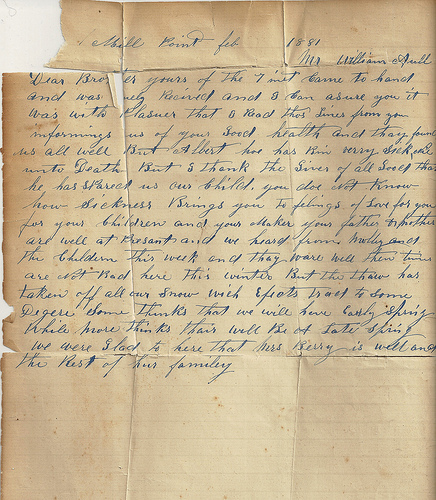
The first is a letter which was started but not finished or sent. It was probably written by Sarah Jane Cronk (1850-1929), wife of Reuben Cronk (1841-1931) who was a butcher in Deseronto for most of his life. It gives a touching account of the recovery from illness of her second eldest child, Albert, who was born in 1877.

Sarah Jane Cronk's letter

She wrote:

Mill Point feb 1881
Mr William Aull
Dear Brother yours of the 7 inst came to hand and was duly Recived and I Can asure you it was with Plasuer that I Read thos Lines from you informings us of your Good health and thay found us all well But Albert he has Bin verry sick, nii unto Death But I thank the Giver of all Good that he has spared us our Child. you doe Not Know how sickness Brings you to felings of Love for your for your Children and your Maker your father & mother are well at Presant and we heard from Molly and the Children this week and they ware well then times are not Bad here this winter But the thaw has taken off all our Snow wich efects trad to some Degere some thinks that we will have Early Spring while more thinks thair will be A later Spring we were glad to here that Mrs Berry is well and the Rest of her family

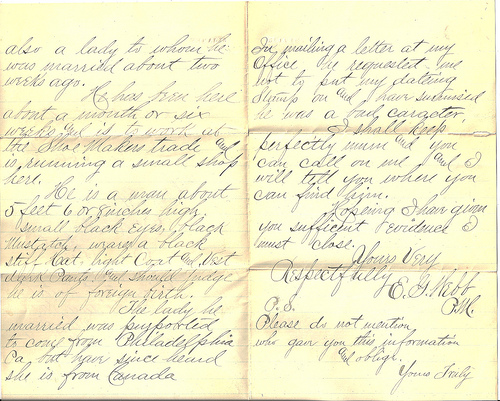
Two of the other letters relate to a fugitive from justice who escaped from Deseronto to Elkland, Tioga County, Pennsylvania in 1882. As well as being a butcher, Reuben Cronk was Deseronto’s Chief of Police in the early 1880s. These two letters were both written to Cronk by the postmaster of Elkland, Eugene G. Webb, who was anxious that the fugitive, W. H. Mabey, alias Amos Hicks, should be captured and taken back to Deseronto and equally anxious that his own role in the affair should be kept secret.

Eugene Webb's letter

In this part of the first letter, written on January 28th, 1882, Webb describes the appearance and activities of the fugitive:

…also a lady to whom he was married about two weeks ago.
He has been here about a month or six weeks and is to work at the Shoe Makers trade and is running a small shop here.
He is a man about 5 feet 6 or 8 inches high, small black eyes, black mustatch, wears a black stiff Hat, light Coat and Vest dark Pants and should judge he is of foreign birth.
The lady he married was purported to come from Philadelphia Pa but have since heard she is from Canada.
In mailing a letter at my Office he requested me not to put my dateing stamp on and have surmised he was a bad caracter.
I shall keep perfectly mum and you can call on me and I will tell you where you can find him.
Hopeing I have given you sufficent evidence I must close.
Yours Very Respectfully
E. G. Webb
P.M.
P.S. Please do not mention who gave you this information and oblige Yours Truly

What crime had Mabey/Hicks committed? Did Chief Cronk actually make the trip to Elkland to retrieve him?

We simply don’t know: sometimes these chance survivals just raise more questions than they answer!

Symposium poster

Symposium poster


Registration is now open for a one-day symposium exploring common ground between First Nations and Settlers in Eastern Ontario. This event will include representatives of First Nations and Settler communities presenting information on historical perceptions of land and the importance of working together to come to shared understandings about its significance to us all.

The event has been organized by the Board of Deseronto Archives and the Community Archives of Belleville and Hastings County, with the support of the Hastings County Historical Society, the Mohawks of the Bay of Quinte and the Town of Deseronto.

There is no charge for the symposium but registration is essential – visit the booking page for more details.

Location: Quinte Sports and Wellness Centre, Belleville
Date: Saturday October 26th, 2013: 9am-4pm

Read the media release [PDF] here.

« Previous PageNext Page »