News


2015.09 two pairs of glasses made by Canada Optical

After the iron we featured a few weeks ago, here are two more examples of Deseronto-made items. These glasses frames were manufactured at the Canada Optical Company’s factory on Main Street in Deseronto, the building which was until recently the Deseronto Fleamarket and which originally contained drying kilns for the Rathbun Company’s lumber business. It is marked number 15 on the detail of the 1895 map below:

Dry kilns and sash factory. c.1895

According to an article in the Quinte Scanner newspaper of October 4th, 1972 this building had several other uses between these two:

The building which is occupied by Canada Optical at present housed a match factory in the 1920’s, a meat packing plant in the early ’30’s and a cheese factory after that. Canada Optical started operations in 1946; in 1947 an extension was added to the factory, this consisted of an old hanger from the nearby wartime airfield.

At this time the firm was called the Canada Zyl Company, (it is still known by this name to local residents) and was producing four or five different types of spectacle frames in only two colours. They were made of a highly inflammable material and had to be stored in thick walled buildings well away from the main plant.

Here is how the building looked in 1972:

The factory moved from this location in 1996 to a building at the airport on the Tyendinaga Mohawk Territory. It closed down in 2002.

Thanks to Andrea Hinz for the donation of these frames, another piece of Deseronto’s manufacturing past.

Edward Walter Rathbun's signature

E. Walter Rathbun, MPP, 1905 (CABHC: 2017-73/1)

Edward Walter Rathbun enlisted on this day in 1915. He was born in Deseronto on December 28th, 1865, the eldest son of Edward Wilkes Rathbun and his first wife, Elizabeth How Burt. After the death of his father in 1903, E. Walter Rathbun took over the running of the Rathbun Company. He was mayor of Deseronto, like his father before him, in 1914 and was also active in provincial and local politics: between 1905 and 1908 E. Walter represented Hastings East in Ontario’s Legislative Assembly.

In the 1901 census the Rathbun household comprised E. Walter, his wife Aileen and his mother-in-law Emma C. C. Blair. Rathbun had married Aileen Blair in Portsmouth, England, in 1893.

Rathbun was active in the local militia, holding the rank of Lieutenant-Colonel when he enlisted at the age of 49. Belleville’s paper, The Intelligencer, reported his departure in the following way on February 15th, 1915:

Farewell to Colonel Rathbun
At Deseronto, on Saturday night the opera house was filled with an enthusiastic audience of well-wishers to Col. Rathbun and his gallant comrades, who are going to the front with the guns of the 6th Brigade. An address was presented by those associated with him from boyhood, and patriotic music by local talent, led by Mr. Hercher [Herchimer] Aylesworth—a host in himself—stirred all present.

Colonel Ponton, of Belleville, carried the greetings of the Bay of Quinte District and comrades-in-arms west of Deseronto, and congratulated both the gallant Colonel and the Town on having the honor of furnishing a commander of a Brigade, which General Lessard has pronounced one of the best ever inspected in the whole Dominion in organization, spirit and efficiency.

A bountiful supper was served at the close and another of Canada’s soldier sons left for the post of duty.1

He arrived in England in March 1915, when his brigade of the Canadian Field Artillery was transformed into the Canadian Reserve Artillery. Rathbun himself was transferred to the Canadian Forestry Corps when it was established in 19162: presumably as a consequence of his experience in running the Rathbun Company’s lumbering business in Deseronto. The Forestry Corps was established to harness Canadian expertise in the lumber industry to supply the Western Front with the wood it desperately needed. It operated in England, Scotland and France. His service record shows that he was struck off in September 1917 and returned to Canada on the SS Carmania.

Grave stone for E. Walter RathbunE. Walter Rathbun died in Deseronto on September 6, 1940. His wife, Aileen, was living in Scotland at the time with her brother, Arthur Blair, and Rathbun’s body was transported to Toronto for cremation and his ashes were then shipped overseas. There is a memorial to the couple in the cemetery at Nairn in Scotland. This image of it is from the Scottish War Graves Project‘s site. The incription reads:

In memory of Col Edward Walter Rathbun, Royal Canadian Artillery died 6th Sep 1940 and his wife Aileen Blair who died 1944.


1 Our thanks to the Community Archives of Belleville and Hastings County for this information
2 For a history of the Corps in the First World War, see The Canadian Forestry Corps, by C.W. Bird and J.B. Davies, published in 1919.

The Archives has recently been in contact with Silvy Embury of Lethbridge, who sent us some photographs of an iron which belonged to her grandmother, Helen Boyle.

2015.01(1) left view of iron

On the back of the iron is an information panel which records details of the iron’s manufacture, including the fact that it was made in Deseronto by the Redi-Heat Electric Company Ltd.

2015.01(5) iron information panel

There is not a lot of information in the Archives about Redi-Heat, but there is an advertisement for the company in the May 28th, 1948 issue of the Deseronto Post newspaper:

1948 May 28 Redi-heat ad

REDI-HEAT

ELECTRIC COMPANY LIMITED

A DESERONTO INDUSTRY

MANUFACTURERS OF NEW MODERN LINES

OF ELECTRICAL APPLIANCES

HOT PLATES

IRONS

TOASTERS

HEATERS

RANGETTES

DESERONTO                  TELEPHONE 76

The February 4th, 1948 edition of the Post (held here on microfilm) notes that the company was originally based in Belleville, from 1921, and had been in Deseronto since 1932. The firm was based in the building which originally housed the head office of the Rathbun Company, on the east side of Mill Street, south of Water Street. In the Rathbun era, the building looked like this:

RATHCO-06-48.3

We don’t have any twentieth century photographs of this building. A newspaper report from 1967 notes that Redi-Heat had been bought out by Dravo, although there is no date given for this. If you have any more information about Redi-Heat or the building it was based in, please leave a comment below!

Aerial photograph of Deseronto in winter, c.1920

Canada. Dept. of National Defence / Library and Archives Canada / PA-213876

This aerial photograph is a reproduction of an image held at Library and Archives Canada. It is undated, but was probably taken around 1920, judging from the visible buildings. Right at the bottom of the picture is the chimney of the Big Mill, and on the right is the sash and door factory which took up the western side of the bayshore end of Mill Street. The two roads stretching away from the photographer are Green Street and Mill Street, both of which were lined with trees. The Arlington Hotel can be seen on the middle right of the image, with the Canadian National Railway station just in front of it, on the other side of Main Street.

The Archives will be closed on Christmas Eve and New Year’s Eve, but will be open again on January 7th. We’d like to take this opportunity to wish you a happy and peaceful midwinter break!

Our First World War project is now in full swing, with research under way on 300 people with Deseronto connections who served in the war. There are excellent online resources available for such research and this post explains more about the ones we have been using for our project.

Attestation paper

Library and Archives Canada

Service files of individuals are rich sources of information about the war service of Canadian men and women. Library and Archives Canada (LAC) are in the process of digitizing all of the World War I service files they hold and many are already available. There’s a helpful LAC Cenotaph research guide to interpreting these records, which explains the military organizations, the abbreviations used in the records and has a timeline of the major battles Canadian troops were involved in.

Attestation papers are available online for nearly all veterans of the war. These documents give the name of the enlisting person, their next of kin, their place of birth, occupation and home address. They also hold information about the individual’s height, chest size, and hair, skin and eye colour. Attestation papers also carry the signature (in some cases just the mark) of the enlistee, which we have been using in our project to illustrate each blog post.

War diaries for the various military units are also available at Library and Archives Canada – these have all been digitized and can be read online. These are invaluable for finding out more about where a particular battalion was and what it was doing at a particular time.

Ancestry

Public libraries in Ontario have subscriptions to the library edition of Ancestry, the commercial genealogical site. Ancestry holds a number of digitized record groups which are useful for researching First World War veterans, including:

War Graves Registry Circumstances of Death records

These records from Library and Archives Canada provide details of the circumstances of a soldier’s death, if known, and information on his burial or memorial site

Ontario vital statistics records

Births, marriages and deaths in Ontario from the Archives of Ontario. These are useful for establishing who a veteran’s parents were and whether the veteran was married.

Canadian census records

Provided to Ancestry by Library and Archives Canada. Useful for discovering dates of birth (particularly the 1901 census), family members, locations, ethnicity, and occupations of veterans.

Ancestry also holds copies of the attestation papers from Library and Archives Canada.

Canadian Great War Project

This site brings together information about many of the men who died in the First World War. It includes links to the Canadian Virtual War Memorial and the Commonwealth War Graves Commission entries for individual soldiers.

Canadian Virtual War Memorial

A site maintained by Veterans Affairs Canada which commemorates fallen Canadian soldiers from all conflicts. Users can upload digital materials about a soldier.

Chronicling America

Digitized local American newspapers from 1866 to 1922, free to access in a service provided by the Library of Congress. This site is useful for finding reports on some of the airmen who died in the Royal Flying Corps camps.

Commonwealth War Graves Commission

This site holds information on cemetery locations, graves and memorials. For individual solders, there are digitized registers with brief details about each man and information about what was recorded on their headstones.

Find a Grave

This site has many veterans’ graves listed, particularly those in the European war cemeteries. Several have photographs of the headstones.

findmypast

This UK-focused site requires a subscription. It holds records relating to men who served in the Royal Flying Corps and Royal Air Force in the First World War.

Royal Air Force Museum Storyvault

Allan Walton Fraser RFC casualty cardThe Storyvault contains freely-accessible* digitized records of death and injury reports relating to the Royal Flying Corps and the Royal Air Force between 1914 and 1928. For the period of operation of the two Royal Flying Corps pilot training camps near Deseronto, these records are extremely helpful in explaining the causes of the accidents which befell the young men who died in training during the First World War.

[*Update, January 29th 2015: Low resolution copies are still accessible, but you now have to pay £3.00 for high-resolution images.]

Wikipedia

There are articles in Wikipedia on most of the military units which took part in World War One. The site also holds information on military campaigns, ships used to transport soldiers between Canada and England, and information on the diseases suffered by soldiers on the Western Front.

A recent accession from Edward Wright (2014.18) has added considerably to the Archives’ stock of information relating to the match companies which used to exist in the town. Mr Wright is a collector of matchboxes (a phillumenist) and has done a lot of research into the matches made in Deseronto in the first half of the twentieth century.

The Rathbun Match Company was only in operation for a short time between 1915, when this advertisement appeared on the front of the Canadian Grocer, to 1916, when the Town Council minutes note that it ceased operations in June.

Canadian Grocer - Rathbun Match Company advertisement

Canadian Grocer, August 20th, 1915

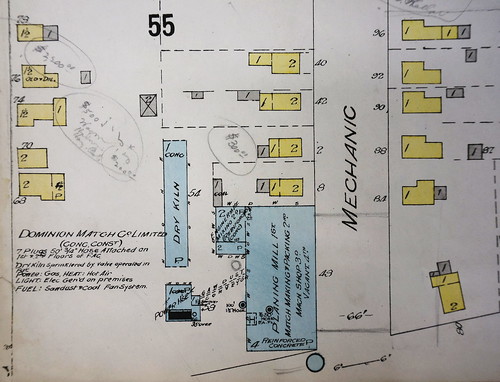
The Dominion Match Company seems to have taken over from the Rathbun concern, and it is clear from the Council minutes that the firm was offered tax exemptions for its site in Deseronto. The factory was on the northwest corner of Mechanic Street and Main Street, as shown in this extract from the town’s fire insurance map:

Detail of fire insurance plan showing the Dominion Match Company

By 1917 the Dominion Match Company was looking to expand. At a Council meeting on July 17th of that year the firm asked:

…the Council to provide for the closing of Quinte Street [the road immediately to the west of the factory] and the diverting and altering of Mechanic Street…and for both portions of said streets to be conveyed to the Dominion Match Company for use in their business and as the enlargement of their premises will necessitate the employing of a great many more hands than they have at present, it will enduce to the prosperity of the town. If the request is granted the company will waive its right to exemption from municipal taxes for the year 1917 to which they are entitled…

The Council approved the request, effectively wiping Quinte Street off the map of Deseronto, and giving Mechanic Street the shape it has today.

The postcard below shows the factory at the height of its operations.

Postcard of the Dominion Match Company, from the collection of R.N. Goodfellow

Mr Wright has a collection of boxes which were manufactured at the Dominion Match Company, including this one of the Dominion Silent Match:

Dominion Silent Match box

A third firm called the Beacon Match Company began operations in Deseronto in September 1919, but it is not clear where this factory was located. It may have used one of the vacated Rathbun Company sites.

A report in the Deseronto Post from March 17th, 1948 notes that the Chamber of Commerce was seeking a new owner for the Dominion Match building, which had “been vacant for many years”. It was in good condition, as it had been used by the Department of Defence during the Second World War.

1948 Mar 17 Match factory future

Today, the Deseronto Community Recreation Centre occupies the site of the Dominion Match Company’s factory and Mechanic Street still has a kink in it: the only visible evidence of Deseronto’s match-manufacturing history and the only curving road in the whole town.

Mechanic Street in 2014

It was a full house at Deseronto Public Library this afternoon, as author Frances Itani launched her new novel, Tell, to an appreciative audience of more than fifty people.

Frances Itani talking to a full house at Deseronto Public Library

Tell is a follow-on story to Deafening, the author’s first novel, which was published in 2003. Like Deafening, Tell is based in Deseronto, and it follows the story of four of the characters from the first book. It is set in the period immediately following the end of the First World War. Frances made excellent use of the archives here in Deseronto in her research for the book and we were delighted to host her first stop on the promotional tour.

Frances Itani signing copies of 'Tell'

And we are pleased to report that every copy of Tell was snapped up by the audience!

Tell by Frances ItaniThe Deseronto Public Library and Deseronto Archives are delighted to announce that they will be hosting the launch of Frances Itani’s new novel, Tell on Thursday, August 28th at 1pm in the Deseronto Public Library.

Tell follows on from the author’s first novel, Deafening, which was partly set in Deseronto. It picks up on four of the minor characters from Deafening and follows their stories in Deseronto after the First World War.

After a reading from the novel, books will be available for signing by the author. Refreshments will be served.

Estella Burkett was a teacher at the Deseronto Public School. She was born in Maynooth, Ontario in 1913 to Agnes Shields and Patrick Burkett. The picture below shows her with her class of children in 1949, outside the old Public School building. Estella retired in 1974 and lived in Belleville until her death in 2010 at the age of 97.

2010.27(6)

Estella did a considerable amount of travelling in her vacations and she donated some of her photographic materials and notes about her excursions to the Deseronto Archives in 2004. These materials include some photographs taken on a trip to Berlin in 1955, ten years after the end of World War II and six years before the city was divided by the construction of the Berlin Wall. Estella took photographs of the monuments her tour group visited, including this image of a statue of Joseph Stalin, which was removed in 1961 and melted down.

Statue of Stalin

She also photographed the Brandenburg Gate, which would be isolated by the Berlin Wall six years later and impassable until the Wall’s destruction in 1989. The damage caused to the Gate during the Second World War is visible in this image.

Brandenburg Gate 1955

These photos are good examples of the way that small local collections can be unexpected sources of information about entirely different parts of the world. It’s not until we dig into the boxes and do the work of describing the materials, that it becomes possible for everyone else to see what is in them.

The north-south streets at the eastern end of Deseronto are numbered, like those in many North American towns. We have First Street, Second Street, Fourth Street and Fifth Street, but Third Street is nowhere to be seen.

Numbered streets on map of Deseronto from Bing

Well, that’s actually not quite true: you can see it in the Archives.

Here is a detail of a plan of the town made in about 1895:

Third StreetYou can see Third Street in the middle of the map and there’s also a Sixth Street on the far left. As you can see, Third Street was never a very long road, stretching only from Main Street down to the flour mill on Water Street.

On this day in 1896 (the Victoria Day holiday), most of this side of town went up in flames, destroying docks and many buildings. Newspapers across North America reported on the fire. This clipping is from the May 27th 1896 edition of the Daily Public Ledger of Maysville, Kentucky:

Daily Public Ledger report on Deseronto fire of 25 May 1896

Fire destroyed two-thirds of the east end of the town of Deseronto, Ont., and nearly a hundred families are homeless. The Rathbun Co.’s big flour mill, storehouse and elevator, the shingle and lumber docks, the Roman Catholic church and about one hundred dwelling houses were burned. Most of the houses were occupied by workmen. The total loss will exceed $300,000.

The original Roman Catholic Church of St. Vincent de Paul stood on the north side of Dundas Street in this part of Deseronto. The church had been built in 1883 at a cost of over $4,000. Herbert A. Osborne took this photograph of it in around 1895:

St. Vincent de Paul church, c.1895

When the church was rebuilt, it was located further west; still on the north side of Dundas Street but away from the more industrial areas of the town. It was completed in November 1896.

Unlike the church, it appears that Third Street was never rebuilt after the fire. By the time the map below was made for the Canadian Northern Ontario Railway in 1912, the road  had vanished.

Detail of 1912 map of the Canadian Northern Ontario Railway

A neat example of history affecting geography!

« Previous PageNext Page »