News


CIBC in October 2012 (from Google Streetview)

Deseronto CIBC in October 2012 (from Google Streetview)

The CIBC branch in Deseronto will be closing its doors for good this summer, bringing to an end more than 120 years of banking history in the town.

The Bank of Montreal was the first firm to open a bank in Deseronto: Herbert Osborne took this photograph of its original Main Street branch in around 1895:

Bank of Montreal, c.1895

Bank of Montreal, c.1895

In 1904 the Bank of Montreal built a new structure at Centre and Main on the corner of the park lot.

DESCOM-06-23

DESCOM-06-23

Shortly after the Bank of Montreal opened its new building, the Standard Bank opened a branch in Deseronto, in September 1905. Seventeen years later, a new brick building, the current CIBC branch, was constructed on the south side of Main Street. Here is the bank under construction:

2009.26 CIBC-09-02

2009.26 CIBC-09-02

And here is the finished building in the 1920s:

2009.26 CIBC-09-15

2009.26 CIBC-09-15

In 1928 the Standard Bank was taken over by the Canadian Bank of Commerce. During the Great Depression it was common practice for banks to rationalize their branches and transfer customers to another firm. The Bank of Montreal closed down in 1932 and its customers were moved to the Canadian Bank of Commerce.

This is how the building looked in 1933:

2009.26 CIBC-09-17

2009.26 CIBC-09-17

The Bank of Montreal building was taken over by the Town of Deseronto and became the Town Hall in 1945, with Council holding its first meeting there on November 15th of that year. In 1961 the Canadian Bank of Commerce merged with the Imperial Bank of Canada to become the Canadian Imperial Bank of Commerce. The CIBC Deseronto branch celebrated its 100th anniversary in 2005.

Hattie May Mastin signature

On January 8th, 1916, Hattie May Mastin joined the Army Medical Corps in Kingston, Ontario as a nursing sister. She was born on July 31st, 1888 in Deseronto, the daughter of Melbourne Mastin and Minerva Jane (née Bruin). Hattie had served in the military hospital in Belleville for seven weeks. She was living at 269 William Street, Belleville when she joined the army. Hattie was the first woman to enlist of the people from Deseronto who served in the war, one of only two in total.

Her service record shows that she was transferred to the 7th Canadian General Hospital in Le Treport, France on June 18th, one of 46 new nursing sisters who arrived that day, according to the unit’s war diary.

Mastin left England for Canada on the SS Carmania on July 12th and was demobilized on July 15th, 1919 in Ottawa on general demobilization. In 1921, Hattie was back with her mother and siblings, living at 234 John Street, Belleville.

The Deseronto Public Library and Deseronto Archives were delighted to welcome Frances Itani back to town to mark the culmination of the Tri-County Reads events for 2015. Tri-County Reads is a joint program of the Public Libraries of Northumberland, Hastings and Prince Edward County and this year the book chosen was Frances Itani’s Deafening, a First World War novel which is partly based in Deseronto.

Guided tour walkers at the Dockside Tavern, Deseronto

The Deseronto event on October 17th began with a guided walk for around 45 people around Mill and Main Streets. The photograph shows the tour group as it passed what is now the Dockside Tavern. This building was originally the Empress Hotel, owned by William Jamieson. Jamieson’s widow sold the lot to John Freeman, Frances Itani’s great-grandfather, who ran it as the Arlington Hotel. Itani’s grandmother, Gertie Freeman,  was born in the house adjoining the hotel in 1898. Gertie became deaf at 18 months and her life experiences formed the inspiration for Grania, the main character in Deafening. Like Grania, Gertie attended the Ontario Institution for the Education of the Deaf and Dumb (now the Sir James Whitney School for the Deaf) in Belleville.

The house where Gertie Freeman was born can be seen in this late nineteenth century photograph of the property, taken by Herbert A. Osborne:

The Empress (later Arlington) Hotel, c.1895

At the time the Freemans owned the hotel, Deseronto was at its industrial peak. This picture was taken from an upstairs window, and shows the mills and factories of Mill Street:

View from Arlington Hotel, c.1895

The walking tour also stopped outside the Post Office and Naylor’s Theatre, both of which featured in Deafening and its sequel, Tell. Afterwards, the group convened for lunch at the Legion, followed by a fascinating talk from Frances Itani on the inspiration and process of writing the novel Deafening and Tell.

Frances Itani

Frances Itani

Fans of the novelist will be pleased to hear that Frances is currently working on the third novel  in the Deseronto trilogy.  This one will take a particular interest in the experiences of people who are adopted and Frances is keen to interview individuals who are adopted and who are willing to share their thoughts with the author. Please email the Archives at deseronto.archives@gmail.com if you were adopted and would be happy to be interviewed by Frances for her next Deseronto-based book.

From the week beginning August 10th, the Deseronto Archives will be open on Mondays, instead of Wednesdays, between 10am and 4pm.

Opening hours

Quinte Scanner banner

Archives volunteer Dyan Bonter has been working for three years on a project to transcribe obituary notices from The Quinte Scanner, the newspaper published in Deseronto between 1968 and 1982. This project is now complete, and all the obituaries are now available on this site.

Obituaries can be useful sources for making family history links, for identifying friend and family connections, or as a way of remembering former residents of the town. We hope that they will prove useful – and thank you, Dyan, for all your hard work!

A recent accession to the Archives gives us an insight into what life was like for the men who worked in the lumber shanties which supplied firms like the Rathbun Company with their raw materials.

James R. Hill was born in Tyendinaga in around 1863, the son of Isaac and Lucinda Hill. Isaac died before 1871. The photograph below shows James with his mother and two sisters, Susan (on the left) and Elizabeth Josephine (standing), and Elizabeth’s daughter, Elsie. The picture was taken by Herbert Osborne, a Deseronto photographer who was active in the early 1890s.

Members of the Hill family in around 1892

The Hill family, c.1892 2015.19 (1)

James married Lucretia Claus in Tyendinaga on October 14th, 1896 and the couple had two children: Ruth, born in 1898 and Selma, born in 1900. In the 1901 census, James and Lucretia were living next door to Lucinda, Elizabeth and Elsie. Susan had married a Maracle and in 1902 was living in Rochester, New York.

In October 1902 James was working in Collins Inlet, near Manitoulin Island, in a lumber camp. He wrote a letter to his sister, Susan, talking about his life in the camp and his feelings about his distant family members in Deseronto.
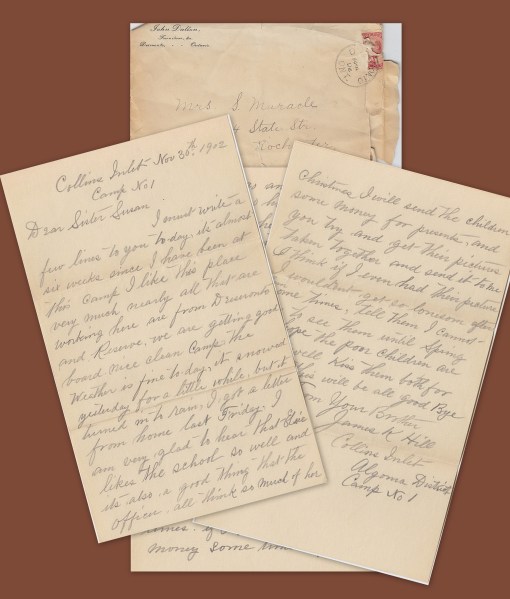
Letter from James Hill to Susan Maracle, 2015.19 (13)

Letter from James Hill to Susan Maracle, 2015.19 (13)

Collins Inlet Nov 30th 1902
Camp No. 1
Dear Sister Susan
I must write a few lines to you to-day, its almost six weeks since I have been at this camp. I like this place very much nearly all that are working here are from Deseronto and Reserve, we are getting good board, nice clean Camp. The Weather is fine to-day, it snowed yesterday for a little while, but it turned into rain, I got a letter from home last Friday. I am very glad to hear that Elsie likes the school so well and its also a good thing that the officers all think so much of her. I intend to go and see her before I go home and I must write to her before Christmas. I wrote to Lucretia the second Sunday I was here but she never answered me yet, and perhaps is’nt going to. Charlie Claus is here with me and we are going to stay all winter and drive the river in the Spring if we keep our health, there was about forty Indians here from our Reserve, and about sixteen Chippewa Indians from Manitoulan Island, but most of our Indians have left here for some other Camps. I suppose you see Ruth & Selma some times. If I can draw some money some time before Christmas I will send the children some money for presents, and you try and get their picture together and send it to me I think if I even had their picture I wouldn’t get so lonesom after them some times, tell them I cannot go to see them until Spring. I hope the poor children are both well kiss them both for me. This will be all Good Bye
From Your Brother
James R. Hill
Collins Inlet
Algoma District
Camp No. 1

It is not clear what happened to James after this. His wife moved to Rochester in 1906 and was working as a servant for the Babcock family in 1910. In 1911 Lucretia married William Charles Holley, with whom she had another three children. She died in Brighton, New York on September 2nd, 1957.

Perhaps the reason this letter survives is because James died young and it was kept as a memento of his life and his affection for his family. It was found in a house in Main Street, where Lucinda Hill, James’s mother died in 1933.

If you missed the history talk on the nineteenth century development of Deseronto this weekend, there’s a chance to catch it again on YouTube:

Due to a technical hitch on the day, the visuals weren’t available, but this version includes the slides!

Marlene Brant Castellano and wampum beltsMarlene Brant Castellano got our summer series of local history talks off to a great start with her examination of the local history of the Bay of Quinte from a Mohawk perspective.

Marlene used reproductions of two famous wampum belts to tell the story of the Mohawk people’s interactions with Europeans, beginning with the treaty represented by the Two-Row Wampum in 1613 with the Dutch. The two purple rows of the belt were intended to show the parallel courses of a European ship and a Haudenosaunee canoe, bound together by friendship, peace and respect. The other belt, the Friendship Belt, represents the Covenant Chain connecting the two peoples: a chain of silver which needs to be regularly polished by both groups in order to maintain its shine.

Marlene got the audience involved from the beginning, with questions about the importance of family roots and stories and what they mean to us. Until recently, formal education in Canada paid little or no attention to native people’s own histories, while the use of native languages was actively repressed for many years. Marlene noted that this has now changed and Indigenous children are now able to connect to their stories and language in a way that people of British descent may have taken for granted in the more Anglo-centric teaching of the past.

The stories associated with wampum belts have endured within these communities for hundreds of years, and Marlene explained that a thorough knowledge of their meaning and importance is a key part of being a chief. A chief, she noted, is an archivist, as well as a leader!

History talks poster


Tomorrow sees the first in a new series of talks on local history. We are delighted to welcome Marlene Brant Castellano to Deseronto Public Library to talk on the topic of ‘Mohawks and Settlers: neighbours throughout history’.

The talk is free to attend and all are welcome. It starts at 1pm and will be followed by refreshments. We hope to see you there!

Date: May 23rd

Location: Deseronto Public Library

Time: 1pm – 2pm


The next talk in the series, ‘The Development of Deseronto’ will take place on June 20th (same time, same place).

On this day in 1915 a ‘Musical and Literary Entertainment’ was held in Naylor’s Theatre in Deseronto. The concert was performed by Professor Eppes*, a music teacher, and some of his pupils.

Here we have reproduced the programme for the concert, with links to online versions of the various pieces where we have been able to find them, so that you can experience at least some of the concert 100 years later. We’ve even made a playlist of the ones on YouTube.

PROGRAMME

PART I.

1. Trio – ‘Sous les drapeaux de la Glorie’……………………….Blow
MISS CAMPBELL, MR. MAXWELL AND MR. EPPES
2. Piano Duett – ‘Norwegian Hunter’s March’…………………Orem
MISS M. EDWARDS AND MR. EPPS
3. Piano Solo – ‘Dance of the Mermaids’……………………Englemann
MISS MADELINE HAGGERTY
4. Vocal – ‘Nothing too good for the Irish‘……………………………
MISS MARJORIE ARMITAGE
5. Piano Solo – (a) ‘Polonaise Militaire‘ Op. 40 No. 1………Chopin
(b) ‘Berceuse,’ Op. 13 No. 7……………………Ilynsky
6. ‘The Bandelero‘……………………………………………………………..Stuart
MR. HERKIMER AYLSWORTH
7. Piano Solo – (a) ‘Valse in A Minor,’ No. 2, Op. 12………….Greig [Grieg]
(b) ‘Le Maitre a Danses’…………………….Gabriel-Marie
MISS PEARL McCULLOUGH
8. Saxophone Solo – Irish Airs………………………………………….
MR. THOS. MAXWELL
9. Vocal – ‘The Little Hero‘………………………………………..Adams
MR. AYLSWORTH

PART II

1. Trio – ‘Gavotte,’ Op. 57…………………………………….Tourbie
MISS CAMPBELL, MR. MAXWELL AND MR. EPPS
2. Piano Solo – ‘The Minstrel Boy and St. Patrick’s Day,’ Op. 47…Pape
MISS M. MALONEY
3. Vocal – Selected…………………………………
MISS G. CLEMENT
4. Piano Solo – (a) March…………………………………….Gurlitt
(b) Allegro from Quartette in F., No. 10………..Mozart
MISS MARY EDWARDS
5. Vocal – ‘The Wreck of the Hesperus‘…………………….Longfellow
MR AYLSWORTH
6. Piano Solo – (a) Minuett…………………………………….J. D. Brown
(b) Bluette…………………………………….Duvernoy
7. [Recitation?] – Selected………………………..
MISS P. McCULLOUGH
8. Piano Solo – Gavotte…………………………………………Berche
MISS MAE BARTLEY
9. Drill – By the Patriotic Sons and Daughters of the Empire…………….
GOD SAVE THE KING

Musical entertainment program


*William Eppes was born in Quebec City on February 20th, 1875. He married Bessie Alford in Belleville on March 30th, 1899 and by 1901 the couple were living in Tyendinaga. In the 1911 census they were in Mill Street, Deseronto and in 1921 they were living in Dundas Street.

« Previous PageNext Page »