News


A mention in the Napanee Standard of April 7, 1881, led former Deseronto archivist, Ken Brown, on a detective trail to hunt down a published description of ‘Deseronto and its industries’. The article in question appeared in the journal Lumber World, published in Buffalo, New York, in 1881. This publication proved difficult to find, but eventually we established that the Hagley Library in Wilmington, Delaware, held a copy (call number: TS800.L98). This library specialises in collecting the records of American enterprise (and is based on the site of the original DuPont gunpowder factory). The library’s head of imprints, Max Moeller, was incredibly helpful and has furnished the Archives with a digital version of the file.

The article runs to seven pages and is handsomely illustrated with etchings of some of the principal industrial buildings of the town: the saw mill, sash and door factory, flour mill, cedar mill and steamboat wharf. The text is fulsome (verging on the sycophantic) in its praise of the Rathbun company. Here are a few extracts:

The original saw mill has given place to one of immense proportions; extensive machine and blacksmith shops; sash and door factories; cedar mills; flour mills; lines of steam and sailing vessels; commodious and extensive warehouses and docks have been called into being, and, so great has become the importance of Deseronto as a shipping centre, the United States government has established there a Consular Agency. [p.32]

The total number of vessels which sailed from Mill Point (Deseronto) loaded by or for the firm alone, during the season of navigation beginning March 31, 1880 and ending November 20, 1880, was 509, of which 300 cleared for United States, and 209 for Canada ports. This does not include passenger steamers. During the season of navigation it is not an unusual sight to see from fifteen to seventeen vessels loading at the Deseronto docks simultaneously. [p.35]

The firm of H. B. Rathbun & Son is too well known and stands too high in the commercial world, to require commendation at our hands, yet our acknowledgement of an appreciation of the numerous courtesies extended, upon occasions when we have visited their establishments will not be inappropriate. Mr E. W. Rathbun, upon whom has devolved, in a great measure, the direction and management of the vast interests of the firm, has repeatedly demonstrated that courteous demeanor is not incompatible with careful watchfulness and prudence in business affairs, and were we to hazard a guess as to the prime cause of the magical success which has crowned the business career of this firm, we should attribute it in a large degree to the courteous and affable manner in which everyone who has dealings with them is treated. [pp.36-37]

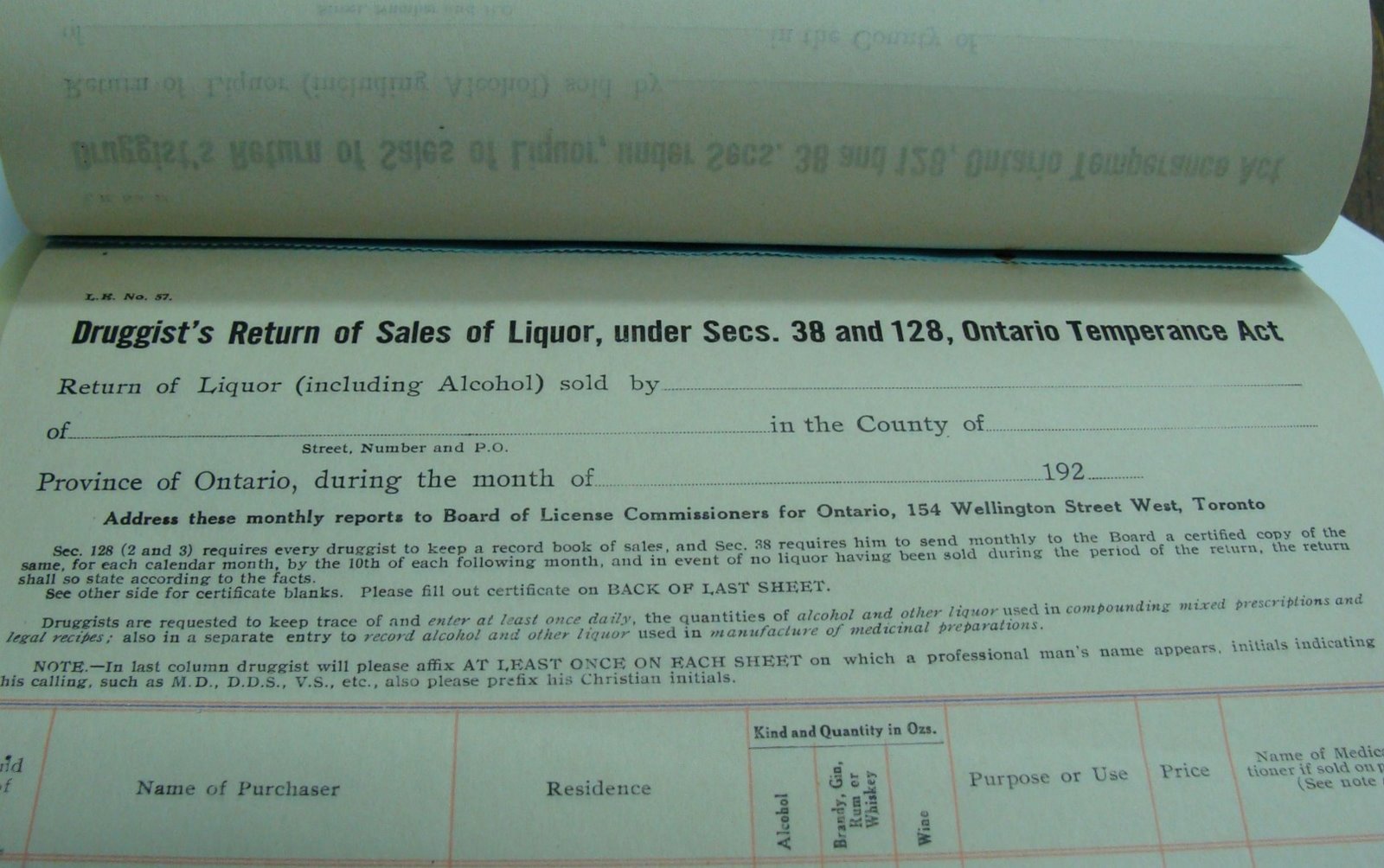
This was what you would have had to do in Ontario in 1925, anyway. Deseronto Archives holds a ‘Register of Liquor Sales’ which records sales of alcohol made by local druggist T. L. McCullough between October 16, 1925 and May 31, 1927. Under the terms of the Ontario Temperance Act of 1916, a customer was only allowed to buy alcohol if he or she had obtained a prescription from a doctor who had deemed “intoxicating liquor necessary for the health of his patient”.

The volume has columns for the name of the patient and the prescribing doctor, the quantity of alcohol purchased and its cost. The majority of the sales were for ‘alcohol’ or for spirits: brandy, gin, rum or whiskey. There is also a column for wine, but only four purchases of wine are recorded in the volume; all for communion wine for local churches. Every month, the druggist would return a copy of each page to the Board of License Commissioners for Ontario (the predecessor body to today’s Liquor Control Board of Ontario).

This volume was presented to the Town of Deseronto by Dorothy McCullough.


Well, OK, maybe we won’t be keeping this one in the Archives. Congratulations to Archives volunteer Tracy Brinklow and her husband Matthew on the safe arrival of baby Isaac on 12th March.

The Kimmett family donated this photograph to Deseronto Archives today, in memory of Don Kimmett. It depicts the manager, coach and team members of the Deseronto Baseball Club, who were Bay of Quinte League champions in 1950.

The team, from left to right and back to front were:
Kenny Brant, catcher; Don Kimmett, coach; Carl Tinney, pitcher; Jimmy Rodgers, centre field; Fred Smith, catcher; William Wood, manager; Gord Jackson, third base; Don Armitage, second base; Kenny Brennan, first base; George Knight, right field; Bill Doreen, pitcher; Doug Sexsmith, short stop; P. Martin, left field

The caption on the photo only has first initials, so if you can help us with the full first names of the team, we’ll be happy to fill those in. [Thanks to all who have helped with names!]

The March/April 2008 issue of Deseronto News and Views contained a commentary on the dangerous state of the town’s sidewalks during the snowy winter and a plea for the Town Council to act. This photograph is of a letter written in December 1898 on the same subject which was published in The Tribune, the town’s newspaper at the time.
So not a new problem, then…

Two old maps of Deseronto have surfaced in the last few weeks. One is a photocopy of an 1875 plan of Mill Point (as Deseronto was known at the time). The image below shows the lumber mill, workshops, the steam boat wharf and the post office of the day (click on the image for a closer look). At that time, Main Street was also known by its alternative name of Front Road.

Mill pond, Mill Point, 1875

Around 20 years later, the area around the original mill had changed considerably. The detail below is from a plan of the southern part of Deseronto, made at the height of the industrial era of the town in the late 1800s. Here, the western side of Mill Street is taken up with a sash and door factory. The wharves have expanded greatly and railways form elaborate patterns around the whole site.

Deseronto Mill Pond area, c.1895

The ‘dry kilns’ on this plan are now occupied by the Deseronto Flea Market, but otherwise these buildings have all gone and the area is now a centre for recreation, rather than industry.

Centennial Park
Photo by Dana Valentyne

This watercolour painting was one of several commissioned by Deseronto Public Library in the early 1960s, leading up to the Centennial celebrations of 1967. It shows the corner of the park and the Post Office, with the Town Hall visible on the right of the picture. The artist was Garnet Hazard (1903-1987), who was living in Deseronto at the time.

The public-spirited aim of the Library Board of the day was that:

Every one who steps into the library can gaze at the town as it is seen by the gifted insight of these painters. Their paintings will capture the courage, hopes, disappointments, struggles, and loveliness of the people of this town.

Rev. Douglas Blair
Library Board

This photograph shows the same view as it appeared on April 16, 2008:

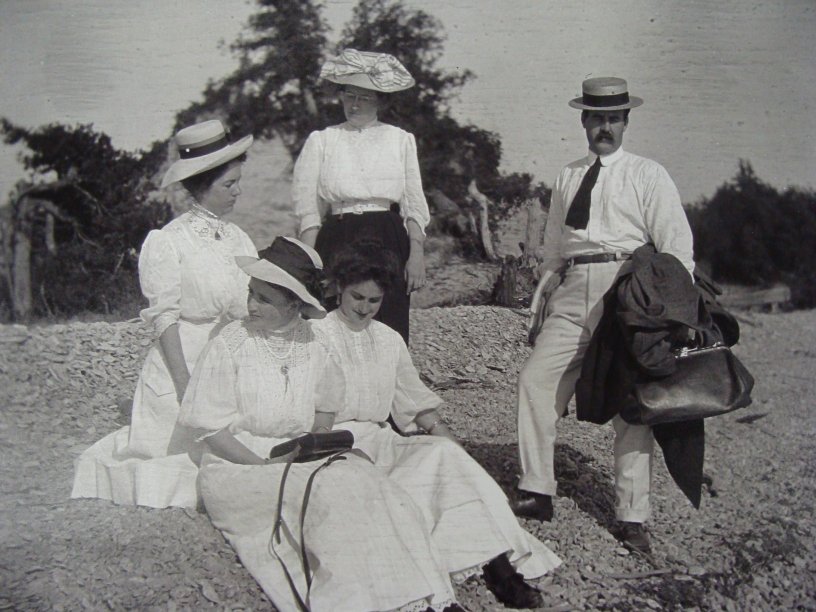
As we’re experiencing a particularly snowy February, here’s a photograph to remind us that the warm days of summer will be here again before too long. This shot was taken by Harold McMurrich Rathbun, grandson of Hugo Burghardt Rathbun, the man who established Deseronto as a major lumber centre in the late nineteenth century.

It was taken on a trip to the Sandbanks in Prince Edward County in July 1908. To modern eyes, the people in the group seem rather over-dressed for a July day at the lake. Look at the thickness of the coat that the man is carrying. And what on earth did he have in that bag?

The negative of this photograph is one of many taken by Harold M. Rathbun that were presented to Deseronto Archives by the South Fredericksburg Heritage Committee in 2005. The photo’s reference number is HMR2-06-28.

Deseronto Archives was one of six archives to be granted funding from the Friends of the Archives of Ontario in 2007. We asked for the money to pay for much-needed archival packaging and supplies for the Archives. This photograph shows some of the materials that we purchased with the money. One priority for this year is dealing with the photographs that we hold, and re-packing them in archival quality polyester sleeves is part of that plan. This work is now well under way, thanks to this generous support from the FAO.

As St. Valentine’s Day approaches, Deseronto Archives investigates a love story that began on the Mohawk Reserve (now known as the Tyendinaga Mohawk Territory) one hundred years ago.

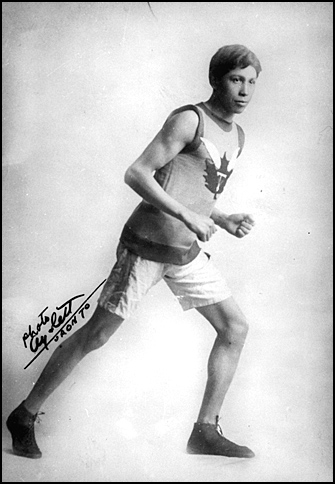
Tom LongboatOne of the most famous Canadian athletes of 1908 was Tom Longboat, a marathon runner with a string of successful races to his name. He was born in 1887 to Onondaga parents in the Six Nations of the Grand River Indian Reserve.

His first major race victory was at the 1906 Around the Bay Race in Hamilton, Ontario. In 1907 he won the Boston Marathon and the following year he went to London, England, to run in the Olympic Games. Unfortunately he did not manage to complete that marathon, as he collapsed after running 19 miles (30 kilometres) in hot and humid conditions.

Longboat turned professional in November 1908 and it seems to be at about this time that he met Lauretta Maracle, who was described by the New York Times as “an Indian school teacher” at the reserve near Deseronto. The Albuquerque Citizen has an intriguing report about the couple’s courtship (which manages to get Lauretta’s name completely wrong). They planned to marry at Massey Hall in Toronto, after a benefit performance on 28 December 2008. Lauretta was an Anglican and the New York Times noted on 20 December that Tom was to be received into the Anglican Church the next day.

A last-minute snag was reported in the same paper on December 27, under the headline ‘Ban on Longboat Wedding’. The Archbishop of Toronto, Arthur Sweatman, had written to Rev. Alfred H. Creeggan of Deseronto, who was due to conduct the ceremony and told him not to, as he believed that Tom’s conversion was too sudden and therefore unlikely to be sincere. Other Anglican ministers were also prohibited from presiding over the wedding, but the marriage did go ahead, although it is not clear who officiated.

The union between Tom and Lauretta was ill-starred, however, as Tom was reported missing, presumed dead, during the First World War and Lauretta married another man. On Tom’s return she decided to stay with her new husband. Shortly afterwards, Tom also married again, to Martha Silversmith, who was from his own Six Nations reserve.

There are no images of Lauretta available, but this photograph from Library and Archives Canada (C-014095), via the Wikimedia Commons site shows Tom in his prime (although his pose looks far from natural).

« Previous PageNext Page »