News


New Archives of Ontario building

New Archives of Ontario building

The Archives Association of Ontario held its annual conference at York University yesterday. The location was chosen to mark the opening of the new Archives of Ontario building, which is centrally placed on the Keele campus of the university.

Tours of the building were arranged on Thursday evening and it really is a wonderful facility. Unfortunately, we were not allowed to take photographs, so I can’t share with you the amazing reading room or the fantastic curved wall which divides the microfilm reading room from the main one. The wall is covered with a beautiful custom-made wallpaper, made up of reproduction photographs in a themed timeline. There isn’t a picture of this on the AO website either, so you will have to take my word for it that it looks amazing (or go and see it for yourself!).

Miriam McTiernan (Archivist of Ontario) and other members of the Archives of Ontario’s staff gave a presentation on the move to the new building in the first session of the conference. The scale of the move was impressive: 55,000 microfilm reels were moved, for example, and over 50,000 containers of varying shapes and sizes.  The Archives employed a film-maker to record the whole move, so we got to see the resulting video, which was only eight minutes long, but which really captured the excitement and effort involved in the move. There doesn’t seem to be a lot about the new building on the AO’s website yet, but I hope they will make the video available there. [UPDATE, July 18: there is a trailer on YouTube for a five-part mini series about the move – which includes a few shots of the curved wall.]

One thing I found really interesting was the plan to make it possible to consult the AO’s microfilm from a distance. This will mean (if I’ve understood this correctly) that researchers won’t have to order microfilms on inter-library loan or turn up to look at them at York, but will be able to access them over the Internet.  As the AO is still very dependent on microfilm for a lot of its indexes, this seems like a wonderful idea. It isn’t available yet, but I look forward to hearing more about this – for a huge province like Ontario, immediate remote access to the most popular holdings is really essential.
As part of an investment of $15 million by the Ontario Ministry of Culture, all users of public libraries in Ontario now have access to Ancestry Library Edition within the libraries for the next two years. Ancestry is a tremendous resource for anyone researching people, holding, as it does, an enormous range of databases.

For family historians, the ability to search across census information and immigration details can be of immense assistance in tracing the whereabouts of family members in the past.

Ancestry Library Edition can only be accessed from within Ontario’s public libraries. As Deseronto Archives is situated within Deseronto Public Library, we are very pleased to be able to make use of this service, which is already proving extremely useful in answering family history enquiries from our users. If you are in Ontario, are having trouble with your family tree and haven’t got a personal subscription to Ancestry, we highly recommend hot-footing it down to your local library!


Deseronto Archives will be open on Saturdays in June, July and August, between 10am and 2pm.

The Lennox and Addington Museum and Archives hosted a workshop on “Identification, Preservation and Description of Photographs and Documentary Art”. The morning session was run by Jennifer Bunting, historian and archive consultant. This focused on the different types of photographic materials that archives and museum staff might come across in the course of their work. It was wonderful to be able to handle (with cotton gloves on, of course!) the early photographs that Jennifer brought along – it was the first time that I had had a chance to see a daguerreotype, ambrotype and tintype up close, for example.

There are a number of online resources which might help in dating nineteenth century photographs, although most seem to be based in the UK. Roger Vaughan’s picture library is one example.

In the afternoon we heard from Iona McCraith, preservation consultant, about how best to store photographic materials. Iona had some sad examples of photographic negatives that were deteriorating due to ‘vinegar syndrome‘. These materials are best protected by being stored at low temperature and humidity levels. Given the warm and often fairly humid summer conditions that we get in this area, it seems likely that decay of photographic negatives that have been stored in the average family home will be fairly rapid. In these conditions, the Image Permanence Institute suggests that negatives will begin to break down in under 50 years: a significant preservation problem.

The earliest minutes for the town council of Deseronto (in the days when it was known as Mill Point) show the names of the Reeve and four town councillors. One of the names is that of Florence Donoghue, which was intriguing, as it seemed highly unlikely that a woman could have been a councillor in 1872. The mystery was soon cleared up, as later minutes in the same volume referred to this councillor as “Mr. Donoghue”.

A check on the 1901 census shows Florence Donoghue as a male who was born on 28 January 1832. Directories of the time show Donoghue and Bro. as dry goods merchants on the south side of Main Street, at its junction with Prince Street. Donoghue and his partner, James Oliver, were still in business in 1911, when Donoghue was 79 years of age. The shop would have been one of those in the picture below:


Florence, it transpires, was fairly common as a boy’s name in Ireland in the late nineteenth century. In the 1881 census of Canada there were 64 Florences whose place of birth was Ireland. 24 of those were men. Florence Donoghue was born in Ontario, but (as his name suggests) he is listed as being of Irish descent.

Deseronto Storm (usually known locally as ‘The Storm’) is the junior hockey team that many people in Deseronto and surrounding areas follow with keen interest nowadays. Back in the 1920s the town had another successful team, this one made up of young men from the Deseronto High School. They were the Central Ontario Inter-Scholastic League Champions in 1926 and 1927.

Mary Hird, the daughter of Charlie Cole, the left defence player, has lent images of the two Deseronto High School teams to the Archives so that we could copy them and share them with others.

1925-1926 team:


FRONT ROW (left to right) – L. Bruyea, left wing; F. Whitton, centre; M. Detlor, right wing.; C. McVicker, goal.
BACK ROW (left to right) – J. Whitton, Manager; J. McVicker, Mascot; L. McVicker, sub.; M. Perry, right defence; C. Cole, left defence; F. Butzer, sub.; E. I. Gale, Principal of Deseronto High School.

James McVicker (1909-1974), the team’s mascot, is already familiar to us as the drummer in the ‘Circle Six Orchestra’, whose photograph has featured on the blog before. That photograph was clearly taken in the same photographer’s studio as these two.

1926-1927 team:

FRONT ROW (left to right) – M. Detlor, right wing; F. Whitton, centre; J. Whitton, Manager; L. Bruyea, left wing; C. McVicker, goal.
BACK ROW (left to right) – B. Brant, coach; G. Green, sub; L. McVicker, right defence; B. Campbell, sub; C. Cole, left defence; A. D. Campbell, Principal.

Daniel Clarence McVicker (1907-1985), the goaltender for both teams was later to become a physician and worked as a doctor in Deseronto for many years. If you have further information about the other members of the team, please share them in the comments.

To modern eyes, the difference in the levels of equipment between these players and those of today’s is quite striking. As is the complete lack of logos on the 1920s teams’ kit!

“Look out for two grey-haired, not-very-tall people in green anoraks”.

This was how Mrs Devos described herself and her husband. We had arranged to meet at London City Airport, although we had only known each other through the Internet, and for a mere five weeks.

Mr Devos had put ‘Deseronto’ into Google in February and had come across this blog. He got in touch by email on February 18, to tell me about his father’s photograph album, which I’ve described in an earlier post. We were delighted to get copies of the photographs, but as Mr Devos lives in Worcestershire, England, our interaction has been purely through email.

Last Friday I posted a ‘Thank you’ letter to Worcestershire from Manchester, where I was attending the Archives 2.0 conference and talking about the work we’re doing in Deseronto using online resources such as Blogger and Flickr (including, I might add, the story behind the Devos photo album). Noticing that the letter was posted in England, Mr Devos emailed to say that he would be in London this week and to see if there was any chance of meeting up. As it happened, I would be on my way from Edinburgh to Kent via London today.

So we arranged our rendezvous (despite misgivings of friends of both parties, who were automatically suspicious of meetings arranged with strangers over the Internet!). We found each other without mishap (the green anoraks were instantly recognisable) and had a lovely chat over a cup of coffee in the airport café. We’ve gone from a chance international online encounter to a face-to-face meeting in London in just over a month!


When I talked about our accession of the Devos photo album in Manchester last week, as one of the consequences of putting materials online, I didn’t know that I would actually be getting to meet Mr Devos and his wife. It is another example of the fact that you never know quite where these online initiatives are going to take you, if you are willing to let them.

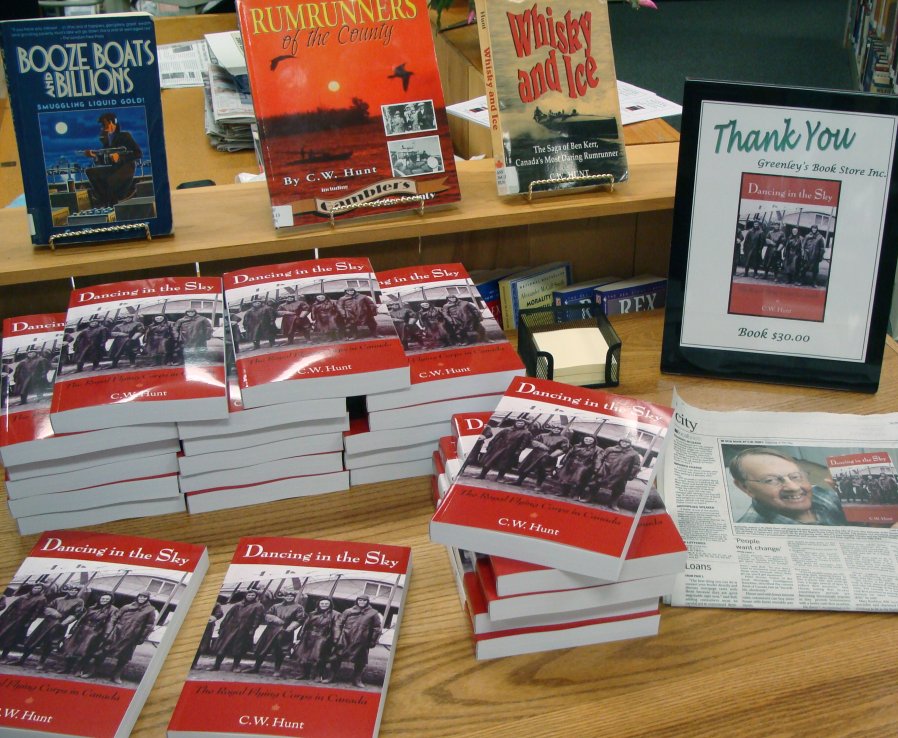
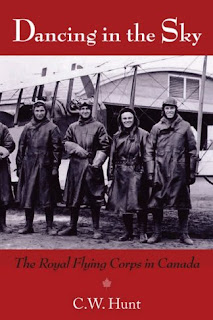
The book launch today was a resounding success. Every single one of the copies of Dancing in the Sky brought to the library by Greenley’s Bookstore was sold, with a long waiting list for the next delivery.

Piles of books before they were all sold
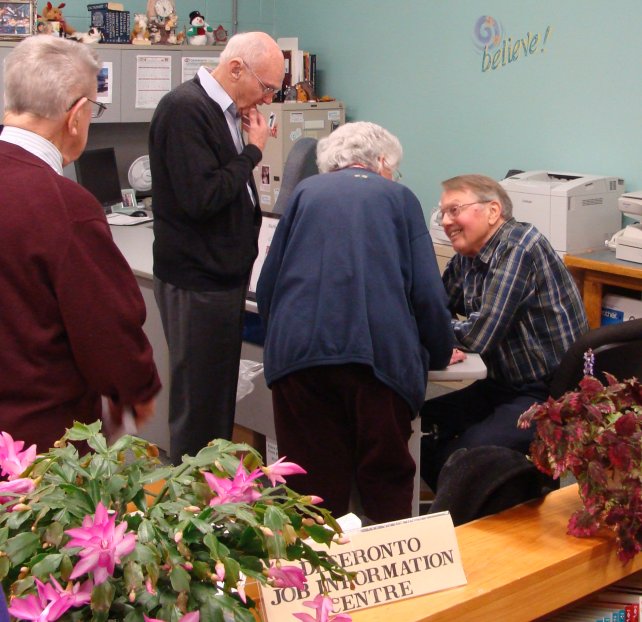
Bill Hunt must have a very sore right hand tonight after signing over forty copies of his book. There was quite a long line of people waiting for him to autograph their copies at one point.


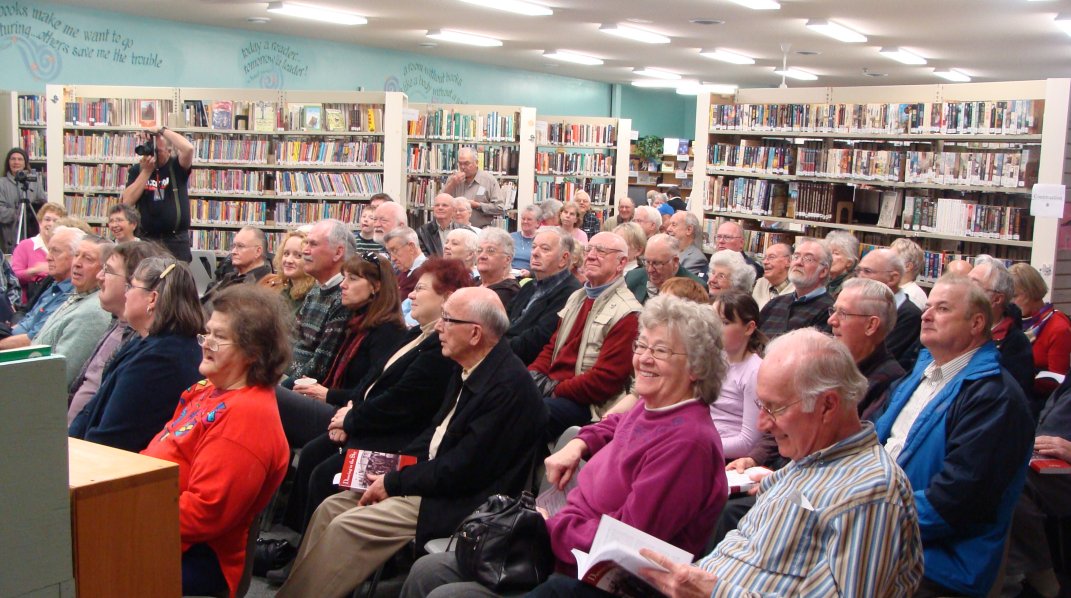
We estimate that 135 people came to hear Bill talk about the training of pilots in Canada during the First World War. His talk was full of interesting facts and contained a number of insights into the great impact that the arrival of the air cadets had upon the economy and people of Deseronto.


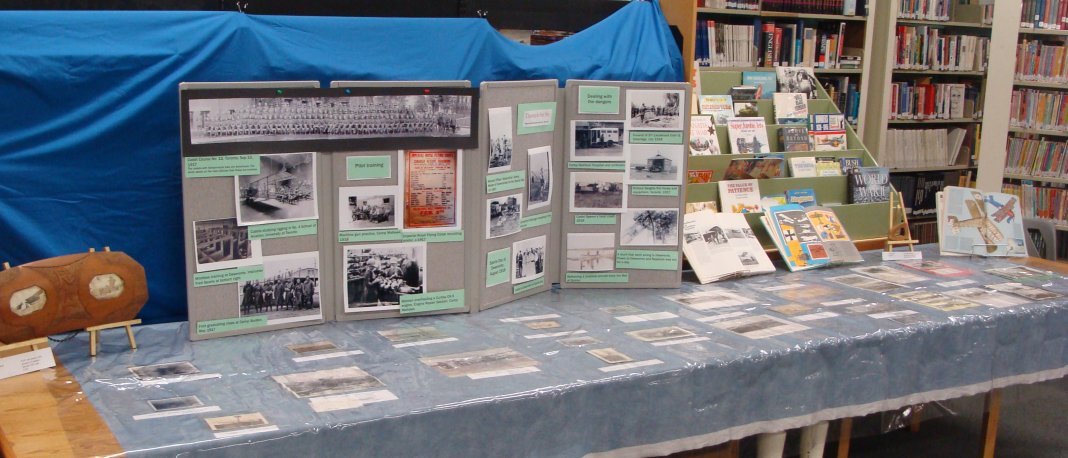
Bill was at pains to point out how important the archival record has been in helping him to research this volume: the diaries and photographs left by the young pilots have been a wonderful resource. Music to an archivist’s ears! We put together a display of photographs from the book, library books and original materials from the Deseronto Archives’ collections, as a side-show to the main event:


It was a wonderful afternoon and a tribute to the huge amount of work that went into the preparation, particularly by Deseronto’s Librarian, Frances Smith, by Dana Valentyne of the Deseronto Revitalization Program, and by the Chair of the Deseronto Public Library Board, Don Simpson. Many thanks to them, to Deseronto’s Mayor, Norm Clark, for a great welcoming address, and to the sponsors of the raffle prize: Greenleys Bookstore, The Chocolate Room and the Small Town Café and Bakery. Thanks also to Lori Brooks of the Deseronto Job Information Centre (whose domain was requisitioned for the book-signing) and to everyone who came – you helped to make this event a huge success.

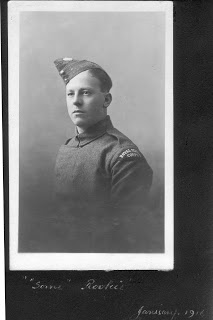
The Archives’ collections on the World War I flying camps have been hugely boosted recently by the acquisition of a series of photographs which belonged to a flight instructor in Camp Mohawk. Sergeant Christopher Paulus Devos (pictured here as a cadet in 1916) was an Englishman who was in No. 84 Canadian Training Squadron throughout its period of operation, in Camp Mohawk and in Camp Taliaferro in Fort Worth, Texas. He was one of only two English airmen of the original squadron to survive and return to England after the war. He compiled two photograph albums recording life in the camps.

Sergeant Devos’s son, Denzil Devos, has kindly scanned in the pages of the Camp Mohawk album and donated them to the Archives. He has also copied some of the Fort Worth album, including photographs of Captain Vernon Castle and some aerial shots of Toronto. We have been able to share all these images through our Flickr account. There are many images of crashed aircraft in the group, but a few show the lighter side of Royal Flying Corps life, such as this group shot of airmen “poshed up” for a night out in Belleville on a bus from the Hotel Quinte:

Plans are well under way for the launch of C.W. (Bill) Hunt’s new book, Dancing in the Sky. The book was originally started by Al Smith, who began to write about the World War I training airfields around Deseronto. Al collected stories from people who had worked at (or had otherwise been involved with) the two camps (Camp Mohawk and Camp Rathbun) and amassed a number of photographs. Bill took over the project in 1998 and broadened the research to include the other Royal Flying Corps Canada locations in Ontario. The photographs collected by Al Smith are now available for research in Deseronto Archives (under the name J. Allan Smith Collection). The book is being published by Dundurn Press this month.

The Deseronto Public Library will be the venue for this launch on the 7 March 2009 at 2.00pm. We’ll be mounting a display of photographs and other historic materials relating to the Deseronto camps, and refreshments will be served. Bill Hunt will then talk about his book. Greenley’s Book Store will be there with copies of the book to buy (which I’m sure Bill will be happy to sign!) and there will also be a raffle draw with a chance to win a copy of the book and a selection of other goodies.

It is shaping up to be a great event, so if you have a chance to, please come along that afternoon! The invitation (a PDF file) has more details.

CAMPM-06-05

« Previous PageNext Page »