industry


Sometimes the bald information in records of the past can conceal stories of human suffering and loss. But those bare bones of birth, death, marriage and census details can also be used to give structure and meaning to half-remembered family stories and newspaper reports from days gone by.

Deseronto’s Tribune  newspaper of August 31, 1888 reported the death of Philip Gaylord, a man who was working for the Rathbun Company, in the following (rather graphic) way:

Fatal Accident

On the afternoon of Saturday, 25th inst., Philip Gaylord, an employee of the Cedar Mill, was the victim of an unfortunate accident which was followed with fatal results. He was employed as a teamster and was engaged in hauling cars loaded with refuse from the mill to the yards. About the middle of the afternoon he left the mill with a loaded car and had almost reached its destination in the yard east of the Chemical works. It happened, however, that one of the pieces of stuff on the car projected too far from the load and as the car proceeded along the track between two piles of wood, this piece was caught and as the horses moved on it was swung about, throwing Gaylord from the load.  He fell on the rails, and the loaded car passed over him, the wheels mutilating him in a dreadful manner.

Railway tracks behind the cedar mill in 1907, with refuse burner chimneys in the distance (HMR1-06-79)

Mr. Donaldson, the foreman of the yard, witnessed the accident and ran immediately to his assistance.  He was conveyed at once to Dr. Newton’s surgery where it was found that his right arm was nearly cut off, the bones being shattered to the very shoulder, while the right leg was also fearfully mangled.  Dr. Newton immediately amputated the arm at the shoulder joint, and the leg above the knee; he also amputated the great toe of the left foot which had also been crushed.  The young man bore the operation well, but the terrible shock was too great and after midnight he began to sink rapidly and he expired at an early hour on Sunday morning.

The funeral took place on Sunday afternoon and was numerously attended.  The deceased, who was 21 years of age, was the son of Levi Gaylord, of the township of Arden.  He was a steady young man and had gained the good will and respect of his companions and fellow workmen.  His sudden cutting off is rendered more sad by the fact that he was to have been married in the course of two or three months.  His last words, somewhat indistinctly uttered, expressed a message which he wished to be conveyed to his betrothed.

The obituary was discovered on this blog by a researcher who was trying to find out about the parentage of a woman called Minnie May Penny who was born in January 1889. The family story had been that she was adopted by Charles and Emma Penny in Arden after one of her parents was killed in a railway accident that spooked some horses. Marriage and census records show us that Emma Penny’s father was Levi Gaylord and that she was therefore the sister of Philip, the man who died in Deseronto in August 1888.The similarity of the family story and the information from the obituary strongly suggests that the soon-to-be-wed Philip was Minnie’s father. Minnie’s date of birth was January 4, 1889 and in the 1891 census we find her living with the Pennys in Arden and carrying their surname, which bears out the family story that she was adopted by them. Now we know from the information in the newspaper story that the Pennys were her paternal aunt and uncle.

But who was Minnie’s mother?

We had a date of birth for the child, but no name for her mother apart from a family story that it might have been Haws or Boomhower. This time, it was the Ancestry website which was the best source of information. A search on Minnies born in Ontario on January 4, 1889 brought back a likely match: Minnie Hawes was born to Ida Hawes of Olden Township, Frontenac County (not far from Arden) on that day. No father’s name is given on her birth registration, but the matches between the family stories and the records mean that Philip Gaylord and Ida Hawes are highly likely to be Minnie’s parents and that Philip’s ‘indistinctly uttered’ last words had been meant for Ida, the woman he had planned to marry.

Mystery solved!

Ontario’s marriage records show us that Ida went on to marry a man called Stephen Dolan in August 1892, by which time Minnie was living in Arden with her aunt and uncle. Minnie herself married a man called Robert Loyst in 1905 and by 1911 the couple had three children and were living in Nipissing. We can hope this was a happy ending to a life which had such an unfortunate beginning.
An interesting new accession arrived by email this week from Ray MacDonald, whose mother, Mary Hawley MacDonald Selby, wrote a series of six emails to her grand-daughter in 1999, when she was in her eighties. The emails describe life in Deseronto during the hard years of the 1930s, when the Hawley family moved here from Toronto in the hope of finding seasonal work in the canning factories. Here’s Mary’s description of the struggle to find clothing:

We never bought new clothes, we wore whatever was given to us in other words “hand me downs”. Shoes did not always fit and were worn past “outgrown”. My feet to this day will verify this. When the soles of shoes were worn through Howard would repair them from old shoes. He then learned how to skin the tread from old Tires to make new soles. The men of the family had one decent pair of trousers and a button up sweater to wear for good and hand me downs for work pants. Never had a suit for over ten years. From l930 to 1939 my Aunts sent their outdated clothes to Mother and I, and we tried to update them to wear. In my first year at high school they sent me a new dress, and I wore it all winter. Each week end it was washed and pressed for the next week. Always had to take it off after School to save it. The next winter I had grown and we Cut it down and made a jumper out of it because I had outgrown it.

It’s a fascinating glimpse into a time of struggle: you can read all Mary’s stories on our ‘About Deseronto‘ site. Her brothers, Howard and Rocky, founded the Hawley Brothers furniture company on Main Street, Deseronto, in the 1940s. This successful firm operated until the brothers’ retirement and Mary describes the early years of the company in her emails.

Technical digression

Sharing the stories was something of a technical challenge: Mr MacDonald sent us the printed emails scanned into a PDF file. I had visions of having to re-type all 10 pages in order to turn them into something that I could share on the About Deseronto site. A colleague from the UK gave me some helpful advice. There are two types of PDF files – some are images only and require optical character recognition software in order to convert them into text (my colleague recommended http://www.paperfile.net/). Others are images and text. You can tell whether you’ve got the latter by searching within the PDF file. If you can find words, then it’s image and text. For this type of file (which is what I had), there’s a useful program called pdftotext which will convert the PDF file into a text file. You can get pdftotext as part of the XPDF download. You have to extract the zip file and then run the program from the command line, after navigating to the directory where the pdftotext program is sitting. You run the program by simply typing ‘pdftotext’ followed by the name of the file you need to convert and the name of the text file you want to create. For example: pdftotext myfile.pdf newfile.txt.

Mary Selby died in 2009, so we are very grateful to her son for sharing these emails with us and for giving us permission to share them with a wider audience.

Rainbow Protex Ltd.

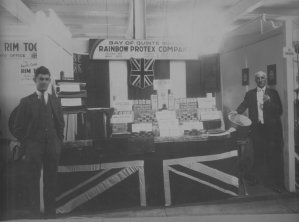
This photograph shows a stand at a trade show in the 1920s or 1930s. The company represented is Rainbow Protex, a manufacturer of auto top dressings and boot and shoe polish. At this period, car roofs were usually made of fabric that had been coated with rubber. To keep them looking good and to protect the rubber from the effects of sunlight and cold or wet weather, black oil-based varnishes known as auto top dressings were applied to their surfaces.

This particular company’s head office was in Toronto, but (according to the photograph) the factory that produced the polishes and dressings was in Deseronto. One of the men in the photograph is William Macdonald Mackintosh, a chemist, originally from Liverpool in England (U.S. patent no. 771,257 was issued in 1904 for his ‘Compound for Waterproofing Fabrics’). Mackintosh’s granddaughter got in touch with the Archives recently, asking whether we had any information about the company for which Mackintosh was working.

We don’t have any details about the firm in the Archives, so, with her permission, we are sharing this copy of Martha Mackintosh’s photograph here, in case anyone can tell as more about this particular company. We would like to know exactly where in Deseronto its factory was and when it was in operation. Please comment if you can help!

On this day in 1892 a concert was held at the Deseronto Opera House[1] by the Edith Ross Scottish Concert Company, who were invited to perform by the St. Andrew’s Society which had recently been formed in the town. According to the Tribune which was published on the next day:

The following lines, composed by Mr. A. D. McIntyre, the talented secretary of St. Andrew’s Society, as a welcome to the Edith Ross Scottish Concert Company, were read by him with great effect at their entertainment in the opera house last night:

Miss Edith Ross and Company,
We kindly welcome you,
And hope our hearts you will engross
With song and music too;
We trust that ye will feel at ease,
Just as you would at hame,
And may our toes and fingers freeze
If we give cause to blame.

We hope that you will soon again
Revisit our good town,
Which surely in a year or so
Will be a city grown;
For we have here the energy
And everything beside
To make Deseronto go ahead
At ebb or flood of tide.

I’m sure if you took twa’ three days
To look our works around,
That you would wonder where on earth
Their likes could e’er be found;
With basswood, pine and oaken logs
Your brain would sure be tossed,
And round great piles of every kind
Of lumber you’d get lost.

You’d see the logs a rolling up
The runway from the dam,
Sliced into lumber instantly;
I tell you it is gran’
To see the slabs thrown, lightning speed,
From sound and healthy pine,
And in the finer part that’s left
Behold a nine by nine.

The Factory you’d visit too,
Where they make sash and door,
And ship them to Australia
And other countless shores;
Then you would ramble to the wharf,
Where ends the B. of Q,[2]
Its rails and solid bed stops short
When Jamie Stokes[3] they view.

And now you jump upon the train,
No trouble in the least,
And step off on the platform
At Deseronto East;
Blacksmith, Machine and Loco Shops
Are now left far behind
With Car Works and the Shipyard, full
Of crafts of every kind.

The Cedar Mill you’ve also passed,
Where ties are made and shipped,
And where the Shipyard’s sturdy oak
Is often sawn and ripped;
Another mill you have sped by,
Where shingles are the ware,
And now from off this platform,
Behold the Grist Mill there!

Here you can buy the purest flour
That ever yet was made,
And Oh! you’d open wide your eyes
Surprised at Richard’s[4] trade;
The wheat is brought by great shiploads
And by the Railway too;
But come a little farther down,
The Burners we will view.

Here’s where the refuse is all burned,
The sawdust and the dross
To wondrous chemicals are turned
That nothing go to loss;
And if you look away beyond
The Refuse Docks appear,
Which, in the summer, are filled up
For winter work and cheer.

And still a little farther down
The Secret Works you see,
Where one of Scotland’s honored sons[5]
Practises chemistry;
And right behind, encircled neat,
The Gas Works you espy,
From whence our streets and ilka house
Receive their light supply.

And yet a wee bit farther on
Red Terra Cotta stands
In its artistic excellence
Pourtrayed by Hynes’[6] hand,
Who pounds and moulds it with his fist
This and the other way,
And then brings forth a matchless bust
In Terra Cotta clay.

But what’s the use in trying thus
Our industries to name,
For it would take a week or more
To numerate the same:
Imagination needs must fly
Far North, South, East and West,
In town and city, bush and plain,
You see the Rathbuns’ Crest.

Again, a welcome please accept
From old St. Andrew’s boys,
Who wish ye “Merry Christmas”
And many earthly joys;
And as you travel through this world
Do not forget, we pray,
The thriving town and leal hearts
On Quinte’s famous bay.

This poem is a wonderful snapshot of the industries along the Deseronto waterfront in 1892. According to the 1901 census, Archibald Duncan Macintyre was an accountant who was born in Scotland on 3 March 1859. We can surmise from the contents of his poem that he worked for the Rathbun Company. He came to Canada in 1876. In an account of the first annual St. Andrew’s Day dinner (November 30th, 1892), the Tribune described Macintyre as “a true and loyal Highlander” and a man of “poetic genius”. A few years later, he had become the Chief of the Sons of Scotland and the Archives holds this photograph of him:

Photograph of Archibald D. Macintyre, c.1902

Photograph of A. D. Macintyre, c.1902

Macintyre died in William Street, Trenton, on December 13th, 1921. His occupation was given as “Filing Clerk, C.N.Ry [Canadian National Railway] Stores”. He had been living at that address for three years before his death. He was, however, buried in Deseronto’s cemetery: an event that also took place, coincidentally, on December the 15th.


[1] At this date the Opera House was on the upper floor of the Baker Block on Main Street
[2] The Bay of Quinte Railway
[3] James Stokes was listed in the 1891 census for Deseronto as ‘wharfinger’: the man in charge of the day-to-day business of the wharf. He was 42 at the time of the census. He died in Toronto on April 4, 1913, aged 64.
[4] This was presumably Richard Rayburn, the flour mill manager, according to the 1891 census.
[5] The 1891 census lists 41 year-old William D. McRae as “Superintendent, Gas and Chemical Works”. McRae was born in Scotland.
[6] Michael J. Hynes, artist and manager of the Terra Cotta works

Metcalfe Foods had canning factories in Deseronto from 1912, according to a Deseronto Post article published in 1948. The archives has three copies of this photograph of the staff of the firm, taken in the 1930s (either 1932 or 1938, according to notes on the photos).

Staff of Metcalfe Foods, 1930s

Staff of Metcalfe Foods, 1930s

One of the employees pictured here, Floyd Marlin, wrote down many of the names of those pictured and his list is reproduced below. If you are able to fill in any of the gaps, please post a comment or drop the Archives an email. Some of the spellings here are possibly wrong, so please let us know if you spot one that needs correcting.

Front row, left to right:
?
?
?
Pansy Lindsay
Mrs McCabe
Muriel Cole
Gerty Toppings
Mrs Ed Martin
Mrs McLaughlin
Mrs Herb Histed
Lila Histed
?
Lizzy Marlin
Mrs Wager
Mrs Harv Scriver
Mrs Norm Davis
?
?
? Smith
Marion Clause
Mrs Scyler Smith

Second row:
?
?
Ruby Maracle
Mrs Herb Maracle
Barbara Rennolds
Jean Cronk
Mrs E. [Ernie] Crisp
Bessie Young
Mrs Cat Young
Mrs Bill Miller
?
Lola Brooks
Violet Cole
Mrs Bessy O’Ray
Annie Johndrew
Meta Clause
Mrs Hoppings
Mrs De Mille
?
Susannah Maracle [formerly Brant]
Audrey Maracle
?
Mrs Fred Laurence

Third row:
Mrs A. Joyce
Mrs Bill Purvis
Vera Dawson
Mrs Abe Cronk
?
Alice Leafe
Mrs Morley Gault
Mrs Arney Cole
Mrs Alport
?
Mrs Nellie Tompkins
Maude Covert
Elsie Maracle
Verda Maracle
Muriel Cole
? Gault
Lou Green

Back row:
?
Fred Powell
?
Tom Jackson
Jim Sharpe
Bert Richardson
Art Howard
Abe Cronk
Ed. Chambers
Dixie [?] Green
Jim Sager
Evert Martin
Claborn Tompkins
Norm Davis
Floyd Marlin
Walter Joyce
Jack Barber
Joe Clare
Fred Hoppings
Phil ‘Cribby’ Blake

Maude Covert, who also appears in this photograph, lived at the house we featured in an earlier post.

Maude Covert

Maude Covert

A mention in the Napanee Standard of April 7, 1881, led former Deseronto archivist, Ken Brown, on a detective trail to hunt down a published description of ‘Deseronto and its industries’. The article in question appeared in the journal Lumber World, published in Buffalo, New York, in 1881. This publication proved difficult to find, but eventually we established that the Hagley Library in Wilmington, Delaware, held a copy (call number: TS800.L98). This library specialises in collecting the records of American enterprise (and is based on the site of the original DuPont gunpowder factory). The library’s head of imprints, Max Moeller, was incredibly helpful and has furnished the Archives with a digital version of the file.

The article runs to seven pages and is handsomely illustrated with etchings of some of the principal industrial buildings of the town: the saw mill, sash and door factory, flour mill, cedar mill and steamboat wharf. The text is fulsome (verging on the sycophantic) in its praise of the Rathbun company. Here are a few extracts:

The original saw mill has given place to one of immense proportions; extensive machine and blacksmith shops; sash and door factories; cedar mills; flour mills; lines of steam and sailing vessels; commodious and extensive warehouses and docks have been called into being, and, so great has become the importance of Deseronto as a shipping centre, the United States government has established there a Consular Agency. [p.32]

The total number of vessels which sailed from Mill Point (Deseronto) loaded by or for the firm alone, during the season of navigation beginning March 31, 1880 and ending November 20, 1880, was 509, of which 300 cleared for United States, and 209 for Canada ports. This does not include passenger steamers. During the season of navigation it is not an unusual sight to see from fifteen to seventeen vessels loading at the Deseronto docks simultaneously. [p.35]

The firm of H. B. Rathbun & Son is too well known and stands too high in the commercial world, to require commendation at our hands, yet our acknowledgement of an appreciation of the numerous courtesies extended, upon occasions when we have visited their establishments will not be inappropriate. Mr E. W. Rathbun, upon whom has devolved, in a great measure, the direction and management of the vast interests of the firm, has repeatedly demonstrated that courteous demeanor is not incompatible with careful watchfulness and prudence in business affairs, and were we to hazard a guess as to the prime cause of the magical success which has crowned the business career of this firm, we should attribute it in a large degree to the courteous and affable manner in which everyone who has dealings with them is treated. [pp.36-37]

« Previous Page