archives


From a Hastings County directory of 1868-1869, this map shows the street plan of the village of Mill Point, later to become the town of Deseronto.

Mill Point in 1869

It is interesting to see how few streets were laid out at that time: Thomas Street, which now runs the entire length of the town, was only two blocks wide in 1869. Centre and Prince Streets were yet to be established and there were no roads north of Dundas. In 1869 the village did have a Third Street, however, which is more than the town can boast today! Compare this plan with the appearance of the town in 1962:

Deseronto lots, 1962

In 1869 the industrial core of the village was firmly in the southwest corner, where the steam saw mill, wharf, post office and ship yard can be seen. The H. B. Rathbun and Son advertisement from the 1869 directory neatly summarizes the firm’s interests at this date:

1869 advertisement for H. B. Rathbun and Son

The 1869 map also shows the location of Deseronto’s first church, at the top of [St.] George Street, close to the current location of the Presbyterian Church of the Redeemer. The Union Church had been built in 1868 as a shared place of worship: the Anglicans had a service there in the morning, the Presbyterians in the afternoon, and the Methodists in the evening.

Only one residence is marked on the earlier map: presumably that of the Rathbun family. At this period, Edward Wilkes Rathbun (1842-1903) had taken over the day-to-day running of H. B. Rathbun and Son, due to his father’s ill health. E. W. Rathbun built the Deseronto firm into a hugely successful business, becoming a millionaire in the process. While other family members built houses on Dundas Street, away from the busy industries of the waterfront, E. W. Rathbun liked to be close to his concerns. His Main Street home was a substantial property, as this photograph shows:

E. W. Rathbun's house on Main Street, Deseronto

This house no longer exists. To the front, it looked out on Central Park (now the Rathbun Memorial Park), which was laid out at E. W. Rathbun’s expense. He brought in A. J. Hopkins, a landscape gardener from Oswego, New York, to do the work.  The back of the house would have afforded good views of the Rathbuns’ industrial empire along the waterfront of the Bay of Quinte: Edward Wilkes Rathbun was clearly a man who liked to keep a close eye on his business!

It’s ‘Follow an Archive’ day today, where everyone is being encouraged to discover more about history and archives through the online updating service, Twitter. Twitter is a great way of finding out what’s happening in all sorts of areas of interest: ranging from breaking news via long-established media organisations to information about local events and activities.

In Ontario, there are now quite a few archives who are talking (tweeting) about their activities and their wonderful collections on Twitter. You can receive updates from the Archives of Ontario, Dundas Museum and Archives, the Cobourg and District Historical Society, Port Hope Archives, Appleby College Archives and Elgin County Archives (and, of course, Deseronto Archives!).  The organizers of this event have compiled a directory of tweeting archives all around the world.

On Twitter, the #followanarchive tag will be used to share information about what archives are doing on Twitter to bring their treasures to a whole new audience.

In conjunction with the Family/Heritage Day competition, the Archives hosted a visit from a group of Grade 2 students from Deseronto Public School today. These children have visited the Library before, but this was the first time that a school group has visited the Archives.

I told them a little bit about writing through the ages and what an archivist does to take care of the things that people have recorded. They enjoyed looking at the Library’s 1920s borrowers’ register and the 1894 signature quilt from the Archives. I was wearing cotton gloves and explaining how precious these things were, but am not sure the message got through: one of the boys asked if he could slam the book shut and see whether a cloud of dust escaped. I said “Definitely not!”.

Matching captions to images

After that, we set them going on a matching exercise with a set of 25 Deseronto images which had lost their captions. I wasn’t quite sure how well this would work with this age group, but they seemed to have fun and several asked if they could take their particular picture home with them.

There was another activity set up with colouring materials to make an illuminated initial, but by the end of the matching exercise the children were more interested in choosing new library books to take home with them. Three or four girls came and looked at the print-outs of illuminated initials with me (I found the UK National Archives’ Flickr account a useful source of these) and took them home with them: perhaps this was too ambitious an activity for this age group.

It was a fun morning, if a little noisy and manic at times!

new shelvesPossibly you have to be an archivist or librarian to understand my excitement this morning when I came into the Archives and found that the archive fairies had been at work and installed our new (recycled) shelving and processing area.

Many thanks to Don Simpson, the chair of the Deseronto Public Library Board and to Frances Smith, Deseronto’s Librarian, for being the brains and brawn (not necessarily in that order!) behind this much-needed installation. Also a special mention to library volunteer Sean Woodcock who did a lot of the heavy lifting!

Wrapped volumes at Peterborough Museum and Archives

Wrapped volumes at Peterborough Museum and Archives

Every year, the Municipal Archives Interest Group of the Archives Association of Ontario holds an Open House at one of its member archives. On September 26, archivists from around the province gathered at Peterborough for a tour of the Peterborough Museum and Archives, a business meeting and a barbecue. This sort of event is very valuable for the province’s municipal archivists, many of whom are the only professional archivist on their municipality’s staff.

Peterborough’s archives are extremely short of space (something that is true of many other archives, too), so it was interesting to see how Mary Charles, the archivist there, had managed to make the most of the shelf space that is available to her. One solution that seemed to work well in a number of ways was the wrapping of bound volumes in acid-free paper. Archivists often enclose bound volumes in specially-made acid-free boxes, but this is quite an expensive option and can take up a significant amount of shelf-space. By wrapping them in paper, the volumes are protected, easier to handle and can be stacked more closely together without causing them further damage. The volumes were a source of dust and the air quality of the storage space (which is also the reading room and archives workspace) has improved markedly as a result of this work.

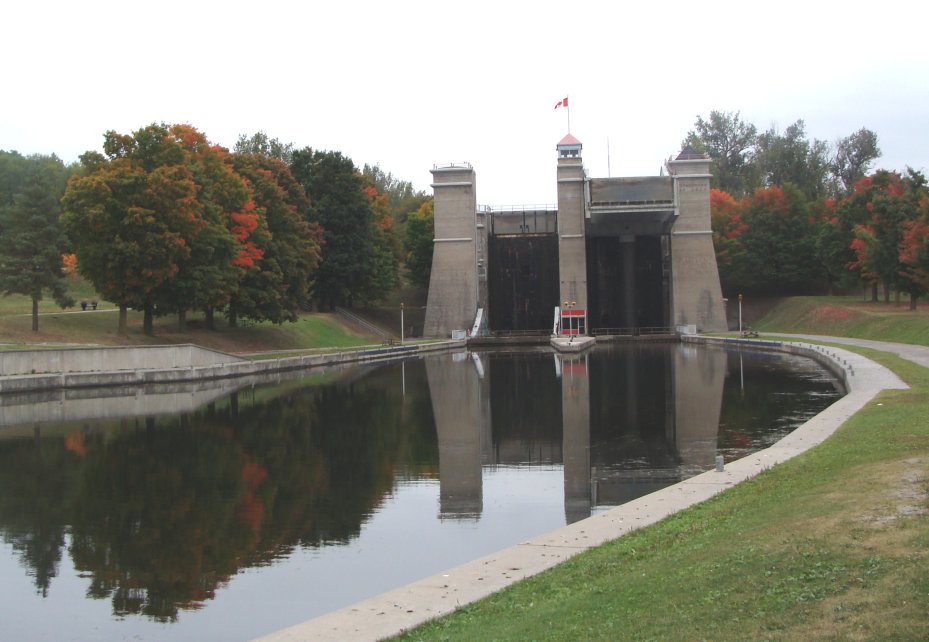
Peterborough’s fall colours seem a little in advance of Deseronto’s right now. This is a view of the lift lock on the Trent-Severn Waterway in the city:

Lift Locks on the Trent-Severn Waterway

Lift Locks on the Trent-Severn Waterway

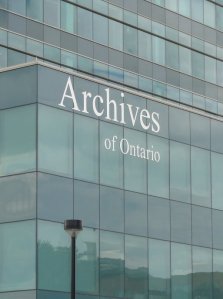
New Archives of Ontario building

New Archives of Ontario building

The Archives Association of Ontario held its annual conference at York University yesterday. The location was chosen to mark the opening of the new Archives of Ontario building, which is centrally placed on the Keele campus of the university.

Tours of the building were arranged on Thursday evening and it really is a wonderful facility. Unfortunately, we were not allowed to take photographs, so I can’t share with you the amazing reading room or the fantastic curved wall which divides the microfilm reading room from the main one. The wall is covered with a beautiful custom-made wallpaper, made up of reproduction photographs in a themed timeline. There isn’t a picture of this on the AO website either, so you will have to take my word for it that it looks amazing (or go and see it for yourself!).

Miriam McTiernan (Archivist of Ontario) and other members of the Archives of Ontario’s staff gave a presentation on the move to the new building in the first session of the conference. The scale of the move was impressive: 55,000 microfilm reels were moved, for example, and over 50,000 containers of varying shapes and sizes.  The Archives employed a film-maker to record the whole move, so we got to see the resulting video, which was only eight minutes long, but which really captured the excitement and effort involved in the move. There doesn’t seem to be a lot about the new building on the AO’s website yet, but I hope they will make the video available there. [UPDATE, July 18: there is a trailer on YouTube for a five-part mini series about the move – which includes a few shots of the curved wall.]

One thing I found really interesting was the plan to make it possible to consult the AO’s microfilm from a distance. This will mean (if I’ve understood this correctly) that researchers won’t have to order microfilms on inter-library loan or turn up to look at them at York, but will be able to access them over the Internet.  As the AO is still very dependent on microfilm for a lot of its indexes, this seems like a wonderful idea. It isn’t available yet, but I look forward to hearing more about this – for a huge province like Ontario, immediate remote access to the most popular holdings is really essential.

Deseronto Archives was one of six archives to be granted funding from the Friends of the Archives of Ontario in 2007. We asked for the money to pay for much-needed archival packaging and supplies for the Archives. This photograph shows some of the materials that we purchased with the money. One priority for this year is dealing with the photographs that we hold, and re-packing them in archival quality polyester sleeves is part of that plan. This work is now well under way, thanks to this generous support from the FAO.

« Previous Page