1910s


Another family mystery this week, this time from across the Atlantic with a story which starts in the small Lincolnshire town of Brigg in England. The person we’re interested in is a man called Preston North, a tailor who was born there in 1859 to Frank and Jane North.

At the time of 1901 census of England, Preston North was living in three rooms in a house in Paradise Place, Brigg, with his wife, Martha (née Little) and their eight children: Caroline, Alice, Lucy, Frank, Preston, Charles, Percy and Robert. A 41-year-old tailor of the same name (and who was born in Brigg, Lincolnshire) is also listed as living in a boarding house in Pontefract, Yorkshire. The Pontefract Preston North is listed as single, rather than married. Interesting…

1901 census North family

1901 census entry for the North family (UK National Archives: RG13/3102 f.42 p.35)

By the time of the next census, in 1911, Martha is listed, still living in three rooms in Paradise Place with her six sons (Harry is the youngest, born after the 1901 census), but Preston is not at home that night and is not to be found anywhere else in England through the census records, although the fact that Martha lists herself as married rather than widowed suggests that Preston is still alive somewhere.

We don’t have access yet to the 1921 census records, so will have to wait a few years to see what they might tell us. What we do know is that Martha died in Brigg in 1924 and by 1933 Preston North was living in Deseronto. In that year he sent a postcard to his grand-daughter in England which showed the Bank of Montreal in the town (the building which is now the Town Hall).

On the postcard, Preston North noted that the bank had closed down due to lack of business (this happened in 1932 as a result of the Depression).

His great-grand-daughter also owns a letter which was written in Deseronto by North in 1939 (when he would have been eighty years old).

Letter from Preston North, 1939

Letter from Preston North, 1939

He wrote:

Deseronto
Sept 14th 1939

Dear Alice and all at home,

The war has started

I was glad to get your letter on sept 12th and I did not get any other letters you sent before Christmas. It is a fight to the finish Canada has gone to a finish no fooling this time.

Returning men are going up by the thousands and no turning back. They have got into Warsaw and the women are fighting like tigers.

I am very well but I don’t work much only at my own clothes. 3 years war if not more. Hoping to hear from you at any time. Give my best wishes to all.

From your father Preston North

Deseronto Canada xxxx Bye bye

The story in the North family in England is that Preston started another family here in Canada and never returned to England. They don’t know where or when he died, or when precisely he came to Canada.

On September 12, 1944 an old man called John North was buried in the Deseronto cemetery. Could this have been the man formerly known as Preston? (The name of the North’s second son was Preston John North, so it’s possible that his father shared his middle name as well as his first name. Or just borrowed it!)

UPDATE, January 23, 2013

Some new information about John Preston North has emerged. On June 19th, 1915 he married Chloe Anne Lalond in Kingston, Ontario. He claimed to be 42 years old (he was actually 52) and a bachelor who had been living in Kingston since 1910. This would explain his absence from the 1911 UK census. There was a family story that this man was a bigamist, and this evidence seems to confirm that this was the case. In 1916 John Preston North was living in Napanee when he signed up to join the Canadian Expeditionary Force. By this stage his real age was 57, but he claimed to have been born in 1872 and to be 44. So not only was North apparently a bigamist, but he also seems to have been a habitual liar!

The arrival of the Royal Flying Corps in Deseronto in 1917 provided a new angle of perspective on the town: for the first time, photographs began to be taken from the air. Aerial photographs became increasingly important to the campaign on the Western Front in Europe as the First World War progressed and learning how to take good photographs from the air would have been a vital skill for the trainee pilots based in Camp Mohawk and Camp Rathbun.*

The  album of World War One photographs mentioned in our previous post includes this shot of the town from a pilot-training aircraft over the Bay of Quinte, looking north over Deseronto.

At the top left of the photograph is Rathbun Park and the Town Hall (at that time it was the Bank of Montreal), with Centre Street and the Post Office also visible. Between the waterfront and Main Street several railway cars can be seen, running along tracks where Water Street is today. The buildings next to the lake shore are the Rathbun Company’s cedar mill (on the right), which manufactured cedar railway ties, fence posts and shingles and the car works (on the left). The smoke from the cedar mill’s chimney shows that this was still in operation when the photograph was taken, although generally the Rathbun Company’s industries were winding down at this time, with many of their buildings being taken over for use by the Royal Flying Corps as administrative headquarters and repair shops for aircraft engines.

The picture below, from the same album, shows the interior of a typical engine workshop. Women as well as men were employed in mechanical work in these establishments (and, unusually for the time, at the same rates of pay). The person to the left of centre of this shot is a woman.

In the winter months, the Canadian training camps were relocated to a US Army base at Fort Worth, Texas. Several of the photographs in the album show scenes from the Texas camps, including this photograph of a First World War tank:

We end this post with another aerial view from the album. This one is labelled ‘Fort Worth, Texas’:

*For a timeline demonstrating the increasing significance of aerial photography on the Western Front in the First World War, see this useful blog post by Tim Slater.

A recent transfer to the Archives from the Oshawa Community Museum and Archives includes a series of photographs of a collapsed bridge, without any information as to the location of it. I’m sharing it here to see if anyone can help us pinpoint it. The other photographs in the album mainly show scenes from Royal Flying Corps training camps in Ontario (Camps Borden and Mohawk) and Texas (Camp Taliaferro, Fort Worth) and were taken during the First World War in 1917 and 1918. The bridge could be somewhere near one of these camps, or perhaps somewhere else entirely!

This photograph shows an overview of the bridge site. There are no buildings on the side of the bridge nearest the camera, but there are several houses on the other side of the river:

Site of mystery bridge

This one shows a Coast to Coast bus in the water at the side of the bridge:

‘Coast to Coast’ bus next to the bridge

And this one is a close-up view of the bridge itself:

Collapsed bridge

Collapsed bridge

Please leave a comment if you can help.

The air cadets stationed in the Deseronto area during the First World War had to work hard to train as pilots but they also found time to enjoy themselves, too.  On this day in 1918, the Deseronto Wing held a Sports Day. We believe this photograph was taken at that event:

Men racing on barrels shaped like horses in the water by the wharf in Deseronto

‘Horse’ racing on the waterfront, August 1, 1918

The Archives here in Deseronto has a rather patchy selection of local newspapers for the twentieth century. There’s a good run of The Quinte Scanner from 1968 to 1982 but apart from that we really only have lucky survivals of The Deseronto Post and a few editions of the Daily Intelligencer, Belleville’s newspaper. Finding out what newspaper we have for a particular year or decade involved consulting two different lists, the contents of which are not easy to absorb.

We’ve now combined the information from those lists into a single online resource. It’s a Google Calendar into which each newspaper edition has been entered as an event. If you have a Google account, you can view the newspaper calendar, which we’ve made public. From the calendar page, click on the small Add to Google Calendar symbol at the bottom right. This will add the newspaper calendar to your Google calendar page.

In order to see what we have for a particular year, you need to install the ‘Year View’ feature for your calendar (in Google Calendar, go to the ‘Settings’ page, then ‘Labs’ to do this). Once you have the Year View, you can use it to get to a particular year, then click on any month to see if we hold any local papers for that particular time period. The picture below is of the month of October 1925, where we have two issues of the Deseronto Post and three of the Daily Intelligencer. Click on the image for a closer look.

Newspapers for October 1925

This is just an experiment, really, but it’s already proving useful in making it much quicker to answer questions about whether we have any newspapers for a particular date.


Dating old photographs is not always an easy process but, just occasionally, archivists get lucky. This is one of those times. We’re working on arranging and describing the Hall Family materials at the moment and this photograph shows Flossie Hall, who was born in Deseronto in 1887. At the time the photo was taken, she was working as a schoolteacher. She has helpfully written the name of the school on the blackboard behind her: School Section No. 10, Mariposa, Victoria County. Not only that, but Flossie thoughtfully wrote the date that the photograph was taken, too: Mar. 28, 1912, which was, like today, a Wednesday (you’ll see from a comment elsewhere on the board that Ray needed to work on his spelling!).

If you look above the heads of the children, you’ll see the school clock, frozen in time at 2.50pm. So for once, we know the exact moment when this photograph was taken. A rare occurrence!

“High Diving”: aircraft crashed in the Bay of Quinte

A report from the Napanee Express of November 15th, 1918, four days after the signing of the Armistice.

One result of the signing of the armistice will be the immediate close of the two aviation camps at Deseronto, Camp Mohawk and Camp Rathbun. The commanding officers received instructions Monday morning from Ottawa to make arrangements for the demobilization of the force and the safe storage of machines and equipment. The engines are being taken out of the planes, coated with vaseline and being stored away. This work it is expected will be finished in about two weeks, and then the camp will be abandoned except by caretakers.

It was decided some months ago to make use of the camps at Deseronto all winter, and not send the men south for training the same as had been done last year. It as the intention to install elaborate heating and sanitation systems so that the men would be comfortable during the cold weather. About a month ago, however, the authorities at Ottawa, apparently ordered the discontinuation of the work.

The aviation camps have been popular resorts for sight seers the past two years, and the planes have been a frequent spectacle manoeuvering over our town. The men also have been welcome visitors to the town on many occasions. They were of a superior class, always well conducted and gentlemanly. Their departure will mean a social and sentimental, as well as a real business loss to the merchants of Deseronto.

Bob Almey, 1918, 2011.18 (9)

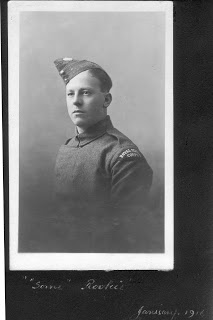
J. Robert (Bob) Almey (1895-1989) was one of the last group of pilots to be trained at Camp Mohawk, one of the two Royal Flying Corps establishments near Deseronto in the First World War. The photo here shows Bob in his Royal Flying Corps uniform. It was brought into the Archives for scanning a few weeks ago by Bob’s grandson, Rob Woodward.

The war ended before Bob Almey was posted to Europe, which was fortunate for him, given the short life expectancy of pilots on the front line in those days. Bob returned to his studies at the Ontario Agricultural College (now the University of Guelph) and completed his degree in horticulture. In 1921 he was appointed as Manitoba’s first ever provincial horticulturalist.

He went on in 1928 to work for the Canadian Pacific Railway as their Chief Horticulturalist. In this role, Bob was responsible for landscaping the surroundings of 2,000 railway stations across the West of Canada, giving new immigrants and visitors a favourable first impression of the region. By the 1940s, 11,000 packets of seeds were being distributed to stations each year, while CPR greenhouses across the Prairies and British Columbia grew 600,000 plants a year, of up to 125 varieties.

Gladiolus mortonius from Sericea on Flickr

Bob Almey knew each station so well that he could “recite from memory their layouts, the variety of flowers they grew and the amounts needed”. He retired in 1960 but continued to be active in the Manitoba horticultural community (being particularly famous for his gladioli) until his death in 1988.

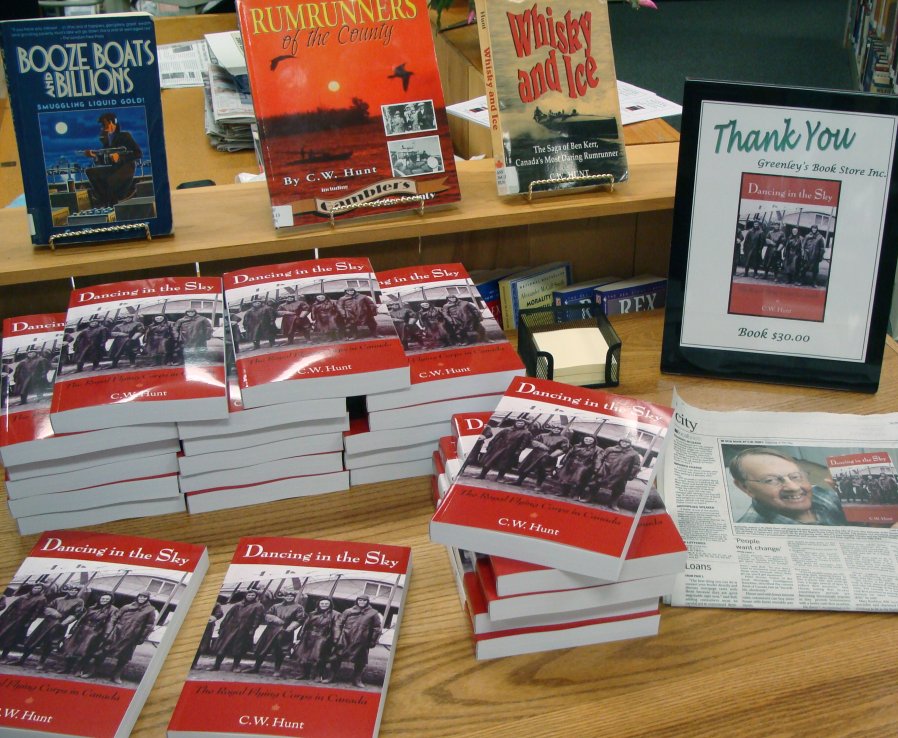
The book launch today was a resounding success. Every single one of the copies of Dancing in the Sky brought to the library by Greenley’s Bookstore was sold, with a long waiting list for the next delivery.

Piles of books before they were all sold
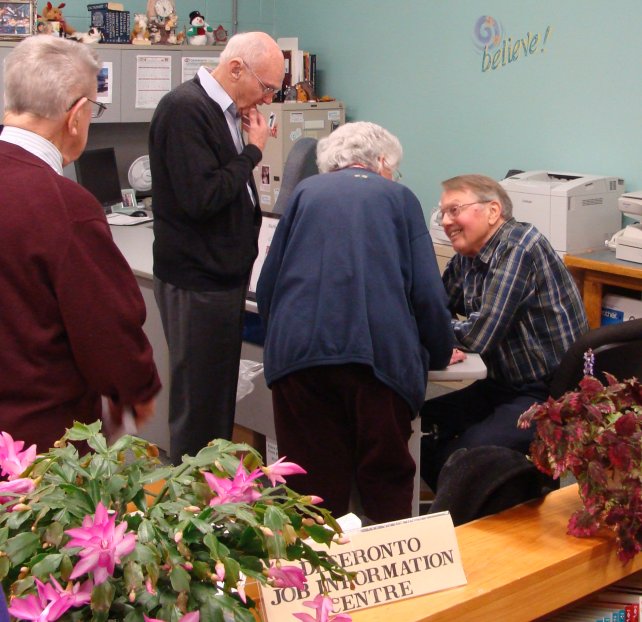
Bill Hunt must have a very sore right hand tonight after signing over forty copies of his book. There was quite a long line of people waiting for him to autograph their copies at one point.


We estimate that 135 people came to hear Bill talk about the training of pilots in Canada during the First World War. His talk was full of interesting facts and contained a number of insights into the great impact that the arrival of the air cadets had upon the economy and people of Deseronto.


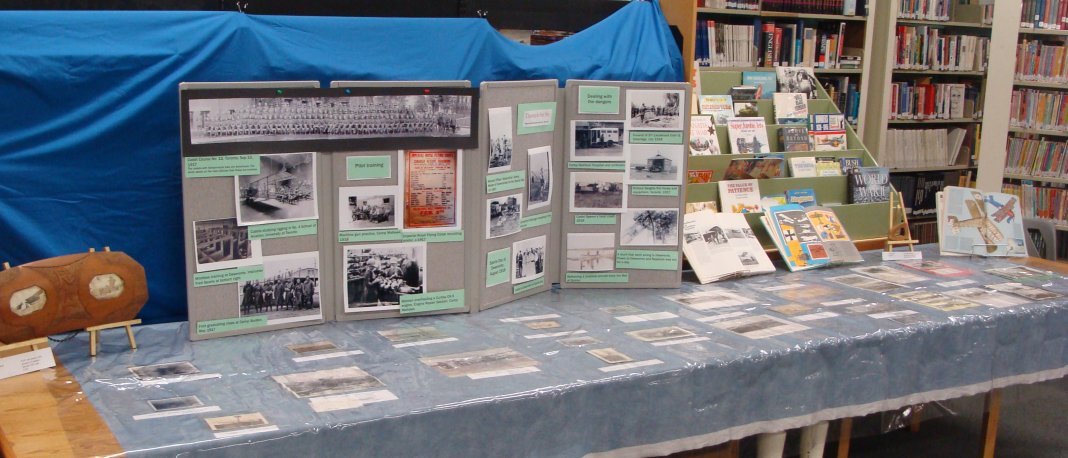
Bill was at pains to point out how important the archival record has been in helping him to research this volume: the diaries and photographs left by the young pilots have been a wonderful resource. Music to an archivist’s ears! We put together a display of photographs from the book, library books and original materials from the Deseronto Archives’ collections, as a side-show to the main event:


It was a wonderful afternoon and a tribute to the huge amount of work that went into the preparation, particularly by Deseronto’s Librarian, Frances Smith, by Dana Valentyne of the Deseronto Revitalization Program, and by the Chair of the Deseronto Public Library Board, Don Simpson. Many thanks to them, to Deseronto’s Mayor, Norm Clark, for a great welcoming address, and to the sponsors of the raffle prize: Greenleys Bookstore, The Chocolate Room and the Small Town Café and Bakery. Thanks also to Lori Brooks of the Deseronto Job Information Centre (whose domain was requisitioned for the book-signing) and to everyone who came – you helped to make this event a huge success.

The Archives’ collections on the World War I flying camps have been hugely boosted recently by the acquisition of a series of photographs which belonged to a flight instructor in Camp Mohawk. Sergeant Christopher Paulus Devos (pictured here as a cadet in 1916) was an Englishman who was in No. 84 Canadian Training Squadron throughout its period of operation, in Camp Mohawk and in Camp Taliaferro in Fort Worth, Texas. He was one of only two English airmen of the original squadron to survive and return to England after the war. He compiled two photograph albums recording life in the camps.

Sergeant Devos’s son, Denzil Devos, has kindly scanned in the pages of the Camp Mohawk album and donated them to the Archives. He has also copied some of the Fort Worth album, including photographs of Captain Vernon Castle and some aerial shots of Toronto. We have been able to share all these images through our Flickr account. There are many images of crashed aircraft in the group, but a few show the lighter side of Royal Flying Corps life, such as this group shot of airmen “poshed up” for a night out in Belleville on a bus from the Hotel Quinte:

« Previous PageNext Page »