1910s


Jack Martin's signature

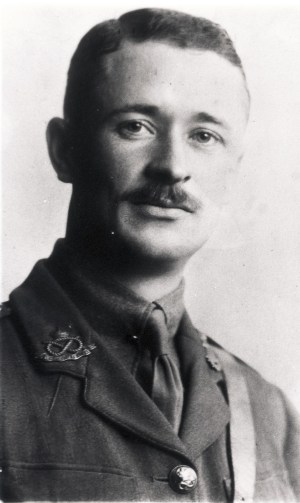
On this day in 1914 Jack Martin joined up in Valcartier, Quebec. He was born on June 11, 1893 in Deseronto, the son of William Martin and Harriet (née Salter). He attended Deseronto High School but by 1911 was living with his mother and brother in New Westminster, British Columbia.

On his attestation paper Jack was described as being five feet and nine inches tall, with a dark complexion, brown eyes and brown hair. Martin  joined the 7th Battalion (British Columbia Regiment), No. 4 Company, with the regimental number 17142.

Jack was killed in 1915.

It was a full house at Deseronto Public Library this afternoon, as author Frances Itani launched her new novel, Tell, to an appreciative audience of more than fifty people.

Frances Itani talking to a full house at Deseronto Public Library

Tell is a follow-on story to Deafening, the author’s first novel, which was published in 2003. Like Deafening, Tell is based in Deseronto, and it follows the story of four of the characters from the first book. It is set in the period immediately following the end of the First World War. Frances made excellent use of the archives here in Deseronto in her research for the book and we were delighted to host her first stop on the promotional tour.

Frances Itani signing copies of 'Tell'

And we are pleased to report that every copy of Tell was snapped up by the audience!

Queen's WWI - MacTavish, Roswell Murray

Roswell Murray MacTavish – image courtesy of Queen’s University Archives

Roswell ‘Ross’ Murray MacTavish was born on September 22, 1888 in St. George, Ontario, the son of William MacTavish and Margaret (née McKay). His father was the Presbyterian minister of Deseronto between 1895 and 1905 and Ross attended both the Deseronto Public School and Deseronto High School.

He studied at Queen’s University, getting his Bachelor of Arts degree in 1907 and a Bachelor of Divinity degree in 1913. He had obtained a travelling scholarship and was in England at the outbreak of World War I. On this date in 1914 he enlisted as a trooper in the 2nd King Edward’s Horse regiment. He obtained a commission as a second lieutenant in the 2nd Battalion of the South Staffordshire Regiment on March 13th, 1915.

MacTavish was the first person with a Deseronto connection to join the armed forces in the First World War. He rose to the rank of Captain and was awarded the Military Cross on January 1, 1919.

MacTavish continued to serve in France after the war, working at the headquarters of the 6th Infantry Brigade. He died of influenza in the No. 3 Canadian Stationary Hospital at Arques on February 6, 1919 and was buried in the Longuenesse Souvenir Cemetery, Saint-Omer.

Ross MacTavish’s younger brother, Wilfrid, named his son (born in Saskatchewan in 1919) Roswell Murray. Roswell Murray MacTavish junior joined the Royal Canadian Air Force during the Second World War as a flying officer and was killed when his Hurricane aircraft crashed in Scotland on March 18th, 1944. He was buried in Ayr cemetery.

Tell by Frances ItaniThe Deseronto Public Library and Deseronto Archives are delighted to announce that they will be hosting the launch of Frances Itani’s new novel, Tell on Thursday, August 28th at 1pm in the Deseronto Public Library.

Tell follows on from the author’s first novel, Deafening, which was partly set in Deseronto. It picks up on four of the minor characters from Deafening and follows their stories in Deseronto after the First World War.

After a reading from the novel, books will be available for signing by the author. Refreshments will be served.

Armies of Europe at a glance

Armies of Europe at a glance from the The Sun, New York, August 2nd, 1914: Russia, Germany, Austria, France, Italy, England, Serbia

Today marks the 100th anniversary of the declaration of war by Great Britain on Germany in response to the German invasion of Belgium on that day. At 11pm Greenwich Mean Time that evening (6pm Eastern Standard Time), Britain and its Dominions (including Canada, Australia, New Zealand, India and South Africa) were officially at war. You can hear about people’s memories of their reactions to the declaration in this podcast from the Imperial War Museum.

During the next four years we will be marking the 100th anniversaries of local events in relation to the war on this blog. We plan to commemorate the enlistment and conscription of individual Deseronto and Tyendinaga Mohawk Territory men, women, and boys, their deaths in action and from disease, as well as events associated with the local Royal Flying Corps/Royal Air Force pilot training establishments at Camps Rathbun and Mohawk, which operated between 1917 and 1918.

Our aim is to use archival materials from Deseronto and from around the world to demonstrate the local effects of a global war.

If you have photographs, or letters, or family stories about the First World War in Deseronto and the surrounding area, we’d love to share them here as part of this project: you can email us at deseronto.archives@gmail.com.

The north-south streets at the eastern end of Deseronto are numbered, like those in many North American towns. We have First Street, Second Street, Fourth Street and Fifth Street, but Third Street is nowhere to be seen.

Numbered streets on map of Deseronto from Bing

Well, that’s actually not quite true: you can see it in the Archives.

Here is a detail of a plan of the town made in about 1895:

Third StreetYou can see Third Street in the middle of the map and there’s also a Sixth Street on the far left. As you can see, Third Street was never a very long road, stretching only from Main Street down to the flour mill on Water Street.

On this day in 1896 (the Victoria Day holiday), most of this side of town went up in flames, destroying docks and many buildings. Newspapers across North America reported on the fire. This clipping is from the May 27th 1896 edition of the Daily Public Ledger of Maysville, Kentucky:

Daily Public Ledger report on Deseronto fire of 25 May 1896

Fire destroyed two-thirds of the east end of the town of Deseronto, Ont., and nearly a hundred families are homeless. The Rathbun Co.’s big flour mill, storehouse and elevator, the shingle and lumber docks, the Roman Catholic church and about one hundred dwelling houses were burned. Most of the houses were occupied by workmen. The total loss will exceed $300,000.

The original Roman Catholic Church of St. Vincent de Paul stood on the north side of Dundas Street in this part of Deseronto. The church had been built in 1883 at a cost of over $4,000. Herbert A. Osborne took this photograph of it in around 1895:

St. Vincent de Paul church, c.1895

When the church was rebuilt, it was located further west; still on the north side of Dundas Street but away from the more industrial areas of the town. It was completed in November 1896.

Unlike the church, it appears that Third Street was never rebuilt after the fire. By the time the map below was made for the Canadian Northern Ontario Railway in 1912, the road  had vanished.

Detail of 1912 map of the Canadian Northern Ontario Railway

A neat example of history affecting geography!

August 4th 2014 will mark the 100th anniversary of Canada’s entry into the First World War. Organizations and communities around the world are marking this occasion by examining the effect the war had on their local area. We’ll be doing this in Deseronto, too.

In the Archives we started by researching the 34 names of the First World War casualties named on the town’s war memorial. In the process we found out some interesting facts about the monument itself.


War memorial in Deseronto, April 2014

The memorial, which stands on the South side of Main Street, opposite Rathbun Park, was unveiled in a ceremony on Labour Day (September 3rd) 1923. The event was attended by many of the townspeople, as the photograph below (one of several taken on the day) shows. A piece of land forty feet square was purchased by the Town of Deseronto from the Rathbun Company for the monument’s site, at a cost of $100.

Unveiling ceremony for the Deseronto war memorial

The memorial itself was donated to the town by a former Deseronto resident named Thomas Carson Brown. Thomas was born on 21 April 1870, the son of Thomas Brown and Emily Varty and one of 10 children. His mother died in childbirth in Lennox and Addington County (where the family had a farm) when Thomas was seven years old and by 1881 the family had moved to Mill Point (Deseronto). In the 1891 census, when he was 21, Thomas’s trade is given as bricklayer. His father died just six weeks after the census was taken.

It was through the bricklaying trade that Thomas C. Brown would go on to earn his fortune in New York State, where his firm constructed a number of public buildings, including the Plattsburgh Normal School, pictured here, and a large section of the Clinton Correctional Facility at Dannemora. Deseronto’s newspaper, The Tribune, reported Brown’s marriage in August 1899 to Hattie B. Humphrey, noting that “the groom is well and favourably known in Deseronto, where he passed his boyhood days. He is now engaged in the contracting business in Little Falls. He is a brother of Mrs. Jas. Sexsmith.” Thomas’s sister, Jane Brown, married James Sexsmith in Deseronto in January 1884. She died of pneumonia in 1910.

Plattsburgh Normal School

Brown went on to serve as a Senator in the New York Senate between 1925 and 1930, where he took a keen interest in prison reform issues. He clearly never forgot his home town of Deseronto, as the generous gift of a war memorial demonstrates. It is not just a war memorial, however, as Thomas C. Brown ensured that his parents and five of his sisters (Jane, Ida, Etta, Emma and Annie) were also commemorated on the structure, as you can see in this detail.

Detail of war memorial

Thomas himself died on May 24th, 1952 at his home at 1174 Lowell Road, Schenectady, New York: you can read his obituary in the Schenectady Gazette (PDF made available through the Fulton History site).

Over the next four years we will be marking the 100th anniversaries of local people’s involvement in the First World War here on the blog. There are a lot of stories to be told and we are always keen to hear new ones, so if you have any local World War One information which you would like to share with the world, please let us know!

It’s surprising just how often people discover items of historical interest in the walls of their properties. Today’s accession arrived in the Archives as a result of renovation work going on in a house in Mill Street in Deseronto. Grateful thanks to Shelley Dupont for bringing them in!

Three items were found inside a wall of the house. The first is a photograph of an unidentified family. The picture has suffered some damage from being inside the wall for perhaps 100 years, but the image is still fairly clear. There is nothing on the back of the photograph to identify the group.

Unidentified family portrait

The second photograph has more information – these three children are identified as  Hazel Annie Cole, aged 3 years and 5 months; Murney Nelson Cole, aged 1 year, 9 months and Edna Kathleen Cole, aged 6 months. Hazel was born July 27 1910 in Milford, Prince Edward County – dating the picture to late 1913/early 1914. Their parents were Jesse Abbot Cole  and Alta Theresa Viale.

Cole children

The third item also has a Prince Edward County connection. It is a wooden rectangle, covered with black felt, and with a tin plaque, bearing the name of Eliza Dodge. This is a coffin plate. Eliza died in South Marysburgh on March 1st, 1890.
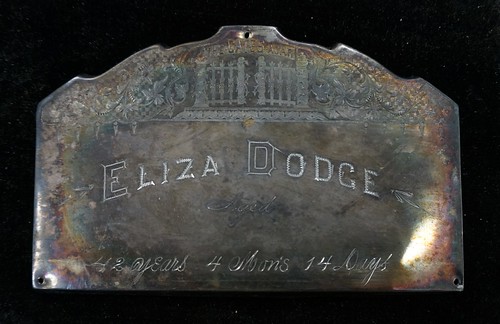
Memorial for Eliza Dodge

A little digging through the census and vital statistics records shows us that Eliza was married to Frederick Dodge and her maiden name was Thompson. In the census taken in 1891, the year after Eliza’s death, Frederick is working as a telephone and telegraph operator and living with his two daughters, Rosa Bell Dodge, aged seven, and Sarah Ann Cole, aged 19. Yes, Cole again. A bit more digging yields up information on a connection between Sarah Ann and the three children in the photograph: Sarah Ann, Eliza Dodge’s daughter (known as Annie),  married Claude Wilmot Aylsworth Cole on December 11th, 1890. Claude was the older brother of Jesse Abbot Cole, the father of the three children

Annie Cole is the link between the last two items: she’s Eliza’s daughter and aunt to the three Cole children. Perhaps the first photograph has a Cole family connection, too? Claude and Jesse came from a family of four sons and one daughter, which just happens to be the configuration of the family in the first photograph. We’re entering into the realms of wild supposition here, but it’s just possible that this photograph represents Simon Aylsworth Cole (1844-1922), his wife Sarah Letitia Boulter (1848-1922) and their five children: Claude (1870-1938), Edna (1873-1929), George (b.1876), Arthur (1877-1941) and Jesse (1879-1937). If so, it would have been taken in around 1885.

Or they could be other people entirely!

UPDATE (Feb 15th, 2014): Thanks to Claudia (Cole) Grendon for adding some more details to this story in the comments. She tells us that Annie Cole was her grandmother and that Annie moved to Mill Street in around 1939 with her son, Wilmot Havelock Cole and his family. She died in around 1946 and (additional information from Tammy Cole Peterson) was buried in Glenwood Cemetery in Picton, where her husband, Claude, had also been laid to rest.

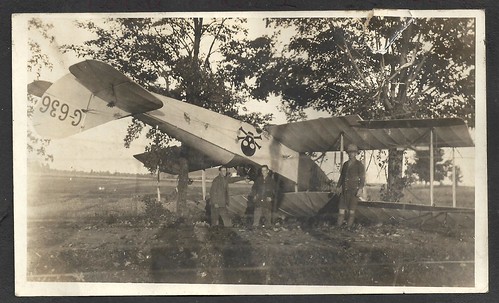
A month ago, we received a new accession of photographs  from Dave Stapley, whose family once owned a farm on the Boundary Road, at the eastern side of Deseronto. The farm was close to the World War One pilot training site, Camp Rathbun, and many of the 33 photos depict men, buildings, and aircraft of the camp.

As usual, there are pictures of crashes on the ground (look closely at the trees on this one in relation to the aircraft):

Crashed aircraft

Crashes into hangar buildings at the camp:

Aircraft crashed into hangar door

And into water (you can see the Foresters’ Island Orphanage in the background of this shot):

There are also several photographs of (mainly) unidentified individuals, including this lovely shot of a man crossing the finishing line of a race:

Man crossing finishing line

The skull-and-crossbones motif seen on the aircraft and on the tops of the runners here is a symbol used by the men of 90 C.T.S. (Canadian Training Squadron), which was based at Camp Rathbun. We know nothing about the creator of these photographs, but we can  surmise that he was a member of 90 C.T.S. who left his photographs behind him after he left the area.

Joseph Thompson's top hatA new accession takes us back almost one hundred years, to a time when the Rathbun family were still the most influential people in Deseronto. After the death of the Rathbun Company’s driving force, Edward Wilkes Rathbun, in 1903, his eldest son, Edward Walter Rathbun (1865-1940), took over as head of the company. He was also active in provincial and local politics: between 1905 and 1908 E. Walter represented Hastings East in Ontario’s Legislative Assembly.

In the 1901 census the Rathbun household comprised E. Walter, his wife Aileen and his mother-in-law Emma C. C. Blair. Rathbun had married Aileen in Portsmouth, England, in 1893. The family had three servants living with them: a maid, a cook and a coachman. In 1901 the coachman’s name was William Wood, but in later years this position was held by Joseph Thompson. The top hat we’ve just received belonged to Joseph, who was the Rathbuns’ coachman at the beginning of the First World War.

By 1914 E. Walter Rathbun was the Mayor of Deseronto, as his father had been before him. He was also active in the local militia, holding the rank of Lieutenant-Colonel. On February 1, 1915, he joined the Canadian Overseas Expeditionary Force, at the age of 49. He arrived in England in March 1915, when his brigade of the Canadian Field Artillery was transformed into the Canadian Reserve Artillery. Rathbun was transferred to the Canadian Forestry Corps when it was established in 19161: presumably as a consequence of his experience in running the Rathbun Company’s lumbering business in Deseronto. The Forestry Corps was established to harness Canadian expertise in the lumber industry to supply the Western Front with the wood it desperately needed. It operated in England, Scotland and France.

E. Walter Rathbun died in Deseronto on September 6, 1940. His wife, Aileen, was living in Scotland at the time with her brother, Arthur Blair, and Rathbun’s body was transported to Toronto for cremation and his ashes were then shipped overseas. There is a memorial to the couple in the cemetery at Nairn in Scotland. It reads:

In memory of Col Edward Walter Rathbun, Royal Canadian Artillery died 6th Sep 1940 and his wife Aileen Blair who died 1944.

Appropriately enough, the Darnaway Forest near Nairn was the site of one of the Canadian Forestry Corps’ lumber camps during World War One: Nairn therefore seems a fitting location for this Deseronto lumberman’s body to be resting.


1 For a history of the Corps in the First World War, see The Canadian Forestry Corps, by C.W. Bird and J.B. Davies, published in 1919.

« Previous PageNext Page »