1910s


A recent accession from Edward Wright (2014.18) has added considerably to the Archives’ stock of information relating to the match companies which used to exist in the town. Mr Wright is a collector of matchboxes (a phillumenist) and has done a lot of research into the matches made in Deseronto in the first half of the twentieth century.

The Rathbun Match Company was only in operation for a short time between 1915, when this advertisement appeared on the front of the Canadian Grocer, to 1916, when the Town Council minutes note that it ceased operations in June.

Canadian Grocer - Rathbun Match Company advertisement

Canadian Grocer, August 20th, 1915

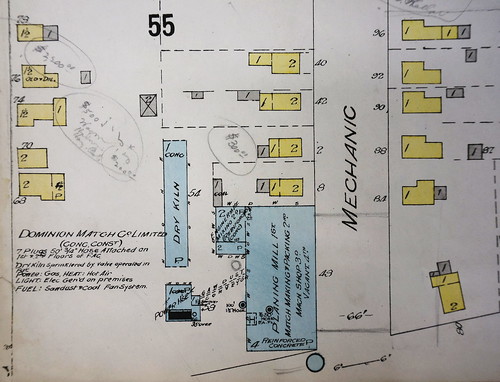
The Dominion Match Company seems to have taken over from the Rathbun concern, and it is clear from the Council minutes that the firm was offered tax exemptions for its site in Deseronto. The factory was on the northwest corner of Mechanic Street and Main Street, as shown in this extract from the town’s fire insurance map:

Detail of fire insurance plan showing the Dominion Match Company

By 1917 the Dominion Match Company was looking to expand. At a Council meeting on July 17th of that year the firm asked:

…the Council to provide for the closing of Quinte Street [the road immediately to the west of the factory] and the diverting and altering of Mechanic Street…and for both portions of said streets to be conveyed to the Dominion Match Company for use in their business and as the enlargement of their premises will necessitate the employing of a great many more hands than they have at present, it will enduce to the prosperity of the town. If the request is granted the company will waive its right to exemption from municipal taxes for the year 1917 to which they are entitled…

The Council approved the request, effectively wiping Quinte Street off the map of Deseronto, and giving Mechanic Street the shape it has today.

The postcard below shows the factory at the height of its operations.

Postcard of the Dominion Match Company, from the collection of R.N. Goodfellow

Mr Wright has a collection of boxes which were manufactured at the Dominion Match Company, including this one of the Dominion Silent Match:

Dominion Silent Match box

A third firm called the Beacon Match Company began operations in Deseronto in September 1919, but it is not clear where this factory was located. It may have used one of the vacated Rathbun Company sites.

A report in the Deseronto Post from March 17th, 1948 notes that the Chamber of Commerce was seeking a new owner for the Dominion Match building, which had “been vacant for many years”. It was in good condition, as it had been used by the Department of Defence during the Second World War.

1948 Mar 17 Match factory future

Today, the Deseronto Community Recreation Centre occupies the site of the Dominion Match Company’s factory and Mechanic Street still has a kink in it: the only visible evidence of Deseronto’s match-manufacturing history and the only curving road in the whole town.

Mechanic Street in 2014

Thomas Mungo's signature

On this day in 1914 Thomas Mungo enlisted in Valcartier, Quebec. He was born in Montreal, Quebec, in 1877 according to his attestation paper. He and his wife, Caroline (maiden name Calhoun), were living in Tyendinaga at the time of the 1911 census, with their three children. When he signed up, the family were in Hamilton.

Mungo worked as a teamster before the war and was a Mohawk. He joined the 16th Battalion of the Canadian Expeditionary Force with the regimental number 28537. On his attestation paper he is described as being five feet seven inches tall, with a dark complexion, brown eyes and black hair. His service record shows that he sailed for England on the RMS Andania in early October 1914 and arrived in France on February 13th, 1915.

Tom received leg injuries on April 16th, 1915 and rejoined the 16th Battalion on April 28th.

He would not make it home.

Ernest Mesley's signature

On this day in 1914 Ernest Mesley joined up in Valcartier, Quebec. He was born in Deseronto on January 30th, 1892 to William Henry Mesley and Emmeline (née Jones). He gave his profession as ‘armature winder’.

Mesley was five feet nine inches tall, with grey eyes and dark brown hair. He joined the 1st Battalion of the Canadian Expeditionary Force with the regimental number 7663. His service file shows that he left Canada on the SS Cassandra on October 4th, 1914. He joined the 2nd Battalion in France. At Ypres on April 23rd, 1915 he received a bullet to the right thigh and spent several weeks in hospital in England. He did not recover the full use of his leg and a medical board held in August 1915 recommended that he be invalided home to Canada. He left England in September on the SS Missanabie and was discharged as medically unfit in Kingston on February 9th, 1916.

Ernest married Jessie Hannah Stevens in Peterborough, Ontario, on December 26th, 1921. He died on March 28th, 1979.

Harold Charles Marsden's signature

Harold Charles Marsden joined up on this day in 1914. He was born on November 16th, 1897 (he gave 1896 on his attestation paper) in Deseronto, the son of Charles Marsden and Carrie (née Hagadorn). Marsden’s occupation when he enlisted in Valcartier was jeweller.

He was five feet six and a half inches tall, with blue eyes and dark hair. He joined the First Brigade of the Canadian Field Artillery with the regimental number 40458. His service record shows that his unit sailed on October 3rd, 1914. He was promoted to corporal in March 1915 and served in France from May 1915 with the Canadian Field Artillery. He was hospitalized from January to July 1916 with an infection, and was reduced to the ranks for drunkenness in September of the same year. In July 1917 he was in hospital again, suffering from impetigo. In August he was admitted to hospital with a cyst on his jaw. He spent the rest of the war in England and attained the rank of sergeant in May 1919.

Harold left Liverpool on the SS Belgic in August 1919 and was demobilized in Halifax on August 23rd. He moved to California with his mother, his sister Jane and his brother-in-law, George Mark. Between 1920 and 1930 he married Mary Rose Alumbaugh. The couple had two children.

George Fraser Kerr's signature

George Fraser Kerr was born in Deseronto on June 8th, 1895, the son of John James Kerr and Isabella (née Fraser). John J. Kerr was a dry goods merchant in Deseronto. The family rented a large house on the southwest corner of Thomas and Mill Streets, photographed by Herbert A. Osborne in around 1895. The house no longer stands. In the 1891 census the Kerrs had a live-in domestic servant, 20 year-old Clara Green.
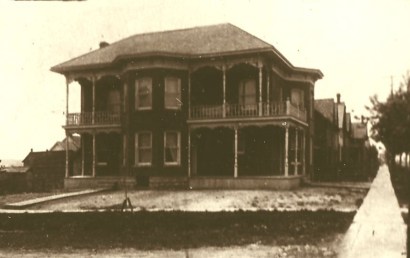
J.J. Kerr residence, Deseronto

J. J. Kerr residence, Deseronto

By 1901 the family had moved to Napanee and in 1911 they were living in Galt. When Kerr enlisted on this day in 1914, they were living at 135 Tyndall Avenue in Toronto and George was working as a chemist. He joined the 3rd Battalion of the Canadian Expeditionary Force in Valcartier, with the regimental number 9570.

Kerr’s service record shows that he arrived in England on October 25th, 1914. On February 11th, 1915, he went to France with the 3rd Battalion. He was promoted to Lance Corporal on June 2nd and to Acting Corporal on September 18th of that year. On February 2nd, 1916 he was appointed Corporal and Lance Sergeant, but this promotion was shortlived: he was reduced to the ranks on April 7th at a Field General Court Martial:
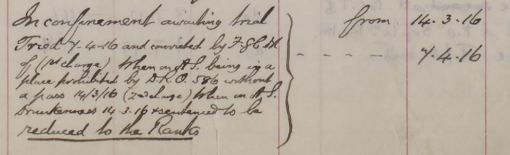
George Fraser Kerr reduced to ranks

From 14.3.16 to 7.4.16: In confinement awaiting trial. Tried 7.4.16 and convicted by F.G.C.M. of (1st charge) When on A[ctive] S[ervice] being in a place prohibited by D.R.O. [Divisional Routine Order] 586 without a pass 14/3/16 (2nd charge) When on A.S. Drunkenness 14.3.16 & sentenced to be reduced to the Ranks

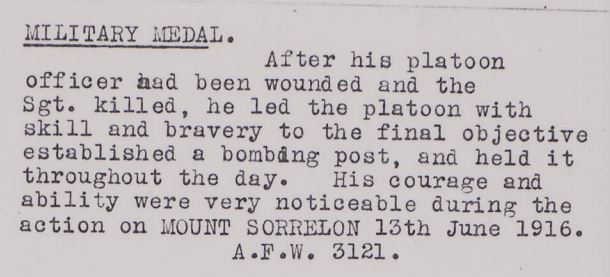
On June 13th, 1916 Kerr was involved in the Battle of Mont Sorrel. He was awarded the Military Medal for his actions:
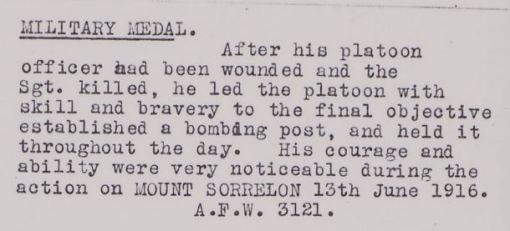
George Fraser Kerr Military Medal citation

MILITARY MEDAL
After his platoon officer had been wounded and the Sgt. killed, he led the platoon with skill and bravery to the final objective established a bombing post, and held it throughout the day. His courage and ability were very noticeable during the action on MOUNT SORRELON 13th June 1916. A.F.W. 3121

After this event, Kerr was appointed Acting Sergeant on June 18th, 1916. Kerr was one of four 3rd Battalion men wounded on July 28th in the trenches near Ypres. He received shrapnel injuries to his right wrist and left thigh and ankle and was sent back to England to recover. He remained in hospital until December 12th, when he was discharged to the 12th Reserve Battalion at Hastings, Sussex.

He received a commission as a lieutenant in the 12th Reserve Battalion on August 1st, 1917 and went back to France on October 15th, 1917. He rejoined the 3rd Battalion a month later. In February and March 1918 he was treated in hospital in France for scabies, rejoining his unit on April 2nd. Kerr was one of six officers wounded at the Battle of Amiens on August 8th, 1918. It may have been this action for which he was awarded the Military Cross (the citation is vague about the date of the engagement). This is how his actions were described in the citation, published in the Edinburgh Gazette on December 4th, 1918:

For conspicuous gallantry and devotion to duty. When leading his platoon to the jumping-off line he found a gap, which he filled, putting an enemy machine-gun nest out of action, killing about thirty and capturing a battery of 77 m.m. guns. At the jumping-off line he found one company had not arrived, so he led his platoon into its place, with the advancing waves. He was then wounded, but continued to the final objective, clearing out another machine gun nest of two guns on the way. The next two days he continued in the line doing splendid work, and refusing to leave owing to shortage of officers.

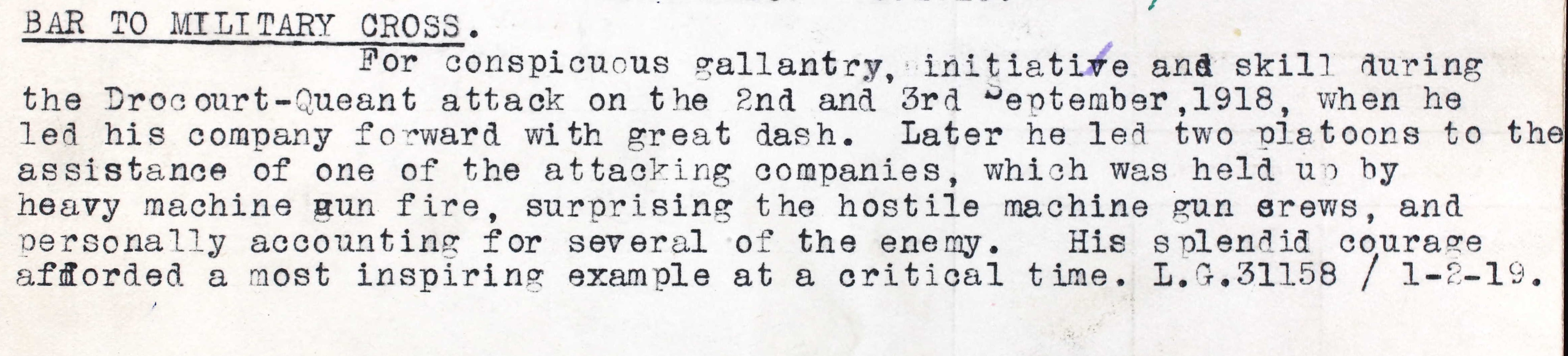
Kerr was back in action on September 2nd, this time at the Drocourt-Quéant Line. He received a bar to his Military Cross for this attack:
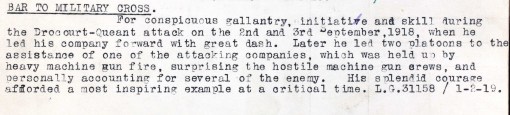
George Fraser Kerr MC-bar citation

BAR TO MILITARY CROSS
For conspicuous gallantry, initiative and skill during the Drocourt-Queant attack on the 2nd and 3rd September, 1918, when he led his company forward with great dash. Later he led two platoons to the assistance of one of the attacking companies, which was held up by heavy machine gun fire, surprising the hostile machine gun crews, and personally accounting for several of the enemy. His splendid courage afforded a most inspiring example at a critical time. L.G.31158 / 1-2-19

Kerr was appointed Temporary Captain on September 15th, 1918. Twelve days later, he was involved in the action which resulted in him being awarded the Victoria Cross:
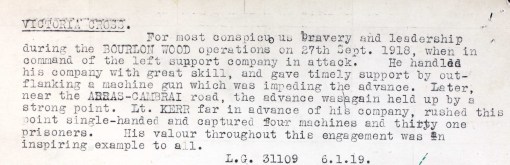
George Fraser Kerr VC citation

VICTORIA CROSS
For most conspicuous bravery and leadership during the BOURLON WOOD operations on 27th Sept. 1918, when in command of the left support company in attack. He handled his company with great skill, and gave timely support by out-flanking a machine gun which was impeding the advance. Later, near the ARRAS-CAMBRAI road, the advance was again held up by a strong point. Lt. KERR far in advance of his company, rushed this point single-handed and captured four machines and thirty one prisoners. His valour throughout this engagement was an inspiring example to all. L.G. 31109 6.1.19

Kerr’s medals are held at the Canadian Museum of History.
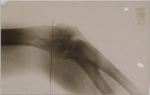
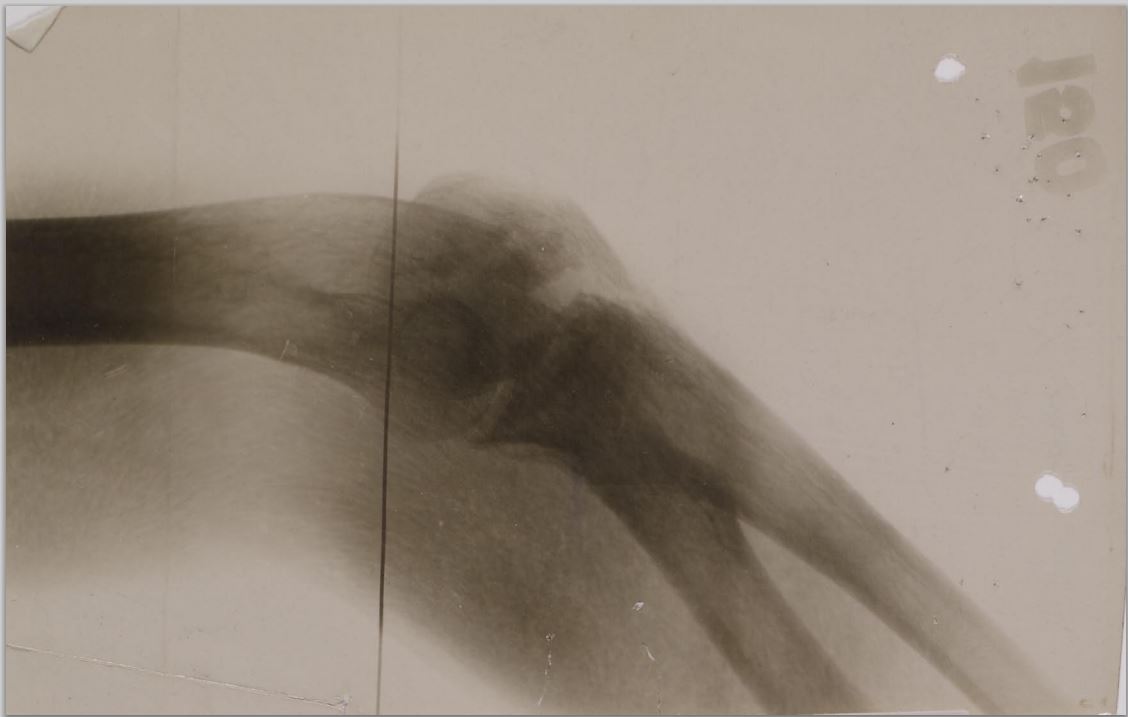
Xray image of Kerr's right arm

Xray of Kerr’s right arm from his service record

George Fraser Kerr ended the war with the rank of Captain. On January 3rd, 1919 the horse he was riding in Lind, Germany shied into a tree, causing George to fracture his right arm. He was treated in hospital in England and then sent home to Canada on May 23rd on the SS Megantic. The fingers of his right hand had already been damaged by the shrapnel wound he received in 1916 and now his right elbow had a limited range of movement. He was discharged from the army as medically unfit for further service as a result of his injuries on July 16th, 1919 in Toronto.

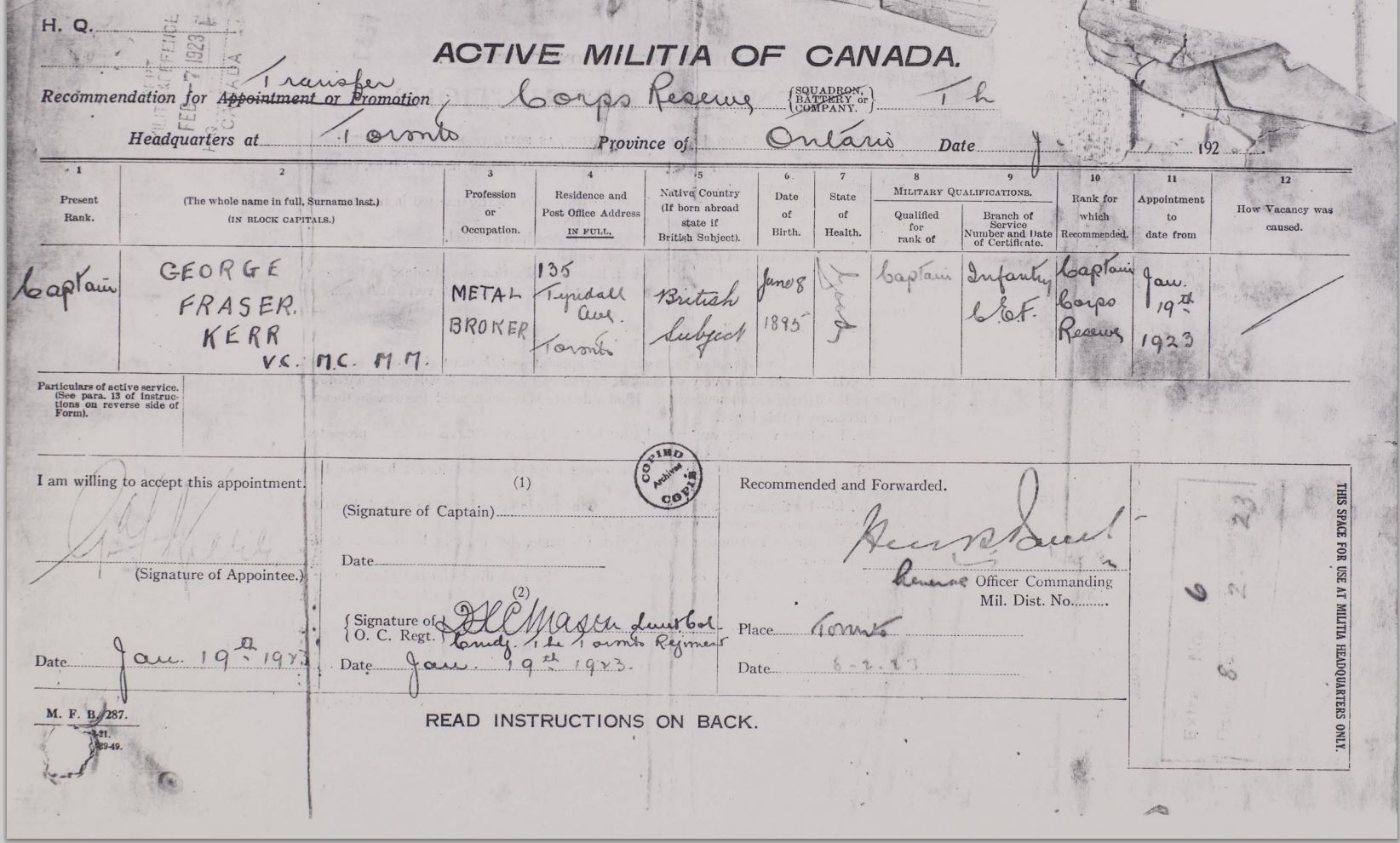
In 1923 George was appointed as a Captain in the Militia. He was working as a metal broker at the time.
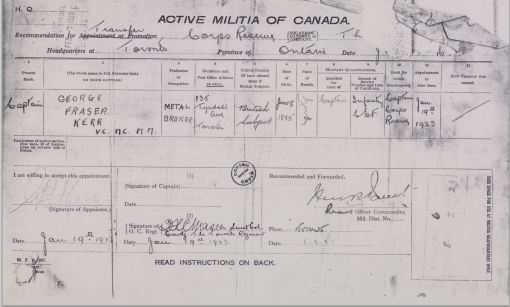
George Fraser Kerr militia appointment

Kerr married Mary Beeman on March 16th, 1924 in Toronto and the couple had two daughters. George died of carbon monoxide poisoning on December 8th, 1929 and was buried in Mount Pleasant Cemetery, Toronto.

On this day in 1914, machinist David Austin Powles enlisted in Valcartier, Quebec. He was born in Tyendinaga in 1890, the son of William Powles, a Mohawk, and Jemima (née Pierce), an Englishwoman who died in 1897.

His service record shows that he left Canada on the SS Cassandra on October 4th, 1914. He was reported wounded on April 25th, 1915 (a gunshot wound to the thigh) and spent time in hospital in England. He was sent home to Canada in September 1915 and was discharged in Quebec on September 22nd. The reason given for his discharge was a ‘cable from Ottawa.’ The cable is not included in his service file.

On April 25th, 1935, Powles married Edna Alice Madill (née Rinneard), a widow, in Oshawa. He died on December 14th, 1957 and is buried in Mount Hope Catholic Cemetery, Toronto. Edna died in 1984.

Cuthbert Beaubien's signature

On this day in 1914, Cuthbert Beaubien, an electrician, enlisted at Valcartier, Quebec. He was born on Amherst Island on August 16th, 1891, the son of William Beaubien and Jane McCormick. By 1911 the family were living in Deseronto and Bert is named in a list of Deseronto High School students who fought in the war.

On his attestation paper, Bert is described as being five feet eight and a half inches tall, with a dark complexion, grey eyes and black hair. He joined the Canadian Field Artillery with a regimental number of 40597. His service record shows that his unit sailed from Halifax on October 3rd, 1914. Beaubien served in France with the 1st Brigade, Canadian Field Artillery; he was promoted bombardier on July 16th, 1915 and corporal on June 9th, 1916. He admitted to hospital in England suffering from haemorrhoids in October 1916 and had an operation on them in January. By late February he had recovered.

Beaubien arrived back in Halifax on January 29th, 1919 on the RMS Empress of Britain and was demobilized in Ottawa on March 7th, 1919. He married Dorothy Conger on April 25th, 1921 in Kingston, Ontario.

Arthur Markle's signature

On this day in 1914 Arthur Arrison Markle signed up in Valcartier, Quebec. He gave his next of kin as Mary Markle, of 1863 3rd Avenue East, Owen Sound and stated that he was born in Deseronto on 20 September 1891. There was a Markle family in Deseronto in the 1881 census: Alfred and Margaret, with a son called Simco. Arthur’s service record gives his brother’s name as Simco. By 1891 the family were living in North Fredericksburg. Seven years later, both parents were dead and the children were distributed among family members.

Markle joined the 5th Battalion of the Canadian Expeditionary Force. His regimental number was 13776. He was five feet six and a half inches tall, with a ruddy complexion, blue eyes and dark hair. His service record shows that his unit sailed from Canada on the SS Lapland on October 3rd, 1914.

Arthur was killed in 1915.

Con Barnhart's signature

On this day in 1914, Con Barnhart enlisted in Valcartier, Quebec. Con was a Mohawk, the son of Charles Barnhart and Susan (née Maracle), born on 18 September 1888. He gave his occupation as carpenter when he signed up.

Barnhart joined the 2nd Battalion of the Canadian Expeditionary Force and his regimental number was 7711. He was five feet nine inches tall, with a fair complexion, blue eyes and brown hair. His service record shows that he joined the 2nd Battalion in France on February 8th, 1915. He had an eventful war, with frequent injuries and illnesses and several disciplinary procedures listed on his file.

He did not make it home.

Alexander Gowan's signature

On this day in 1914 Alex Gowan, a machinist, signed up in Valcartier, Quebec. He was born on January 5, 1894 in Deseronto, the son of William Gowan and Sarah (née Stewart).

On his attestation paper Alex was described as being five feet and seven inches tall, with a dark complexion, blue eyes and brown hair. Gowan had previously served with the Canadian Army Medical Corps for one and a half years. His regimental number in the 14th Battalion was 26656. Gowan’s service record shows that his unit sailed for England on October 3rd, 1914. He served in France with the 1st Canadian Field Ambulance

Gowan was injured on April 29th, 1915 at the Second Battle of Ypres with a gunshot wound to the shoulder. He spent six weeks in hospital and rejoined his unit in June, serving with them in France for the rest of the war.

Gowan sailed home on the RMS Olympic, leaving Southampton on April 14th, 1919. He was demobilized on April 23rd. After the war Gowan worked as a chauffeur. He married Tera Evelyn Miles in Ottawa on October 4th, 1923. He died on December 29th, 1961.

« Previous PageNext Page »