1910s


Arthur Markle's signature

On this day in 1915, Arthur Markle was one of 46 men from the 5th Battalion  killed in action in an attack on German trenches at the Battle of Festubert in France. The battalion’s war diary describes the engagement:

5th Battalion war diary for 23-24 May 1915

5th Battalion war diary for 23-24 May 1915 at Library and Archives Canada


…May 24th 1915 K-5 [a German trench and machine-gun redoubt] was attacked at 2.35 a.m.; taken and held until relieved at midnight 24th/25th May.

Casualties:- 13 officers and 259 other ranks

Killed:- Major D. Tenaille; Capt. J.R. Innes-Hopkins; Capt. J. M. Currie; Capt. D. Meikle; Capt. C.E. McGee and 11 N.C.O’s and 30 men

Wounded:-Major N. I. Edgar; Major G. G. Morrris; Major E. Thornton; Capt. Geor. Endacott; Capt. Stanley Anderson; Capt. F. R. Davies, Lieut. D. Rundell; Lieut. B.C. Quinan and 30 N.C.O’s and 174 men

One non-commissioned officer and 13 men were listed missing in addition to these casualties.

As Arthur was buried near the front line his grave was not marked. He is remembered on the Vimy Ridge memorial.

Arthur Markle's casualty record

Circumstances of casualty record at Library and Archives Canada for Arthur Markle

 

James Edward Clarence Brennan's signature

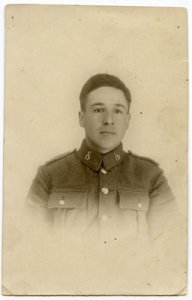
James Edward Clarence Brennan signed up in Kingston on this day in 1915. Brennan was born in Bogart, Ontario on October 9th, 1897, the son of Frank Brennan and Annie (née Hogan). The Brennans were living in Deseronto in the 1901 and 1911 censuses and James Edward Clarence attended the Deseronto High School.

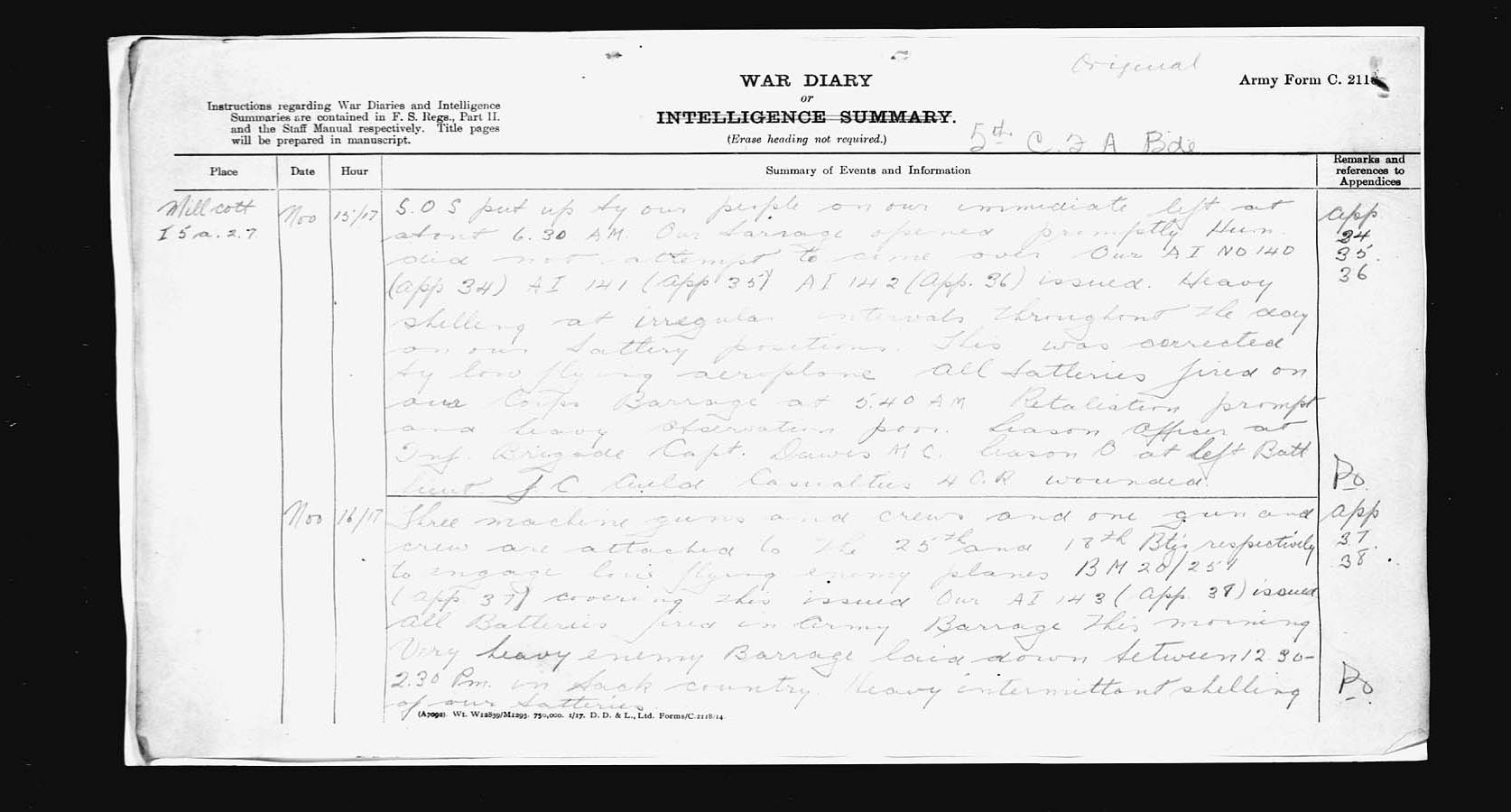
When he signed up, Brennan was five feet, four and three-quarters inches tall, with a medium complexion, blue eyes and dark hair. He had been working as a ‘Timekeeper’. His regimental number was 89751 in the 26th Battalion. His service record shows that he arrived in England on August 18th, 1915 and left for France on January 16th, 1916 to serve with the Canadian Field Artillery. Brennan was with the 5th Brigade at Mill Cott, east of Ypres, when he was injured by a shell on November 16th, 1917. The war diary of his unit noted the injury:

Clarence Brennan injured

Extract from war diary of the 5th Brigade of the Canadian Field Artillery, courtesy of Library and Archives Canada

Mill Cott Nov 16/17 … 1 O.R. [other rank] wounded …

The previous page of the war diary noted that on November 16th there had been:

Very heavy enemy Barrage laid down between 12.30-2.30 Pm in back country. Heavy intermittent shelling of our batteries.

Clarence had shrapnel wounds to his left thigh, calf and ankle and was temporarily deafened in his left ear by the blast of the shell. He spent the next few months in hospital in England, recovering from his injuries, but was left unable to walk properly, suffering from foot drop. He was discharged back to Canada, arriving in June 1918 on the hospital ship Goorkha. The Intelligencer newspaper reported on June 28th that a reception was held for him in Deseronto by members of St. Vincent de Paul church. Brennan was discharged from the army on August 21st, 1918, classified as medically unfit for further service and eligible for a pension due to his disability.

He married Evelyn May Fairbairn on September 15th, 1921, in Pembroke, Ontario. He was killed just over a year later, on September 19th, 1922, when a tree fell on him in Flanders, Ontario, fracturing his skull. He was buried in the St. Vincent de Paul cemetery in Deseronto.

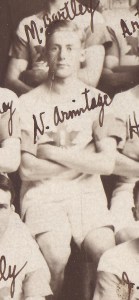
Norman Armitage in 1914

Norman Armitage's signatureNorman Charles Armitage signed up on this day in 1915. He was born in Lindsay, Ontario, the son of Elias Armitage and Hattie (née Fryer) on October 25th, 1896. In the 1901 and 1911 censuses the family were living in Deseronto, where Norman attended the High School. The picture above was taken in 1914 when Norman was a member of the Deseronto Fire Team.

On enlisting at Kingston, Armitage was five feet six and a half inches tall, with a fair complexion, blue eyes and light hair. He gave his occupation as ‘Clerk’. His regimental number was 89750 and he joined the 26th Battalion of the Canadian Expeditionary Force. His service record shows that he arrived in England on August 18th, 1915 and initially was assigned to the 7th Brigade of the Canadian Field Artillery, stationed in Westenhanger, Kent. In May 1916 he went to France and served with the 3rd Divisional Trench Mortar Battery and the 3rd Divisional Ammunition Column.

He had trench fever in December 1917, which left him weakened and suffering from dizziness, chest pain and shortness of breath. In March 1918 he was examined by a medical board which recommended that he be invalided to Canada. He arrived back in Halifax on July 3rd on the RMS Empress of Britain and was discharged in Kingston on August 9th, 1918 as medically unfit for further service.

Norman Armitage married Kathleen Maracle on January 27th, 1923 in Windsor, Ontario. They had four children (their son Robert was killed while serving with the Canadian Navy in the Second World War). Norman died on February 21, 1976 in Napanee Hospital. He was buried in Deseronto Cemetery.

John Wesley Lindsay's signature

On this day in 1915, John Wesley Lindsay joined up in Belleville. He was born in Deseronto on May 27th, 1894 to James Lindsay and Della (née Howard). He was described as five feet, nine and a half inches tall, with a dark complexion, brown eyes and dark brown hair.

Lindsay joined the 39th Battalion with a regimental number of 413021. His service record shows that he arrived in England in July and was treated for an infection in November 1915. In December he was transferred to the 21st Battalion when he went overseas. In January 1916 he was admitted to hospital with myalgia, returning to duty in February. He received a gun shot wound to the chest in March 1916 and was treated in hospitals in England until June. The bullet remained in his chest and caused pain when standing. He served the rest of the war in England, returning to Canada in June 1919. He was demobilized on July 3rd in Kingston.

John Wesley Lindsay survived the war and married Pansy Grace Maracle in Toronto on April 5th, 1922. Pansy later changed her name to Patricia. The photograph below shows her when she was working for the Metcalfe canning factory in Deseronto in the 1930s.

Pansy Lindsay

John Wesley Lindsay died on October 20th, 1949 and is buried in the Deseronto Cemetery.

John Culbertson's signature

On this day in 1915 John Culbertson signed up in Belleville. He claimed to have been born in Deseronto on August 21, 1891, but census records suggest that his true year of birth was 1885. He was the son of Alexander Culbertson and Sarah (née Penn), who were both Mohawks. He was a lumberman.

Photo of John Culbertson

Photo of John Culbertson from Kanhiote Tyendinaga Territory Public Library

On signing up, Culbertson was five feet four and a quarter inches tall, with dark hair, brown eyes and a dark complexion. He joined the 39th Battalion with a regimental number of 413012. His service record shows that he arrived in England on July 3rd, 1915. He was transferred to the 19th Battalion in January 1916 and joined them in France on January 20th. He was wounded by shrapnel on September 15th, 1916 at the Battle of Courcelette and was sent back to England to recover. He rejoined his battalion in France on April 9th, 1917.

On October 30th, 1917 John was admitted to hospital suffering from impetigo. He spent several months in various military hospitals in France and England and rejoined the 19th Battalion in France on May 7th, 1918.

By the end of the war Culbertson held the rank of Lance Sergeant. He left England in May 1919 on the RMS Caronia and was demobilized in Toronto on May 24th. It is not clear what happened to him after the war: please comment if you know!

With last week’s post about Jack Martin, we saw the 100th anniversary of the first death of a Deseronto man in World War I. In total, 40 of the Deseronto and Tyendinaga men who signed up to the Canadian Expeditionary Force had died by the end of 1918. Another (Ross MacTavish) died in 1919 and Ambrose Clause died in 1920 as a result of his service. In total in this project we are following the wartime careers of 302 local people (two women and 300 men).

The death of 42 of these people represents a total fatality rate of 14%, which is higher than the national rate of Canadian casualties (around 10%). There is a statistically significant difference, however, between the fatality rate for the Mohawk men in our sample and the rate for non-Mohawks. In our group, Mohawks make up about one third of the total number who enlisted: 98 of the 300. But they were much more likely to die than their non-Mohawk comrades. Twenty-two of the 42 men from the Deseronto area who died were Mohawks, which represents a fatality rate of 22% of those who enlisted. The equivalent rate for non-Mohawk men from the Deseronto area was 10%.

Volunteers were much more likely to be killed than conscripted men: only one man in our group who was drafted under the 1917 Military Service Act was killed during the war. He was also a Mohawk.

The chart below shows the distribution of deaths of Deseronto-area people over the course of the war, beginning in April 1915:

Chart showing the distribution of WW1 deaths by month of the war

Ten of the 42 men who died were killed by illnesses or disease of various kinds. The remaining 32 were killed in action or died of injuries received while fighting. In a later blog post, we’ll look at the corresponding figures for the men of the Royal Flying Corps (later the Royal Air Force) who died while they were attached to the Deseronto pilot training camps.

Jack Martin's signatureJack Martin was reported missing, presumed dead, on April 24, 1915 after the Second Battle of Ypres. This battle was the first in which chlorine gas was used as a weapon by the Germans. It was the first major engagement of the war for the 7th Battalion and nearly two-thirds of the men who fought in it lost their lives. In all, more than 2,000 Canadians were killed in this battle, with another 4,500 wounded or captured.

Jack’s service file shows that he was originally reported missing, then it was thought that he had been taken prisoner by the Germans. It was not until 1917 that he was assumed to be dead.

Gas attack at the Second Battle of Ypres

Gas attack at the Second Battle of Ypres (image from battleofypres.blogspot.com)

Jack’s body was not recovered. His name appears on the Menin Gate memorial.


John Charles Pearson signature

John Charles Pearson enlisted on this day in 1915 in Calgary, Alberta, where he was working as a stockman. He was born in Deseronto on October 21st, 1883, the son of Robert Pearson and Sarah (née Wilson). In 1911 he was living in Battleford, Saskatchewan with his wife, Anna Maud and three children.

When he enlisted, Pearson was five feet seven inches tall, with a medium complextion, grey eyes and brown hair. He joined the Canadian Army Service Corps with a regimental number of 49481. His service record shows that he arrived in England in May 1915 and served in France between June and October. In November he was sent to England, where he served with the 101st Remounts Battalion. In November 1917 he was admitted to hospital with digestive problems. In March 1918 he was sent back to Canada and was discharged as medically unfit in Calgary on April 20th, 1918.

After the war, in 1924, Pearson left Canada for the United States. In May 1940 he was living in Richmond, California and he died in California on June 8th, 1959.

John Hetherington signature

On this day, John Hetherington signed up in Kingston, Ontario. He was born in Napanee on February 15th, 1895, to Robinson Hetherington and Mary Ann (née Bell). At the time of the 1901 census the family were living in Deseronto: John attended Deseronto High School. The Hetheringtons were back in Napanee in 1911 and living in Thomas Street, Deseronto in 1921.

On joining up, Hetherington was five feet ten inches tall, with a fair complexion, blue eyes and light hair. His regimental number was 411131. He sailed from Montreal on the SS Missanabie on June 24th, 1915 and joined the Princess Patricia’s Canadian Light Infantry in France in July.

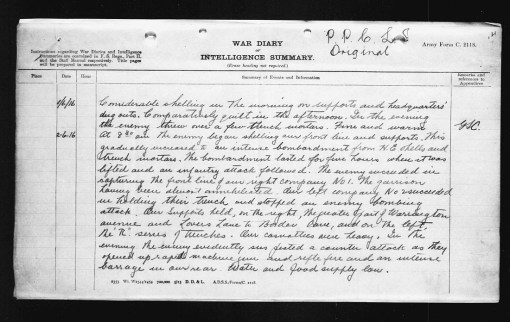
On June 2, 1916 Hetherington received back injuries when he was buried in a dugout by a shell at Ypres, in the Battle of Mount Sorrel. The extract from his unit’s war diary below describes the engagement:

War diary for the Princess Patricia's Canadian Light Infantry for June 2, 1916

2-6-16 At 8.30 am the enemy began shelling our front line and supports. This gradually increased to an intense bombardment from H.E. [high explosive] shells and trench mortars. The bombardment lasted for three hours when it was lifted and an infantry attack followed. The enemy succeeded in capturing the front line of our right company No. 1. The garrison having been almost annihilated. Our left company No. 2 succeeded in holding their trench and stopped an enemy bombing attack. Our supports held, on the right, the greater part of Warrington avenue and Lovers Lane to Border Lane, and on the left, the “R” series of trenches. Our casualties were heavy. In the evening the enemy evidently suspected a counter attack as they opened up a rapid machine gun and rifle fire and an intense barrage in our rear. Water and food supply low.

Hetherington returned to duty on July 17th, 1916. He spent the rest of the war in England and was appointed to the rank of corporal in June 1918. He left England for Canada in August 1919 and was demobilized at Kingston on August 26th. His parents were still living in Deseronto in 1921.

In 1931 John was living in Scarborough with his wife, Bessie (Hoover), and two young sons. His occupation was “Drugless Practitioner”.

On September 9th, 1939 he enlisted again, this time in Innisfail, Alberta, to fight in the Second World War. He was demobilized on September 6th, 1946.

Hetherington died in 1961 and was buried at Mount Pleasant Cemetery in Toronto.

Earl Grant Berry's signatureOn this day in 1915 a fourth-year medical student named Earl Grant Berry enlisted in Toronto. Berry had been born in Deseronto on December 4th, 1887, the son of Robert James Berry and Ida Jean Grant.

On enlisting, Berry was described as five feet nine and a half inches tall, with a fair complexion, blue eyes and brown hair. He had a tattoo on the front of his right forearm which read ‘E.E.G.B.”. Berry joined the Canadian Army Medical Corps with the regimental number 910. He gave his mother as his next of kin: her address was 44 Kippendavie Avenue, Toronto.

His service record shows that Berry arrived in England on the SS Corinithian on May 27th, 1915. His first posting was to Moore Barracks in Shorncliffe, Kent, where he was appointed to the rank of sergeant on July 1st, 1915. In October he was transferred to the Mediterranean, leaving Devonport for Salonika in Greece, where he arrived on November 21st. He remained in Greece until April 14th, 1916, when he went back to England. He returned to Canada to complete his medical training in June 1916, travelling on the SS Sicilian.

Berry was discharged from the army in Quebec on June 8th, 1916. He married Agnes Ellen Sheather, a nurse, on September 1, 1922 in Toronto. They lived in Oshawa for a while and moved to Merlin, Ontario in 1938 where Berry worked as a physician and Medical Health Officer for the county of Kent. He died in a car accident on October 14th, 1961.


« Previous PageNext Page »