1910s


Harty Wilson Morden signature

On this day in 1915, Harty Wilson Morden signed up for the first time in Victoria, British Columbia. He was born in Deseronto on July 26th, 1883 (he says 1885), the son of Cornelius H. Morden (who died in January 1883) and Eliza (née) Buchanan (who died in Deseronto in 1904).

Harty Wilson Morden was described as a banker, five feet eight and a half inches tall, with hazel eyes, iron grey hair and a fresh complexion. He was allocated the regimental number 102663. Morden enlisted for a second time on April 27th, 1916, in Ottawa, noting that he had previously served for four months in the “51st Victoria Rifles, B.C.”. He was given a number of 246179. On October 6th, 1917, he enlisted again, this time in Toronto, with a number of 2365588. On this attestation form, he stated that he had served as a lieutenant in the 252nd Battalion (Lindsay) for eight months. This third attestation paper is marked “Overseas Training Co. University of Toronto COTC”. A form on his service file notes that he was struck off the strength of the 207th Battalion with the rank of sergeant in order to take up a commission in the 52nd Battalion.

Morden gained a commission in the British Royal Berkshire Regiment in August 1918. His batman was Private George Frederick Barnes, for whom Morden wrote a letter of recommendation after the war.

Letter from Harty Morden WIlson

Morden survived the war and sailed to Canada on the RMS Baltic in October 1919. He married Maud Killmaster in Vancouver on August 2nd, 1930. He died on December 2nd, 1958 and was buried at the Glenwood Cemetery in Picton, Ontario.

Clarence Victor Robeson signature

On this day in 1915, Clarence Victor Robeson enlisted in Winnipeg, Manitoba, where he was working as a bank clerk. He had been born in Deseronto on July 25th, 1892, the son of James Robeson and Jennie (née Ritter).

Robeson was five feet six inches tall, with a fair complexion, brown eyes and dark hair. His regimental number was 540359. His service record shows that he arrived in England on January 31th, 1916 on the SS Missanabie. He served in the pay office and with the reserve cyclists in England, and in November 1917 joined the machine gun corps in France. In September 1918 he received a gunshot wound to the right shoulder and was sent to England to recover. In January he was given permission to marry, and he wed Margaret Buchanan in Surrey on January 8th, 1919. They travelled to Canada on the SS Melita in April 1919 and Robeson was demobilized in St. John, New Brunswick, on April 10th.

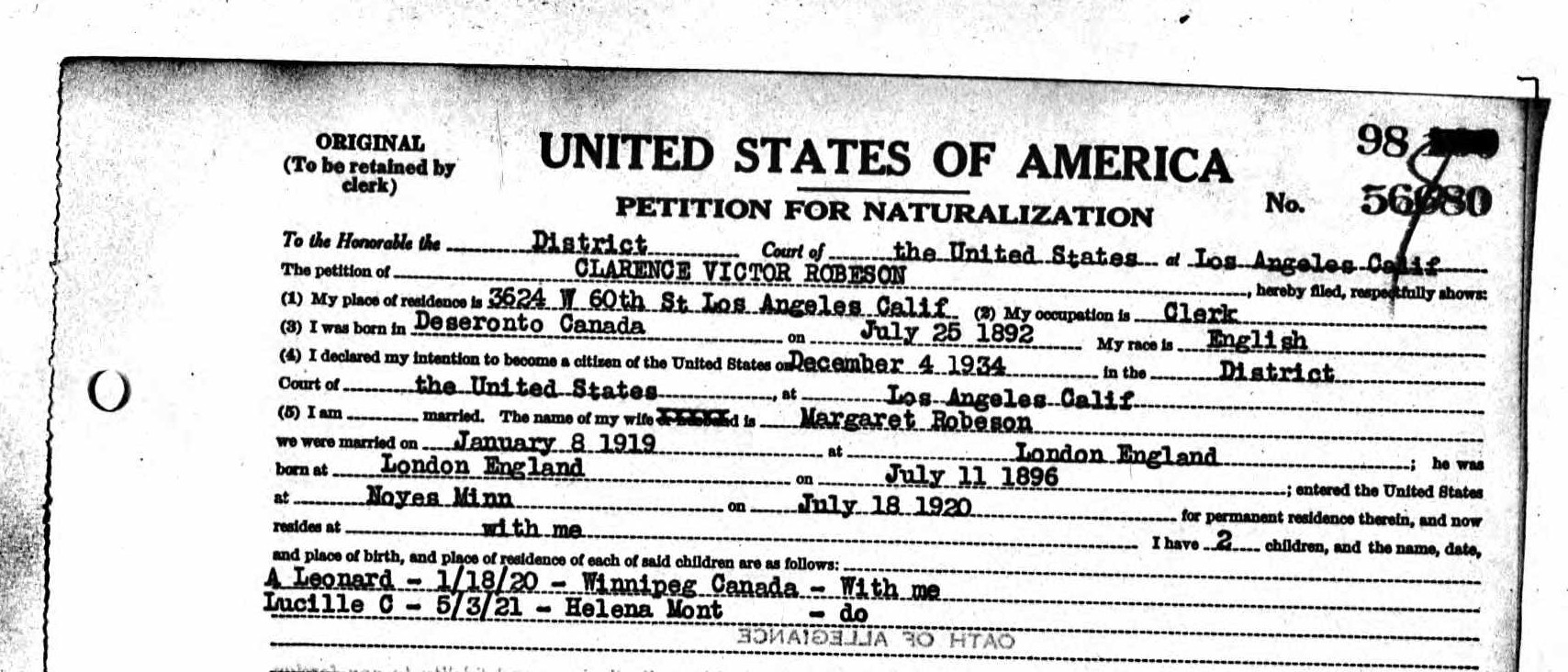
The couple went back to Winnipeg, where their first child was born, then moved to the United States. Their second child was born in Helena, Montana and they later moved to California. Clarence applied to become naturalized as a US citizen in 1934, at which time the family were living at 3624 W 60th St, Los Angeles, California. Citizenship was granted in 1937.

Clarence Victor Robeson application for naturalization


Clarence died in California on August 13th, 1972 and Margaret died there on August 21st, 1977.

Matthew Brant signature

On this day in 1915, Matthew Brant signed up in Kingston. He had been born in Deseronto on March 25th, 1891, the son of Cornelius Brant and Catherine (née Maracle), members of the Mohawks of the Bay of Quinte.

Brant joined the 59th Battalion of the Canadian Expeditionary Force with the regimental number 455599. When he enlisted, he was described as five feet seven inches tall, with a fair complexion, brown eyes and dark brown hair. His service record shows that he left Halifax for England on April 5th, 1916. In August 1916 he was treated for an infection and he joined the 21st Battalion in France on October 14th, 1916. On August 14th, 1917 he was wounded in the left ankle by a shell: a fragment of the shell was removed from his ankle and he recovered in hospital in England, being discharged in October. He spent the rest of the war in England in a reserve battalion.

Matthew Brant arrived back in Canada on April 20th, 1919 and was demobilized at Kingston four days later.

Charles David Powless, a piano maker, joined the 80th Battalion in Smiths Falls on this day in 1915, with the regimental number 219144.  Powless was born in Deseronto on April 25th, 1894, the son of David John Powless and his wife, Louisa (née Maracle), both Mohawks of the Bay of Quinte. Louisa died in 1907 and the family were living in Toronto by 1910, when David married an English widow called Rose Hannah Mepham (née Hawkins). Charles gave Miss Margaret Bruce (friend) of 166½ Christie Street, Toronto, as his next of kin.

Powless’s service record shows that he arrived in England on the SS Scotia on August 19th, 1916. He joined the 15th Battalion in France in November 1916. While in England and France, he was admitted to hospital several times, suffering from bronchitis and in February 1918 he was wounded by gas in France. He was sent to England to recover and then transferred back to Canada on the SS Aquitania in January 1919. Charles was discharged on February 27th, 1919 in Toronto as medically unfit for further service due to the damage he had sustained to his lungs. He died on February 11th, 1929 during an operation in Montreal and his death was determined to be due to his military service. He was buried in the Cataraqui Cemetery in Kingston.


Harold Dean Powless signature

On this day in 1915, Harold Dean Powless signed up in Toronto, where he was a piano worker. Powless was born in Deseronto on November 5th, 1898, the son of David John Powless and his wife, Louisa (née Maracle), both Mohawks of the Bay of Quinte. Louisa died in 1907 and the family were living in Toronto by 1910, when Harold’s father married an English widow called Rose Hannah Mepham (née Hawkins). When Harold enlisted, they were living at 56 Humbert Street, Toronto.

Harold was described as five feet four and a half inches tall, with a fair complexion, grey eyes and black hair. He was transferred to the 58th Battalion of the Canadian Expeditionary Force, with the regimental number 453787. He claimed to be 18, but was actually 17 when he signed up. His service record shows that he arrived in England on the SS Caronia on November 11th, 1916 and was transferred to the 36th Battalion. In December he was admitted to hospital for a month, suffering from pneumonia. In January he joined the 107th Battalion and went to France with them on February 25th, 1917. He was sentenced to seven days of field punishment number one for “obtaining double rations by false pretences” in  April 1917. In July 1918 he was transferred to the 2nd Battalion.

Harold married Florence May Mason in Luton, England in late 1918. The couple arrived in Canada on board the SS Scotian on August 3rd, 1919. He was demobilized in Quebec on August 5th.

SS Scotian

SS Scotian, courtesy of the Waugh Family site

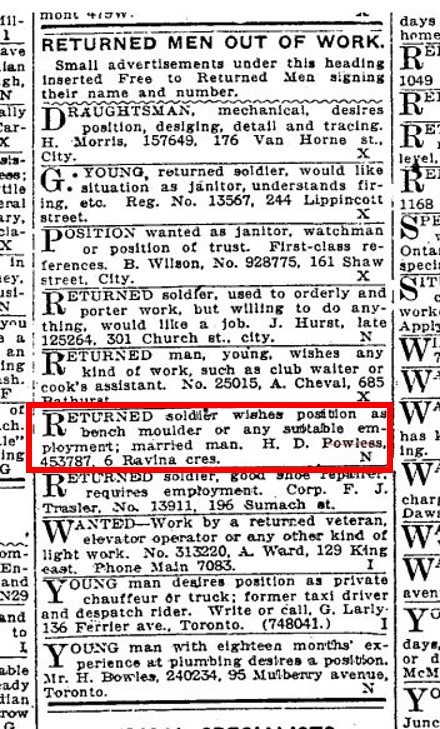
By November 1920, Harold was back in Toronto and, along with other returned soldiers, was looking for work, as this extract from the Toronto Star shows. At this time he was living at 6 Ravina Crescent with his wife.

Job-seeking advertisement from Harold Dean Powless

Image courtesy of the Canadian Great War Project.

Harold and Florence eventually settled in Oshawa, where Harold worked as a carpenter. Harold died there in 1977 and was buried in the Oshawa Union Cemetery and Florence died in 1991.

Vincent Carnahan's signature

On this day in 1915, Vincent Carnahan enlisted in Belleville. He was born in Deseronto on December 11th, 1897, the son of William Henry Carnahan and Sarah (née Doran). He was described on his attestation paper as five feet five inches tall, with a dark complexion, hazel eyes and dark brown hair. He joined the 34th Battery of the Canadian Field Artillery with the regimental number 300341.

Carnahan’s service record shows that he arrived in England on the SS Missinabie on December 29th, 1915. He joined the 3rd Division’s Trench Mortar Battery on the Western Front on April 27th, 1916. On June 3rd he was reported missing after an attack at the Battle of Mount Sorrel near Ypres in Belgium. He had been injured when his trench mortar had been destroyed, dislocating his left ankle and damaging his knee. He was then taken prisoner and on July 12th he was reported to be in a prisoner of war camp at Duisburg. On October 3rd he was transferred to another camp at Friedrichsfeld.

After 23 months as a POW, Vincent was repatriated to England in May 1918 and admitted to hospital. He was unable to straighten his left leg as a result of damage to his hamstring. He spent several months in various hospitals in England and in the summer of 1918 he was married to Violet Packer in Lambeth, England. Carnahan was sent back to Canada in October 1918 for further treatment and was discharged as medically unfit for further service on April 2nd, 1919 in Kingston. Violet travelled from Liverpool to Canada on the SS Grampian in June 1919, listed as a military dependent.

Vincent left Canada for the United States on March 24th, 1920, arriving in Detroit. He was not travelling with Violet, and it is not clear what happened to her after the war.

Patrick Vincent Carnahan married Isabella Effie Chislitt in Toronto on September 3rd, 1919. He died in 1975 and the couple were buried at the Knoxville Presbyterian Church Cemetery in Port Hope.

Arthur Rosendale's signature

On this day in 1915 Arthur Rosendale signed up in Kingston. He was born in Bassingbourn, Cambridgeshire, England, the son of Frederick Rosendale and Elizbeth (née Dellar) on April 17th, 1887 (he said 1886 when he enlisted). Arthur arrived in Canada in July 1913 on the SS Virginian. On October 29th, 1914 he married Ellen Charlotte Glenny in Deseronto. She was also English and had arrived in Canada on the SS Canada in February 1913 , in a party travelling under the auspices of the Women’s Domestic Guild of Canada.

Arthur Rosendale was a plumber and when he enlisted was described as having a fair complexion, grey eyes and light brown hair. He was five feet nine and a half inches tall. He joined the 5th Battery of the Canadian Field Artillery with a regimental number of 300284. His service record shows that he arrived in England in October 1915 and joined the 1st Heavy Battery in France on November 10th. In November 1917 he was admitted to hospital with an abscess and was discharged, healed in January 1918.

Rosendale contracted influenza and died of the disease on October 22nd, 1918.

Ernest Brennan's signature

On this day in 1915 Ernest Brennan signed up in Kingston. He was born in Deseronto on July 9th, 1896, the son of Frank Brennan and Annie (née Hogan). He had attended Deseronto High School and was working as a chauffeur when he enlisted. His younger brother, Clarence, had signed up in May. Ernest was five feet seven and a half inches tall, with a dark complexion, blue eyes and dark brown hair.

He joined the 5th battery of the Canadian Field Artillery with a regimental number of 300283. His service record shows that he was treated for a sprained ankle in May 1916. Brennan served in the 3rd Ammunition Sub-Park of the Canadian Army Service Corps in France from July 1916. He went on leave to England in November 1917 and was admitted to hospital suffering from sciatica and myalgia, with pains in his lower back and legs. He was discharged in March 1918, classed as B3 (fit for sedentary work abroad), but then had a further three months in hospital in the spring and summer of 1918 being treated for an infection.

Brennan left Scotland on the SS Saturnia on July 1919 and was demobilized in Kingston on August 8th. He was living with his parents in Green Street, Deseronto in 1921, when he and his father were both working as cheese makers. He married Mary Loreto Doré on June 21, 1921 in Deseronto. Information from public family trees suggests that he died in Kemptville, Ontario, on February 11th, 1966.

Joseph Amos Green signatureOn this day in 1915, Joseph Amos Green enlisted in Toronto. His mother was Margaret Green, a Mohawk, and in 1891 he was living with her in Deseronto, aged seven. By the time of the 1911 census he was married (to another Margaret) and living in Gananoque, working as a sailor. His mother died in 1912 in Brant Street, Deseronto. By the time Amos Green enlisted, he and his wife had two children, Margaret and Mary.

When he enlisted, Green was five feet eight and a half inches tall, with a dark complexion, light brown eyes and black hair. He joined the 83rd Battalion of the Canadian Expeditionary Force with the regimental number 171101. His occupation was tent maker and he was living at 87 Wilton Avenue in Toronto.

Green’s service record shows that he sailed from Montreal on the SS Corsican on September 25th, 1915, arriving in England on October 5th. He was later transferred to the 39th Reserve Battalion and the 26th Battalion.

Green did not make it home.

Horace Thompson's signature

Horace Alexander Thompson signed up at Camp Barriefield on this day in 1915. He had been born on April 14, 1896 in Deseronto, the son of Elizabeth (née McCormack) and David Thompson.

On enlisting, Thompson gave his occupation as student. He was five feet five and three-quarter inches tall, with a light complexion, blue eyes and brown hair.  His regimental number was 510085. His service record shows that he went overseas on the SS Scandinavian on October 1st, 1915 and served with the Canadian Army Service Corps. He was admitted to hospital in May with a broken right wrist after an injury received when cranking the engine of a car. He arrived in France in September 1916. In March 1917 he returned to England to take up a commission as a lieutenant. He was treated for an infection in January 1918. In June 1918 he returned to France to join the 3rd Battalion. He was injured by a gas shell in September and sent to England to recover, where he remained until the war ended.

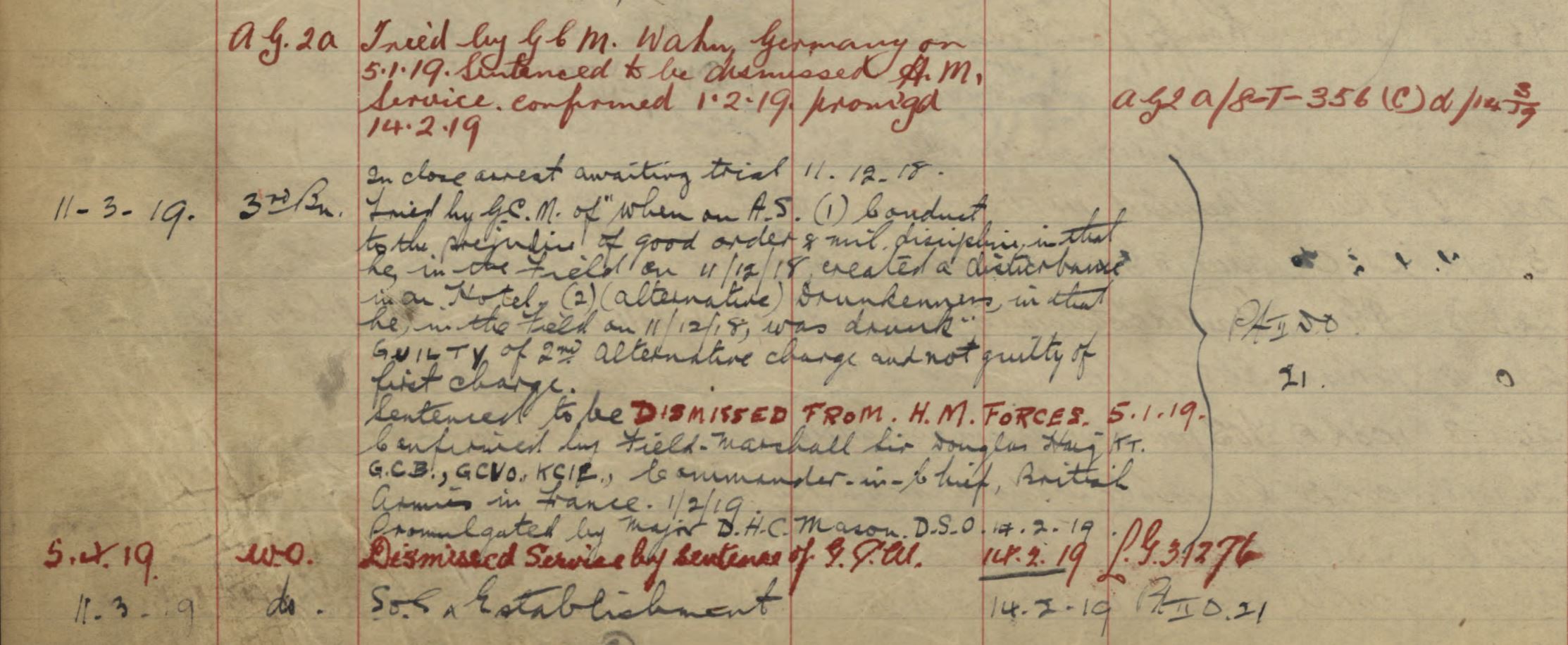
On November 12th, the day after the war ended, Thompson was arrested for creating a drunken disturbance in a hotel. His record shows that he was tried in January 1919 and dismissed from the forces.

Thompson returned to Canada as a civilian on the SS Cretic in March 1919. He is found living with his parents at the time of the 1921 census in Thomas Street, Deseronto, working as a mechanic. John Boyd, Thompson’s grandson, tells us that he worked for Bell Canada and worked in Chicago for a time and that he served in the Second World War. He retired to Green Point, Prince Edward County and later lived in Ottawa, where he died in around 1971.

« Previous PageNext Page »