1910s


Roy Edgar Pelton signature

Roy Edgar Pelton died of cavernous sinus thrombosis in Toronto General Hospital on this day in 1918 (although some sources say he died on April 15th). Pelton was serving as a cadet with the Royal Flying Corps’ 42nd Wing, based in Deseronto. He had originally enlisted in the Canadian Expeditionary Force in Vancouver on January 25th, 1917 and had served in the Canadian Army Service Corps for eight months with the regimental number 200223. He joined the Royal Flying Corps in Winnipeg on November 13th, 1917 (number 153779) and was officially appointed to Corps on January 13th, 1918 in Toronto. He was five feet four and a half inches tall, with a dark complexion, black hair and blue eyes.

He would have spent the winter training in Texas with the rest of 42nd Wing, and must have fallen ill on his return to Ontario in April 1918: his death registration notes that he had been ill for two weeks. Initially his death was recorded on his Royal Flying Corps record as a flying accident in Texas. This was later crossed out and replaced with the correct information.

Pelton's UK RFC record

Roy was born in Grandview, Manitoba on July 10th, 1896 (other sources say October 7th), the son of Hiram Whitney Pelton and Edith Abigail (née Powell). Between 1901 and 1911 the family moved from Manitoba to British Columbia: Pelton gave his home address as 833 Pacific Street, Vancouver.

Pelton was buried in Mountain View Cemetery, Vancouver.

Roy Edgar Pelton's headstone

Cadet Pelton’s headstone, courtesy of SusanR at Find a Grave

Clement A. Jones signature

On this day in 1918 Clement Archie Jones enlisted in the United States Army in Rochester, New York. He was born in Deseronto on August 14th, 1890, the son of James Jones and Annie (née Clement). James died in 1892 and by the time of the 1915 New York census the family had moved to Rochester. Clement completed a draft registration card in June 1917, claiming exemption due to the need to support his widowed mother. He was described as tall, of medium build and with dark blue eyes and dark brown hair.

Jones enlisted in the 12th Company, 3rd Training Battalion, 153rd Depot Brigade and was transferred to Company K, 310th Infantry on April 25, 1918, according to the World War Service Record Rochester and Monroe County, New York. He trained at Camp Dix, Wrightstown, New Jersey and went overseas on May 20th, 1918.

Some 96 Deseronto-born men completed draft registration cards in the United States. However, only a small percentage of those who registered went on to serve in the armed forces. Most of the US army personnel files of the First World War were destroyed by fire in 1973, so it is not easy to establish which of these Deseronto men joined the America military.

William Howard Leeroy signature

On this day in 1918, William Howard Lee Roy, a cook, signed up in Toronto. He stated that he was born on September 18th, 1897 in Deseronto and that his mother, Ella Paterson (né Howard) was still living in Deseronto. When he enlisted, he was living in St. Louis, Missouri.

William joined the 2nd Depot Battalion of the 1st Central Ontario Regiment with the regimental number 3233521. He was five feet three and three quarter inches tall, with a medium complexion, brown eyes and brown hair. His service record shows that he arrived in England on June 21st, 1918 and joined the 19th Battalion in France on October 29th. In December he was treated in hospital for 12 days for flat feet. By February 1919 he was back in England and he left for Canada in March. He was demobilized in Toronto on April 8th, 1919.

After the war, William Howard Lee Roy was living at 8 Grape Street, Rochester, New York, with his mother and her husband, John Paterson and his uncle, Lorenzo Howard.

George Dafoe signature

On this day in 1918, George Arthur Dafoe, a farmer, was conscripted at Kingston. He was born in Tyendinaga on August 30th (or 31st), 1888, the son of James Dafoe and Sarah Eliza (née Scrimshaw).

Dafoe joined the 1st Depot Battalion of the Eastern Ontario Regiment with the regimental number 3057582. He was five feet seven inches tall, with a dark complexion, blue eyes and brown hair. His service record shows that he did not go overseas and was demobilized in Belleville on January 13th, 1919.

George was living in Deseronto in 1936 and 1937 when his parents died. He died in Belleville in 1960, according to a brief obituary in the Intelligencer newspaper.

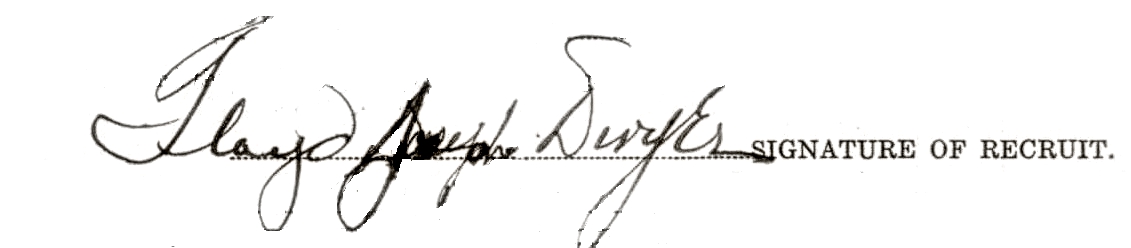
Floyd Joseph Dwyer signature

Floyd Joseph Dwyer of Sturgeon Falls, Ontario, died of a fractured skull in a flying accident at Camp Taliaferro in Texas on this day in 1918. He had joined the Royal Flying Corps in Toronto on July 17th, 1917 and was a member of 87 Canadian Training Squadron, which was part of the Deseronto Wing. He claimed he was 19 when he enlisted, giving the name of a friend, Mr E. O. Bowman of 678 Decarie Boulevard, Montreal, as his next of kin. His regimental number was 74247 and he was five feet five inches tall.

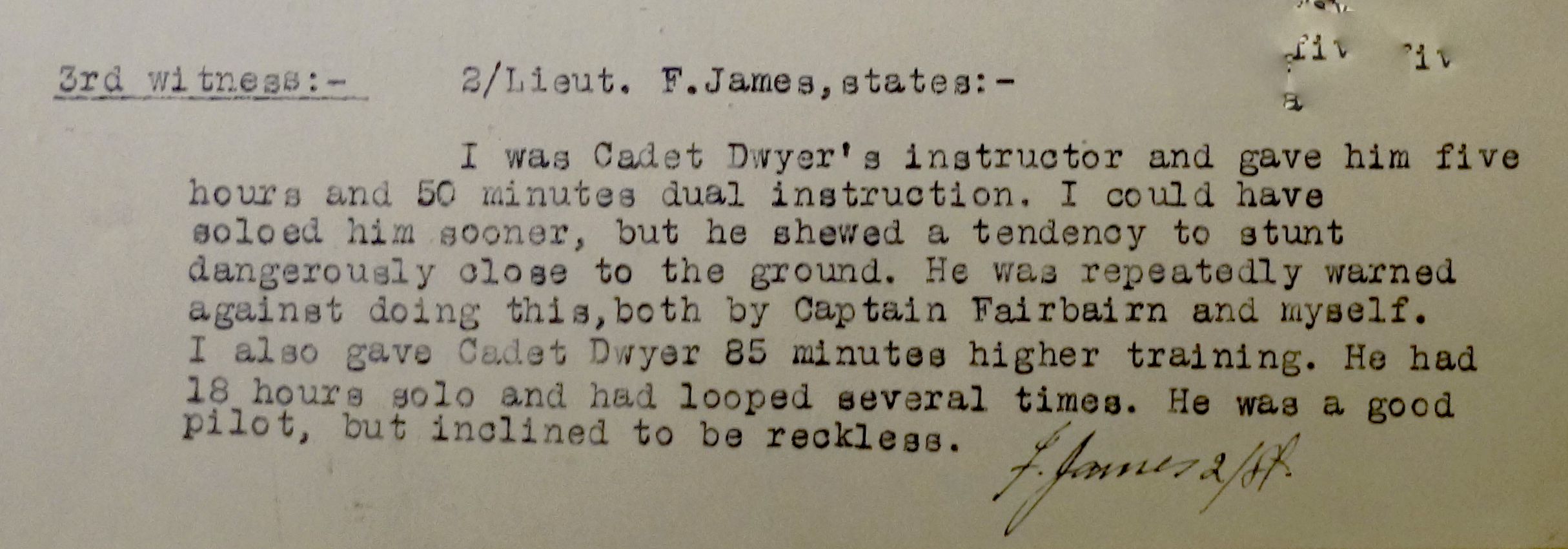
The official report of Dwyer’s accident notes that he was flying alone in a Curtiss JN-4 which crashed upside down in a field to the northwest of the camp; the cause of his crash was unknown. He was attached to 87 Canadian Training Squadron. At the Court of Inquiry held the same day, 2nd Lieutenant James gave the following statement:

Detail of Attorney General's 1918 file RG4-32/800 from the Archives of Ontario

Detail of Attorney General’s 1918 file RG4-32/800 from the Archives of Ontario

3rd witness:- 2/Lieut. F. James, states:-

I was Cadet Dwyer’s instructor and gave him five hours and 50 minutes dual instruction. I could have soloed him sooner, but he shewed a tendency to stunt dangerously close to the ground. He was repeatedly warned against doing this, both by Captain Fairbairn and myself. I also gave Cadet Dwyer 85 minutes higher training. He had 18 hours solo and had looped several times. He was a good pilot, but inclined to be reckless.

[signed] F. James, 2/Lt

Dwyer was buried on May 4th, 1918 in the Notre-Dame-des-Neiges cemetery in Montreal.

Floyd Dwyer was the last casualty of the Deseronto Wing of the Royal Flying Corps in their Texas winter quarters: within three weeks of his death the training squadrons had returned to Camp Mohawk and Camp Rathbun.

Walter Lasher signature

Walter Charles Lasher, a carpenter, was conscripted in Kingston on this day in 1918. He was born in Deseronto on December 3rd, 1891, the son of Peter Lasher and Maria (née Deline). Walter married Mary Phyllis Cains in Kingston on October 12th, 1912, but gave his marital status as single on his draft form. His service record reveals an even more complex history: this man originally enlisted in May 1915 as William Lasher, with a wife called Ida and an address of 72 Cedar Street, Belleville. He appears to have been struck off as medically unfit in June.

When he was drafted in 1918, Lasher joined the 1st Depot Battalion of the Eastern Ontario Regiment with the regimental number 3057551. He was five feet eight inches tall, with a fair complexion, blue eyes and fair hair. A will made by him on the day of enlistment gives his wife as Effie Lasher of Selby, Ontario. Lasher spent 12 days in hospital in Kingston in April 1918 with bronchitis. He was re-admitted on May 6th with the same complaint and left without permission of the medical officer on June 15th. His medical notes record that he “went to United States”. His service record states that he was struck off the strength of the Battalion as a deserter on August 7th, but that he re-enlisted on November 23rd (another note on his file states that he was in isolation in Belleville with bronchitis on this date). He was again struck off as a deserter on December 27th, 1918.

After the war, Walter lived in Toronto and possibly in Marlbank, Hastings County.

Asa Steed signature

On this day in 1918 Asa Steed, a blacksmith, was conscripted in Hamilton. He was born in Deseronto on December 15th, 1896, the son of Asa Steed (also a blacksmith) and Katherine (née Moriarty). By the time Asa was drafted into the army, the family had moved to Sudbury.

Asa joined the 1st Depot Battalion of the 2nd Central Ontario Regiment with the regimental number 3108585. He was five feet six inches tall, with a ruddy complexion, grey eyes and brown hair. His service record shows that he left Canada for England on May 15th, 1918 on the SS City of Marseilles and arrived in France in September, where he served with the 7th Battalion. He reported sick with an infection in January 1919 and was sent to England for treatment. He left England on the SS Celtic on May 7th, 1919 and was demobilized in Toronto on May 17th.

Steed was back in Sudbury in 1921, living with his parents and still working as a blacksmith. He married Pearl Diana Lachance in Espanola, Ontario, on 26 October 1937.

Edward Bissell's signature

On this day in 1918, Edward Arthur Bissell (who had enlisted as Edward Griswould) was killed at Les Brebis in France.

The note on his service record reads:

Edward Arthur Bissell report of death

Rept from Base

13-3-18 Killed in Action (Gassed)

Bissell was buried in the Aix-Noullette Communal Cemetery Extension in France.

Charles Warren Ludbrook signature

Charles Warren Ludbrook was conscripted on this day in 1918 in Kingston. His birth registration records that he was born on July 26th, 1890 in Portland Township, Ontario. His parents were Albert Ludbrook and Ann Amelia (née Snider). Albert, a photographer, died in Verona in 1915 and by 1917 the family was living in Deseronto, where Ann Amelia Ludbrook died on May 28th.

Charles Ludbrook joined the 1st Depot Battalion of the Eastern Ontario Regiment with the regimental number 3057214. He was five feet six and a half inches tall, with a fair complexion, blue eyes and brown hair. His service record shows that he was examined by a medical board on May 24th, 1918, which determined that he had been experiencing epileptic fits from the age of 15. He was discharged as medically unfit for service on June 1st.

In the 1920 US census, Charles was living with his sister and brother-in-law in Oswego, New York. He died of epilepsy in the Lockwood Hospital in Kingston on November 23rd, 1920. He was buried with his parents in Verona Cemetery.

Joseph Amos Green signature

On this day in 1918, (Joseph) Amos Green died of jaundice in the 14th Canadian General Hospital in Eastbourne, England.  The extract from his service record below shows that he had previously been in hospital in 1916 and 1917 with shrapnel and gunshot wounds to his hands but had otherwise been healthy.

Amos Green's medical history

Jaundice was relatively common disease in First World War soldiers, and Japanese researchers had determined that it was spread through the urine of infected rats (this disease is now known as leptospirosis). Men in the trenches were more likely to be infected in this manner, but Amos Green was with the 13th Reserve Battalion in England when he fell ill.

Green’s medical records show that he had been diagnosed with syphilis in November 1917 and was treated as an outpatient at the 13th Canadian General Hospital in Hastings between November 1917 and February 1918. At this time, treatment for syphilis involved injections of an arsenic-based drug (Novarsenobillon) and mercury. An article in the British Medical Journal of April 20, 1918, described the deaths of two New Zealand soldiers through liver damage after treatment with Novarsenobillon.1 It seems it was the cure for syphilis which killed Amos Green, rather than the disease itself, as his doctor wrote “Jaundice (Arsenical poisoning)” on his notes:

Death of Amos Green

Green was buried in the cemetery in Seaford, Sussex.

Joseph Amos Green's grave

Joseph Amos Green’s grave, courtesy of FindaGrave.com (uploaded by wertypop)

His widow, Margaret, and two daughters, Margaret and Mary were living at 9 Dunedin Street, Toronto at the time of his death. The Toronto Evening Telegram reported his death on March 11th, 1918:

Toronto Telegram report of Joseph Amos Green's death

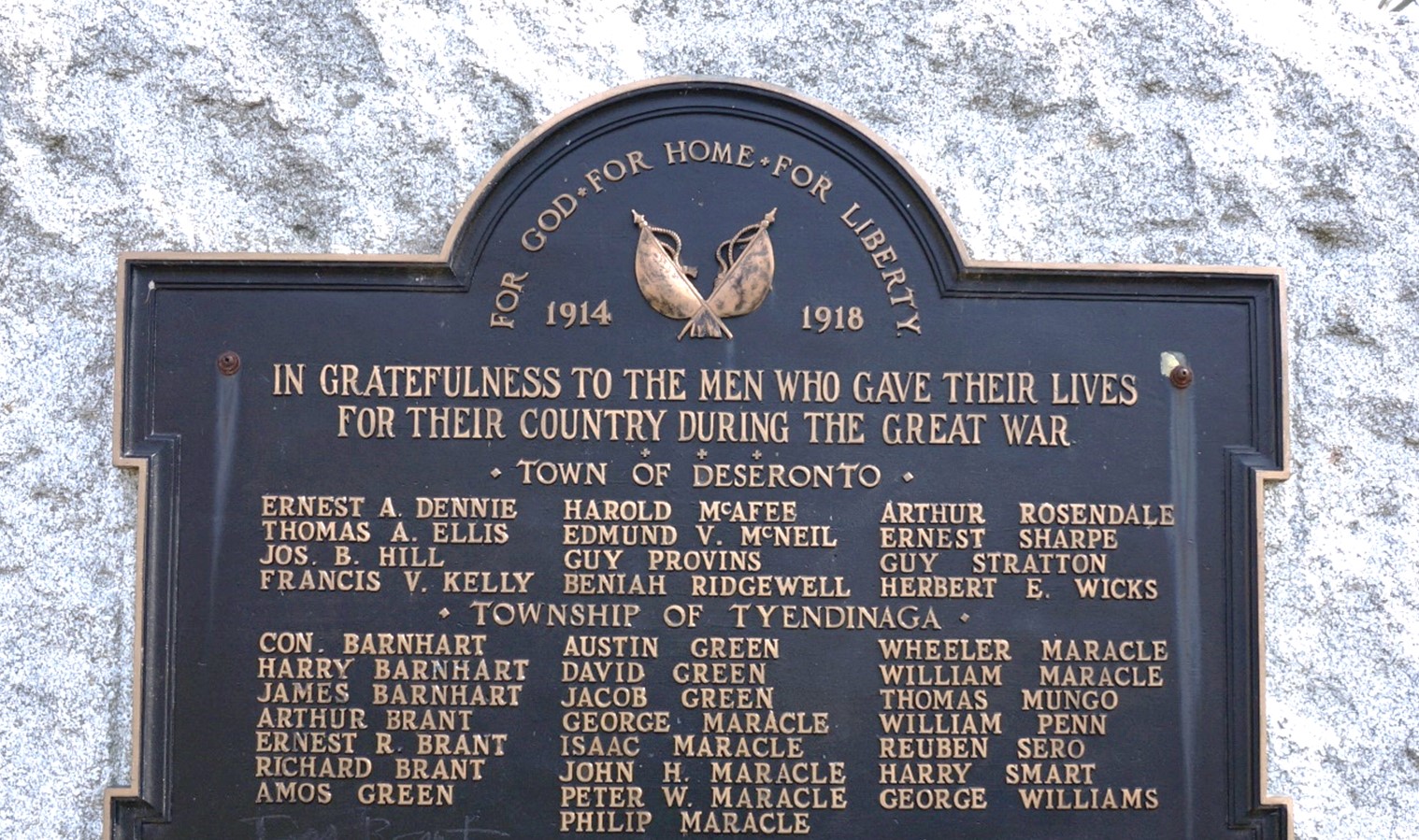
Amos Green is remembered on the Deseronto war memorial.

Deseronto memorial


1 Fenwick, Sweet & Lowe ‘Two Fatal Cases of Icterus Gravis Following Injections With Novarsenobillon’ British Medical Journal [PDF] 20 April 1918

« Previous PageNext Page »